Connect with us

Economy

Buhari Insists Nigeria is Self-Sufficient in Rice Production

Published

on

self-sufficient in rice production

By Adedapo Adesanya

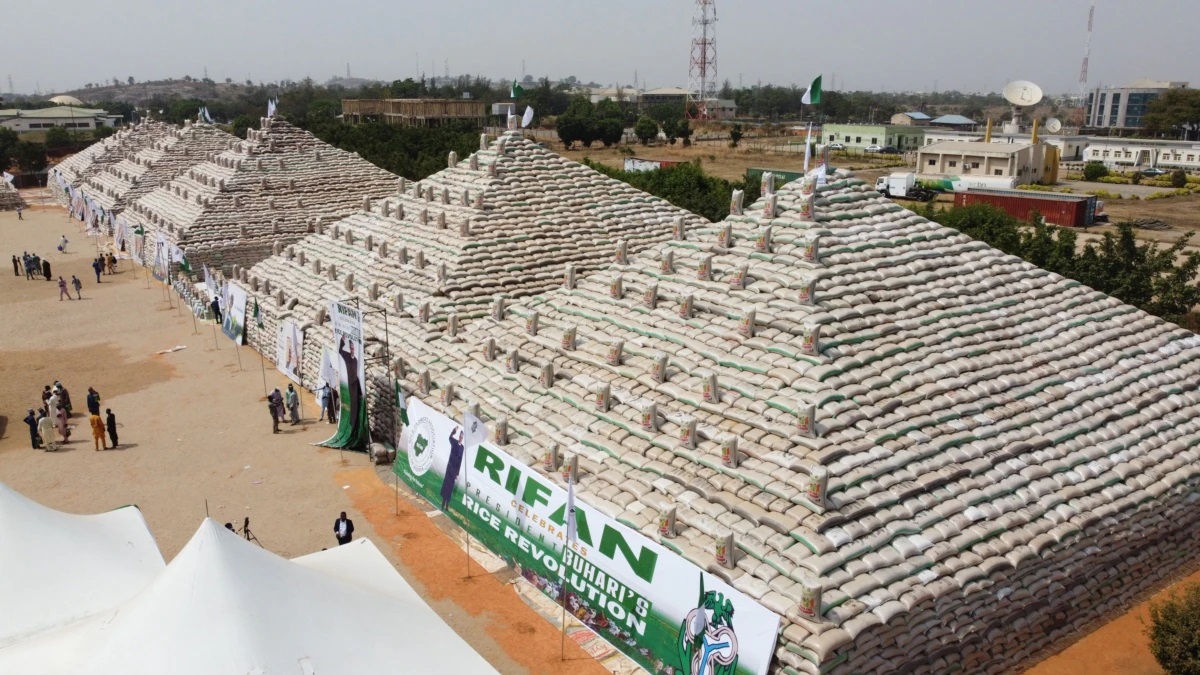
President Muhammadu Buhari has claimed that his administration’s agricultural revolution has led to the creation of over 13 million direct and indirect jobs in the last seven and half years, insisting that Nigeria is self-sufficient in rice production, thanks to the Central Bank of Nigeria (CBN).

The Nigerian leader made these remarks last Friday in Washington D.C. at an interactive session entitled, A conversation with President Muhammadu Buhari of Nigeria, co-hosted by the United State Institute of Peace (USIP), the International Republican Institute, the National Endowment for Democracy, and the International Foundation for Electoral Systems.

He used the occasion to advise Western nations again not to be in a rush to eliminate the usage of fossil fuels in a bid to ensure a healthy climate.

Further, he said Nigeria’s economy had registered positive growth in the last two quarters despite the gloomy outlook in the global economy and the war in Ukraine.

President Buhari also cautioned Western nations on the frivolous issuance of travel advisories on Nigeria, urging the international media to be more objective in its reportage of the country.

He told the international community that despite the non-nonchalant actions and attitudes of some of the country’s friends and allies, Nigeria is nonetheless winning the war on terrorism, making significant progress in dealing with the threats to Nigeria’s and the sub-regions safety and survival.

The Nigerian leader also called on the United States to do more to improve the quality of governance in the West African sub-region, warning that the survival of democracy is being challenged in the aftermath of the democratic set-backs witnessed in Mali, Guinea, and Burkina Faso.

Expounding on steps taken by his administration to expand Nigeria’s economy since coming into power in 2015, the President said focused interventions in agriculture, driven by the Central Bank of Nigeria (CBN), transitioned the country from being a net importer of rice, Nigeria’s staple food, to becoming self-sufficient in its production.

‘‘This same scheme has financed the establishment and operations of our 50 integrated rice mills.

‘‘It has also financed over 4.5 million smallholder farmers, ensured the cultivation of almost 6 million hectares of farmland, and almost 700 large-scale agricultural projects have been funded.

‘‘This agricultural revolution has led to the creation of over 13 million direct and indirect jobs,” he said.

President Buhari also told the Washington D.C Community of global thought leaders and Democracy Advocacy Groups that the focus on the Agricultural Sector placed Nigeria in a better position to handle the systemic shock caused by both COVID-19 and the Russia-Ukraine war on global food supply chains and attendant price spikes.

He added that the revolution in the sector had improved the country’s capacity in the agro-allied sector, making it more efficient in enhancing and maximizing production yields and post-harvest losses.

‘‘The non-oil sector remains the future of our economy, and I hope successive governments will consolidate on the gains we have recorded under my leadership.

‘‘You will agree with me that the Russia-Ukraine war has compelled many economies to carry out reforms and re-adjust policies to cope with the challenges posed by the conflict.

‘‘In this regard, we are paying more attention now to energy transmission and distribution through targeted collaboration with global companies like Siemens to improve our efficiency in the Power Value Chain,’’ he said.

Business Post reports that despite Mr Buhari’s insistence that the country was self-sufficient in rice production, the price of the product at the local market has gone above the ceiling. The price of a 50kg bag of rice is sold between N45,000 and N48,000, depending on the brand. In 2015, before he assumed office, the price was between N8,000 and N11,000.


Adedapo Adesanya is a journalist, polymath, and connoisseur of everything art. When he is not writing, he has his nose buried in one of the many books or articles he has bookmarked or simply listening to good music with a bottle of beer or wine. He supports the greatest club in the world, Manchester United F.C.

Advertisement
Click to comment

Leave a Reply

Your email address will not be published. Required fields are marked *

Economy

Customs Street Chalks up 1.08% on Renewed Buying Pressure

Published

on

Customs Street NGX

By Dipo Olowookere

A 1.08 per cent growth was further printed by the Nigerian Exchange (NGX) Limited on Friday on improved appetite for Nigerian stocks.

Data showed that the insurance sector lost 0.61 per cent yesterday due to profit-taking as the energy space gave up 0.08 per cent, while the commodity counter closed flat.

However, the industrial goods landscape appreciated by 2.06 per cent, the banking index improved by 1.31 per cent, and the consumer goods sector expanded by 0.83 per cent.

At the close of business on Customs Street, the All-Share Index (ASI) increased by 1,563.92 points to 147,040.07 points from 145,476.15 points and the market capitalisation went up by N996 billion to N93.722 trillion from N92.726 trillion.

UAC Nigeria led the advancers’ log yesterday after it grew by 10.00 per cent to N96.80, Transcorp Hotels jumped by 9.71 per cent to N172.80, Royal Exchange appreciated by 8.89 per cent to N1.96, Ikeja Hotel soared by 8.74 per cent to N31.10, and Veritas Kapital leapt by 8.07 per cent to N1.74.

On the flip side, Union Dicon declined by 10.00 per cent to N6.30, ABC Transport slipped by 9.88 per cent to N3.10, AXA Mansard depreciated by 7.19 per cent to N12.90, FTN Cocoa lost 4.62 per cent to trade at N4.75, and Guinea Insurance dropped 3.36 per cent to finish at N1.15.

A total of 38 stocks ended on the gainers’ table and 17 stocks finished on the losers’ table, representing a positive market breadth index and strong investor sentiment.

Traders transacted 361.6 million equities for N14.8 billion in 21,051 deals yesterday versus the 1.9 billion equities worth N19.2 billion traded in 23,369 deals a day earlier, showing a decline in the trading volume, value, and number of deals by 80.97 per cent, 22.92 per cent, and 14.20 per cent, respectively.

The busiest stock for the session was Zenith Bank with 59.5 million units worth N3.6 billion, Access Holdings traded 46.1 million units valued at N973.0 million, Fidelity Bank exchanged 29.4 million units for N560.4 million, FCMB transacted 27.9 million units worth N293.9 million, and Tantalizers sold 13.0 million units valued at N29.8 million.

Continue Reading

Economy

Nipco, 11 Plc Crash OTC Securities Exchange by 4.76%

Published

on

NIPCO LPG Depot

By Adedapo Adesanya

Energy stocks influenced the 4.76 per cent loss recorded by the NASD Over-the-Counter (OTC) Securities Exchange on Friday, December 5.

The culprits were the duo of 11 Plc and Nipco Plc,with the former shedding N32.17 to end at N291.83 per share compared with the previous day’s N324.00 per share, and the latter down by N21.00 to sell at N195.00 per unit versus the previous session’s N216.00 per unit.

Consequently, the NASD Unlisted Security Index (NSI) slumped by 170.16 points to 3,401.37 points from 3,571.53 points and the market capitalisation lost N101.81 billion to close at N2.035 billion from the N2.136 trillion quoted in the preceding session.

The OTC securities exchange suffered the decline yesterday despite the share prices of three companies closing green.

Central Securities Clearing System (CSCS) Plc was up by N1.80 to close at N39.80 per share compared with Thursday’s price of N38.00 per share, Air Liquide Plc appreciated by N1.09 to N11.99 per unit from N10.90 per unit, and FrieslandCampina Wamco Nigeria Plc grew by 78 Kobo to N56.57 per share from N55.79 per share.

During the session, the volume of transactions rose by 6,885.3 per cent to 18.2 million units from 4.3 million units, the value of transactions ballooned by 10,301.7 per cent to N389.7 million from N347.2 million, but the number of deals declined by 29.7 per cent to 26 deals from 37 deals.

Infrastructure Credit Guarantee Company (InfraCredit) Plc ended the day as the most traded stock by value on a year-to-date basis with 5.8 billion units worth N16.4 billion, followed by Okitipupa Plc with 170.4 million units valued at N8.0 billion, and Air Liquide Plc with 507.5 million units worth N4.2 billion.

InfraCredit Plc also finished the day as the most traded stock by volume on a year-to-date basis with 5.8 billion units transacted for N16.4 billion, followed by Industrial and General Insurance (IGI) Plc with 1.2 billion units sold for N420.2 million, and Impresit Bakolori Plc with 536.9 million units worth N524.9 million.

Continue Reading

Economy

Naira Depreciates to N1,450/$1 at Official Forex Market

Published

on

Naira-Dollar exchange rate gap

By Adedapo Adesanya

The Naira depreciated further against the US Dollar in the Nigerian Autonomous Foreign Exchange Market (NAFEX) on Friday, December 5, as FX demand pressure mounts.

The Nigerian currency lost N2.60 or 0.18 per cent against the greenback to close at N1,450.43/$1 compared with the previous day’s N1,447.83/$1.

Equally, the domestic currency declined against the Pound Sterling in the official forex market during the session by N4.48 to trade at N1,935.45/£1, in contrast to Thursday’s closing price of N1,930.97/£1 and shrank against the Euro by 43 Kobo to end at N1,689.17/€1 versus the preceding session’s rate of N1,688.74/€1.

Similarly, the local currency performed badly against the US Dollar at the GTBank FX counter by N2 to close at N1,455/$1 versus Thursday’s N1,453/$1 but traded flat at the parallel market at N14.65/$1.

As the country gets into the festive period, pressure mounted on the local currency reflecting higher foreign payments and lower FX inflows.

However, there are expectations that the Nigerian currency will be stable, supported by interventions by to the Central Bank of Nigeria (CBN) in the face of steady dollar Demand and inflows from Detty December festivities that will give the Naira a boost after it depreciated mildly last month.

Traders cited by Reuters expect that the Naira will trade within a band of N1,443-N1,450/$1 next week, buoyed by improved FX interventions by the apex bank.

As for the crypto market, it was down yesterday due to profit-taking associated with year-end trading. However, the December 1-Year Consumer Inflation Expectation by the University of Michigan fell to 4.1 per cent from 4.5 per cent previously and 4.5 per cent expected. The 5-Year Consumer Inflation Expectation fell to 3.2 per cent from 3.4 per cent previously and 3.4 per cent expected.

With the dearth of official economic data of late, these private surveys have taken on a new level of significance and the market banks of them to make decisions.

Cardano (ADA) depreciated by 5.7 per cent to $0.4142, Dogecoin (DOGE) slid by 5.1 per cent to $0.1394, Ethereum (ETH) dropped by 3.9 per cent to $3,039.75, Solana (SOL) declined by 3.8 per cent to $133.24, and Litecoin (LTC) fell by 3.7 per cent to $80.59.

Further, Bitcoin (BTC) went down by 2.6 per cent to sell at $89,683.72, Binance Coin (BNB) slumped by 2.2 per cent to $883.59, and Ripple (XRP) shrank by 2.1 per cent to $2.04, while the US Dollar Tether (USDT) and the US Dollar Coin (USDC) remained unchanged at $1.00 each.

Continue Reading

Trending