Economy
Banks Ration New Naira Notes as Cash Shortage Hits Financial System
By Adedapo Adesanya
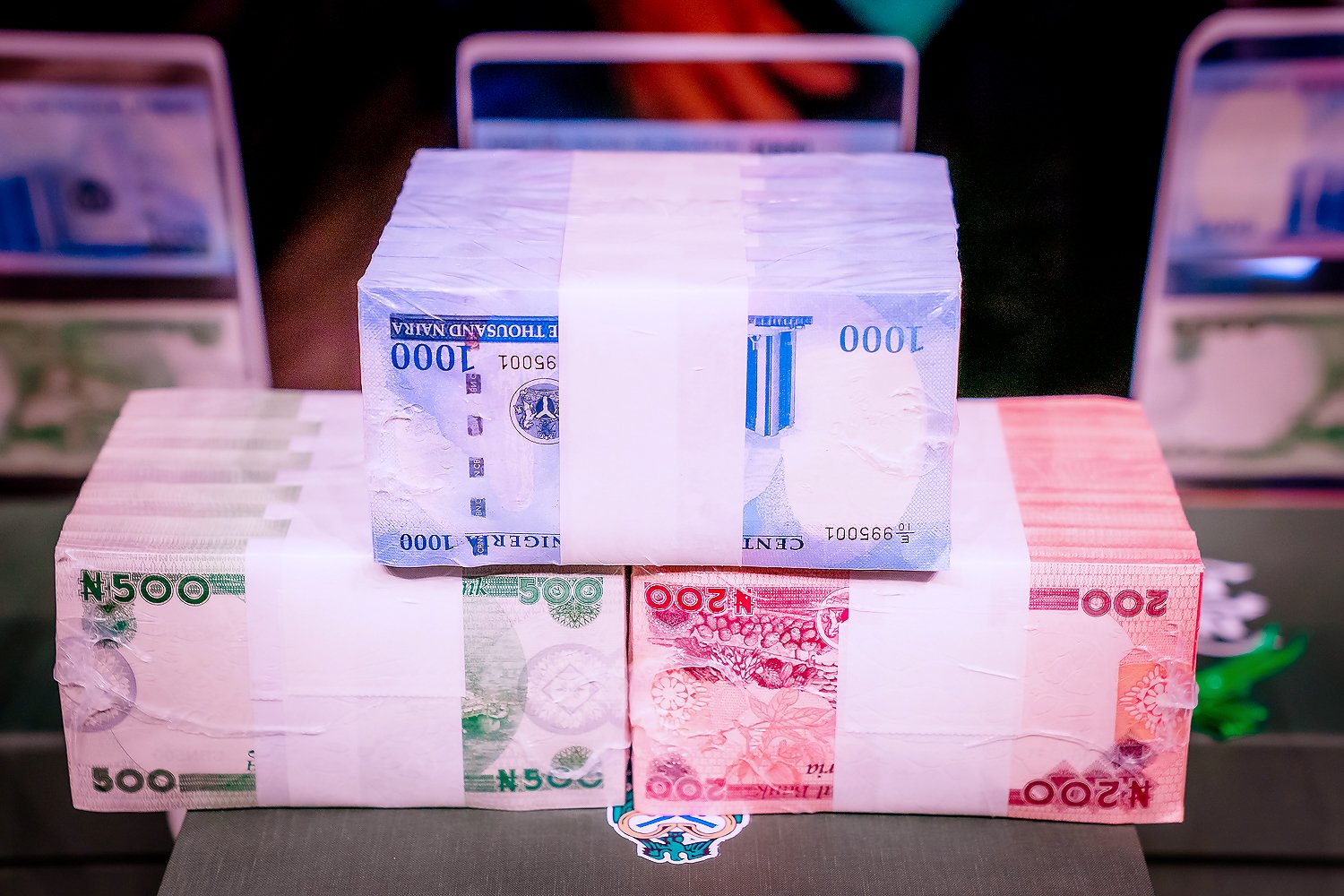
Days after the Central Bank of Nigeria (CBN) rolled out the new Naira notes, Business Post can independently verify that Nigerian banks are rationing the banknotes.
According to conversations with employees and customers of several banks in the country, the old notes would still be given out to customers alongside the new notes due to the limited supply of the redesigned N200, N500, and N1,000 from the CBN.
Recall that the central bank had announced limits on cash withdrawals via over-the-counter (OTC), Automated Teller Machines (ATMs), and other channels after it called on customers to deposit their old N200, N500, and N1,000 notes. This move was part of initiatives to increase the use of electronic transfers.
In a notice, the CBN said customers would no longer be able to withdraw more than N20,000 per day via the ATM and PoS terminals and N100,000 per week via the same channels.
“The maximum cash withdrawal per week via Automated Teller Machine (ATM)) shall be N100,000, subject to a maximum of N20,000 cash withdrawals per day. Only denominations of N200 and below shall be loaded into the ATMs,” the disclosure stated.
It also said, “the maximum cash withdrawal via point of sale (POS) terminal shall be N20,000 daily.”
As for cash withdrawals via OTC, the central bank stated that it would be N100,000 for individuals, with a 5 per cent processing fee for amounts above the cap, while for corporate organisations, the limit is N500,000 and 10 per cent charge for amounts above the limit.
The maximum cash withdrawal over-the-counter (OTC) by individuals and corporate organizations per week was pegged at N100,000 and N500,000, respectively, from January 9, 2023.
This newspaper confirmed that customers who opted for cash withdrawals were given a mix of the old and new N1,000 notes, which is not the usual practice when new notes are introduced into the financial system.
For instance, a customer who doesn’t want to be named said he went to a Wema Bank branch on Monday (December 19) for a N30,000 withdrawal via cheque and was given N20,000 in old N1,000 notes and N10,000 in the redesigned notes.
Another bank customer said the GTCO in her area gave her about 40 per cent of the new notes while the rest were the old notes. She, however, expressed that it would drive her to adopt electronic platforms rather than visit the ATMs.
Speaking with a staff of one of the commercial banks, who asked for anonymity, it was confirmed that they were instructed to ration the notes.
Another bank rep, who is familiar with banking operations, confirmed to this reporter that, “People get it at the branch. I hear it’s being rationed, yes.”
Meanwhile, Business Post gathered that some of the commercial banks are battling with cash shortages ahead of the January 9, 2023 commencement of the new cash withdrawal policy of the CBN. At one of the branches of a tier-one bank on Akonwonjo Road, Egbeda, Lagos, on Wednesday, customers who wanted to withdraw cash were asked to wait for customers to make cash deposits before they could be attended to.
Also, at the branch of another bank on Idimu Road in Egbeda, it was a similar situation, as a few customers with large cash withdrawals had to wait for a while to have their requests granted.
This has already frustrated some customers, who are beginning to doubt the efficacy of the new CBN policy.
One of them, who identified himself as Mr Raymond Ademola, said, “This policy is only meant to frustrate the masses. I don’t know why people would be restricted from taking their funds from banks. But I thought this policy is supposed to start next year; why is it difficult to withdraw cash?
Economy
FG Saves N6trn in Fuel Subsidy Payments in 2025—NMDPRA Chief
By Adedapo Adesanya
The chief executive of the Nigerian Midstream and Downstream Petroleum Regulatory Authority (NMDPRA), Mr Saidu Mohammed, has revealed that bold economic reforms by President Bola Tinubu’s administration saved the country over N6 trillion on petroleum product imports in just the first nine months of 2025.
Mr Mohammed disclosed this while speaking at the Nigeria International Energy Summit (NIES) in Abuja, said the savings were the result of full downstream deregulation, harmonisation of the forex market, and the trading of crude and petroleum products in Naira.
He added that these bold moves have created stability in the downstream petroleum market, encouraged investment, and ensured a sufficient supply of petroleum products across the country.
The NMDPRA boss also revealed that the nation’s refining capacity is expected to surpass 1 million barrels per stream day (bpsd) in the medium term.
He said the surge in domestic refining capacity is being driven by a combination of new refinery investments, the rehabilitation of existing Nigerian National Petroleum Company (NNPC) Limited refineries, and strategic private-sector participation.
According to him, the planned investments in other refineries, along with issued Licences to Establish (LTEs) for new facilities, will continue to expand Nigeria’s refining footprint, reducing dependence on imported products and stabilising domestic supply.
He said: “For decades, our downstream value chain has been associated with negative sectoral performance indicators such as infrastructural deficit, weak market structures, sub-optimal supply chain efficiency, inadequate investment, poor regulatory compliance, and unacceptable operational safety and environmental indices.
“Today, I am pleased to affirm that this narrative is rapidly changing and that the sector is truly witnessing the early but irreversible signs of a renaissance-type transformation that is driven by bold reform; enabled by investment; and sustained by effective market and operational regulatory enablement.
“In the few years of the operationalisation of the new legal framework of the Oil and Gas sector in Nigeria (PIA 2021), Nigeria’s downstream sector has evolved into a fully liberalised market and is no longer defined by scarcity and supply uncertainty.
Supply stability has consistently ensured sufficiency of all Petroleum products. The pricing structure of the downstream sector is becoming more driven by the fundamentals of the market and generally attaining the stability level required for encouraging investment in this expansive sector of the economy.
“The supply chain landscape of the sector, which depended significantly on import of nearly all Petroleum Products for a long time, is rapidly transforming with growing supply through the nation’s domestic refining capacity, expanding gas-based alternative fuels, improved logistics, and increased private-sector participation.
“At the heart of this transformation stands the Dangote Petroleum Refinery, the largest single-train refinery in the world with an installed capacity of 650,000 barrels per stream day (bpsd), which is currently contributing a significant portion and in some cases 100 per cent of our domestic requirement of Petroleum Products. The optimal operationalisation of the plant’s installed capacity and future upscaling of the plant is undoubtedly needed to fulfil the national aspirations of making Nigeria a regional and continental energy hub.
“The capacity for enhanced domestic supply of Petroleum product in Nigeria will continue to grow as the planned investments in our refinery sector mature. We are optimistic that the issued Licences to Establish (LTEs) refineries, which are being progressed through various levels of completion, coupled with the rehabilitation of the NNPCL refineries, will improve the overall installed refining capacity in Nigeria to well over 1 million bpsd in the medium term.
“The bold economic reforms of President Bola Tinubu have created the renaissance that the downstream sector is enjoying and would continue to leverage upon for sustained sectoral growth in the future. The cumulative impact of the full deregulation of the downstream sector, the harmonisation of the forex market, the incentivization and deepening the use of gas and the trading of crude and product in Naira has reduced the fiscal economic losses of importing Petroleum Product by over N6 trillion in the 1st nine months of 2025.”
Economy
Nigeria Targets 10bscfd Gas Production in Next Four Years
By Adedapo Adesanya
The federal government says Nigeria is targeting gas production of 10 billion standard cubic feet per day (bscfd) by 2030, positioning natural gas as a cornerstone of national energy security and economic prosperity.
The Minister of State for Petroleum Resources (Gas), Mr Ekperikpe Ekpo, said this while delivering a ministerial address at the ninth Nigeria International Energy Summit (NIES) 2026 in Abuja.
The Minister said the government’s efforts were yielding tangible results, with Nigeria’s gas production maintaining an upward trajectory in 2025, averaging between 7.5 and 7.6bscfd.
He disclosed that domestic gas supply exceeded two bscfd for the first time, marking a historic milestone for power generation, industrial use and household consumption.
The Minister also said significant progress in environmental performance, with gas flaring reduced to some of the lowest levels recorded in recent years, in line with Nigeria’s commitment to end routine gas flaring by 2030.
He noted that investor confidence in the gas sector had been strengthened, citing Final Investment Decisions (FIDs) in key upstream gas projects supported by improved regulatory clarity under the Petroleum Industry Act (PIA).
“Across the midstream and downstream segments, pipeline infrastructure, processing facilities and gas-to-power projects have expanded, improving connectivity, boosting domestic utilisation and supporting cleaner cooking solutions, job creation and industrial stability.
“Under President Bola Tinubu’s Renewed Hope Agenda, government policy prioritises the expansion of domestic gas infrastructure while strengthening Nigeria’s presence in regional and global gas markets.
“This includes facilitating investments in gas processing, storage and distribution, as well as accelerating gas-to-power projects aimed at addressing energy poverty and enhancing industrial competitiveness,” he said.
The minister emphasised that Nigeria’s energy future was inseparable from peace, partnership and shared responsibility, calling on governments, investors, development partners, host communities and civil society to move from dialogue to decisive action.
“Our collective task is to build an energy system that powers prosperity, strengthens stability and supports regional integration,” he said.
He said Nigeria’s energy strategy is firmly aligned with global energy transition realities while responding to Africa’s unique development challenges, including widespread energy poverty, limited industrial capacity and inadequate access to reliable power.
“While the world moves towards lower-carbon systems, Africa must pursue a transition that is not only green, but also just, inclusive and development-driven.
“Nigeria is leveraging its abundant natural gas resources to balance climate responsibility with economic development, positioning gas as the backbone of industrial growth, job creation and expanded energy access,” he said.
Economy
Transcorp, DMO, CardinalStone, Chapel Hill Denham, Others Win at NGX Made of Africa Awards
By Aduragbemi Omiyale
The 2025 Made of Africa Awards, hosted by Nigerian Exchange (NGX) Group Plc, paraded an array of winners, including brokers, issuing houses, trustees, fund managers, listed companies, and other market participants.
The event was to reward excellence in value delivery, compliance, and market impact, with Transcorp, the Debt Management Office, CardinalStone, Chapel Hill Denham, and MTN Nigeria Communications as recipients.
Business Post reports that the other recipients were First Trustees Limited as the Best Trustees in Terms of Deal Value, Legend Internet as the Market Debut Excellence award winner.
Further, CardinalStone Securities emerged as Equity Trader of the Year and Broker of the Year, Capital Express Securities won ETPs Trader of the Year, and Stanbic IBTC Stockbrokers was named Fixed Income Trader of the Year. Chapel Hill Denham received awards for Fund Manager with the Largest Listed Fund Size and Market Operator with the Highest Value of Foreign Portfolio Investment Transactions.
Mainstreet Capital and APT Securities and Funds jointly won Issuing House with the Highest Number of Primary Market Equity Transactions, while Anchoria Advisory Services led in corporate bond issuances. Dangote Cement was named Best Issuer in Terms of Fixed Income Listings, BUA Cement received the award for Most Compliant Listed Company, and Transnational Corporation Plc was honoured for Capital Market Excellence in Equity. Network Capital was named the Most Compliant Trading License Holder, United Capital Securities won the Best Sponsoring Trading License Holder and Banwo and Ighodalo received recognition for legal advisory value in capital market transactions.
Special recognition went to the Debt Management Office for fixed income market development and to the Capital Markets Correspondence Association of Nigeria for capital market reporting, and Lambeth Capital/Bamboo Systems Technology were recognised for onboarding the highest number of new retail investor accounts.
The chairman of NGX Group, Mr Umaru Kwairanga, said the awards underscore the role of market stakeholders in strengthening investor confidence and improving market standards.
“Their achievements set a benchmark for performance, integrity and innovation across the capital market,” he said, adding that sustaining this level of discipline and transparency is essential to maintaining the trust of both domestic and international investors in Nigeria’s financial markets.
The chief executive of NGX Group, Mr Temi Popoola, said, “Operational efficiency and cooperation across the ecosystem are increasingly important as trading activity diversifies and investor expectations continue to rise.”
On his part, the Executive Commissioner for Operations at the Securities and Exchange Commission (SEC), Mr Bola Ajomale, said the awards underscore the value of compliance and transparency in market development.
“Recognition through the Made of Africa Awards reinforces the importance of adherence to market rules and standards. When operators demonstrate accountability and professionalism, it strengthens investor confidence, ensures market integrity, and supports sustainable growth across Nigeria’s financial markets,” he said.
The chief executive of NGX Limited, Mr Jude Chiemeka, said recognising strong performance across the ecosystem supports deeper market participation and long-term capital mobilisation.
-
Feature/OPED6 years agoDavos was Different this year
-
Travel/Tourism9 years ago
Lagos Seals Western Lodge Hotel In Ikorodu
-
Showbiz3 years agoEstranged Lover Releases Videos of Empress Njamah Bathing
-
Banking8 years agoSort Codes of GTBank Branches in Nigeria
-
Economy3 years agoSubsidy Removal: CNG at N130 Per Litre Cheaper Than Petrol—IPMAN
-
Banking3 years agoSort Codes of UBA Branches in Nigeria
-
Banking3 years agoFirst Bank Announces Planned Downtime
-
Sports3 years agoHighest Paid Nigerian Footballer – How Much Do Nigerian Footballers Earn