Connect with us

Auto

Motorists Demand Reversal of New Third-Party Insurance Policy

Published

on

third-party insurance policy

By Adedapo Adesanya

The Insurance Consumers Association of Nigeria (INSCAN), which includes motorists, has called on the National Insurance Commission (NAICOM) to reverse its directive on the increase of third-party motor insurance premium in Nigeria.

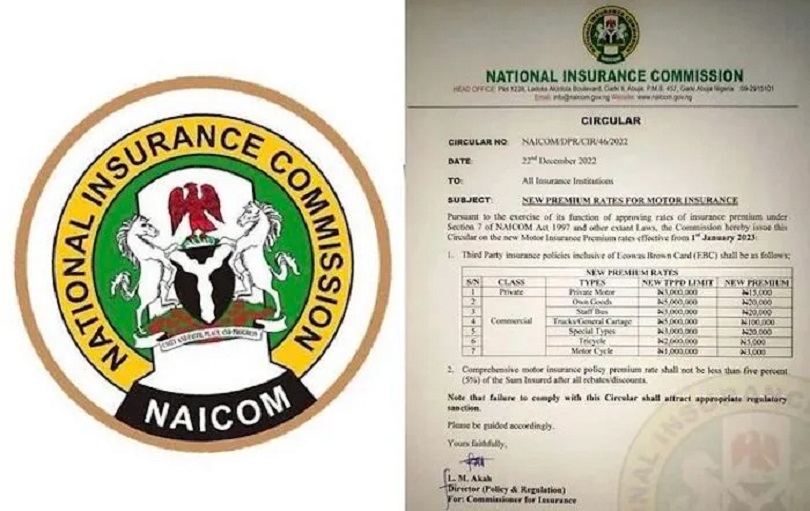
NAICOM recently issued a policy directive on the increase of third-party insurance policy in Nigeria by 200 per cent.

INSCAN, in a letter signed by its National Coordinator, Mr Yemi Soladoye, demanded the reversal of the directive, saying it amounted to a deliberate breach of the fundamental Principle of Utmost Good Faith and other decent regulatory principles guiding Insurance practice.

“We hereby write with respect to your Circular No.: NAICOM /DPR/CIR.46/2022 dated Dec. 22, 2022, increasing the third-party motor insurance premium in Nigeria by 200-400 per cent for different categories of motor vehicles.

“And by implication, giving only one week’s notice to the insuring public of Nigeria to comply.

“We demand the reversal of the directive as it amounts to a deliberate breach of the Fundamental Principle of Utmost Good Faith and other decent regulatory principles that guide insurance practice,” it said.

The INSCAN recalled that enough time was given to the public for feedback and adjustments to be made on the recent cases of currency redesign as well as the cash withdrawal limit introduced by the CBN.

It said the almost 20 million Motor Insurance Consumers in Nigeria deserved more than a week’s notice for compliance, describing the duration as a great insult to the collective intelligence of Nigerians.

The association said it had read over 500 public comments by Nigerians on the directive, saying the reputation slowly built for the Nigeria Insurance Industry was being eroded by the series of condemnations.

It said that practitioners, as well as the various arms of the central government of Nigeria, were being unfairly treated.

It quipped, “How much has your commission paid out to victims and customers of Proscribed Insurance Companies over the past 20 years as required under Section 78 of the Insurance Act 2003 to justify an astronomical increase in premium amount?

“Where is the report of an ad hoc committee required to be set up under Sec. 52 of the Insurance Act 2003, stating the imperative of increasing Insurance Premium by a whopping 200 per cent?

“We also know that the referred Sec. 52 of that Insurance Law does not confer arbitrary powers on you because Insurance is a business affected by Public Policy and otherwise it becomes legalised robbery,” it said.

The association said that the predictable outcome of the directive would be a substantial increase in the number of fake Insurance Underwriters in Nigeria.

You are definitely aware of the fact that even at the current N5,000 MTP Premium, many Nigerians still patronise the fake underwriters.

“And this is not because these Nigerians cannot afford the N5,000 but because they don’t see any benefit be it under your genuine or the fake cover,” the association said

It said that the directive would garner more money to the pockets of NAICOM and insurance operators and more hardship to Nigerian insurance consumers.

“To what extent have the interests of the Policyholders of the Insurance Underwriters, whose licences you revoked in the past year, been protected?

“How much have you paid to the various Fire Brigades in Nigeria as Fire Service Maintenance Fund as prescribed under Sec. 65 of the Insurance Act 2003.

“But still, you are quick to increase the Premium burden on the largely dissatisfied Insurance Customers in Nigeria,” it said.

INSCAN lamented the increment without due consideration for the feelings of the consumers, particularly in Nigeria, where the good customers who didn’t make claims are never rewarded.

The association said that failure to reverse the obnoxious directive would put NAICOM on record as the regulator with the highest level of impunity and insensitivity in Nigeria.

It stated that NAICOM’s policy directive was not subjected to civilised trade practices, professionally-accepted insurance principles, transparent customer-oriented regulations and humane attention to the economic situation of most Nigerians.

The association said that consumers were further convinced that the motive behind the directive was self-serving, arrogant and detrimental to their interests.

It said NAICOM was established to protect consumers, demanding a reversal of the policy pending proper consideration of the grey areas of the directive.


Adedapo Adesanya is a journalist, polymath, and connoisseur of everything art. When he is not writing, he has his nose buried in one of the many books or articles he has bookmarked or simply listening to good music with a bottle of beer or wine. He supports the greatest club in the world, Manchester United F.C.

Auto

Court Restrains Police, FRSC from Imposing Car Insurance Fines Without Court Order

Published

on

third-party insurance

By Adedapo Adesanya

The Federal High Court in Abuja has restrained the Nigeria Police Force and the Federal Road Safety Corps (FRSC) from imposing fines on motorists for third-party motor vehicle insurance violations without a court order.

The ruling followed a suit marked FHC/ABJ/CS/291/2025 filed by activist-lawyer, Mr Deji Adeyanju, against the Inspector-General of Police, the Attorney-General of the Federation and the FRSC.

Delivering judgment on Friday, Justice Hauwa Yilwa held that while both the police and the FRSC have the power to enforce compliance with third-party motor insurance, they lack the legal authority to impose fines on alleged offenders.

The suit was initiated through an originating summons, brought pursuant to Section 17 of the Motor Vehicles (Third Party Insurance) Act, 1950, Sections 68(3) and (4) of the Insurance Act, 2003, as well as provisions of the Federal Road Safety Commission (Establishment) Act, 2007.

Mr Adeyanju had asked the court to determine whether the police could enforce third-party insurance, impose fines without judicial backing, and whether such enforcement during routine stop-and-search operations violated constitutional rights.

He also sought a declaration on whether the power to enforce third-party motor insurance lies exclusively with the FRSC.

In addition to the declaratory relief, the applicant requested orders of perpetual injunction restraining the police from enforcing third-party insurance and from imposing fines without judicial backing.

He further urged the court to hold the Attorney-General of the Federation accountable for providing legal guidance on the scope of police powers under the relevant statutes.

However, in its judgment, the court drew a distinction between enforcement and sanctioning powers.

Counsel to the applicant, Mr Marvin Omorogbe, said the court upheld the authority of both the police and the FRSC to ensure compliance with motor vehicle insurance laws, but firmly ruled against the imposition of fines by either agency.

According to him, the court held that “the police and the road safety may enforce” compliance but “outrightly lack the powers to impose fines on third parties or vehicle owners” in the course of such enforcement.

“The court went further to restrain the IGP, the Police Force and all their officers, including the FRSC, from imposing fines on motor vehicle users or Nigerian citizens,” Mr Omorogbe said.

Reacting to the judgment, Mr Adeyanju expressed satisfaction, noting that the central objective of the suit had been achieved.

“The sole reason why we came to court is that we wanted the court to make a positive declaration that the police and the road safety do not have the right to impose fines on any Nigerian over motor vehicle insurance. And we have succeeded,” he said.

He argued that the ruling would curb what he described as a pattern of extortion by enforcement agencies and restore confidence among motorists.

Mr Adeyanju added that although the court declined to grant all the reliefs sought—particularly the request to strip the police entirely of enforcement powers—it nonetheless made a significant pronouncement on the limits of those powers.

He also urged Nigerians to take advantage of the judgment to assert their rights and seek legal remedies where necessary.

On the other hand, counsel to the defendants, Mr Victor Okoye, said the judgment was only partly favourable to the police and signalled plans to challenge it at the Court of Appeal.

Mr Okoye disclosed that the defence had raised a preliminary objection questioning the jurisdiction of the court to entertain the suit, arguing that the originating summons was incompetent and unsuitable for resolving contentious issues.

He relied on appellate authorities to stress that jurisdiction is fundamental to adjudication and must be determined before any substantive issues.

Despite this, he noted, the court proceeded to deliver judgment.

Continue Reading

Auto

Pamtech Issues Public Disclaimer on Popular Auto Influencer Juliet Ibekwe

Published

on

Juliet Ibekwe Somiari Lucky

By Modupe Gbadeyanka

A public disclaimer has been issued on two former representatives of Pamtech Group, Mr Somiari Lucky and Ms Juliet Ibekwe, who is a popular auto influencer.

In the notice signed by the chief executive of Pamtech, Mr Chidomere Ndubuisi, on Tuesday, members of the public were informed that the duo no longer work with the organisation.

Mr Ndubuisi, who did not disclose why he disengaged the duo, however, emphasised that Mr Lucky and Ms Ibekwe are “not authorised to act on behalf of, represent, negotiate, or enter into any business dealings in the name of Pamtech Media Ltd or Pamtech Group.”

Ms Ibekwe rose to fame by creating content on how to make vehicles work efficiently. She became a notable auto content creator in Nigeria and garnered more fans for her car care tips.

In the disclaimer today, Pamtech warned “the general public, our valued clients, partners, and stakeholders” that doing business with Ms Ibekwe and Mr Lucky is “at their own discretion and risk, and such engagements do not involve Pamtech Group in any capacity.”

“Any business transactions, agreements, or engagements entered into with the above-mentioned individuals are strictly personal to them; Pamtech Group shall not be held liable or responsible for any commitments, representations, or obligations made by them after their exit from the company,” another part of the notice stressed.

The Owerri, Imo State-based firm further noted that, “Any use of the Pamtech name, brand, platform, or reputation by them without written authorisation is unauthorised and not recognised by the company.”

The company urged its clients, partners, and members of the public to verify all engagements directly with Pamtech Group official channels, and also ensure that all payments and communications are made only through verified company accounts and representatives.”

Pamtech expressed its commitment to delivering excellence, integrity, and professionalism across all its services in media, automobile, and business solutions.

Continue Reading

Auto

Mixed Reactions Over Nigeria’s Ban on Importation of Accidented Vehicles

Published

on

import accidented cars nigeria

By Modupe Gbadeyanka

Reactions have continued to trail the decision of the federal government to stop the importation of accidented vehicles into Nigeria by car dealers and others.

On Tuesday, the government declared that it would no longer accept the importation of vehicles without prior certification, noting that it was worried at the influx of substandard automobiles into the country.

The Minister of State for Industry, Trade, and Investment, Mr John Enoh, said the no certification, no entry policy tagged the Standard Organisation of Nigeria–National Automotive Design and Development Council Vehicle Conformity Assessment Programme was now fully implemented with immediate effect, noting that any vehicle that fails to meet the requirements would be denied entry into the country.

“I want to clarify again that this is not a proposal or a pilot. This has become government policy and takes immediate effect upon commencement,” he declared at a meeting in Abuja, stressing that vehicles coming into the nation must obtain pre-shipment certification.

“So, the endorsement integrates vehicle safety into Nigeria’s economic policy framework. It aligns fiscal instruments, foreign exchange import financing, and revenue systems with safety and standards objectives.

“It also strengthens the long-standing work of the Standard Organisation of Nigeria and NADDC within a coordinated whole-of-government approach.

“I think that with effect from the commencement of this SON-NADDC VehCAP, all new and used vehicles and automotive products entering Nigeria must obtain pre-shipment certification on that VehCAP before form M approval, before customs valuation, before power processing, before import clearance, and before market entry,” he stated.

“No vehicle or automotive product shall be imported, cleared, registered or licensed without valid certification. Any non-compliant import shall be subject to refusal of clearance, seizure, or sanctions under applicable laws,” he added.

Mr Enoh disclosed that, “We did not arrive here by accident. Too many Nigerians have died from accidents caused by vehicles that fell short of required standards. Nigeria deserves better, and this government is determined to deliver better.”

While he admitted that some Nigerians may not be able to afford new vehicles, the government cannot fold its arms and allow its citizens to die because of substandard cars.

“I think that without taking an extreme position, we must find a middle ground. There are economic challenges, there is purchasing power, and there is also the capacity of local assemblers to meet demand.

“But at the very minimum, if we adhere strictly to existing regulations, such as limits on the age of imported vehicles, our problem will not be nearly as bad as it is,” he said.

“A vehicle that is non-compliant at the federal level must not be registered at the state level. For the FCCPC, you are expected to treat VehCAP certification as a baseline for consumer protection enforcement for vehicles. State governments, because we run a federation with federal units, state governments are expected to align vehicle registration systems with VehCAP requirements. Most importantly, let me acknowledge the very profound role that was played by the Minister of Finance and Coordinating Minister of the Economy, Wale Edun, for approving the VehCAP initiative,” he warned.

While some Nigerians applaud this initiative, others believe citizens would be exploited by government officials and make the price of fairly used cars more expensive. Some dealers have been accused of bringing in accidented cars, refurbishing them and selling to unsuspecting customers at exorbitant prices.

Continue Reading

Trending