Connect with us

Education

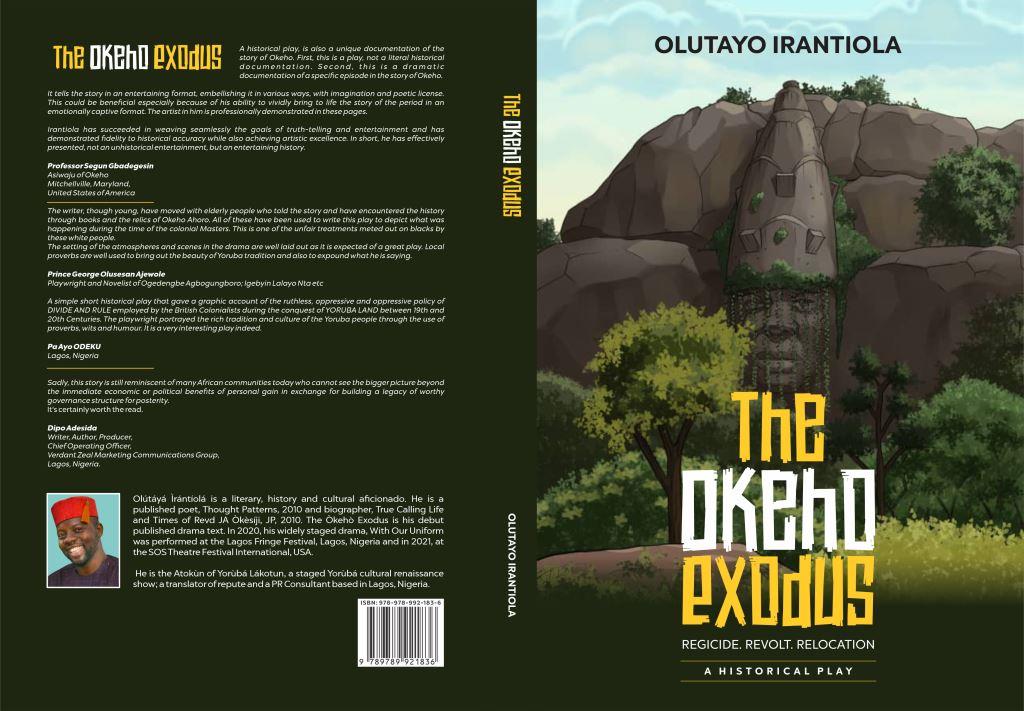
The Okeho Exodus: A Review

Published

on

THE OKEHO Exodus Akeem Akinniyi

By Akeem Akinniyi

Playwright: Olutayo Irantiola

Publisher: Peo Davies Communications

Year of Publication: 2022

Reviewer: Akeem Akinniyi

Olutayo Irantiola’s The Okeho Exodus is a historical play set in 1916 but written in a modern-day language and filled with elements that will not alienate a reader in these present times. The play revisits the past of the descendants of Okeho, who resettled among the hills along with ten villages to stem the tide of invasion by the Dahomey and Fulanis. What follows are intrigues of betrayal and bastardisation of culture by colonialists, which eventually leads to the tragic end of not only the king but the loss of the town’s sovereignty to the colonial masters.

The theme of betrayal dominates the play, and the only character who survives it is Oba Arilesire, who built a harmonious home of settlers which sets the tone for successive kings before the turn of Onjo Olukitibi.

The emergence of Captain Ross and his fellow conquerors in Okeho with their laws and subjugation of the people leads to distrust among the chiefs and sets the plot to oust the king, Onjo Olukitibi.

A wave of betrayal rises among the chiefs who think Onjo Olukintibi has sold them out to the colonialists referred to as ‘Ajele’ (a Yoruba word for usurpers). The internecine fighting grows beyond the borders of Okeho and extends to other towns as Balogun Olele seeks allies from far and within against the king.

In the end, the king is captured and annihilated along with his family. Captain Ross avenges the death of the king, and attacks and arrests the unerring chiefs to bring law and order to Okeho, thereby establishing the sovereignty of the colonial masters.

The play deploys antithesis effectively to strike a balance in the events as well as the lives of the characters and the passing of the years. Oba Arilesire’s reign is filled with harmonious living and unity among the people. He would go on to die peacefully in his sleep. This is contrasting to the reign of Onjo Olukintibi whose reign ends in disarray with mistrust in the air and would later die agonizingly in the hands of his own people.

Another is the replacement of invaders; at first, it is the Fulanis and Dahomeys whose aggression make the people of Okeho flee to the new place. Little had they settled down when the colonialists invaded their space, and sadly, it will result in their return to the place they left earlier.

The challenges of colonialism to traditional laws and customs are symbolized by the emergence of Captain Ross whose influence and power conflicted with Onjo Olukintibi, thereby reducing his relevance before the people. His authority is challenged, and as Captain Ross’ influence grows, Olukitibi’s stature shrinks.

The people of Okeho begin to see him as the puppet of the white man. An example is the statement of Oladunni (41) “The reign of Olukitibi is already disheartening. We have never experienced this in Okeho Ahoro, I have been watching with keen interest, and I am getting to lose hope in his leadership abilities. People have been saying that Olukitibi was not the right person to be crowned, he was imposed on us by the colonial masters. But will the kingmakers and the oracle lie?”

The theme of betrayal echoes throughout the book, and it is expressed in many ways. Jinjin represents the modern, inquisitive, and courageous woman who believes in equality. She also represents the Biblical Eve, whose inquisitiveness led to the fall of man through her desire to partake in the Oro traditions. A Yoruba cult tradition that forbids the participation of women. She never hides her intent to break all patriarchal foundations (25):

Jinjin: My right to social equality, freedom of association and speech. I want to know more about Oro. If it was an entirely sacred thing, men should also stay out of the rituals.

To achieve her husband, Olojomo’s commitment to making her participate, she weaponises sex, and the poor man submits to her guiles: “Yes, my mind is at rest now.  I am sure that I would soon partake of the ritual, and we would break all the limitations that have been set by many generations” ” (63).  Olojomo would go on to get her involved in the ritual, a flaw that ridicules his legacy in the Oro cult leading to his disgrace from the group by fellow initiates who considered his actions a betrayal of trust.

Another female character of note is Oladunni, who challenges the status quo of the submissive housewife who must accept everything that her husband dishes out to her. She broke patriarchal norms by talking back at her husband Oga Akooda (37) who in a state of excitement and drunkenness about the Oro festival insults her father which she replied accordingly and disrespectfully. The husband chases her with the intent to beat her and, instead of being apologetic, tries to give reasons for his uncouth behaviour. (38)

Oga Akioda: She has to swallow those words if not, there won’t be peace any longer in this house. She thought I was tipsy and could not reason well.

Oladunni: I will go to the court of Ross. You will learn lessons. I cannot tolerate you any longer. You are a violent man. (He wants to chase her again, but Akoda holds him).

The court of Ross is the court of the white man which allows room for divorce. This can be seen as a breakaway from the cultural norm of family and community elders settling marital conflicts. It reflects a subjugation of traditional authority. Some of the little cracks that, bit by bit collapse the wall of traditions and customs.

The playwright makes use of songs to communicate and express the mood. The language, though direct, is sometimes riddled with too much Yoruba aided by code-mixing and translations that somehow belabour the point. Some scenes appear intrusive, as we have during the choice of kingship. Above all, the playwright achieves his aim of telling an ancient story to a modern audience by reflecting on the effects of colonialism and its attendant evils of erosion of cultures and abuse of power.

Akinniyi Akeem is an advertising copywriter with one of the leading PR agencies in Nigeria. He enjoys the art of writing, and in his spare time, he loves to delight the blank page with poetry and short stories. 

Advertisement
1 Comment

Leave a Reply

Your email address will not be published. Required fields are marked *

Education

Hallos Launches Learning247 Summit

Published

on

Hallos

By Adedapo Adesanya

Live-learning and creator-economy platform, Hallos, as part of its expansion drive, has unveiled plans to equip millions of youths and women with digital skills and monetisation opportunities through the Learning247 Hallos Summit, aimed at integrating Nigeria’s South-East into the rapidly expanding global creator economy.

At a sensitisation and stakeholder engagement forum in Enugu, the organisation also called for stronger strategic partnerships with government agencies, educational institutions, development organisations, media houses and private-sector stakeholders to advance the creator economy as a credible engine for mass employment, youth prosperity and inclusive economic growth.

The chief executive of Hallos, Mr Alexander Oseji Uzoma, renewed the call for increased investment in internet penetration, reliable power supply, digital infrastructure, creative studios and youth-focused innovation hubs across Nigeria, especially the South-East.

Describing the creator economy as one of the most accessible and scalable employment frontiers globally, he noted that with basic tools such as a smartphone, internet access and creative skills, young people can build audiences, monetise knowledge and generate sustainable income without heavy capital investment or long career pathways.

According to Mr Uzoma, the creator economy offers low-barrier entry into diverse professions, including content creation, social media influencing, live tutoring and digital coaching, video production, podcasting, graphic design, music and performance arts, digital marketing, merchandise design, e-commerce and community management. These activities support a broader value chain spanning production, distribution, technology and management.

The Hallos co-founder also explained that global projections place the creator economy in the hundreds of billions of dollars, with millions of creators worldwide earning sustainable incomes, stressing that Hallos is focused on localising these opportunities to ensure African youths can participate meaningfully and compete globally.

He further noted that Hallos operates a live-learning and creator-focused platform that integrates education, gamified quizzes, merchandising and voluntary fan donations into a single ecosystem. Through the platform, creators can host live learning sessions and masterclasses, earn from quizzes and challenges, sell branded merchandise, receive voluntary donations, build communities around their expertise and organise monetisable podcasts.

Mr Uzoma said the creator economy, driven by social media platforms, streaming services, digital commerce and content monetisation tools, has evolved into a major global industry capable of generating wealth, creating jobs and expanding export earnings.

He stressed that social media should no longer be viewed as a recreational space but as a viable business environment for wealth creation.

“The focus should not just be on content creation alone but on building businesses around content. It is about value creation and structured digital entrepreneurship,” he said.

He disclosed that Hallos intends to reach about 10 million youths nationwide, with over 5,000 already engaged across its programmes, while placing strong emphasis on bridging the gender gap by empowering women and girls through targeted digital training, mentorship and access to monetisation platforms.

As the digital economy continues to expand, Hallos said the creator economy stands out as a practical and scalable solution to youth unemployment, offering low entry barriers and global earning potential.

The company reaffirmed its commitment to bridging the gap between talent and income, enabling young Africans to earn well above minimum wage through creativity, knowledge and structured participation in the global digital economy.

Continue Reading

Education

Bayero University PG Students to Enjoy Dangote’s N1.5bn Scholarship

Published

on

Dangote Foundation Bayero University

By Modupe Gbadeyanka

Post-graduate students of Bayero University Kano (BUK) will benefit from a scholarship worth about N1.5 billion from the Aliko Dangote Foundation (ADF).

The businessman put down the funds to support eligible MBA, entrepreneurship, and management postgraduate students of the institution under an initiative known as MHF Dangote Graduate Business Scholarship.

At a ceremony on Tuesday, the foundation and the school signed a Memorandum of Understanding (MoU) at the auditorium of the Dangote Business School, Kano.

The deal is to provide N300 million annually over five years as scholarship awards to the beneficiaries, who will receive N150,000 each per session, beginning with the 2024/25 academic session. This is equivalent to 50 per cent of the current N300,000 fee paid by the post-graduate students. There are 1,225 students in the Business School (696 fresh and 529 returning students).

One of the beneficiaries, Mr Khalid Bababubu, who is into manufacturing and specialises in MBA, Finance and Investment, thanked the organisation for the gesture.

“We are happy to be beneficiaries of this initiative. Education is the bedrock of national development, and we will not take this scholarship for granted,” he said.

A representative of ADF, Ms Mariya Aliko Dangote, said, “Our vision at the Foundation is to build human capital that translates into economic opportunity.

“Strengthening business and entrepreneurship education is critical to turning knowledge into enterprise, innovation, and jobs. This scholarship deepens our commitment to Dangote Business School by investing directly in the next generation of business leaders and change-makers.”

On his part, the Vice Chancellor of Bayero University Kano, Prof. Haruna Musa, said, “This support comes at a critical time for many families. Beyond financial relief, it strengthens the Business School’s role as a centre for developing entrepreneurial and management talent, particularly for women who are increasingly taking leadership roles in enterprise.”

It was explained that newly admitted students will receive automatic tuition reductions during registration, and returning students who have already paid in full will receive rebates. The N300 million allocation is structured to cover all eligible postgraduate students based on current enrolment capacity.

Any unutilised balance in the first year will be retained within the Dangote Business School development envelope to strengthen learning infrastructure and digital academic capacity, ensuring continued enhancement of the academic environment.

The MHF Dangote Graduate Business Scholarship is distinct from ADF’s recently announced nationwide STEM education interventions.

Continue Reading

Education

Entries for InterswitchSPAK 8.0 Begin, Over N40m up for Grabs

Published

on

Entries for InterswitchSPAK 8.0

By Aduragbemi Omiyale

Senior secondary school students across Nigeria have been invited to apply and demonstrate their academic excellence on a national stage in the eighth edition of the prestigious national science competition known as InterswitchSPAK.

The contest is organised by Interswitch, Africa’s leading technology company focused on creating solutions that enable individuals and communities prosper.

Registration for InterswitchSPAK 8.0 via www.interswitchspak.com has opened and will close on Friday, May 24, 2026. For the first time, in addition to group registrations through schools, parents can also register their individual children for the competition.

This year’s edition features a scholarship pool exceeding N40 million, with Interswitch expanding the prize structure to ensure broader impact.

The overall winner will receive a N15 million tertiary scholarship, including monthly stipends. The first runner-up will be awarded a N10 million scholarship, including monthly stipends; while the second runner-up will receive a N5 million scholarship, also including monthly stipends. All scholarships are payable over 5 years. Also, the top 9 finalists will all receive brand new laptops and other exciting prizes.

In addition to the top prizes, Season 8 introduces enhanced rewards for student finalists ranked 4th to 9th, as well as increased recognition for teachers supporting qualifying students from 1st to 9th place. This expanded structure reinforces Interswitch’s commitment to rewarding academic excellence and recognising the critical role educators play in shaping student success.

“At Interswitch, we strongly believe that Nigeria’s future will be shaped by how well we nurture today’s young minds. InterswitchSPAK goes beyond competition; it is a long-term commitment to empowering students and supporting teachers who are laying the foundation for innovation, problem-solving, and national development.

“As we launch Season 8, we remain focused on creating opportunity, rewarding merit, and inspiring excellence across Nigeria,” the Executive Vice President for Group Marketing and Communications at Interswitch, Ms Cherry Eromosele, said.

Designed to empower young minds in the Science, Technology, Engineering, and Mathematics (STEM) areas, InterswitchSPAK identifies, nurtures, and rewards students while equipping them with the skills and knowledge required to excel in STEM fields and drive innovation.

Over the past seven seasons, InterswitchSPAK has positively impacted thousands of students across the country, offering full university scholarships, mentorship opportunities, and national recognition for outstanding academic performance.

Beyond these rewards, the programme has consistently reinforced the importance of STEM education as a critical driver of innovation, problem-solving, and sustainable national development.

Through a transparent, technology-enabled selection process, InterswitchSPAK has also promoted educational equity by providing students from diverse socio-economic backgrounds with equal access to opportunity, ensuring that performance and merit remain central to success.

Continue Reading

Trending