Education
From Okeho Ahoro to Okeho Ile: A Review of the Okeho Exodus
By Mutiat Titilope Oladejo
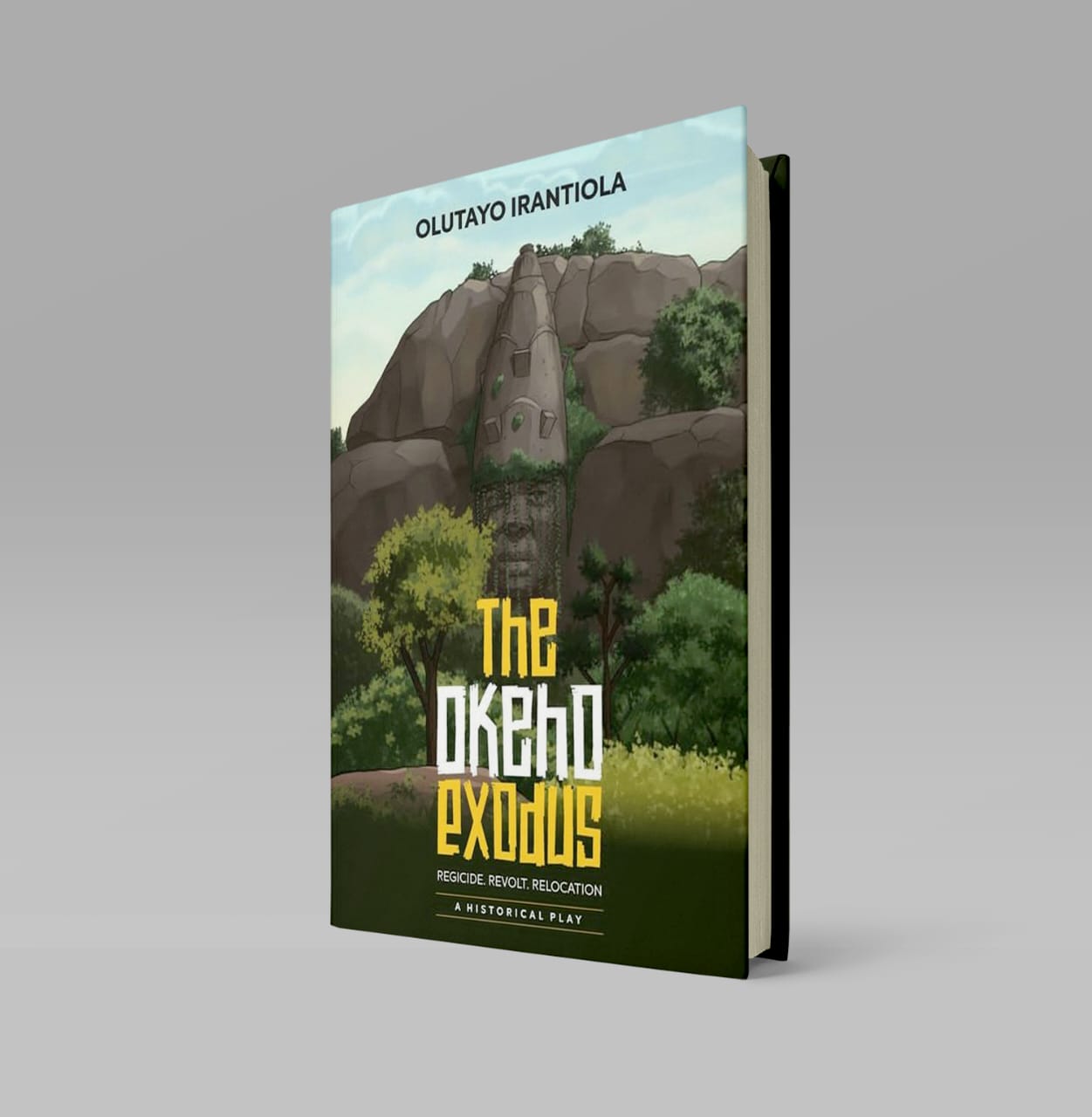
Title: Okeho Exodus: Regicide, Revolt, Relocation: A Historical Play
Playwright: Olutayo Irantiola
Publisher: Peo Davies Communications
Year of Publication: 2022
Reviewer: Dr Mutiat Titilope Oladejo
As a historian, I find it interesting to read Olutayo Irantiola ‘s book on The Okeho Exodus. I reviewed the book, and I am pleased to say that we have our story, and it is good that we can recreate them for our pleasure and for the future.
While lecturing at Emmanuel Alayande College of Education, I had the cause to visit Okeho to supervise students in teaching practice. I also visited other towns in Oke-Ogun. In my travels around Oke-Ogun, I am distraught by the level of development in that region of Oyo State. I even wonder if Ibarapa and Oke Ogun regions are ever on the map of development in Oyo State.
Okeho, a typical Yoruba town, maintained its identity to survive the nineteenth-century turmoil tensioned by the transition from the illegitimate commerce of the slave trade to the legitimate commerce of the Bible and plough.
Olutayo Irantiola’s play fiction, the Okeho-Iseyin uprising of 1916 to narrate the everyday realities of major events that aggravated the chaos. It is pertinent to note that it coincided with the period of the first World War. Britain, at this time, used colonial laws to encapsulate the colonies.
The book gave the impression that encounters with the Fulani and Dahomey already influenced the internal security issues of the town and its environs. This can’t be downplayed because the Fulani and even Nupe have years of integration into the Oke-Ogun region. Of course, Prof. Babatunde Ayeleru’s inaugural lecture gives us the impression that the Dahomey/French influence remains relevant in some parts of the Oke-Ogun region. Some doctoral students are also investigating the cross-border trade between Nigeria and Benin Republic via Oyo north.
The threats, then, made Oba Arilesire call for a common political identity between Okeho and the towns around. There was a merger that enabled cooperation against enemies. However, the death of the king and the emergence of Onjo Owolabi Olukitibi as the new king changed the status quo. Although the book gave the impression that the Ajele created havoc at this time, I disagree a bit because the Ajele was a revenue collection institution that existed since the eighteenth century. Little or nothing can the Onjo do to stop it. It is only the British policy of indirect rule that reinforced the Ajele. Taxation should not be the issue; the people were just estranged from the colonial influence on everyday life.
The uprising also emanated from rancour and mischief among the Baale. Pointedly, Baale Olele, Balogun Atilola, Alasia and Ba’Ogan were fingered as opposition to the reign of Onjo Owolabi Olukitibi. They wanted him out because he was considered an agent of colonial imposition.
The schema headed by Baale Olele was possible because the citizens preferred the traditional lifestyle. The book gave the impression that there was opposition to colonial rules against open defecation, thus compelling them to build toilets in their homes. Vaccination of children was also considered taboo as it was believed that it would affect their brains.
Courts were established, and it was considered a big threat to the existing gender relations. Women used the courts to snap out of oppression as they sought a divorce. To men, oppression is normal and should not be questioned. Statistics from the archives I used in my book: The Women Went Radical: Petition Writing and Colonial State in Southwestern Nigeria, 1900-1953, attest to this because Okeho and Iseyin had high rates of divorce in the 1940s.
Furthermore, Christianity was a threat as the custodian of traditional religion believed that the missionaries were causing havoc to the belief system. Men worked as labourers to survive the colonial economy, and the scope of authority that gave powers to the police angered them. The policemen (Akoda) were considered traitors.
Scholars have opinions on the issues, but the book sets us into an interesting fiction. Mofeyisara Oluwatoyin Omobowale, in “Okeho Uprising” in the International Encyclopedia of Revolution and Protest, concluded that the uprising was brutally suppressed. Prof. J. A. Atanda, in the article: “The Iseyin-Okeiho Rising of 1916: An Example of Socio-Political Conflict in Colonial Nigeria,” published in the Journal of Historical Society of Nigeria, 1969, affirms that taxation was not the problem but just a revolt against colonial imposition to all spheres of life.
The schema extended to Iseyin as the uprising was jointly executed to wipe out Onjo Olukitibi, the queen and the prince. Captain Ross responded swiftly by mobilizing the colonial army to capture Baale Olele and cohorts. They were sentenced to death by hanging.
The chaos led to the disruption that made colonial rule more pronounced. The people were compelled to move from Okeho Ahoro, the site of the uprising, to Okeho Ile to ensure effective monitoring by the colonial state.
I appreciate my friend for his patriotism in writing this book, the playwright and I attended Abadina College, the University of Ibadan, the University of Ilorin for undergrads and back to the University of Ibadan for postgraduate programmes.
I will like to mention that I appreciate my friends at the University of Ilorin who chose to return home after their studies. A number of them insisted they would be back home to teach, farm or work with the local government. I appreciate their patriotism! It also dawned on me that I also feel the same way about Ibadan city as my home.
Long live Oyo State!
Dr Mutiat Titilope Oladejo is of the Department of History, University of Ibadan
Education
Tinubu Hails 2026 African Spelling Bee Championship Winner Adeolu Oreofe
By Modupe Gbadeyanka
The winner of the 2026 African Spelling Bee Championship, Ms Adeolu Oreofe, has been congratulated by President Bola Tinubu.
In a statement on Friday by his Special Adviser on Information and Strategy, Mr Bayo Onanuga, the President described the outstanding achievement of the 14-year-old student as the importance of sustained investment in education, literacy, and youth development.
The student of St. Lawrence Metropolitan College in Ado Ekiti claimed the championship in the Junior Category in Harare, Zimbabwe recently.
She defeated contestants from over 20 African countries to claim the continental crown, which comes with a $5,000 educational scholarship.
She finished second at the 2023 MTN Spelling Bee and the 2024 Ekiti State Spelling Bee. She then placed fifth at the 2025 African Spelling Bee and second at the 2025 Nigeria Spelling Bee, before clinching the first prize this year in the continental championship.
Mr Tinubu applauded Oreofe’s dedication, as well as the unwavering support of parents, teachers, and mentors who contributed to this remarkable success, noting that she did not allow earlier disappointments to deter her from her determination to reach the top.
“I am convinced that this feat not only brings honour to Nigeria on the continental stage but also serves as an inspiration to millions of young Nigerians to pursue excellence in academics and personal development.
“As a government, we will continue to strengthen the education sector by creating opportunities that enable Nigerian youths to compete and excel globally. I wish Miss Oreofe continued success in her future endeavours,” the President further said in the statement by his chief spokesman.
Education
Tinubu Chooses Adelabu as NECO Board Chair, Salako to Chair NBTE Board
By Adedapo Adesanya
President Bola Tinubu has made new appointments in the country’s educational sector, covering the National Examination Council (NECO), the National Board of Technical Education (NBTE), the Federal Polytechnic in N’yak Shendam, Plateau State, and the National Library of Nigeria, all institutions under the Federal Ministry of Education.
According to a statement on Wednesday, President Tinubu appointed Professor Modupe Adeola Adelabu as Chairman of the Governing Board of NECO, and retained the current registrar, Professor Ibrahim Dantani Wushishi.
The President also appointed Dr Bongfa Binfa as Rector of the Federal Polytechnic, N’yak-Shendam, Plateau State, and renewed the tenure of Professor Chinwe Veronica Anunobi as chief executive of the National Library of Nigeria.
For the chairmanship of the National Board of Technical Education (NBTE), President Tinubu appointed Professor Babatunde Salako.
On April 10, President Tinubu reappointed the incumbent executive secretary, Professor Idris M Bugaje, for a second and final term of five years.
Professor Adelabu, who will chair NECO, is a retired Professor of educational administration who rose through the ranks to full professorship at the Obafemi Awolowo University (OAU) in Ile-Ife, Osun State.
She was a former Deputy Governor of Ekiti State (2013- 2014) and the Chairman of the National Board for Technical Education (NBTE) between 2018 and 2021.
Professor Babatunde Salako, the new chair of NBTE, is a globally respected researcher with decades of experience in higher education, institutional governance and national policy leadership.
He previously served as the Director General of the Nigerian Institute of Medical Research (NIMR) from 2016 to 2024, a period during which the institute experienced significant revitalisation, enhanced research governance, expanded international collaborations, and improved infrastructure and research outputs.
Dr Binfa, from Plateau State, succeeds Dr Mukaila Zakari Ya’u, the pioneer Rector of the Federal Polytechnic, N’yak-Shendam, whose tenure expired on March 16, 2026.
President Tinubu approved the appointment of Dr Binfa for a single term of five years, following the conclusion of the process for appointing a new Rector through a public advertisement in national dailies in September 2025.
Dr Binfa holds a Doctor of Philosophy (PhD) in Mechanical Engineering from Universiti Teknologi Malaysia. Before this appointment, Dr Binfa was Deputy Rector (Academic) at the Federal Polytechnic of Oil and Gas, Bonny. He was also a Lecturer in the Mechanical Engineering Department at the Federal Polytechnic, Idah.
President Tinubu approved the renewal of the tenure of Professor Chinwe Veronica Anunobi as CEO of the National Library of Nigeria for a final term of five years. She was first appointed on September, 2, 2021.
Since assuming office, she has led several institutional reforms aimed at repositioning the National Library as a modern technology-driven knowledge institution, including the development and operationalisation of the National Repository of Nigeria, the Newspaper and Magazine Locator, the Index and Abstract to Nigerian Newspapers, and the National Virtual Library of Nigeria.
She has also played a strategic role in advancing the long-awaited completion of the National Library Headquarters project and in initiating plans to migrate heritage collections from the 34 state branches to the new headquarters in Abuja.
According to the statement, the President expects that the renewal of her tenure would ensure continuity in the implementation of ongoing reforms, completion of the National Library Headquarters project, and execution of the 2025-2030 Strategic Plan of the institution.
Education
Senior Varsity Workers Warn of Indefinite Strike After April 30 Deadline
By Adedapo Adesanya
The Senior Staff Association of Nigerian Universities (SSANU) has issued a final deadline of April 30 for the federal government to conclude the ongoing renegotiations with its members or face indefinite shutdown of universities nationwide.
The warning was contained in a communiqué at the end of a Special National Executive Council (NEC) meeting of SSANU over the weekend in Abuja.
The union, in the document signed by its National President, Mr Muhammed Ibrahim, clarified that negotiations with the government were still ongoing and have not been concluded, contrary to reports suggesting otherwise.
SSANU expressed concern over what it described as misleading information circulating in the public domain, particularly claims that a 30 per cent increase in allowances had already been approved. The union insisted that no such agreement has been finalised or signed by the parties involved.
Reaffirming its stance, SSANU stressed that it would not accept any outcome that falls short of the understanding reached during the renegotiation process. It emphasised the need for fairness, due process and respect for collective bargaining principles in arriving at a final agreement.
Part of the communique read: “NEC reaffirmed that the renegotiation process with the Federal Government is still ongoing and has not been concluded.
“NEC expressed serious concern over attempts in the public domain to portray the process as concluded, particularly through the circulation of a letter suggesting approval of a 30 per cent increase on allowances, when discussions are still in progress, and no final agreement has been signed by the parties.
“It maintained that SSANU will not accept any outcome that falls below the negotiated understanding reached in the course of the renegotiation process and insists that fairness, due process and collective bargaining principles must be respected.
“Consequently, NEC in session, reaffirms its position by the Joint Action Committee of NASU and SSANU on the final ultimatum given to the Federal Government from April 1 to 30 to conclude the renegotiation process and sign their respective agreements. Should the Federal Government fail to conclude the renegotiation process and sign the agreements within the stated period, SSANU will have no alternative but to commence an indefinite, comprehensive and total industrial action along with NASU.
“NEC calls on all members of the Union across the branches to remain calm, vigilant, united and prepared to fully comply with the decisions of the Union in defence of their welfare, dignity and collective interest.
“NEC in session passes a vote of confidence on the National Administrative Committee under the leadership of M. H. Ibrahim, and also reaffirms its full support for the union.
“NEC reiterates that SSANU remains committed to the defence of the rights and welfare of its members and will continue to pursue justice with firmness, unity and resolve.”
-
Feature/OPED6 years agoDavos was Different this year
-
Travel/Tourism10 years ago
Lagos Seals Western Lodge Hotel In Ikorodu
-
Showbiz3 years agoEstranged Lover Releases Videos of Empress Njamah Bathing
-
Banking8 years agoSort Codes of GTBank Branches in Nigeria
-
Economy3 years agoSubsidy Removal: CNG at N130 Per Litre Cheaper Than Petrol—IPMAN
-
Banking3 years agoSort Codes of UBA Branches in Nigeria
-
Banking3 years agoFirst Bank Announces Planned Downtime
-
Sports3 years agoHighest Paid Nigerian Footballer – How Much Do Nigerian Footballers Earn