

Banking
CBN to Review Nigerian Sustainable Banking Principles
By Aduragbemi Omiyale
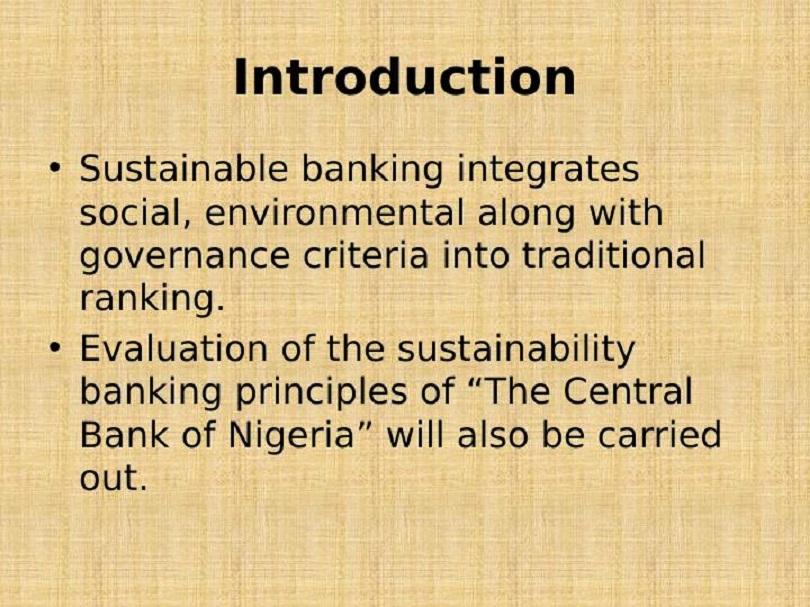
Steps are already being taken by the Central Bank of Nigeria (CBN) to review the Nigerian Sustainable Banking Principles to incorporate climate risk reporting for the banking sector.
Ms Aisha Mahmood, the Special Adviser to the Governor of the CBN, Mr Godwin Emefiele, on Sustainable Banking, revealed this information.
She disclosed this while delivering her presentation at the Investor Engagement session organised by the Nigerian Exchange (NGX) Limited and the Global Reporting Initiative (GRI) themed Empowering Responsible Investing – ESG Disclosure in Lagos last Wednesday.
At the event, she spoke on the CBN’s efforts to enable sustainable banking in the country via regulatory enforcement of ESG disclosures for banks.
On his part, the Divisional Head of Capital Markets at NGX, Mr Jude Chiemeka, posited that sustainable finance could be a transformative tool to shape the Nigerian economy for the better.
He noted that the exchange recognises the power and potential of responsible investing, adding that it firmly believes that sustainable finance is not merely a buzzword but a transformative force that can shape our economy and society for the better.
Mr Chiemeka further added that the NGX has wholeheartedly embraced this vision and has taken concrete steps to contribute to the advancement of responsible investment practices.
“Through their work, they have paved the way for greater accountability and responsible business practices. We laud their dedication and unwavering commitment to building a more sustainable future,” he stated.
For his part, the Director of GRI Africa, Mr Douglas Kativu, represented by the Manager for GRI Africa, Ms Tendai Matika, stressed why ESG information mattered to investors, advising companies to prepare their disclosures in line with the GRI standards.
“As a general rule, investors want to understand what the major ESG risks and opportunities facing a business are, including how the firm measures and monitors these factors, among others,” Mr Kativu said.
On her part, the Divisional Head of Business Support Services Division and General Counsel of NGX, Mrs Irene Robinson-Ayanwale, reiterated NGX’s commitment to fostering responsible investing and sustainable finance by driving conversations, creating innovative products, and developing strategic partnerships which can contribute to building a more sustainable and resilient economy.
She said, “In line with our commitment, NGX is currently working on an ESG Program rollout that will further help companies manage material ESG risks and leverage the opportunities created.
“Additionally, we are developing the NGX Carbon Plus initiative, which will recognize companies that demonstrate their commitment to reducing their carbon emissions with practical and impactful projects.
“Through this initiative, we aim to galvanize sustainable action and contribute to mitigating the challenges posed by climate change.”
Business Post reports that GRI partnered with the bourse on the engagement session to further educate the investor community on incorporating ESG data into decision-making.
Banking
Public Offer: Sterling Holdco Allots 13.812 billion Shares to 18,276 Shareholders
By Aduragbemi Omiyale
Sterling Financial Holdings Company Plc has allotted shares from its public offer of 2025 to investors with valid applications.
The allotment follows the earlier receipt of final approval from the Central Bank of Nigeria (CBN) and the recent clearance by the Securities and Exchange Commission (SEC).
In September 2025, the financial institution offered for sale about 12,581,000,000 ordinary shares of 50 kobo each at N7.00 per share in public offer.
However, the exercise received wide participation from the investing public, with the company getting 18,280 applications for 16,839,524,401 ordinary shares valued at approximately N117.88 billion.
Following a thorough verification process, valid applications were received from 18,276 shareholders for a total of 13,812,239,000 ordinary shares, representing a subscription level of 109.79 per cent and reflecting sustained confidence in Sterling Holdco’s strategic direction, governance, and long-term growth prospects.
The firm approached the capital market for additional funds for the recapitalisation of its two flagship subsidiaries, Sterling Bank and The Alternative Bank.
The capital injection will support the commencement of full operations and contribute to the group’s revenue diversification objectives.
In line with the guidelines set out in the offer prospectus, Sterling Holdco confirmed that all valid applications will be allotted in full. Every investor who complied with the terms of the offer will receive all the shares for which they applied.
A very small number of applications were not processed or were partially rejected due to non-compliance with the offer terms, including duplicate payments and failure to meet the minimum subscription requirement of 1,000 units or its multiples, as stipulated in the offer documents.
The group ensures a seamless post-offer process, with refunds for excess or rejected applications, along with applicable interest, to be remitted via Real Time Gross Settlement or NIBSS Electronic Funds Transfer directly to the bank accounts detailed in the application forms.
Simultaneously, the electronic allotment of shares has be credited to successful shareholders’ accounts with the Central Securities Clearing System (CSCS) on February 17, and for applicants who do not currently have CSCS accounts, their allotted shares will be temporarily held in a registrar-managed pool account pending the submission of their completed account opening documentation to Pace Registrars Limited, after which the shares will be transferred to their personal CSCS accounts.
Banking
CBN Governor Seeks Coordinated Digital Payment Reforms
By Modupe Gbadeyanka
To drive inclusive growth, strengthen financial stability, and deepen global financial integration across developing economies, there must be coordinated reforms in digital cross-border payments.
This was the submission of the Governor of the Central Bank of Nigeria (CBN), Mr Olayemi Cardoso, at the G‑24 Technical Group Meetings in Abuja on Thursday, February 19, 2026.
According to him, high remittance costs, settlement delays, fragmented systems, and heavy compliance burdens still limit the participation of households and Micro, Small and Medium Enterprises (MSMEs) in global trade.
The central banker emphasised that efficient payment systems are essential for economic inclusion, highlighting that global remittance corridors still incur average costs above 6 per cent, with settlement delays of several days, excluding millions from modern economic activity.
Mr Cardoso cautioned that while digital payments present significant opportunities, they also carry risks such as currency substitution, weakened monetary transmission, increased FX volatility, capital-flow pressures, and regulatory fragmentation.
The G-24 TGM 2026, themed Mobilising finance for sustainable, inclusive, and job-rich transformation, convened global financial stakeholders to advance the modernisation of finance in support of emerging and developing economies.
The CBN chief reaffirmed Nigeria’s commitment to working with G-24 members, the IMF, the World Bank Group, and other partners to build a more inclusive, resilient, and development-oriented global financial architecture.
“We have strengthened our AML/CFT frameworks in line with FATF guidelines, requiring strict dual-screening of cross-border transactions to mitigate risks.
“To deepen regional integration, the CBN introduced simplified KYC/AML requirements for low-value cross-border transactions to encourage broader participation in PAPSS, easing processes for Nigerian SMEs and enabling faster intra-African trade payments.
“We have also embraced fintech innovation through our Regulatory Sandbox, allowing payment-focused fintechs to test secure, instant cross-border solutions under close CBN supervision,” he disclosed.

Banking
Unity Bank, Providus Bank Merger Awaits Final Court Approval
By Modupe Gbadeyanka
The merger and business combination between Unity Bank Plc and Providus Bank Limited remains firmly on course, a statement from one of the parties disclosed.
According to Unity Bank, there is no iota of truth in reports in certain sections of the media suggesting that the merger process had stalled, as the transaction remains firmly on track.
It was disclosed that the necessary regulatory steps have been completed, but only a few other steps to finalise the transaction, especially the final court sanction.
There had been speculations that both lenders may not meet the new minimum capital requirement of the Central Bank of Nigeria (CBN) before the March 31, 2026, deadline.
However, it was noted that the combined capital base of Unity Bank and Providus Bank exceeds N200 billion, which is the minimum requirement to retain a national banking licence under the CBN’s recapitalisation framework.
When completed, the Unity-Providus merger is expected to deliver a stronger, more competitive, and customer-centric financial institution — one with the scale, innovation, and reach to redefine the retail and SME banking landscape in Nigeria.
“The merger with Providus Bank significantly enhances our capital base, operational capacity, and strategic positioning.
“We are confident that the combined institution will be better equipped to support economic growth and deliver innovative financial solutions across Nigeria,” the chief executive of Unity Bank, Mr Ebenezer Kolawole, stated.
Recall that a few months ago, shareholders authorised the merger between the two entities at Court-Ordered Meetings. They also adopted the scheme of merger at their respective Extraordinary General Meetings (EGMs) in September 2025,
The central bank also backed the merger, with a pivotal financial accommodation to support the transaction. The merger also received a further boost with a “no objection” nod from the Securities and Exchange Commission (SEC).
The regulatory approvals form part of broader efforts to strengthen the resilience of Nigeria’s banking system, reinforce capital adequacy across the sector, and mitigate potential systemic risks.
The development positions the combined entity among the 21 banks that have satisfied the apex bank’s new capital threshold for national banking operations.
-
Feature/OPED6 years agoDavos was Different this year
-
Travel/Tourism10 years ago
Lagos Seals Western Lodge Hotel In Ikorodu
-
Showbiz3 years agoEstranged Lover Releases Videos of Empress Njamah Bathing
-
Banking8 years agoSort Codes of GTBank Branches in Nigeria
-
Economy3 years agoSubsidy Removal: CNG at N130 Per Litre Cheaper Than Petrol—IPMAN
-
Banking3 years agoSort Codes of UBA Branches in Nigeria
-
Banking3 years agoFirst Bank Announces Planned Downtime
-
Sports3 years agoHighest Paid Nigerian Footballer – How Much Do Nigerian Footballers Earn



