Economy
FG, States, LGs Agree to Save N790bn from N1.9trn June Revenue
By Adedapo Adesanya
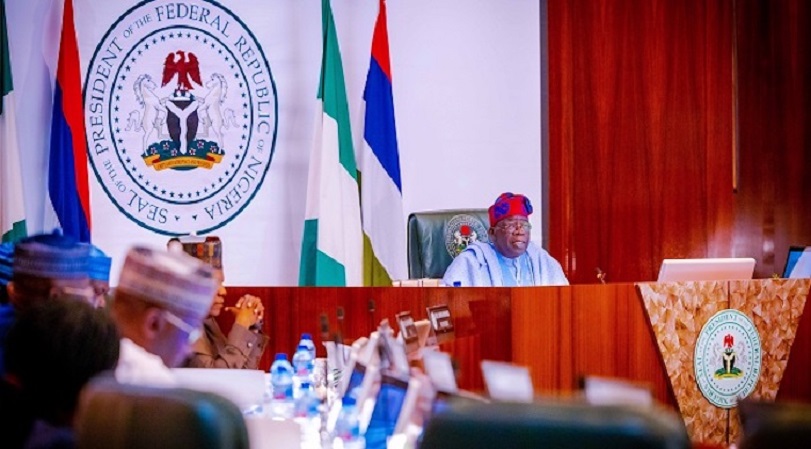
President Bola Tinubu has approved the establishment of an Infrastructure Support Fund (ISF) for states as part of measures to cushion the effects of the petrol subsidy removal on Nigerians.
A statement by Mr Dele Alake, Special Adviser to the President on Special Duties, Communications and Strategy, said the approval was disclosed at the monthly meeting of the Federation Account Allocation Committee on Thursday in Abuja.
He said that the new Fund would enable states to intervene and invest in the critical areas of transportation, including farm-to-market road improvements, agriculture, encompassing livestock and ranching solutions.
Other areas are health, with a focus on basic healthcare; education, especially basic education; power and water resources, which will improve economic competitiveness, create jobs and deliver economic prosperity for Nigerians.
Mr Alake also said that the committee also resolved to save a portion of the monthly distributable proceeds to minimise the impact of the increased revenues occasioned by the subsidy removal and exchange rate unification-on money supply, as well as inflation and the exchange rate.
He said that out of the June distributable revenue of N1.9 trillion, only N907 billion would be shared among the three tiers of government in July, while N790 billion would be saved, and the rest to be used for statutory deductions.
He explained that these savings would complement the efforts of the ISF and other existing and planned fiscal measures aimed at ensuring a tangible improvement in the lives of Nigerians.
Mr Alake said the committee commended Tinubu for the bold decision to remove the petrol subsidy and for providing support to the states to cushion the effects of the removal.
Recall that Business Post reported that the N907.054 billion total distributable revenue included distributable statutory revenue of N301.501 billion, distributable Value Added Tax (VAT) revenue of N273.225 billion, Electronic Money Transfer Levy (EMTL) revenue of N11.436 billion and Exchange Difference revenue of N320.892 billion.
In June 2023, the total deductions for the cost of the collection were N73.235 billion, and the total deductions for savings, transfers, and refunds were N979.078 billion, while the balance in the Excess Crude Account (ECA) was $473,754.57.
Out of the N907.054 billion, the federal government received N345.564 billion, the 36 state government received N295.948 billion, and the local government councils received N218.064 billion, while N47.478 billion was shared to the relevant oil states as 13 per cent derivation revenue.
Economy
Dangote Refinery Only Gets 40% Local Crude Feedstock
By Adedapo Adesanya
There are indications of a possible fuel shortage in Nigeria as the 650,000 barrels per day Dangote Refinery and Petrochemicals, which is responsible for over 60 per cent of domestic supply, is now getting only about 40 per cent of local feedstock.
According to the chief executive of Dangote Refinery and Petrochemicals, Mr David Bird, the refinery currently gets only about five cargoes of crude monthly, against an expected 13 to 15 cargoes.
He explained that this was below its agreed crude oil supply under the Federal Government’s crude-for-Naira arrangement.
According to him, the shortfall has affected the refinery’s ability to optimise local crude supply despite existing agreements being fully met.
“What we see under that agreement, we should be getting about 13 to 15 cargoes a month. And that’s what we could process to meet the domestic fuel requirements of Nigeria.
“Currently, we’re only getting five. So, that’s an underperformance against that pre-agreed volume contract.”
Mr Bird stated that the crude-for-Naira policy was designed to stabilise Nigeria’s foreign exchange market rather than provide financial advantages to the refinery, adding that the company still purchases crude at international benchmark prices.
He explained that the shortfall had caused the refinery to source preferred Nigerian crude grades from the international market at higher costs.
“And that value between the purchase price and the premium that we’re now seeing is money that Nigeria is leaking to the international trading community,” he said.
Last year alone, Dangote Petroleum Refinery imported a total of $3.74 billion worth of crude oil to make up for shortfalls
The Nigerian National Petroleum Company (NNPC), which is the refinery’s main trade partner and minority stakeholder, has been plagued by challenges that restrict optimal crude supply, so the Lagos-based company has to get feedstock from alternative supply links. This led to the importation of crude from Brazil, Equatorial Guinea, Angola, Algeria, and the US, among others.
For instance, in March 2025, the company said it now counts Brazil and Equatorial Guinea among its global oil suppliers, receiving up to 1 million barrels of the medium-sweet grade Tupi crude at the refinery on March 26 from Brazil’s Petrobras.
While Nigeria has so far been insulated from shortages that have plagued countries in South Asia and some parts of Europe, disruptions to trade triggered by the Middle East war may constrain flows, leading to higher prices, even for countries not directly affected.
Economy
OTC Securities Exchange Gains 1.41%
By Adedapo Adesanya
The NASD Over-the-Counter (OTC) Securities Exchange rallied by 1.41 per cent on Wednesday, March 25, with the market capitalisation adding N35.04 billion to close at N2.512 trillion versus the previous session’s N2.477 trillion, and the Unlisted Security Index (NSI) expanding by 58.55 points to 4,198.85 points from 4,140.30 points.
The growth came amid a weak investor sentiment, as the OTC securities exchange recorded two price gainers and three price losers.
The advancers were led by Okitipupa Plc, which chalked up N25 to sell at N275.00 per share compared with the previous day’s N250.00 per share, and Central Securities Clearing System (CSCS) Plc grew by N7.43 to N86.37 per unit from N78.94 per unit.
On the flip side, FrieslandCampina Wamco Nigeria Plc lost N7.04 to sell at N101.13 per share versus Tuesday’s closing price of N108.73 per share, Geo-Fluids Plc went down by 9 Kobo to N2.89 per unit from N2.98 per unit, and Industrial and General Insurance (IGI) Plc dipped 3 Kobo to 50 Kobo per share from 53 Kobo per share.
Yesterday, the volume of securities rose by 135.6 per cent to 2.2 million units from 933,125 units, the value of securities increased by 2.4 per cent to N46.7 million from N45.6 million, and the number of deals grew by 27.6 per cent to 37 deals from 29 deals.
The most active stock by value on a year-to-date basis was CSCS Plc with 39.1 million units exchanged for N2.4 billion, followed by Infrastructure Guarantee Credit Plc with 400 million units valued at N1.2 billion, and Okitipupa Plc with 6.5 million units traded for N1.2 billion.
The most traded stock by volume on a year-to-date basis was Resourcery Plc with 1.1 billion units worth N415.7 million, followed by Infrastructure Credit Plc with 400 million units sold for N1.2 billion, and Geo-Fluids Plc with 132.9 million units transacted for N510.7 million.
Economy
Naira Retreats to N1,386/$ at Official FX Market
By Adedap0 Adesanya
The value of the Naira fell against the Dollar in the Nigerian Autonomous Foreign Exchange Market (NAFEX) on Wednesday, March 25, by N4.07 or 0.29 to N1,386.70/$1 compared with Tuesday’s closing price of N1,382.63/$1.
This was due to forex demand pressure without substantial supply from the Central Bank of Nigeria (CBN) and other sources. Lately, the central bank has not conducted any FX sales to eligible financial institutions, where Bureaux de Change (BDC) operators are allowed to access $150,000 weekly.
Also, in the official market, the Nigerian Naira depreciated against the Pound Sterling at midweek by N7.52 to close at N1,856.38/£1 versus the previous day’s N1,848.86/£1, and retreated against the Euro by N5.82 to trade at N1,605.80/€1 versus N1,599.98/€1.
The domestic currency further lost N3 against the greenback at the GTBank FX desk yesterday to sell for N1,391/$1, in contrast to the preceding session’s N1,388/$1, and at the black market, it depreciated by N5 to quote at N1,405/$1 compared with the N1,400/$1 it was exchanged a day earlier.
The prolonged conflict in the Middle East continues to heighten risk aversion, reducing appetite for emerging-market assets despite Nigeria’s attractive yield environment, which could help sustain offshore inflows and support the local currency in the near term, though structural challenges remain.
The country is making efforts that could help shield it further, including reviewing timelines for approval of resuscitation of moribund oil wells and boosting production, which accounts for over 60 per cent of FX earnings.
As for the cryptocurrency market, it was under pressure on Wednesday, as implied volatility and weakening suggest geopolitical risk concerns remain as macro headlines remain in focus.
Dogecoin (DOGE) depleted by 3.8 per cent to $0.0937, Solana (SOL) depreciated by 3.5 per cent to $89.10, Cardano (ADA) dipped 2.4 per cent to $0.2621, Ethereum (ETH) went down by 2.2 per cent to $2,117.47, Ripple (XRP) slumped 1.9 per cent to $1.38, Bitcoin shrank by 1.5 per cent to $70,012.58, and Binance Coin (BNB) dropped 1.4 per cent to sell for $634.82.
However, TRON (TRX) appreciated by 2.3 per cent to $0.3144, while the US Dollar Tether (USDT) and the US Dollar Coin (USDC) traded flat at $1.00 apiece.
-
Feature/OPED6 years agoDavos was Different this year
-
Travel/Tourism10 years ago
Lagos Seals Western Lodge Hotel In Ikorodu
-
Showbiz3 years agoEstranged Lover Releases Videos of Empress Njamah Bathing
-
Banking8 years agoSort Codes of GTBank Branches in Nigeria
-
Economy3 years agoSubsidy Removal: CNG at N130 Per Litre Cheaper Than Petrol—IPMAN
-
Banking3 years agoSort Codes of UBA Branches in Nigeria
-
Banking3 years agoFirst Bank Announces Planned Downtime
-
Sports3 years agoHighest Paid Nigerian Footballer – How Much Do Nigerian Footballers Earn