General
NIMASA Mulls Expansion of Nigeria’s Deep Blue Project
By Adedapo Adesanya
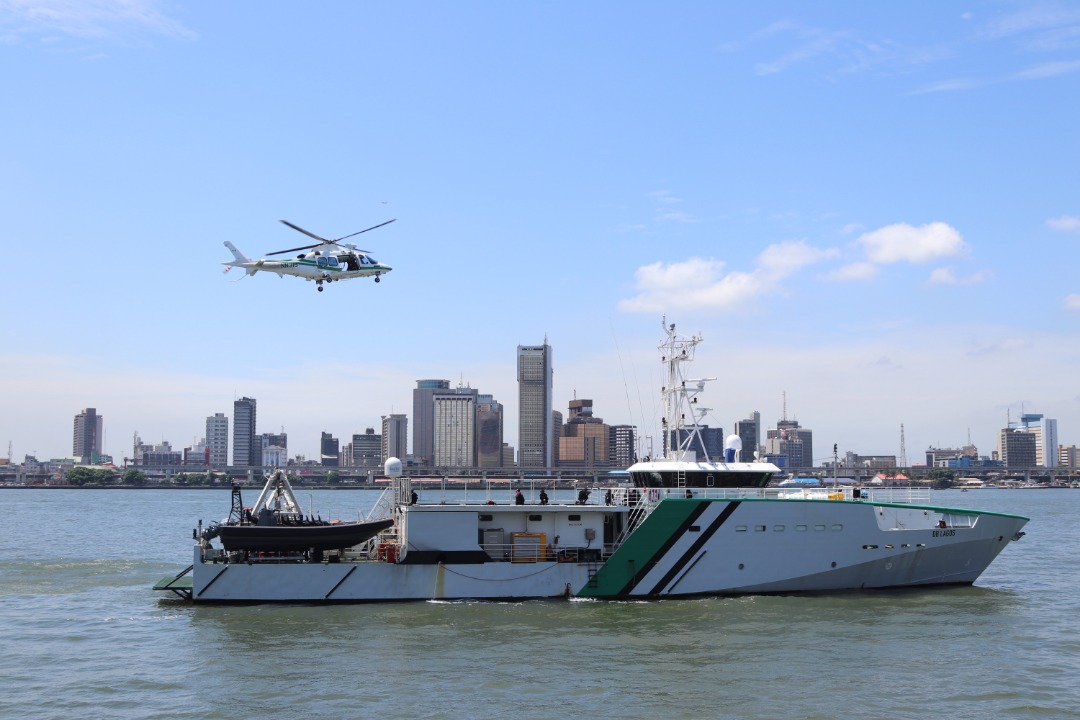
The Nigerian Maritime Administration and Safety Agency (NIMASA) is considering expanding the country’s Deep Blue Project due to its perceived success, with impact felt across the Gulf of Guinea, where it has helped to reduce piracy massively and gained global recognition, to ensure sustainability and greater impact.
The Director General of NIMASA, Mr Dayo Mobereola, made this known during his strategic visit to the Chief of Naval Staff, Vice Admiral Idi Abass, at the Naval Headquarters, Abuja.
Mr Mobereola, while commending the Navy for the harmonious collaboration with NIMASA and congratulating the CNS who had previously served as Maritime Guard Commander under the agency, called for continued partnership with the security outfit under his watch.
“It is important that we continue our partnership and strengthen our relationship. Our purpose here is to congratulate you and to discuss the benefits of the Deep Blue Project, how to sustain it, expand it, and increase its impact on the Gulf of Guinea.
“We are confident that we have the backing of the President, the Minister of Marine and Blue Economy, and the Nigerian Navy, hence, we are working towards presenting our proposal on the necessary improvements to be undertaken,” he stated.
The DG acknowledged the importance of the Deep Blue Project, noting that its impact resonates globally, with the International Maritime Organisation (IMO) commending it.
“The Deep Blue Project is vital, and countries around Africa and some other parts of the world are coming to copy our model. The IMO is asking how a civilian organisation was able to achieve this feat. It is therefore important that we continue to collaborate and do even better for greater sustainability,” he said.
Mr Mobereola also congratulated the Chief of Operations, Nigerian Navy, Rear Admiral Musa Katagum, who is joining the NIMASA governing board as the Navy’s representative.
On his part, the Chief of Naval Staff, Vice Admiral Idi Abass, while welcoming the NIMASA DG and his delegation, commended the Agency for the good work it is doing in the maritime sector and its continued support to the Nigerian Navy.
“Part of my command’s objective is to work in synergy with other agencies to achieve our goal as a country. We complement each other. We have no option but to collaborate and synergise.”
The Naval chief noted some concerns, which include the MoU between NIMASA and the Nigerian Navy, which has been in place since 2007 and should be revisited.
He also solicited for the Navy to be called upon for such needs as vessel repair, hydrographic surveys and chartings, stating the Navy’s capacity in handling such tasks.
The CNS also canvassed NIMASA’s assistance for wreck removal, particularly as the Navy gears towards its 70th Anniversary, where it looks forward to welcoming foreign ships.
He further commended NIMASA for its recent launch of the Cabotage Vessel Financing Fund (CVFF) Application Portal, noting that the organisation has come a long way in its planned disbursement of the fund.
General
Five Transmission Towers Collapse Along Ikot Abasi–Eket 132kV Line
By Modupe Gbadeyanka
The Transmission Company of Nigeria (TCN) has confirmed the collapse of five transmission towers along the Ikot Abasi–Eket 132kV Double Circuit Transmission Line.
This was attributed to severe acts of vandalism, as TCN disclosed that the structure collapsed after vandals removed critical structural bracing members.
The affected towers were N9, J4, N10, N11 and N12, the organisation said in a statement on Friday.
It explained that the extensive damage was discovered during a routine joint line patrol conducted on August 9, 2026, by TCN linesmen.
Further inspection revealed that structural members from seven additional towers along the same transmission corridor had also been removed and stolen. The towers, J3, N8, N13, N14, N15, N18 and N19, are now structurally compromised and pose a risk of further collapse.
TCN condemned this act of sabotage and reiterated its commitment to working hard to maintain a robust and reliable national grid.
The statement said that to mitigate the impact on electricity supply, the network has been reconfigured to prioritise supply to Ekim transmission station, leaving Ibom Power as the only station without supply.
TCN said it is mobilising an urgent intervention to complete the reconstruction of the affected sections of the line, with security agencies also notified to aid investigations and prevent further acts of vandalism along the line route.
General
Abbas Warns Against Delay in Implementing New Ports Regulatory Act
By Adedapo Adesanya
The Speaker of the House of Representatives, Mr Tajudeen Abbas, has urged all relevant government agencies to promptly initiate actions for the full implementation of the Nigerian Ports Economic Regulatory Agency Act, 2026, following its signing into law by President Bola Tinubu.
The bill, sponsored by Speaker Abbas, was aimed at repealing the Nigerian Shippers’ Council Act, Cap. N133, Laws of the Federation of Nigeria, 2004, and establish the Nigerian Ports Economic Regulatory Agency to ensure effective economic regulation of Nigerian ports while safeguarding the interests of shippers, service providers, and users of regulated port services. With the President’s assent, it has now been enacted as an Act of Parliament.
The legislation represents one of the landmark achievements of the 10th National Assembly. It reflects the Speaker’s commitment to legislative excellence, institutional reform, and sustainable economic growth, according to a press statement by the Special Adviser on Media and Publicity to the Speaker, Mr Musa Krishi.
The bill underwent a rigorous and inclusive legislative process, including extensive stakeholder consultations and a public hearing. It was passed by both Chambers of the National Assembly and subsequently assented to by the President.
The Act provides a robust legal and institutional framework to ensure effective economic regulation of Nigerian ports by fostering transparency, competitiveness, and efficiency in port operations; protecting the rights and interests of shippers, service providers, and other port users; and aligning Nigeria’s port regulatory system with global best practices, thereby enhancing the ease and cost-effectiveness of doing business.
Despite receiving presidential assent, the Act has yet to be fully operationalised.
He warned that any further delay would undermine the legislative intent of the reform, prolong the exposure of port users to arbitrary charges and operational inefficiencies, and deny the nation the anticipated benefits of increased revenue, improved trade facilitation, and stronger investor confidence in the marine and blue economy sector.
The Speaker urged the Federal Ministry of Marine and Blue Economy, in collaboration with all relevant Ministries, Departments and Agencies (MDAs) of the federal government, to take the necessary administrative, institutional, and financial measures for the prompt implementation of the Act.
He said this should include the formal transition to, as well as operational empowerment of, the Nigerian Ports Economic Regulatory Agency to discharge its statutory mandate effectively.
The full implementation of the Act is critical to unlocking the economic potential of Nigeria’s ports, reducing the cost of doing business, strengthening trade competitiveness, and positioning Nigeria as the leading maritime and logistics hub in West and Central Africa.
The statement noted that the Speaker reaffirmed the 10th House’s commitment to exercising the necessary legislative oversight to ensure this landmark legislation, along with others assented to by the President, is fully implemented and achieves its intended goals for the benefit of the Nigerian people.
General
FG, NiYA, Cascador Partner to Turn Youth Ideas into Investable Businesses
By Adedapo Adesanya
The Federal Ministry of Youth Development (FMYD), through the Nigerian Youth Academy (NiYA), has partnered with Cascador, a Nigeria-focused platform for growth-stage founders, to provide funding and support for the next generation of Nigerian youth entrepreneurs.
The announcement coincides with International Youth Day 2026, whose global theme this year — Different Contexts, Common Aspirations — calls on institutions to close the gap between young people’s circumstances and their opportunities. The pilot is an early step toward NiYA’s broader ambition to train and empower 7 million Nigerian youth within two years.
The NiYA and Cascador Founders Programme will begin with a pilot cohort of 20 early-stage Nigerian youth founders, including entrepreneurs without formal business registration or established financial records.
Over four weeks, participants will undergo intensive training focused on business fundamentals, investment readiness and pitch preparation. At the end of the programme, the eight top-performing founders will receive non-dilutive funding of up to N5 million each from Cascador, alongside an Enterprise Resource Planning (ERP) solution to help them structure, manage and scale their businesses.
The funding and support will be presented at a Pitch Day organised by NiYA and the Federal Ministry of Youth Development.
The Minister for Youth Development, Mr s Ayodele Olawande, said the partnership would enable NiYA to move beyond training by helping young people transform ideas into investable businesses and achieve sustainable economic participation through business preparation and access to capital.
“The pilot is deliberately designed to test a model that can go beyond one cohort. If young founders can be identified early, prepared properly, connected to credible capital and supported to build stronger business systems, then access to opportunity becomes less dependent on background or existing networks. That is the larger objective: to build a youth entrepreneurship ecosystem in which readiness, ideas and execution can increasingly determine who gets the opportunity to grow.”
The pilot will run in-person in Abuja with virtual touchpoints and 1:1 mentorship. All 20 graduates retain NiYA alumni status, with priority consideration for future opportunities.
NiYA and FMYD have already shown what real commitment to Nigeria’s youth looks like — the platforms, the reach, the ambition to train millions. What we’re building together now is the missing piece, a practical bridge from the ideation stage to real capital-readiness. When a Ministry so dedicated to its young people asked Cascador to help build that bridge, it was an easy decision,” said Trish Thomas, CEO of Cascador.
Ms Oyin Solebo, COO of Cascador and former Managing Director of the ARM Labs Lagos Techstars Accelerator, highlighted the partnership’s impact, saying, “This is what innovative capital deployment looks like: a government building real investment readiness at scale, and a partner meeting that foundational work with non-dilutive funding at exactly the moment it’s needed. Partnerships like this open doors that neither of us could open alone.”