Connect with us

General

Deep Blue Project Has Massively Reduced Piracy Attacks—NIMASA

Published

on

Deep Blue Project

By Adedapo Adesanya

The Nigerian Maritime Administration and Safety Agency (NIMASA) has disclosed that the country has recorded a massive reduction of piracy attacks on the Nigerian waters.

This was disclosed by the Director-General of the agency, Mr Bashir Jamoh, through his Special Assistant on Communication Strategies, Mr Ubong Essien.

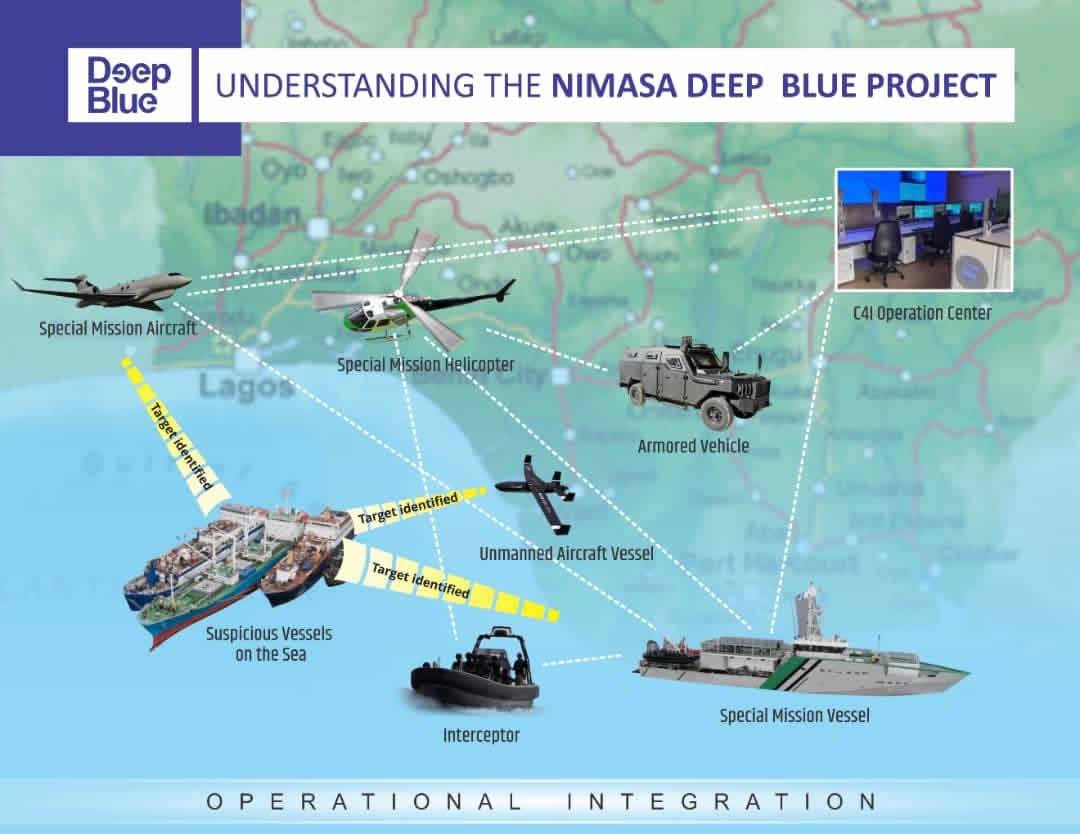
He explained that the low piracy attacks were achieved following the unveiling of the Deep Blue Project, a security architecture in the waters.

He said the security achievement was in collaboration with the Navy, Air Force, the Army and NIMASA as the major drivers.

He said Nigeria has been pressing for the lifting of the War Risk Insurance (WRI) imposed on vessels delivering goods and merchandise to the country due to fears of insecurity.

Mr Jamoh explained that goods coming to Nigeria carry very high and discriminatory fees that fuel inflation in Nigeria, revealing how NIMASA has gone to key maritime stations around the world to make case for the WRI removal.

The NIMASA DG said it was sad that this has persisted despite huge improvements in security on Nigeria’s waters.

“We are all paying the price for it. When goods enter the country, the higher cost in shipping and insurance will drive the cost up.

“The International Maritime Bureau (IMB) has admitted that the attacks have drastically dropped as never before in decades. What baffles the NIMASA management is why that though this reduction in attacks has been admitted by the IMB but the WRI is still in place. It’s a punitive insurance measure.

“The DG has gone to three international meetings where he has been making demand and appeal for removal of War Risk Insurance,” the statement added.

Speaking further, he said: “It is a collaboration between the Ministry of Defence and the Ministry of Transportation. NIMASA is driving it as the realising agency in terms of funding for the acquisition of the assets.

“You have three categories of assets, air, sea and land: In the air asset category, we have two special mission helicopters and two aircraft. The helicopters handle surveillance but in the event of an emergency, they can serve as intervention assets. NIMASA bears the responsibility of the safety of sea operations and thus uses the air assets to ensure this.

“In sea assets, we have two special mission vessels that go to sea and can stay at one spot from time to time and watch out. There are fast-moving interception boats that can take about 16 armed agents each.

“They serve as MSU (Maritime Security Unit). They can be deployed in the event of an attack on any vessel at the nation’s territorial waters or anywhere within its jurisdiction or permit.”

The agency noted that the Deep Blue Project as a specialised security strategy was yielding huge dividends, not only in reducing pirates’ attacks but in the many arrests and recent convictions secured.

He disclosed the latest convictions put at 10 and fines of N200, 000 each by a federal high court sitting in Ikoyi for hijacking a merchant’s vessel, FV Hailufeng II, on May 15, 2020, saying the total number of convictions had risen to 20. This was being achieved under the Suppression of Piracy and Other Maritime Offences (SPOMO) Act of 2019.

“This is the first time such feat has been recorded in Nigeria’s waters. Before now, there were no strong legal instruments to hold the criminals or pirates. Now, Nigeria is becoming a model in the Gulf of Guinea in terms of security the nation’s security architecture and model,” Mr Jamoh said.


Adedapo Adesanya is a journalist, polymath, and connoisseur of everything art. When he is not writing, he has his nose buried in one of the many books or articles he has bookmarked or simply listening to good music with a bottle of beer or wine. He supports the greatest club in the world, Manchester United F.C.

General

Tinubu Seeks Senate Confirmation of Tegbe as Power Minister

Published

on

Joseph Tegbe

By Adedapo Adesanya

President Bola Tinubu has written to the Senate seeking confirmation of the nomination of Mr Joseph Tegbe as the Minister of Power in the Federal Republic of Nigeria.

The request, read by the President of the Senate, Mr Godswill Akpabio, during plenary on Tuesday, was conveyed in a letter addressed to the Senate.

President Tinubu, citing Section 147(2) of the 1999 Constitution (as amended), which empowers the President to nominate ministers subject to Senate confirmation, urged lawmakers to give the request prompt consideration.

Last week, Mr Tinubu nominated Mr Tegbe as the Minister of Power, following the resignation of Mr Adebayo Adelabu to pursue a governorship ambition in Oyo State under the All Progressives Congress (APC) in the 2027 polls.

In the same vein, President Tinubu sought confirmation of two other nominees: Ambassador Sola Enikanolaiye as Minister of State, as well as Mr Rabiu Abdullahi Umar as the chief executive of the Nigerian Midstream and Downstream Petroleum Regulatory Authority (NMDPRA).

“The nomination has been transmitted to the Senate for screening and confirmation in accordance with the Constitution,” a statement by presidential spokesperson Mr Bayo Onanuga read in part.

Like his predecessor, Mr Tegbe is from Oyo State. He is a fiscal and economic reform expert with over 35 years of experience spanning the public and private sectors.

A former Senior Partner and Head of Advisory Services at KPMG Africa, he led wide-ranging initiatives in fiscal policy reform, institutional transformation, and governance in that firm.

Mr Tegbe has also advised key government institutions and private sector organisations on strategic reforms, regulatory frameworks, and investment structuring.

Until his nomination, he served as the Director General and Global Liaison for the Nigeria-China Strategic Partnership (NCSP), and was responsible for strengthening bilateral development cooperation between Nigeria and the People’s Republic of China.

Key priority for Mr Tegbe, if confirmed, will be to institute and execute policies that can help fix one of Nigeria’s most crucial sectors.

Continue Reading

General

Court Orders SERAP to Pay DSS Operatives N100m For Defamation

Published

on

serap dss

By Adedapo Adesanya

Justice Halilu Yusuf of the Federal Capital Territory High Court, Abuja, has awarded N100 million in damages against the Incorporated Trustees of the Socio-Economic Rights and Accountability Project (SERAP).

In his judgment, Justice Yusuf held that two operatives of the Department of State Services (DSS) were right to institute a defamation suit against SERAP.

In the suit, filed in the names of the two DSS officials, Ms Sarah John and Mr Gabriel Ogundele, the claimants accused SERAP of making a false allegation that they invaded its office in Abuja on September 9, 2024.

The court also ordered the organisation to tender a public apology to the two operatives, to be published in two national newspapers and broadcast on two television stations.

In addition, the court awarded N1 million against SERAP as the cost of litigation.

The judgment further stipulated a 10 per cent interest on the damages until the sum is fully paid.

The case follows a dispute that began in September 2024 when SERAP alleged that DSS officers “unlawfully invaded” its Abuja office.

In a post on its X account, the group said, “Officers from Nigeria’s State Security Service are presently unlawfully occupying SERAP’s office in Abuja, asking to see our directors.”

It added, “President Bola Tinubu must immediately direct the SSS to end the harassment, intimidation, and attack on the rights of Nigerians.”

The DSS, however, denied the claims.

It said the visit by its officers was routine and meant to engage the organisation’s new leadership.

The officers later sued, insisting that “no invasion occurred” and that the claims damaged their reputation and led to disciplinary action.

However, SERAP maintained its position.

In a later statement, it said, “We stand by our statements of defence and statements on oath,” insisting that DSS officers “unlawfully invaded our Abuja office.”

During court proceedings, witnesses reportedly said no physical assault took place.

SERAP’s Deputy Director, Mr Kolawole Oluwadare, told the court the claims were based on information from a staff member.

Counsel to the DSS officers, Mr Oluwagbemileke Kehinde, urged the court to grant all reliefs, arguing that the claimants had “substantially proved their case.”

Continue Reading

General

UK Court Freezes Nigerian Oil Trader’s Global Assets Over $40m Debt

Published

on

Abdulrahman Musa Bashar

By Adedapo Adesanya

A court in the United Kingdom has taken sweeping action against a Nigerian oil trader, Mr Abdulrahman Musa Bashar, freezing his assets worldwide in a bid to secure repayment of a long-running debt dispute tied to failed fuel transactions.

The order, issued by the High Court in London, prevents Mr Bashar and his firm, Ultimate Oil and Gas FZCO, from selling, transferring, or otherwise dealing with assets across multiple jurisdictions, including Nigeria, the United Arab Emirates, the United Kingdom, and France. The restriction applies up to the value of the outstanding liability, with disclosed holdings estimated at nearly $170 million.

According to Business Day, the dispute traces back to oil trading agreements between 2022 and 2023, when Dubai-based Petrichor Energy supplied gasoil and Jet-A1 aviation fuel to Ultimate.

Court filings indicate that while deliveries were completed, payments were inconsistent and ultimately fell short, leaving the supplier to pursue legal and arbitration routes to recover its funds.

In an attempt to resolve the matter, Mr Bashar entered a personal repayment agreement in early 2024, backing the company’s obligations with his own guarantee.

He also issued a series of signed cheques as security. However, these measures failed to yield results, as the debt remained unsettled and the cheques were rejected upon presentation.

The court’s decision to impose a global freeze was influenced by what it described as troubling conduct during the dispute. Evidence suggested that assets were being sold without proceeds going toward the debt, alongside concerns that not all holdings had been fully disclosed.

The newspaper reported that testimony also pointed to an alleged warning from Mr Bashar that he might move assets out of reach if negotiations broke down, an assertion the court treated as a credible risk of asset dissipation.

The ruling adds to a growing list of legal challenges facing the businessman. He has previously been sanctioned by English courts for failing to comply with orders in a separate commercial dispute, and was also convicted in Dubai, the UAE, in a different cheque-related case.

With the freezing order now active, Petrichor has expanded its recovery efforts beyond the UK, initiating enforcement actions in both the UAE and Nigeria.

The move aims to block any pathways through which assets could be shielded, while also enabling seizure or control where legally permitted.

In a further escalation, the English court has directed two Nigerian-linked companies associated with Mr Bashar to grant access to a Delta State storage facility, allowing the creditor to recover fuel cargoes tied to the unpaid transactions. Failure to comply could trigger additional legal consequences, including contempt proceedings.

Despite ongoing attempts by Mr Bashar and his company to overturn the freezing order, the court has so far declined to lift the restrictions, leaving the enforcement process firmly in motion.

Continue Reading

Trending