Connect with us

General

Organised Labour Suspends Nationwide Protests

Published

on

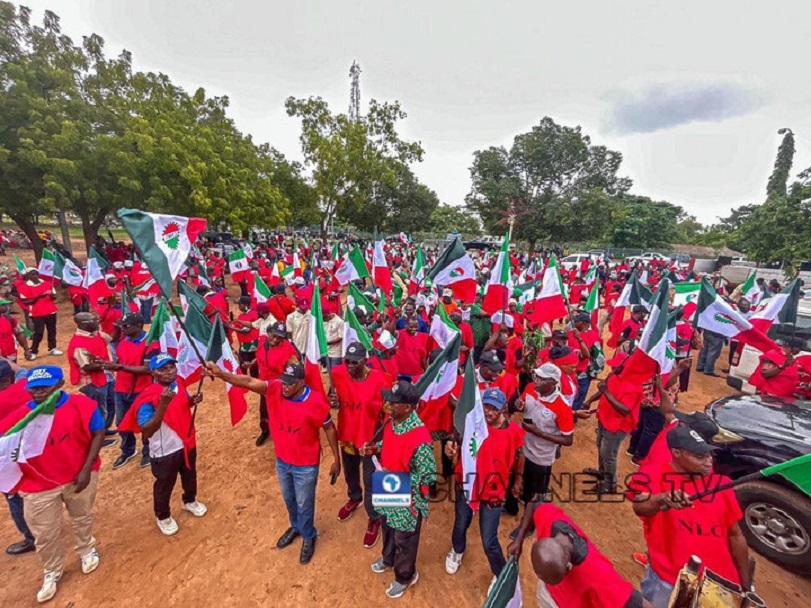
NLC protests in Abuja

By Adedapo Adesanya

Organised labour has suspended its nationwide protests, which commenced on Wednesday, August 2, 2023, to register its grievance against the policies of President Bola Tinubu.

The President of the Trade Union Congress (TUC), Mr Festus Osifo, confirmed the suspension of the action in an interview with Arise News on Thursday morning.

He said the leaders of the several labour unions, who had a meeting with Mr Tinubu on Wednesday night, were assured by the President that the issues raised would be addressed.

He explained the suspension of the demonstrations was based on the assurance by the Nigerian president.

Adedapo Adesanya is a journalist, polymath, and connoisseur of everything art. When he is not writing, he has his nose buried in one of the many books or articles he has bookmarked or simply listening to good music with a bottle of beer or wine. He supports the greatest club in the world, Manchester United F.C.

1 Comment

1 Comment

  1. Pingback: Organised Labour Suspends Nationwide Protests - Bank of Africa
Leave a Reply

Your email address will not be published. Required fields are marked *

General

House of Reps Directs IGP Disu to Produce PFIPC DG Adeyemi

Published

on

PFIPC DG Adeyemi

By Adedapo Adesanya

The House of Representatives Ad-hoc Committee probing the Presidential Foreign Intervention Promotion Council (PFIPC) has ordered the Inspector-General of Police (IGP), Mr Olatunji Disu, to ensure the appearance of the agency’s alleged Director-General, Mr Adeniyi Adeyemi, before the panel on July 29, 2026.

Mr Adeyemi was recently arrested after a court directed the police to do so.

The lawmakers’ call came on Monday just as the Accountant General of the Federation, Mr Shamseldeen Ogunjimi, said that his office declined a request by the PFIPC to open a Treasury Single Account (TSA), insisting that due diligence had not been completed.

Mr Ogunjimi, who spoke when he appeared before the House of Representatives ad hoc committee, explained that though the council requested the opening of a TSA account, his office declined the request pending compliance with established due diligence requirements.

The PFIPC controversy began after the self-acclaimed director-general of the disputed agency, Mr Adeyemi, alleged during a presser that the Chief of Staff to the President, Mr Femi Gbajabiamila, demanded 48 per cent from its N27.3 billion take-off grant.

Mr Adeyemi had also alleged that the Chief of Staff received N400 million through a proxy and requested an additional N200 million to facilitate presidential approvals.

However, Mr Gbajabiamila denied the allegations in a statement on oath, maintaining that he had no personal, official or professional relationship with Mr Adeyemi. He also denied demanding or receiving any money, abusing his office or interfering with law enforcement agencies.

The Chief of Staff further denied any involvement in the alleged death of Mr Babatunde Tanimola, whom Mr Adeyemi claimed acted as an intermediary, as well as allegations linking him to an alleged assassination attempt on the defendant or interference with investigations by security agencies.

Following the allegations, President Bola Tinubu directed the ICPC to investigate the matter.

Also, Mr Gbajabiamila instituted a N15 billion defamation suit against the disputed DG at the High Court of the Federal Capital Territory (FCT), Abuja.

In the suit, he sought N10 billion in general damages, N5 billion in aggravated damages, N200 million as the cost of the action, and an order directing Mr Adeyemi to publish a retraction and apology in five national newspapers and across all social media platforms where the alleged defamatory statements were published.

Following the outrage generated by the issue, the House of Representatives inaugurated a 12-member ad hoc committee to investigate the circumstances surrounding the establishment of the disputed agency and the process through which it was included in the 2026 budget.

The committee is also investigating the alleged allocation of N1.3 billion to the agency in the 2026 Appropriation Act.

The committee is chaired by Yusuf Gagdi, who assured Nigerians that the panel would conduct a thorough and impartial investigation.

Last week, the ICPC confirmed that it questioned Mr Gbajabiamila over the disputed PFIPC, but didn’t give further details on its next step.

During her appearance, the Head of the Civil Service of the Federation, Mrs Esther Walson-Jack, said her office did not allocate office space at the Federal Secretariat in Abuja nor deploy staff to the PFIPC.

“The request for deployment of officers was received and noted for consideration. However, there was no deployment of officers by the Office of the Head of the Civil Service of the Federation to the council,” said Mr Walson-Jack.

The Head of Service also noted that “while there is speculation that the council occupied office space in the Federal Secretariat Phase Three,” her office could state categorically that it “did not allocate any office space to the PFIPC”.

Similarly, the Director-General of the Budget Office of the Federation, Mr Tanimu Yakubu, told the committee that no kobo appropriated for the disputed agency was spent.

Mr Yakubu maintained that while the National Assembly approved funds for the council, the statutory conditions required to release, pay, or spend the money were never met.

“The conclusion is firm. Not one kobo of the personnel provision could lawfully have been drawn, and not one kobo was drawn. The overhead provision never matured into a lawful cash release,” Yakubu said.

“The capital provision never matured into procurement or expenditure. The conditions required for spending were not met and were not close to being met. There is therefore no personnel expenditure to recover. The money never moved because the controls held.”

Continue Reading

General

Atiku Queries N5trn Domestic Borrowing Despite Oil Windfall

Published

on

atiku tinubu

By Adedapo Adesanya

Former Vice President and presidential candidate of the African Democratic Congress (ADC), Mr Atiku Abubakar, has criticised President Bola Tinubu’s continued reliance on domestic borrowing, despite the windfall reportedly made when oil prices surged following the US-Iran war.

Mr Abubakar, in a statement issued on Monday by his Senior Special Assistant on Public Communication, Mr Phrank Shaibu, described the federal government’s fiscal approach as inconsistent, lacking transparency and failing to demonstrate prudent financial management.

He questioned the rationale behind accumulating fresh debt despite what he described as a significant revenue boost from high global crude oil prices.

Mr Abubakar claimed that the Mr Tinubu-led administration has raised approximately N5 trillion from the domestic bond market during the first half of 2026, representing nearly 80 per cent of the amount borrowed within the same period in 2025.

This is even as he argued that such borrowing would ordinarily be justified only if government revenues had fallen sharply.

“The exact opposite is the case,” he said.

He noted that the 2026 national budget was based on a crude oil benchmark of $64.84 per barrel, while Brent crude averaged about $92 per barrel between March 1 and July 14. He added that Nigerian crude traditionally sells at a premium above Brent prices.

The former vice president said the difference between the budget benchmark and prevailing market prices translated into substantial additional revenue for the country.

“This naturally raises two unavoidable questions. First, why is a government enjoying such an extraordinary oil windfall borrowing at almost twice last year’s pace as though the nation were in financial distress? Second, where is the money?” he queried.

He estimated that the price differential generated an additional $27.15 per barrel, amounting to roughly $42.7 million in extra daily earnings based on an average production of 1.5 million barrels per day.

Over 135 days, Mr Abubakar said the excess revenue amounted to approximately $5.76 billion, equivalent to about N7.98 trillion.

He recalled that previous administrations maintained formal structures, including the Sovereign Wealth Fund and other fiscal buffers, to manage excess crude earnings and ensure accountability.

The ADC presidential candidate also expressed concern that despite increased oil revenues and the removal of fuel subsidy, many Nigerians continue to experience worsening economic hardship.

He cited recent United Nations findings indicating that nearly 80 per cent of Nigerians are unable to afford a decent daily meal, while infrastructure deficits persist despite government assurances that subsidy savings would be invested in critical sectors such as healthcare, education and road infrastructure.

The former VP said an ADC-led administration would adopt a rules-based fiscal framework to ensure transparency in the management of revenues earned above the budget oil benchmark.

He said surplus earnings would be channelled towards reducing public debt, strengthening fiscal reserves and financing investments in infrastructure, education, healthcare and agriculture.

“Nigerians deserve answers. They deserve accountability. Above all, they deserve a government that manages national wealth in the public interest, not one that presides over unprecedented opacity while asking future generations to repay debts incurred in the midst of plenty,” he said.

Mr Abubakar also argued that the Tinubu administration had recently embraced a power sector strategy he first advocated more than two decades ago.

He said comments by the Minister of Power acknowledging that Nigeria could no longer rely solely on large, centralised power plants amounted to an endorsement of his long-standing position on decentralised electricity generation.

“It should not take a government three years in office to discover what was obvious more than two decades ago,” Atiku said.

He criticised the administration for increasing electricity tariffs before implementing reforms capable of improving power supply.

“A government that thinks before it acts would have fixed the system before asking citizens to pay more. Unfortunately, this administration has done the exact opposite, raising tariffs first and only now beginning to think about the reforms required to justify those increases,” he said.

The politician recalled that while serving under former President Olusegun Obasanjo, he consistently advocated decentralising electricity generation by harnessing multiple energy sources, including hydroelectric power, natural gas and solar energy.

“This has been my position for over two decades. When President Obasanjo established the Power Sector Reform Committee based primarily on gas-fired generation, I was appointed chairman.

“However, because I fundamentally disagreed with the policy direction, I declined to preside over the committee. I believed then, as I do now, that Nigeria’s electricity future lay in a diversified and decentralised energy mix, not an overdependence on a single source.”

“Nigeria does not suffer from a shortage of ideas. It suffers from a shortage of leaders willing to act on the right ideas at the right time.

“It is never too late to embrace the right policy, but Nigerians should never have had to pay the price for a government that spent three years learning what should have guided its actions from day one,” he added.

Continue Reading

General

FG Rules Out Immediate Electricity Tariff Hike

Published

on

electricity tariff

By Adedapo Adesanya

Millions of electricity consumers across Nigeria will not face higher power bills for now, as the federal government has assured citizens that there are no immediate plans to increase electricity tariffs, dismissing reports of an impending hike across different service bands.

The Special Adviser to the President on Power Infrastructure, Mr Sadiq Wanka, made the disclosure amid growing public concern over the cost of electricity and media reports of his recent remarks.

Mr Wanka said his comments had been taken out of context, stressing that the federal government remains committed to shielding vulnerable electricity consumers from additional financial pressure.

“There is no planned tariff hike for any grid consumer across any service band. The government remains committed to protecting vulnerable households through continued tariff support,” he stated.

According to Mr Wanka, the remarks that generated public debate were made during his presentation at the Asharami Square 3.0 conference held in Lagos on July 22, where discussions centred on investment opportunities in Nigeria’s electricity sector and ongoing reforms designed to attract private capital.

He explained that his presentation focused on how the federal government’s power sector reforms are creating new opportunities for investors across electricity generation, transmission and distribution, rather than announcing any immediate changes to electricity pricing.

“The Special Adviser’s comments were made during a presentation where he addressed investment opportunities in the power sector and how the Federal Government’s reform programme has opened new avenues for investors across the power value chain,” the statement published on his official X account noted.

Mr Wanka reiterated that the government’s long-term electricity pricing framework remains anchored on the National Integrated Electricity Policy (NIEP), which was completed in December 2024 and approved by the Federal Executive Council (FEC) in May 2025.

He explained that the policy supports a gradual transition towards cost-reflective electricity tariffs, a process that has already been implemented for Band A customers, who receive a minimum of 20 hours of electricity supply daily.

However, he emphasised that the policy does not translate into an immediate tariff increase for other categories of electricity consumers.

“In that context, he reaffirmed the tariff policy direction set out in the National Integrated Electricity Policy a long-standing, publicly available policy of gradually transitioning to cost-reflective tariffs already implemented for Band A electricity consumers,” the statement added.

The presidential aide stressed that electricity subsidies would remain in place for consumers outside Band A, contrary to widespread speculation.

“For all other consumer bands, he was clear that there is no plan to remove subsidies. Rather, the Government is exploring how to deliver value and support more efficiently,” the statement said.

As part of that strategy, Mr Wanka highlighted the proposed Power Consumer Assistance Fund (PCAF), established under the Electricity Act 2023, describing it as a more transparent mechanism for delivering targeted subsidies to vulnerable electricity users.

According to him, the fund is expected to channel government support directly into consumers’ electricity accounts or through identity-linked payment platforms, ensuring that subsidies reach intended beneficiaries while improving accountability and boosting investor confidence in the power sector.

Continue Reading