

Connect with us

General

Vessel Carrying Stolen Crude Intercepted in Delta

Published

on

stolen crude oil

By Adedapo Adesanya

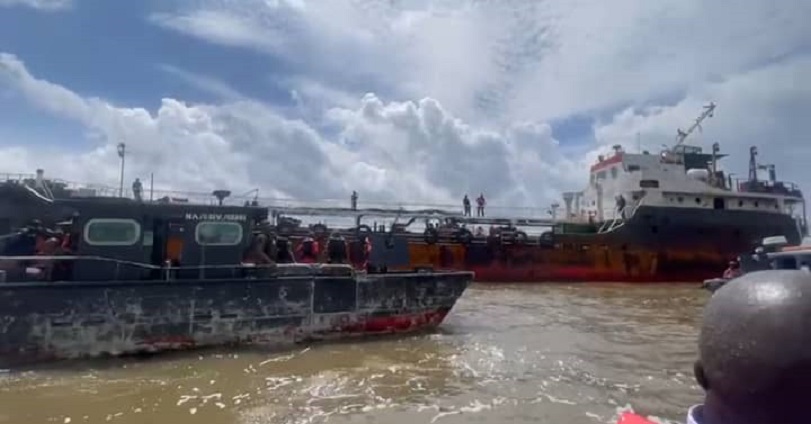
Tanita Security Services, a Nigerian government-approved outfit, has intercepted a vessel allegedly carrying crude oil suspected to have been stolen in the Koko area of Delta State.

The interception happened on Wednesday while the 1117 tons vessel carrying about 8,100 barrels of crude was being escorted by some naval officers.

Tanita Security outfit is a private security company owned by Mr Government Ekpemupolo, popularly called Tompolo, an ex-Niger Delta agitator who recently got a contract from the federal government to protect oil pipelines.

Operatives of the Tanita Security say the vessel, tagged MT Praisel, was flying a Togolese flag and was being escorted by a Navy boat led by a senior naval commander.

The Tanita operatives said they were met with resistance from the navy boat escorting the vessel and that the naval commander threatened to deal decisively with them.

However, the private operatives said it stood its ground and refused to back down.

But they eventually contacted the National Security Adviser, Mr Nuhu Ribadu and the Chief of Naval Staff, Rear Admiral Emmanuel Ogalla, who authorised them to inspect the vessel.

Upon entrance into the ship, the security company says they noticed that the vessel was authorised to carry products by the navy but did not have any approvals from Nigerian Midstream and Downstream Petroleum Regulatory Authority (NMDPRA), the authority responsible for the regulation of the midstream and downstream petroleum operations in Nigeria, for this said voyage.

The incident comes on the heels of the outcry by the federal government that the illegal trade of stolen crude oil inflicts significant economic losses on Nigeria to the tune of N2.3 trillion in 12 months.

It is a loss experts say could impact up to 25 per cent of the nation’s crude oil production. The recent removal of the petrol subsidy has caused nationwide demonstrations by workers’ unions.

Nigeria’s crude production had hit less than 1 million barrels per day earlier this year from challenges ranging from insecurity, low investment, and de-prioritisation of funding of hydrocarbon development arising from the energy transition.

Currently, Nigeria has the technical allowable capacity to produce about 2.5 million barrels of oil per day, but these challenges put the country’s output at around 1.5 million barrels of oil and condensate per day.

Adedapo Adesanya is a journalist, polymath, and connoisseur of everything art. When he is not writing, he has his nose buried in one of the many books or articles he has bookmarked or simply listening to good music with a bottle of beer or wine. He supports the greatest club in the world, Manchester United F.C.

1 Comment

1 Comment

  1. Pingback: Vessel Carrying Stolen Crude Intercepted in Delta - Bank of Africa
Leave a Reply

Your email address will not be published. Required fields are marked *

General

Governors Reaffirm Support For State Police, Electricity Reforms

Published

on

governors forum

By Adedapo Adesanya

State governors have restated their commitment to the establishment of state police and reforms in the electricity sector.

The agreement was reached in a communiqué issued at the end of the 2nd meeting of the Nigerian Governors’ Forum on Wednesday.

During the meeting, the governors deliberated issues affecting the country, noting a dedicated consultation with the Attorneys-General to review the proposed constitutional amendments and frameworks for their decision.

“Governors emphasised the need for the State Police to be constitutionally sound and aligned with federalism and citizens’ rights.

“The Forum noted the collaborative effort and added that the consultation outcomes would strengthen the States’ collective position”, the statement said in part.

The group also received a presentation from the Federal Ministry of Budget and Economic Planning on progress under the National Nutrition 774 (N-774) Initiative.

It reaffirmed the governors’ commitment to improving nutrition outcomes and reducing child malnutrition across Nigeria.

According to the statement, the governors noted the ongoing work on the National Nutrition Bill and encouraged continued engagement with relevant stakeholders to strengthen the legal and policy framework for nutrition governance.

The forum also received a briefing from the World Bank Country Office on the proposed Country Partnership Framework (CPF) for Nigeria covering the period FY2026–2032; the proposed Nigeria Sustainable Agricultural Value-Chains for Growth (AGROW) Programme, a results-based initiative designed to improve agricultural productivity, strengthen value chains, increase private sector participation, enhance food security, and Early Childhood Development (ECD).

The forum supported ongoing collaboration with the Federal Government, the World Bank, and other stakeholders to ensure successful implementation and deliver benefits to participating states.

They approved state-specific interventions and stressed the importance of better coordination across sectors like health, nutrition, education, water and sanitation, social protection, and family support.

On the National Solar Super-Grid (NSSG) Initiative, a proposal to expand electricity access through large-scale decentralised solar generation integrated with a national high-voltage transmission network, it noted the initiative’s potential to support industrialisation, improve energy security, strengthen state electricity markets, and accelerate economic growth.

The governors reiterated their commitment to ongoing power sector reforms and to strengthening collaboration among stakeholders to expand access to reliable and affordable electricity for Nigerians.

Continue Reading

General

London Jury Clears Diezani Alison-Madueke of Bribery Charges

Published

on

Diezani Allison-Madueke

By Adedapo Adesanya

Former Nigerian Minister of Petroleum Resources, Mrs Diezani Alison-Madueke, was on Wednesday found not guilty ​by a London jury of six bribery charges, after ‌five months of trial.

Mrs Alison-Madueke, an oil minister between 2010 and 2015 under then-president Goodluck Jonathan, stood trial ​charged with five counts of accepting bribes and a ​charge of conspiracy to commit bribery, which she denied.

Prosecutors ⁠alleged that the 65-year-old Mrs Alison-Madueke was given “a life of luxury” in London ​from oil and gas industry figures seeking lucrative contracts in Nigeria, ​which has long grappled with mismanagement and corruption.

The jury deliberated for more than 46 hours before reaching its verdict.

Mrs Alison-Madueke was charged by the UK’s National Crime Agency in 2023 over allegations she took £100,000 in cash as well as accepting flights on private jets, chauffeur-driven cars and luxury goods from Louis Vuitton and Harrods.

Other counts allege she received school fees for her son, products from high-end shops such as London’s Harrods department store and Louis Vuitton, and further private jet flights.

Mrs Alison-Madueke has been involved in numerous legal cases globally, including in the United States.

She has been on bail in Britain since she was arrested in October 2015.

In 2023, she was formally charged with accepting bribes, which she has denied.

Mrs Alison-Madueke stood trial alongside oil industry executive, Mrs Olatimbo Ayinde, 54, who was ​charged with one count of bribery relating to ​Alison-Madueke ⁠and a separate count of bribery of a foreign public official.

Also, her elder brother, Mr Doye Agama, 69, was charged with conspiracy to commit bribery ⁠with ​his sister relating to payments made to ​his church.

Both Mrs Ayinde and Mr Agama denied the charges against them and were also ​acquitted by the jury.

Continue Reading

General

Senate Committee Clears Customs of Unremitted N62.2bn Allegations

Published

on

Nigeria customs wale adeniyi

By Adedapo Adesanya

The Senate Committee on Public Accounts has cleared the Nigeria Customs Service (NCS) of allegations that it failed to remit N62.2 billion into the Federation Account, as contained in the 2019 Audit Report of the Office of the Auditor-General of the Federation.

The committee reached the decision on Tuesday during an investigative session with the Comptroller-General of Customs, Mr Adewale Adeniyi, over 77 audit queries raised against the agency in the 2019 and 2020 audit reports.

The committee, however, resolved to establish an ad hoc reconciliation panel to review the remaining 76 audit queries and report for further consideration.

At the hearing, representatives of the Auditor-General’s office informed lawmakers that while the Customs Service generated more than N691 billion in revenue in 2017, only about N629 billion was remitted to the Federation Account, leaving an outstanding balance of N62.2 billion.

Responding, the Customs CG explained that the amount in question consisted of levies collected on behalf of other government agencies and was therefore not meant for remittance into the Federation Account.

According to him, the figure was wrongly classified as under-remittance in the audit report.

Mr Adeniyi stated that while some levies collected by Customs are paid into the Federation Account, others, including certain levies on local production of wheat, textiles and wines, are designated for separate accounts.

He maintained that the disputed N62.2 billion fell into that category and should not have been recorded as unremitted revenue.

The Customs boss also provided explanations on the second and third audit queries, which members of the committee described as satisfactory.

Some lawmakers questioned why the issues had progressed to a Senate investigation, arguing that they should have been resolved during routine reconciliation between Customs officials and auditors.

In his response, Mr Adeniyi noted that the audit years under review coincided with a period of strained relations between the National Assembly and the Customs Service.

The reconciliation committee is expected to work with Customs officials and auditors to resolve discrepancies in the remaining audit queries before further legislative action is taken.

Continue Reading

Trending

