Connect with us

Economy

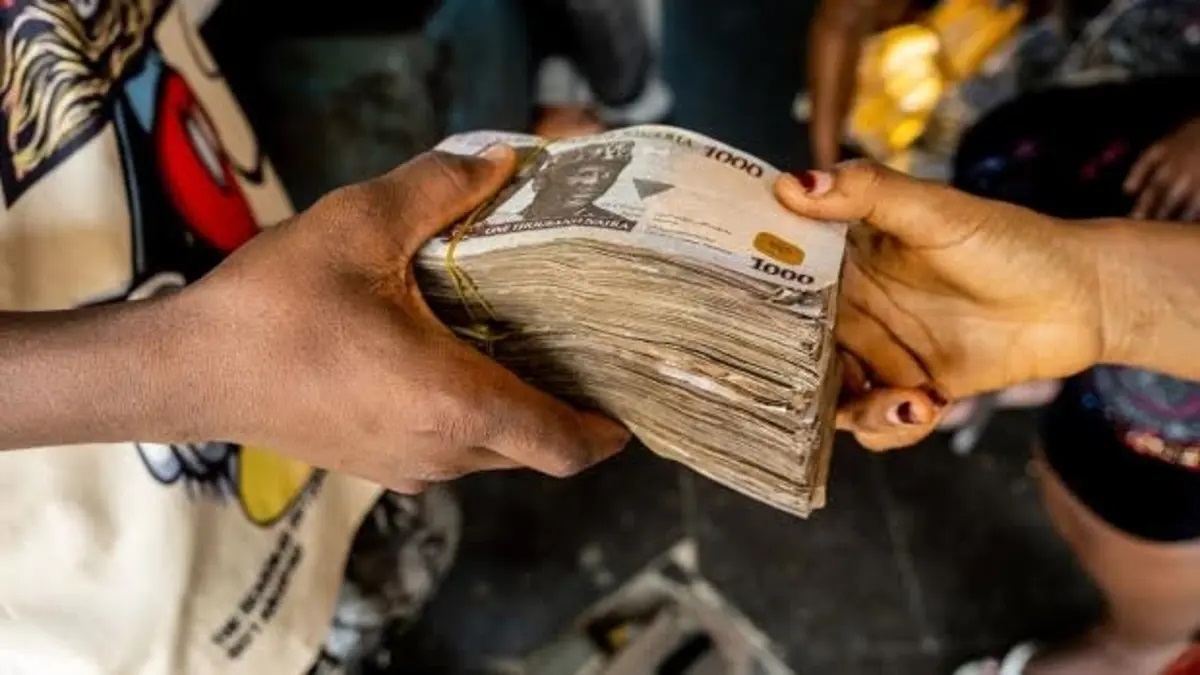
Naira Firms at Official Market, Slacks at Parallel Market

Published

on

print Naira massively

By Adedapo Adesanya

The Naira had a mixed outcome against the US Dollar at the different segments of the foreign exchange (forex) market on Thursday, as the market got a breather following the conclusion of a tribunal that affirmed that President Bola Tinubu was the winner of the 2023 general election, throwing out petitions from the Peoples Democratic Party (PDP) and the Labour Party (LP).

In the Investors and Exporters (I&E)  window, the Nigerian currency gained weight, but in the black market and the Peer-to-Peer (P2P) segments, its value depreciated.

Analysis showed that in the official market, the local currency appreciated against the greenback during the session by 4.5 per cent or N34.97 to settle at N736.62/$1, in contrast to Wednesday’s exchange rate of N771.59/$1.

It was observed that the value of forex trades remained low as the turnover for the session marginally increased by 1.7 per cent or $1.13 million to $66.43 million from the $65.30 million reported in the midweek session.

However, in the parallel market, the Naira lost against the Dollar during the trading day by N4 to sell at N929/$1 compared with the previous day’s rate of N925/$1.

Also, in the P2P, the domestic currency depreciated against its American counterpart by N7 to sell at N933/$1 versus the previous day’s N926/$1.

In the spot market, the Nigerian currency traded flat against the British Pound Sterling and the Euro on Thursday at N986.79/£1 and N842.48/€1 apiece.

A look at the digital currency market showed that most of the coins were in green yesterday, with Bitcoin (BTC) jumping by 2.26 per cent to sell at $26,297.77 and Ethereum (ETH) rising by 1.3 per cent to $1,651.35.

Litecoin (LTC) grew by 2.2 per cent to trade at $63.98, Solana (SOL) jumped by 1.6 per cent to sell at $19.92, Binance Coin (BNB) improved by 1.1 per cent to $217.01, Ripple (XRP) rose by 0.7 per cent to trade at $0.5051, Cardano (ADA) appreciated by 0.6 per cent to $0.2586, Dogecoin (DOGE) expanded by 0.4 per cent to $0.0636, the US Dollar Tether (USDT) increased by 0.04 per cent to $0.9997, and Binance USD (BUSD) gained 0.03 per cent to close at $1.00.


Adedapo Adesanya is a journalist, polymath, and connoisseur of everything art. When he is not writing, he has his nose buried in one of the many books or articles he has bookmarked or simply listening to good music with a bottle of beer or wine. He supports the greatest club in the world, Manchester United F.C.

Economy

Dangote Cement Assures African Consumers Sufficient Supply With 90MT Yearly

Published

on

Dangote Cement final dividend

By Aduragbemi Omiyale

Leading cement maker, Dangote Cement Plc, has reaffirmed its commitment to making Africa fully self‑sufficient in cement production by raising its output to 90 million metric tonnes per annum by 2030 from the current 52 million metric tonnes per annum.

The chief executive of the firm, Mr Arvind Pathak, during a strategic briefing on the company’s expansion drive, disclosed that efforts are being made to accelerate investments across African markets to close supply gaps and support the continent’s infrastructural ambitions.

According to him, the organisation is strengthening the continent’s industrial backbone and reducing reliance on imported construction materials, stressing that, “Our vision is clear — to ensure Africa produces enough cement to meet its own needs…Through continuous expansion, operational excellence, and a strong distribution network, we are positioning Dangote Cement to power growth across the continent. We are not just building a business; we are building Africa’s future.”

“Through our collective determination, we have eliminated Nigeria’s dependence on imported cement and transformed the country into a net exporter of cement to several neighbouring nations,” Mr Pathak added.

Dangote Cement currently operates in multiple African countries, with integrated plants, grinding facilities, and distribution hubs strategically located to serve diverse markets.

The company’s ongoing projects include plant upgrades, capacity expansions, and the introduction of advanced energy‑efficient technologies designed to reduce operational costs and carbon footprint.

Reinforcing the company’s long-term vision, its founder, Mr Aliko Dangote, described self-sufficiency as both an economic imperative and a continental responsibility.

“Africa has no reason to depend on cement imports. We have the raw materials, the talent, and the determination. Our goal at Dangote Cement is to unlock Africa’s potential by ensuring that every nation on this continent can access affordable, high‑quality cement produced within Africa. This is how we build prosperity, job opportunities, and sustainable development,” the businessman stated.

Mr Dangote added that the company’s investments reflect its passion for unlocking continental competitiveness and fostering industrialisation across Africa.

With major infrastructural projects rising across African cities — from highways and bridges to housing developments — the demand for cement continues to grow. Dangote Cement’s renewed push toward continental self‑sufficiency is expected to address supply challenges, stabilise prices, and enhance construction reliability in the years ahead.

Continue Reading

Economy

NASD OTC Bourse Appreciates Further by 0.46%

Published

on

NASD OTC market

By Adedapo Adesanya

The NASD Over-the-Counter (OTC) Securities Exchange appreciated by 0.46 per cent on Friday, February 6, with the market capitalisation expanding by N10.2 billion to N2.207 trillion from the N2.197 trillion quoted in the previous session, while the NASD Unlisted Security Index (NSI) grew by 17.06 points to 3,689.72 points from the previous session’s 3,672.66 points.

The expansion was buoyed by the price appreciation recorded by two securities, which overpowered the declines recorded by four securities.

Central Securities Clearing System (CSCS) increased its value during the session by N4.83 to N53.50 per unit from N48.67 per unit, and IPWA Plc gained 19 Kobo to sell at N2.36 per share versus Thursday’s closing price of N2.17 per share.

On the flip side, Okitipupa Plc lost N10.77 to trade at N220.00 per unit compared with the previous price of N230.77 per unit, FrieslandCampina Wamco Nigeria Plc depreciated by N3.10 to N60.00 per share from N63.10 per share, Geo-Fluids Plc shed 45 Kobo to close at N4.30 per unit versus N4.75 per unit, and Industrial and General Insurance (IGI) weakened by 5 Kobo to 54 Kobo per share from 59 Kobo per share.

A look at the trading data showed that there was a 67.9 per cent drop in the volume of trades to 384,784 units from 1.2 million units, but the value of transactions went up by 33.5 per cent to N16.1 million from N12.0 million, and the number of deals increased by 4.4 per cent to 24 deals from 23 deals.

CSCS Plc ended the day as the most traded stock by value on a year-to-date basis with 16.3 million units exchanged for N667.6 million, followed by FrieslandCampina Wamco Nigeria Plc with 1.8 million units sold for N117.9 million, and Geo-Fluids Plc with 12.4 million units worth N79.5 million.

CSCS Plc also closed the session as the most active stock by volume on a year-to-date basis with 16.3 million units valued at N667.6 million, followed by Mass Telecom Innovation Plc with 13.7 million units worth N5.5 million, and Geo-Fluids Plc with 12.3 million units traded for N79.5 million.

Continue Reading

Economy

CAC Deregisters 400,000 Inactive Businesses in 2025

Published

on

CAC

By Adedapo Adesanya

The Corporate Affairs Commission (CAC) has deregistered more than 400,000 inactive companies from the corporate registry in 2025 as part of reforms aimed at strengthening transparency, protecting the economy and restoring investor confidence.

The Registrar-General of the CAC, Mr Hussaini Magaji, disclosed this on Saturday in Abuja during the commission’s monthly fitness walk, which was organised as part of the activities marking its 35th anniversary.

Mr Magaji said the affected entities were largely companies that had failed to file statutory annual returns for years and were no longer operational, warning that such firms posed serious risks to economic integrity.

He said, “In 2025 alone, we deregistered over 400,000 companies from our records. These were largely companies that had become inactive and failed to meet statutory obligations, including filing annual returns.

“Such entities pose threats to economic operations. Cleaning up the register was necessary to build confidence and ensure that Nigeria has a credible and reliable corporate registry,” he stated.

Mr Magaji explained that a transparent and up-to-date register was critical to attracting both local and foreign investment, as well as preventing the misuse of corporate structures for illicit activities.

The CAC boss described the anniversary fitness walk as symbolic, noting that it reflected the commission’s resilience, teamwork and institutional evolution since its establishment in 1991.

He recalled that the commission began operations as a largely manual agency, once confined to a single office in Garki, Abuja, but has since evolved into a fully digital, end-to-end service provider with global reach.

“The CAC has come a long way, from manual operations in one location to a fully digital organisation. Today, our services are available anywhere, anytime, 24/7. We are the only government agency providing end-to-end digital services,” he stated.

According to him, the commission’s digital transformation has significantly supported the Federal Government’s ease-of-doing-business reforms, eliminating the need for physical visits to CAC offices to register or manage businesses.

“You can register and manage your business from your room without stepping into any CAC office. That is what ease of doing business truly means,” he added.

As part of its support for small businesses, Mr Magaji disclosed that the commission partnered with the Small and Medium Enterprises Development Agency of Nigeria to facilitate the free registration of 250,000 MSMEs in 2025.

He explained that the registrations were deliberately channelled through SMEDAN to ensure beneficiaries also received training and capacity-building support, adding that improved welfare, timely payment of entitlements and clear career progression had boosted staff morale and service delivery.

Continue Reading

Trending