Connect with us

Banking

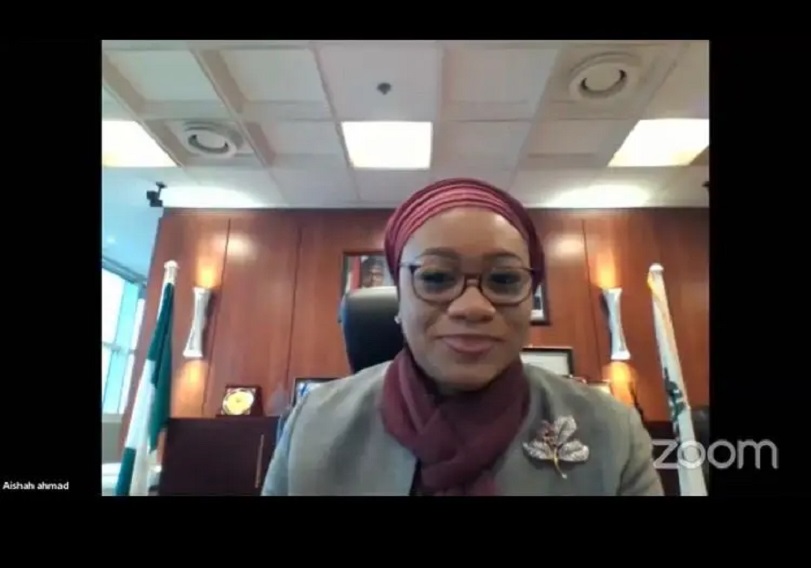
DSS Grills CBN Deputy Governor Aishah Ahmad

Published

on

Aishah Ahmad CBN

By Dipo Olowookere

The Deputy Governor of the Central Bank of Nigeria (CBN) in charge of Financial System Stability, Mrs Aishah Ahmad, has been apprehended by the Department of State Services (DSS).

The central banker was arrested by the country’s secret police to harvest vital information from her over the sale of a first-generation bank, Union Bank of Nigeria Plc, to a relatively new lender, Titan Trust Bank Limited.

The acquisition of the more than 100-year-old financial institution by the less than 5-year-old bank raised eyebrows because the buyer coughed out $300 million to complete the transaction.

Titan Trust Bank is chaired by a veteran banker and former deputy governor of the CBN, Mr Tunde Lemo, and the acquisition came after the likes of Access Bank Plc and Zenith Bank Plc had been previously linked with the transaction, though both denied it.

In June 2022, it emerged that Titan Trust Bank got a $300 million loan from African Export-Import Bank (Afreximbank) through PAC Capital Limited, the investment banking arm of PanAfrican Capital Holdings, to complete the acquisition.

The DSS seems to be interested in how this process went and it is interrogating Mrs Ahmad to get to the root of the matter.

In a post on X, formerly known as Twitter, NTA claimed the intelligence gathering agency detained the Deputy CBN chief to also extract details concerning Polaris Bank, especially its sale to Strategic Capital Investment Limited (SCIL).

Polaris Bank was established after the apex bank revoked the operating licence of Skye Bank Plc in 2018, and in 2022, it sold the lender to SCIL. This deal generated controversy over the value. It was alleged that it was disposed of at a very cheap price of N50 billion despite the CBN injecting over N1 trillion to save the bank from collapse.

The Union Bank and Polaris Bank sales happened under the leadership of the suspended CBN Governor, Mr Godwin Emefiele, who is currently in the custody of the DSS. Mr Emefiele was asked to stay away from his position in June by President Bola Tinubu and was arrested a few days later.

Last week, it was reported that another Deputy Governor of the CBN in charge of Economic Policy, Mr Kingsley Obiora, was being questioned by the agency.

Mrs Ahmad, who joined the central bank in October 2017 to replace Mrs Sarah Alade, who retired in March 2017, is the latest to be quizzed by the DSS. She was formerly with the defunct Diamond Bank Plc.


Dipo Olowookere is a journalist based in Nigeria that has passion for reporting business news stories. At his leisure time, he watches football and supports 3SC of Ibadan. Mr Olowookere can be reached via [email protected]

Advertisement
Click to comment

Leave a Reply

Your email address will not be published. Required fields are marked *

Banking

Ecobank Nigeria Introduces Business App for SMEs to Accelerate Growth

Published

on

ecobank Business App

By Dipo Olowookere

A new digital banking platform created to help business owners in the country to eliminate delays, queues, and operational inefficiencies has been introduced by Ecobank Nigeria.

This mobile application is to strengthen the growth and sustainability of Small and Medium Enterprises (SMEs) across Nigeria, allowing them to manage payments, monitor transactions, oversee cash flow, and run day‑to‑day financial operations directly from their mobile devices.

The Ecobank Business app, now available on the Google Play Store and Apple App Store, cements the bank’s position as a dependable growth partner to SMEs across all sectors, delivering tools that help businesses manage better, grow faster, and operate more competitively in a digital economy. – Ecobank Business — Your Growth Partner.

The introduction of this initiative further reinforces Ecobank’s broader commitment to empowering SMEs through digital innovation, sector‑specific value propositions, and financial solutions like structured loans, trade support, guarantees, and equipment financing.

It also aligns with the lender’s push to re-energise dormant SME accounts, deepen market penetration, promote digital adoption, and scale value‑chain financing through partnerships with corporate anchors.

According to the Executive Director for Consumer and Commercial Bank at Ecobank Nigeria, Mr Kola Adeleke, the Ecobank Business App was developed to address the unique challenges faced by Nigeria’s diverse SME landscape.

Speaking at the unveiling in Lagos, he explained that the platform caters to traders, retailers, tech start-ups, online businesses, hospitality operators, farmers, agro‑processors, manufacturers, construction firms, professionals, social commerce entrepreneurs, schools, associations, and organisations that require transparent and efficient financial management.

Mr Adeleke noted that the app delivers faster payment collection for merchants and retailers, seamless digital transactions for online businesses, efficient vendor and staff management for hospitality players, timely payment solutions for agriculture value chains, and secure handling of bulk and high‑value transactions for manufacturers and construction firms.

He added that professionals such as lawyers and consultants can issue invoices and receive payments easily, while schools and associations can streamline fees, dues, and reporting from a single platform.

Continue Reading

Banking

CBN Approves BDCs Participation in FX Market, Caps Sale at $150,000 Weekly

Published

on

street FX traders

By Adedapo Adesanya

The Central Bank of Nigeria (CBN) has approved weekly foreign exchange (FX) purchases for Bureaux de Change (BDC) operators, with a cap of $150,000, as part of efforts to improve foreign exchange liquidity in the retail segment of the market and meet the legitimate needs of end users.

This comes as the apex bank once again approved the participation of licensed BDCs in the Nigerian Foreign Exchange Market (NFEM), noting that utilisation complies with existing BDC operational guidelines.

Under the new directive contained in a circular signed by the Director of the Trade and Exchange Department, Mr Musa Nakorji, all BDCs duly licensed by the CBN are permitted to access foreign exchange through any Authorised Dealer Bank of their choice, at the prevailing market rates.

The move, according to the circular, aims to deepen market efficiency and ensure broader access to foreign exchange across the economy.

The central bank, however, imposed strict compliance and risk-management conditions on the transactions. Authorised dealers are required to conduct full Know-Your-Customer (KYC) and due diligence checks on BDC clients before any FX sale.

To strengthen transparency and accountability, the CBN directed that all licensed BDCs must submit timely and accurate electronic returns in line with extant regulations. Any unutilised foreign exchange must be sold back to the market within 24 hours, as BDCs are prohibited from holding FX positions purchased from the NFEM.

The circular further restricts settlement practices, mandating that all FX transactions be conducted through settlement accounts with licensed financial institutions. Third-party transactions are prohibited, while cash settlement is limited to a maximum of 25 per cent of each transaction amount.

Overall, the directive reflects the CBN’s broader strategy to balance market access with strong regulatory oversight, ensuring liquidity in the foreign exchange market while safeguarding financial system integrity.

Recall that earlier this week, the Governor of the Central Bank of Nigeria (CBN), Mr Yemi Cardoso, explained that the central bank now allows the foreign exchange market to largely determine prices, while the bank steps in to buy foreign exchange when necessary.

The CBN boss said recent reforms have also made foreign exchange more accessible to ordinary Nigerians, especially those travelling abroad, while warning that Nigerians who are holding foreign currency without real need that such actions could lead to losses.

Continue Reading

Banking

Proposed Bidvest Bank Acquisition by Access Bank Hits Regulatory Brick Wall

Published

on

roosevelt ogbonna access bank

By Aduragbemi Omiyale

The proposed acquisition of South African financial institution, Bidvest Bank by a Nigerian lender, Access Bank Plc, has hit a brick wall.

Access Holdings Plc, the parent company of the Nigerian bank, had announced on December 12, 2024, its intention to completely takeover Bidvest Bank.

Talks regarding the 100 per cent stake acquisition began between the two banks and January 26, 2026, was fixed as the long-stop date by which all conditions required for the completion of the deal.

However, the day has come and gone with the conclusion of the transaction still hanging, according to Access Bank in a statement on Tuesday, February 10, 2026.

The company disclosed that certain conditions, including regulatory requirements, were not fully met as of the expiration of the long-stop date.

While Access Bank thanked the board and management of Bidvest for their patience and support throughout this process, it noted that the brick wall experienced in the transaction “reflects the complexities and extended timelines associated with multi-jurisdictional regulatory and transactional processes.”

However, the chief executive of Access Bank, Mr Roosevelt Ogbonna, said the organisation remains “constructively engaged with stakeholders on this transaction towards finding a potential path to closure.”

“This initial outcome does not diminish our confidence in South Africa’s financial ecosystem,” he declared, pointing out that the lender remains “focused on building Africa’s most respected financial institution, strengthening our trade finance capabilities and delivering long-term value to customers, partners and communities across all our markets.”

Continue Reading

Trending