World
Developing Far Eastern Region Russia’s Priority
By Kestér Kenn Klomegâh
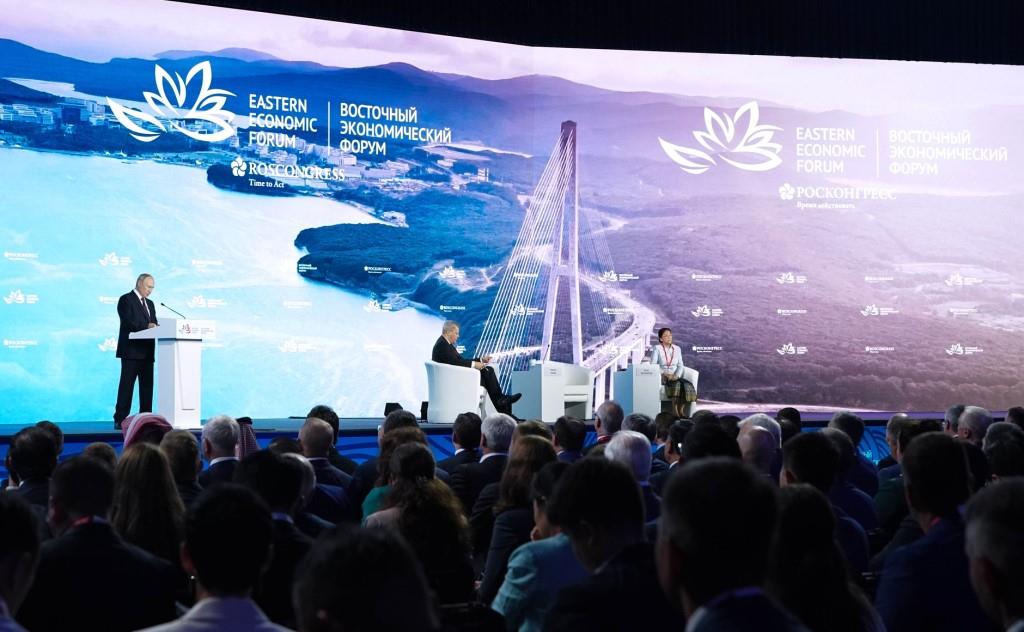
The Eastern Economic Forum (EEF) is held annually in cooperation with the Far East regional administration in the city of Vladivostok. Three years of COVID-19, followed by Russia’s ‘special military operation’ and the current geopolitical situation, have adversely affected this corporate business event, as Russia looks towards the East and makes the main focus on developing the Far East.
Russian President Vladimir Putin said at the opening session that the government would not allow the pace of development to slacken in the Russian Far East as it is a strategic region for the country. “We will definitely not be scaling down the pace of development in the region because the development of the Far East is an absolute priority for Russia, a direct priority for Russia as a whole for the entire 21st century, because it is a colossal region with a small population but huge potential. Of course, this is a strategic interest for the country,” the president said at the Eastern Economic Forum, which Vladivostok hosted on September 10-13.
Putin further pointed out that it is necessary “not only to hold on to this region but also to develop it and put its resources to work for the benefit of the state.” According to the president, “it is necessary to talk not only about the development of mineral resources in the Far East, it is necessary to build even more enterprises for the processing of industrial raw materials, so as to increase the added value.”
Putin later held a discussion with the Vice Premier of the State Council of the People’s Republic of China, Zhang Guoqing. Both noted that Russia-China relations in this area – the area of economic cooperation – have reached a very high level. This is a derivative of what has been achieved in the political sphere, but the results are excellent, as every year, trade grows by almost one-third. This year, over the first seven months, trade is up about the same amount, 24 per cent – to as much as 120 billion. The goal President Xi Jinping and Putin have set – to reach the $200 billion mark in trade – can be achieved by the end of 2023.
In addition to the above, Putin held a discussion with the Deputy Prime Minister of the Lao People’s Democratic Republic, Pany Yathotou, also on the sidelines of the Eastern Economic Forum. Russia and Laos have made significant contributions to the development of bilateral parliamentary relations.
Russian Deputy Prime Minister, Yury Trutnev, earlier reiterated that the forum has been the world’s leading platform for discussing economic and political issues. The largest delegations are from such countries as China, Myanmar, India, Mongolia and Laos. He also expressed confident that a large number of new investment agreements with foreign participation would become the outcome of the forum. The Far East region expects new projects, technologies and jobs; and also to strengthen the Far East’s position in the system of economic relations in Asia Pacific.
For the past few years, Western and European businesses have largely been missing in this forum. And those from Asia and the Pacific are getting fewer and fewer as opportunities seem monotonous and speeches have the same message relating to world geopolitics. Business people are really for business opportunities, not geopolitics. Business people are simply looking for unique products, services and profits.
Nevertheless, at the start of the forum, the photo exhibition Developing the Far East, organized by the Corporation for the Development of the Far East and the Arctic with the support of the Office of the Plenipotentiary Representative of the President of the Russian Federation in the Far Eastern Federal District and the Ministry for the Development of the Russian Far East, opened in the departure area of the domestic terminal.
The exposition presents a chronology of images: a decade during which unique conditions for business development were created in the Far East, more than 2.8 thousand investment projects were launched, about 700 of which have already been put into operation.
According to analysts interviewed by Russian media Izvestia, the forum’s agenda will be comprehensive, covering both domestic Russian and external economic issues. “This year, due to the greater focus on the East that has emerged in the country’s economy, the agenda for discussions are extensive, on both internal domestic and external issues,” according to Vladimir Klimanov, Associate Professor and Director of the Center for Regional Policy at the Russian Presidential Academy of National Economy and Public Administration (RANEPA) Institute of Applied Economic Research.
Anton Kobyakov, Adviser to the President of the Russian Federation and Executive Secretary of the EEF Organizing Committee, says participants have the chance to exchange experiences, and discuss networking practices at EEF events, including a plenary session, panel sessions, round tables, and business dialogues. The main theme of this year’s forum is “The Path to Partnership, Peace and Prosperity” fixed by the Roscongress Foundation. The Eastern Economic Forum was held on 10–13 September 2023 in Vladivostok on the campus of the Far Eastern Federal University.
World
Amid Rising Geopolitical Challenges India Prioritizing Global South Under its BRICS Leadership
By Kestér Kenn Klomegâh
By rotational procedures and consensus adopted in Brazil in December, India has taken over the BRICS+ presidency for 2026, underscoring its highly-enriching membership and gracious opportunity to deepen the intergovernmental association as a leading geopolitical force in the Global South. Brazil took over the BRICS presidency from Russia on January 1, 2025. Following its expansion, BRICS+ currently comprises ten countries: Brazil, China, Egypt, Ethiopia, India, Indonesia, Iran, Russia, South Africa and the United Arab Emirates.
Historically, its conceptual origins were articulated by Russian foreign minister Yevgeny Primakov in 1998, and can be traced to series of informal forums and dialogue groups such as RIC (Russia, India, and China) and IBSA (India, Brazil, and South Africa). In addition to that significant aspect of its history, BRIC was originally a term coined by British economist Jim O’Neill, and later championed by his employer Goldman Sachs in 2001, to designate a group of emerging markets.
The bloc’s inaugural summit was held in 2009 (Yekaterinburg summit) and featured the founding countries of Brazil, Russia, India, and China. These four founding members adopted the acronym BRIC and formed an informal diplomatic club where their governments could meet annually at formal summits and coordinate multilateral policies. The following year, South Africa officially became a member after it was formally invited and supported by China, and unreservedly backed by India and Russia.
South Africa joined the organization in September 2010, which was then renamed BRICS, and attended the third summit in 2011 as a full member. The biggest expansion witnessed Iran, Egypt, Ethiopia, and the United Arab Emirates attending the first summit as member states in 2024 in Kazan, the autonomous Republic of Tatarstan, part of the Russian Federation. Later on, Indonesia officially joined in early 2025, becoming the first Southeast Asian member. The acronym BRICS+ or BRICS Plus has been informally used to reflect new membership since 2024.
On 24 October 2024, an additional 13 countries, namely Algeria, Belarus, Bolivia, Cuba, Indonesia, Kazakhstan, Malaysia, Nigeria, Thailand, Turkey, Uganda, Uzbekistan and Vietnam, were invited to participate as “partner countries”. The partner status would allow these countries to engage with and benefit from BRICS initiatives. It is still unclear whether the countries in this tier have received official membership invitations. But there is the high possibility to ascend the association as full-fledged members in future.
Persistent Multiple Differences
Now as India takes on the helm of BRICS+, experts and research analysts are showing deep interest and are discussing possibilities of multilateral cooperation, existing challenges and identifying diverse priorities, the strength and weaknesses of BRICS+. On a more negative note, multiple contradictions keep piling up among the group, including questions about the future of BRICS as anything other than an ineffective growing talk-shop market.
The biggest obstacle being political divergencies and economic development perceptions. Cultures are distinctive different among the members of this informal BRICS+ association, while all are consistently advocating for wholesale reforms, especially of the United Nations Security Council, and multinational financial institution such as the World Bank (WB) and International Monetary Fund (IMF). Some the members have been adamant to undertake internal reforms at their own state institutions.
As a founding member of BRICS, India plans to find a more suitable path for balancing its non-aligned policy, forge new directions for the development of the Global South under its BRICS+ presidency, while emphasizing trends on the global economic landscape. Arguably, India will definitely act with precision. India is most likely to be non-critical, and moreso with an insight understanding that, not antagonism, but rather ‘cooperation’ must be the underlying basic principle of a multipolar environment.
India’s Rotating BRICS Presidency
Leaders’ meetings (or leaders’ summits) are held once a year on a rotating basis. BRICS has neither a permanent seat nor secretariat. A number of ministerial meetings, for example, between foreign ministers, finance ministers, central bank governors, trade ministers and energy ministers in the country which is presiding BRICS+ association.
Speaking at the BRICS summit back in 2014, Prime Minister Narendra Modi has assertively said that “reform of institutions of global governance … has been on the BRICS agenda since its inception.”
Later, prior to the Kazan summit, Prime Minister Modi explicitly stated that BRICS was never meant to be against anyone or be anti-western, and that it is only non-western. At the Kazan summit, Prime Minister Modi further stated: “We must be careful to ensure that this organization does not acquire the image of one that is trying to replace global institutions”.
At the 17th BRICS Summit held in Rio de Janeiro on 7 July 2025, Prime Minister Modi stated that India would give a “new form” to the BRICS grouping during its presidency in 2026.
Prime Minister Modi proposed redefining BRICS as “Building Resilience and Innovation for Cooperation and Sustainability” and emphasized a people-centric approach, drawing parallels with India’s G-20 presidency where the Global South was prioritized.
Prime Minister Modi affirmed that India would advance BRICS with a focus on “humanity first” highlighting the need for joint global efforts to address common challenges such as pandemics and climate change.
Prime Minister Modi also called for urgent reform of global institutions to reflect the realities of the 21st century, emphasizing greater representation for the Global South and criticizing outdated structures like the UN Security Council and World Trade Organization.
Clarifying further and clearly BRICS+ position: In a briefing in October 2024, Russian Foreign Ministry stated, on its website, that “BRICS framework is non-confrontational and constructive” and that “it is a viable alternative to a world living by someone else’s, alien rules” and by this functional definition, it reinforces BRICS role in the world. BRICS members has the opportunity to mutually deal with any country in the world. It is not prohibited to forge amicable relations with United States and in Europe.
President Putin quoted Prime Minister Narendra Modi in saying that “BRICS is not anti-western but simply non-western” and even suggested that BRICS countries could be a part of the Ukraine peace process.
There are other classical analysis. For instance, Joseph Nye wrote in January 2025 that BRICS, “as a means of escaping diplomatic isolation, it is certainly useful to Russia” and that the same goes for Iran. Nevertheless, political expert Nye explained that the expansion of the BRICS could bring in more “intra-organizational rivalries” which is limiting the groups’ effectiveness. Yet, BRICS consolidation has turned the group into a potent negotiation force that now challenges Washington’s geopolitical and economic goals.
Despite frequent criticisms against Donald Trump, most of BRICS members are pursuing relations with United States, with Kremlin appointing Chief Executive Officer of Russian Direct Investment Fund (RDIF) Kirill Dmitriev as the Special Representative of the Russian President for Economic Cooperation with Foreign Countries. Since his appointment, returning U.S. business to Russia’s market forms the primary focus in the United States. Russian President Vladimir Putin has tasked him to promote business dialogue between the two countries, and further to negotiate for the return of U.S. business enterprises. Without much doubts, similar trends are not difficult to find as India, Ethiopia and South Africa fix eyes on identifying pragmatic prospects for economic cooperation, further to earn significant revenue from trade, and also including pathways to sustain the huge Diaspora’s financial remittances from the United States.
BRICS+ Financial Architecture
The group is dominated by China, which has the largest share of the group’s GDP, accounting to about 70% of the organization total. The financial architecture of BRICS is made of the New Development Bank (NDB) and the Contingent Reserve Arrangement (CRA). These components were signed into a treaty in 2014 and became active in 2015. The New Development Bank (NDB), formally referred to as the BRICS Development Bank, is a multilateral development bank operated by the five BRICS states.
The bank’s primary focus of lending is infrastructure projects with authorized lending of up to $34 billion annually. South Africa hosts the African headquarters of the bank. The bank has a starting capital of $50 billion, with wealth increased to $100 billion over time. Records show Brazil, Russia, India, China, and South Africa initially contributed $10 billion each to bring the total to $50 billion. As of 2020, it had 53 projects underway worth around $15 billion. By 2024 the bank had approved more than $32 billion for 96 projects. In 2021, Bangladesh, Egypt, the United Arab Emirates and Uruguay joined the NDB.
Future of BRICS+ in Geopolitical World
Last year, several countries began working within the BRICS framework, and many states are planning to join this association. In practical terms, BRICS needs to increase its practical impact of its partnership on the level of qualitative development, not just organizational symbolism and public rhetoric as it has been during the past few years. Time has come to avoid excessive bureaucracy and avoid any undesirable rigid attachment to an organizational structure. BRICS has to enhance its economic potential, develop appropriate mechanisms for financial, trade, and economic cooperation.
With India’s presidency in 2026, which is estimated to be a comprehensive and promising eventful year for BRICS, as India has already outlined its framework of priorities, as it did during its G20 presidency several years ago. In close-coordination with members and partner-states within the BRICS association, India has to ensure the balance of multifaceted interests, and ensure or establish mutual-trust in the multipolar world system. The goal of transforming into a full-fledged international organization must go beyond addressing current geopolitical challenges, the necessity to develop effective ways of engaging in global development to reflect multipolarity.
Since its inception, BRICS has undergone a transformation and has gone through several stages of qualitative change. The organizers are still touting the expansion as part of a plan to build a competing multipolar world order that uses Global South countries to challenge and compete against the western-dominated world order. There is obvious interest in this consensus-based platform, hundreds of economic and political areas for cooperation, and for collaborating including politics, economic development, education, and scientific research. The New Development Bank finances various projects in member countries: Brazil, Russia, India, China and South Africa.
On January 1, 2024, five new members officially entered BRICS, namely Egypt, Iran, the United Arab Emirates, Saudi Arabia, and Ethiopia. At a BRICS Summit in Kazan, Russia in October 2024, it was decided to establish a category of BRICS partner countries. The first countries to become partners were Belarus, Bolivia, Kazakhstan, Cuba, Malaysia, Thailand, Uganda and Uzbekistan. The expanded BRICS+ generates 36% of global GDP. That however, according to Economist Intelligence Unit, the collective size of the economies of BRICS+ will overtake G7 by 2045. Today, collectively, BRICS comprises more than a quarter of the global economy and nearly half the world’s population.
World
Comviva Wins at IBSi Global FinTech Innovation Award
By Modupe Gbadeyanka
For transforming cross-border payments through its deployment with Global Money Exchange, Comviva has been named Best In-Class Cross Border Payments.
The global leader in digital transformation solutions clinched this latest accolade at the IBS Intelligence Global FinTech Innovation Award 2025.
The recognition highlights how Comviva’s mobiquity Pay is helping shape a modern cross-border payment ecosystem that stretches far beyond conventional remittance services.
Deployed as a white label Wallet Platform and launched as Global Pay Oman App, it fulfils GMEC’s dual vision—positioning itself as an innovative payment service provider while digitally extending its core money transfer business.
The solution allows GMEC to offer international money transfers alongside seamless forex ordering and other services. These capabilities sit alongside a broad suite of everyday financial services, including bill and utility payments, merchant transactions, education-related payments, and other digital conveniences — all delivered through one unified experience.
“This award is a testament to Oman’s accelerating digital transformation and our commitment to reshaping how cross-border payments serve people and businesses across the Sultanate.
“By partnering with Comviva and bringing the Global Pay Oman Super App, we have moved beyond traditional remittance services to create a truly inclusive and future-ready financial ecosystem.
“This innovation is not only enhancing convenience and transparency for our customers but is also supporting Oman’s broader vision of building a digitally empowered economy,” the Managing Director at Global Money Exchange, Subromoniyan K.S, said.
Also commenting, the chief executive of Comviva, Mr Rajesh Chandiramani, said, “Cross-border payments are becoming a daily necessity, not a niche service, particularly for migrant and trade-linked economies.
“This recognition from IBS Intelligence validates our focus on building payment platforms that combine global reach with local relevance, operational resilience and a strong user experience. The deployment with Global Money Exchange Co. demonstrates how mobiquity® Pay enables financial institutions to move beyond remittances and deliver integrated digital services at scale.”
“The deployment of mobiquity Pay for GMEC showcases how scalable, API-driven digital wallet platforms can transform cross-border payments into seamless, value-rich experiences.
“By integrating remittances, bill payments, forex services, and AI-powered engagement into a unified Super App, Comviva has reimagined customer journeys and operational agility.
“This Best-in-Class Cross-border Payments award win stands as a testament to Comviva’s excellence in enabling financial institutions to compete and grow in a digitally convergent world,” the Director for Research and Digital Properties at IBS Intelligence, Nikhil Gokhale, said.
World
Russia Renews Africa’s Strategic Action Plan
By Kestér Kenn Klomegâh
At the end of an extensive consultation with African foreign ministers, Russian Foreign Minister, Sergey Lavrov, has emphasized that Moscow would advance its economic engagement across Africa, admittedly outlining obstacles delaying the prompt implementation of several initiatives set forth in Strategic Action Plan (2023-2026) approved in St. Petersburg during the Russia-Africa Summit.
The second Ministerial Conference, by the Russian Foreign Ministry with support from Roscongress Foundation and the Arab Republic of Egypt, marked an important milestone towards raising bilateral investment and economic cooperation.
In Cairo, the capital city of the Arab Republic of Egypt, Lavrov read out the final resolution script, in a full-packed conference hall, and voiced strong confidence that Moscow would achieve its strategic economic goals with Africa, with support from the African Union (AU) and other Regional Economic blocs in the subsequent years. Despite the complexities posed by the Russia-Ukraine crisis, combined with geopolitical conditions inside the African continent, Moscow however reiterated its position to take serious steps in finding pragmatic prospects for mutual cooperation and improve multifaceted relations with Africa, distinctively in the different sectors: in trade, economic and investment spheres, education and culture, humanitarian and other promising areas.
The main event was the plenary session co-chaired by Russian Foreign Minister Sergey Lavrov and Egyptian Minister of Foreign Affairs, Emigration, and Egyptians Abroad Bashar Abdelathi. Welcome messages from Russian President Vladimir Putin and Egyptian President Abdelhak Sisi were read.
And broadly, the meeting participants compared notes on the most pressing issues on the international and Russian-African agendas, with a focus on the full implementation of the Russia-Africa Partnership Forum Action Plan for 2023-2026, approved at the second Russia-Africa Summit in St. Petersburg in 2023.
In addition, on the sidelines of the conference, Lavrov held talks with his African counterparts, and a number of bilateral documents were signed. A thematic event was held with the participation of Russian and African relevant agencies and organizations, aimed at unlocking the potential of trilateral Russia-Egypt-Africa cooperation in trade, economic, and educational spheres.
With changing times, Africa is rapidly becoming one of the key centers of a multipolar world order. It is experiencing a second awakening. Following their long-ago political independence, African countries are increasingly insisting on respect for their sovereignty and their right to independently manage their resources and destiny. Based on these conditions, it was concluded that Moscow begins an effective and comprehensive work on preparing a new three-year Cooperation and Joint Action Plan between Russia and Africa.
Moreover, these important areas of joint practical work are already detailed in the Joint Statement, which was unanimously approved and will serve as an important guideline for future work. According to reports, the Joint Statement reflects the progress of discussions on international and regional issues, as well as matters of global significance.
Following the conference, the Joint Statement adopted reflects shared approaches to addressing challenges and a mutual commitment to strengthening multifaceted cooperation with a view to ensuring high-quality preparation for the third Russia-Africa Summit in 2026.
On December 19-20, the Second Ministerial Conference of the Russia-Africa Partnership Forum was held in Cairo, Egypt. It was held for the first time on the African continent, attended by heads and representatives of the foreign policy ministries of 52 African states and the executive bodies of eight regional integration associations.
-
Feature/OPED6 years agoDavos was Different this year
-
Travel/Tourism9 years ago
Lagos Seals Western Lodge Hotel In Ikorodu
-
Showbiz3 years agoEstranged Lover Releases Videos of Empress Njamah Bathing
-
Banking8 years agoSort Codes of GTBank Branches in Nigeria
-
Economy3 years agoSubsidy Removal: CNG at N130 Per Litre Cheaper Than Petrol—IPMAN
-
Banking3 years agoFirst Bank Announces Planned Downtime
-
Banking3 years agoSort Codes of UBA Branches in Nigeria
-
Sports3 years agoHighest Paid Nigerian Footballer – How Much Do Nigerian Footballers Earn