Connect with us

Economy

Naira Sells N1003/$1 at Parallel Market, N1002/$1 at P2P, N775/$1 at I&E

Published

on

Naira at P2P Market

By Adedapo Adesanya

Trading activities resumed at the official segment of the foreign exchange (FX), with the Nigerian Naira returning to familiar territory after the Eid-el-Maulud break due to forex demand pressure.

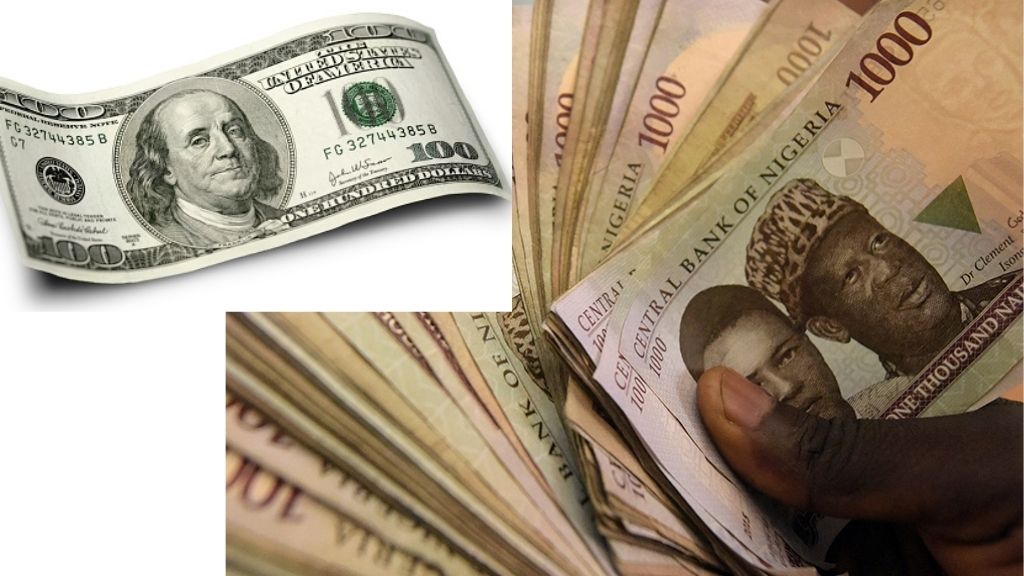
The nation’s currency depreciated against the US Dollar in the Investors and Exporters (I&E) arm of the market on Thursday, September 28, by 2.68 per cent or N20.23 to finish at N775.31/$1 compared with the preceding day’s value of N755.08/$1.

It was observed that the domestic currency crumbled during the session due to FX demand caused by the break, with the spot market recording trades valued at $144.55 million, 6.3 per cent or $8.52 million higher than the $135.98 million achieved on Tuesday.

Unlike the official market, the unregulated FX windows were not affected by the midweek holiday.

The Naira depreciated against the American currency by N9 in the parallel market yesterday to settle at N1003/$1, in contrast to the previous trading day’s exchange rate of N994/$1.

However, in the Peer-to-Peer (P2P) window, the local currency appreciated against the US Dollar on Thursday by N9 to quote at N1,002/$1 compared with Wednesday’s closing price of N1,013/$1.

In the I&E segment, the Nigerian currency gained weight against the Pound Sterling during the session by N12.17 to close at N935.93/£1 versus Tuesday’s value of N948.10/£1 and against the Euro, it improved by N14.24 to finish at N810.14/€1 versus N824.38/€1.

As for the digital currency market, prices went up as most of the tokens tracked by Business Post as weaker US dollars today helped investors’ crypto appetite.

Bitcoin (BTC) jumped by 2.0 per cent to $26,965.47, Ethereum (ETH) appreciated by 2.7 per cent to $1,655.23, Solana (SOL) rose by 4.6 per cent to $20.11, Litecoin (LTC) grew by 2.6 per cent to $65.23, and Cardano (ADA) expanded by 2.5 per cent to $0.2503.

Further, Ripple (XRP) increased by 2.3 per cent to $0.5087, Dogecoin (DOGE) went up by 1.7 per cent to $0.0616, Binance Coin (BNB) moved up by 1.5 per cent to $214.99, and the US Dollar Tether (USDT) rose by 0.08 per cent to $0.9999, while Binance USD (BUSD) closed flat at $1.00.


Adedapo Adesanya is a journalist, polymath, and connoisseur of everything art. When he is not writing, he has his nose buried in one of the many books or articles he has bookmarked or simply listening to good music with a bottle of beer or wine. He supports the greatest club in the world, Manchester United F.C.

Economy

Renewed FX Pressure Weakens Naira to N1,390/$1 at Official Market

Published

on

Naira-Dollar exchange rate gap

By Adedapo Adesanya

The value of the Naira dropped against the United States Dollar in the the Nigerian Autonomous Foreign Exchange Market (NAFEX) on Monday, February 2 by N3.81 or 0.27 per cent to N1,390.36/$1 from the N1,386.55/$1 it traded last Friday.

This was driven by stronger demand for forex at the official market, which outweighed to what was available to meet customers’ needs. But the local currency remained within the expected trading range.

In the same market window, the domestic currency further appreciated against the Pound Sterling during the session by N6.72 to close at N1,899.51/£1 compared with the preceding session’s rate of N1,906.23/£1 and improved against the Euro by N7.70 to trade at N1,644.52/€1 versus the previous trading day’s value of N1,652.22/€1.

In the parallel market, the exchange rate of the Nigerian Naira to its American counterpart remained unchanged yesterday at N1,465/$1 and at the GTBank FX counter, it also maintained stability at N1,419/$1.

The Naira is expected to remain relatively stable in the coming days, boosted by stronger FX liquidity, enhanced price discovery, and a gradual restoration of offshore investor confidence while Nigeria’s external reserves, which provide the Central Bank of Nigeria (CBN) with the capacity to defend the Naira and stabilise the foreign exchange market, have continued to grow steadily.

Updated data showed that Nigeria’s gross external reserves printed at $46.18 billion as of January 29, 2026, reflecting an addition of $62.40 million.

As for the cryptocurrency market, it was bullish after a sharp weekend sell-off while a resurgent US Dollar index, which has logged its strongest two-day gain in nine months, threatened to keep gains in check.

Expectations that US Federal Reserve chair nominee, Mr Kevin Warsh, will be cautious on interest-rate cuts, along with upcoming US jobs data, are seen as potential drivers of further Dollar strength.

The biggest gainer for the session was Cardano (ADA), which rose by 6.2 per cent to trade at $0.2976, Ethereum (ETH) appreciated by 5.5 per cent to $2,319.80, Dogecoin (DOGE) grew by 5.3 per cent to $0.1066, Binance Coin (BNB) gained 4.8 per cent to sell for $776.00, and Solana (SOL) added 4.6 per cent to sell at $103.75.

In addition, Litecoin (LTC) improved by 4.5 per cent to trade at $59.95, Bitcoin (BTC) appreciated by 3.6 per cent to $78,445.62, and Ripple (XRP) expanded by 3.4 per cent to $1.60, while the US Dollar Tether (USDT) and the US Dollar Coin (USDC) traded flat at $1.00 each.

Continue Reading

Economy

NGX Index Records Marginal 0.01% Rise Amid Weak Investor Sentiment

Published

on

All-Share Index NGX

By Dipo Olowookere

The Nigerian Exchange (NGX) Limited managed to finish in the green territory on Monday after it marginally closed higher by 0.01 per cent.

The last minute escape from the bears was triggered by the gains posted by large-cap equities like Zenith Bank, Aradel Holdings and others, offsetting the losses recorded by GTCO, Oando, First Holdco and others.

According to data obtained by Business Post, only 29 stocks ended on the gainers’ chart, while 44 equities landed on the losers’ table, indicating a negative market breadth index and weak investor sentiment.

Universal Insurance rose by 10.00 per cent to sell for N1.32, Premier Paints appreciated by 10.00 per cent to N11.00, DAAR Communications improved by 9.93 per cent to N1.55, RT Briscoe increased by 9.92 per cent to N8.64, and Morison Industries advanced by 9.91 per cent to N10.98.

On the flip side, Omatek declined by 10.00 per cent to N2.70, Union Homes REIT declined by 9.96 per cent to N85.40, AXA Mansard shrank by 9.94 per cent to N14.31, Deap Capital decreased by 9.90 per cent to N8.46, and C&I Leasing moderated by 9.80 per cent to N6.90.

On the first trading session of this week, market participants bought and sold 762.8 million shares valued at N18.4 billion in 55,374 deals compared with the 687.4 million shares worth N15.0 billion traded in 41,553 deals last Friday, a spike in the trading volume, value, and number of deals by 10.97 per cent, 22.67 per cent, and 33.26 per cent, respectively.

Tantalizers ended the day as the most active stock with 88.5 million units sold for N329.4 million, Zenith Bank traded 40.2 million units worth N2.9 billion, Veritas Kapital transacted 39.2 million units valued at N92.1 million, Universal Insurance exchanged 29.3 million units for N38.1 million, and First Holdco transacted 27.6 million units worth N1.1 billion.

The sectorial performance yesterday showed that the mood of investors was in the sell region despite the slight growth recorded by Customs Street, as only the energy index closed in green, rising by 2.00 per cent.

The insurance counter was down by 1.99 per cent, the banking industry depleted by 0.64 per cent, the consumer goods shrank by 0.37 per cent, and the industrial goods retreated by 0.08 per cent.

When the first trading day of February 2026 ended on Monday, the All-Share Index (ASI) went up by 14.23 points to 165,384.63 points from 165,370.40 points, while the market capitalization chalked up N9 billion to finish at N106.162 trillion compared with the previous session’s N106.153 trillion.

Continue Reading

Economy

Brent, WTI Slump 4% as US-Iran Tensions Cool

Published

on

Brent Price

By Adedapo Adesanya

The two major crude oil grades in the global market fell by more than 4 per cent per barrel on Monday after the most recent tensions between the United States and Iran appeared to have eased.

Brent crude futures went down by $3.02 or 4.4 per cent to settle at $66.30 per barrel, while the US West Texas Intermediate (WTI) crude futures declined by $3.07 or 4.7 per cent to $62.14 per barrel.

Last week, markets reacted to the renewed tension in the world’s most important oil-producing and exporting region, and oil prices soared.

However, this weekend, US President Donald Trump said that he believes Iran is “seriously” talking with the US, adding he hopes that negotiations could lead to an “acceptable” deal with the member of the Organisation of the Petroleum Exporting Countries (OPEC).

Market analysts noted that with the US President facing weak poll numbers, a military escalation that risks pushing petrol prices sharply higher appears unlikely ahead of the November midterm elections.

Prices were also pressured by a stronger US Dollar and milder weather forecasts. The American currency strengthened as currency traders cheered President Trump’s nomination of Kevin Warsh as the next Federal Reserve chair. A stronger Dollar makes oil more expensive for investors using other currencies.

US futures prices for diesel, used in heating and power generation, fell more than 6 per cent triggered by forecasts of milder weather in the US, the world’s largest oil consumer.

OPEC+ agreed to keep its oil output unchanged for March at a meeting, the producer group said on Sunday. The brief meeting reaffirmed that decision for March, after earlier gatherings did the same for January and February.

The eight producers – Saudi Arabia, Russia, the United Arab Emirates, Kazakhstan, Kuwait, Iraq, Algeria and Oman – raised production quotas by about 2.9 million barrels per day from April through December 2025, roughly 3 per cent of global demand.

In November, the group froze further planned increases for January through March 2026 because of seasonally weaker consumption.

Four OPEC+ producers that have been pumping crude above their respective quotas have filed with the OPEC Secretariat updated compensation plans through June 2026, OPEC said on Monday.

The countries: Iraq, the UAE, Kazakhstan, and Oman filed updated plans to compensate for pumping above OPEC+ quotas through June 2026.

Continue Reading

Trending