Economy
Mastering Intraday Trading Strategy for Success With Traders Union
Intraday trading is all about quick profits in the fast-paced world of finance. To succeed, you need effective Forex trading strategies. Traders Union (TU) experts are here to help you understand and use the top intraday trading strategies. They’ll share tips on how to spot the right times to enter and exit trades, allowing you to make the most of your opportunities and maximize profits in intraday trading.
Mastering intraday trading
TU’s analysts explained that intraday trading, also known as day trading, involves buying and selling securities within a single trading day. To begin intraday trading successfully, follow these tips:
- Time sensitivity and analysis:
Focus on real-time charts and indicators.
Use shorter time frames for quick decisions.
- Diverse trading strategies:
Choose strategies based on market conditions.
Explore scalping, range trading, and more.
- Quick decision-making and time management:
Stay attentive and act swiftly.
Utilize tools like VWAP orders for efficiency.
- Effective risk management:
Implement stop-loss orders.
Set clear profit and loss limits.
- Profit potential and market understanding:
Be aware of market volatility.
Beginners should learn market analysis, risk management, and trend interpretation.
Intraday trading offers profit potential but requires caution and market knowledge.
The best intraday trading strategies
In Forex, it is imperative to use an effective intraday trading strategy. Experts at Traders Union have explored five key intraday trading strategies that experienced traders use. By understanding these strategies and their entry and exit points, you can make informed decisions and maximize profits.
- Scalping with Bollinger bands – traders aim to make quick profits by identifying price volatility using Bollinger bands.
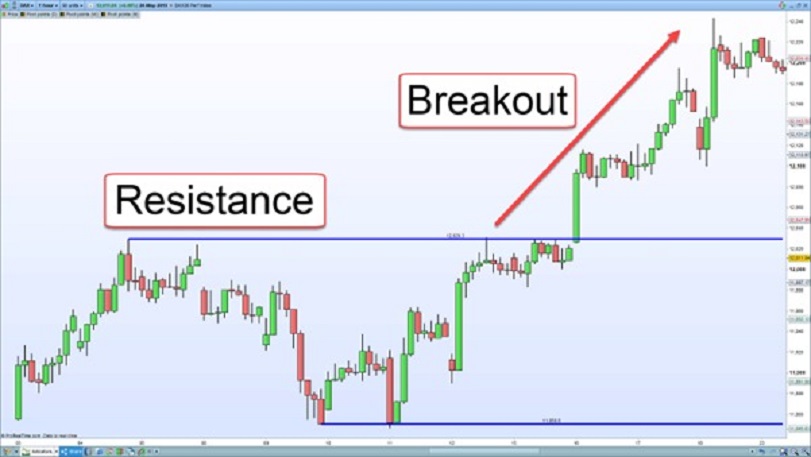
- Breakout trading – this strategy targets price movements when they break through support or resistance levels.
- Moving average crossover (using EMA 13 and 26) – traders use two moving averages to spot potential trend changes.
- Pivot points – these indicators help identify support and resistance levels for effective trade planning.
- Price action strategy – traders study price patterns and candlestick formations to predict future price movements and enter trades accordingly.
Advantages and disadvantages
Intraday trading, a fast-paced trading style, comes with its own set of pros and cons. TU’s experts outline the pros and cons of intraday trading:
Advantages:
- Intraday traders can use margin accounts to control larger positions with less investment, potentially increasing profits if trades go well.
- Successful intraday traders can create a steady income source by consistently making profitable trades and withdrawing profits daily.
- Intraday traders close positions before the market closes, avoiding overnight risks, such as unexpected events or news.
- Intraday trading allows traders to profit from short-term price changes and make multiple trades in a single day.
Disadvantages:
- The market can deceive intraday traders, leading to overconfidence and eventual losses. Caution is essential to avoid impulsive trading.
- Intraday trading requires strict discipline and risk management to prevent adverse effects on trading performance.
- Intraday traders need proficiency in market analysis, chart interpretation, and emotional control. Consistency and continuous learning are crucial.
Intraday trading offers opportunities, but it also demands caution, discipline, and a dedicated skill set.
The effectiveness and profitability of intraday trading
Traders Union analysts highlighted that intraday trading can be profitable with the right strategy. Its profitability depends on factors like skill, knowledge, strategy, and market conditions. It has potential for profit but also risks. Traders must create a solid plan based on research and tested strategies. Understanding technical analysis, charts, and indicators is crucial. Staying informed about market news helps make informed decisions.
Conclusion
Intraday trading can be profitable with the right strategies, but it also comes with risks. To succeed, traders must be time-sensitive and use various strategies tailored to market conditions. Quick decision-making, efficient risk management, and market understanding are crucial. Traders can employ strategies like scalping with Bollinger Bands, breakout trading, moving average crossovers, pivot points, and price action analysis.
Economy
NASD Exchange in Red for Third Straight Session After 0.15% Fall
By Adedapo Adesanya
For the third straight session, the NASD Over-the-Counter (OTC) Securities Exchange closed bearish, further losing 0.15 per cent on Thursday amid weak demand for unlisted stocks.
During the session, the NASD Unlisted Security Index (NSI) declined by 5.70 points to 3,908.67 points from 3,914.37 points, and the market capitalisation lost N3.41 billion to end N2.338 trillion compared with the N2.342 trillion it ended on Wednesday.
The alternative stock exchange suffered a loss despite having more price gainers than price losers, with five for the former and four for the latter.
Okitipupa Plc lost N10.00 to close at N250.00 per unit versus midweek’s N260.00 per unit, Central Securities Clearing System (CSCS) Plc depreciated by N4.98 to N64.92 per share from N69.90 per share, Industrial and General Insurance (IGI) Plc dropped 4 Kobo to sell at 50 Kobo per unit compared with the previous day’s 54 Kobo per unit, and Acorn Petroleum Plc moderated by 1 Kobo to N1.32 per share from N1.33 per share.
Conversely, 11 Plc gained N13.65 to quote at N276.55 per unit versus the preceding session’s N263.00 per unit, FrieslandCampina Wamco Nigeria Plc appreciated by N6.10 to N84.15 per share from N78.05 per share, Food Concepts Plc expanded by 32 Kobo to N3.60 per unit from N3.28 per unit, Geo-Fluids Plc improved by 30 Kobo to N3.60 per share from N3.30 per share, and First Trust Mortgage Bank Plc increased by 10 Kobo to N1.09 per unit from 99 Kobo per unit.
Yesterday, the volume of transactions surged 2,797.1 per cent to 45.8 million units from 1.6 million units, the value of transactions jumped 315.2 per cent to N208.2 million from N50.1 million, and the number of deals soared 18.2 per cent to 39 deals from 33 deals.
At the close of business, CSCS Plc remained the most active stock by value (year-to-date) with 32.6 million units worth N1.9 billion, followed by Geo-Fluids Plc with 117.4 million units valued at N463.1 million, and Resourcery Plc with 1.05 billion units exchanged for N408.6 million.
Resourcery Plc ended the session as the most traded stock by volume (year-to-date) with 1.05 billion units sold for N408.6 million, trailed by Geo-Fluids Plc with 117.4 million exchanged for N463.1 million, and CSCS Plc with 32.6 million units traded for N1.9 billion.
Economy
Bulls Reaffirm Control of Nigeria’s Stock Exchange With 1.39% Surge
By Dipo Olowookere
Sell-offs in energy stocks could not bring down Nigeria’s stock exchange on Thursday, as the gains recorded by the others sustained the upward momentum.
Yesterday, the Nigerian Exchange (NGX) Limited further appreciated by 1.39 per cent on the back of a strong appetite for domestic equities, which are gaining traction among investors.
The banking index grew by 2.63 per cent, the consumer goods sector appreciated by 054 per cent, the insurance counter improved by 0.50 per cent, and the industrial goods space rose by 0.29 per cent, while the energy industry fell by 0.11 per cent.
When the bourse closed for the day, the All-Share Index (ASI) pointed northwards by 2,645.61 points to settle at 193,073.57 points compared with the previous day’s 190,427.96 points, and the market capitalisation soared by N1.698 trillion to N123.934 trillion from N122.236 trillion.
The trio of Deap Capital, Okomu Oil, and Fortis Global Insurance appreciated by 10.00 per cent each to N6.93, N1,459.70, and 55 Kobo apiece, while the duo of Infinity Trust Insurance and Zichis gained 9.96 per cent each to settle at N14.35, and N15.79, respectively.
On the flip side, the quartet of Tripple G, Multiverse, Secure Electronic Technology, and McNichols lost 10.00 per cent each to quote at N5.40, N25.20, N1.80, and N8.28, respectively, while Meyer declined by 9.80 per cent to N20.70.
Business Post reports that there were 52 appreciating equities and 26 depreciating equities on Thursday, showing a positive market breadth index and strong investor sentiment.
The busiest stock yesterday was Japaul with 80.1 million units valued at N293.3 million, Secure Electronic Technology sold 71.8 million units worth N136.5 million, Mutual Benefits transacted 58.7 million units for N277.6 million, Zenith Bank exchanged 53.2 million units valued at N4.5 billion, and GTCO traded 52.6 million units worth N6.2 billion.
Unlike the preceding session, the activity chart was in red after market participants transacted 898.5 million shares for N38.5 billion in 61,953 deals compared with the 3.7 billion shares worth N61.9 billion traded in 68,693 deals at midweek, implying a decline in the trading volume, value, and number of deals by 75.72 per cent, 37.80 per cent, and 9.81 per cent apiece.
Economy
Naira Fall 0.24% to N1,341/$1 at Official FX Window
By Adedapo Adesanya
The Naira depreciated further against the Dollar in the Nigerian Autonomous Foreign Exchange Market (NAFEX) on Thursday, February 19, by N3.24 or 0.24 per cent to N1,341.35/$1 from the N1,338.11/$1 it was traded a day earlier.
However, it improved its value against the Pound Sterling in the official market during the session by N11.16 to sell for N1,805.86/£1 compared with the previous day’s N1,817.02/£1, and gained N7.83 against the Euro to close at N1,577.29/€1 versus Wednesday’s closing price of N1,585.12/€1.
At the GTBank forex counter, the Naira lost N2 against the greenback to settle at N1,349/$1 compared with the N1,347/$1 it was exchanged at midweek, and at the black market, the exchange rate remained unchanged at N1,370/$1.
The performance of the domestic currency in the spot market was weak yesterday amid prevailing dynamics of supply and demand, as the Central Bank of Nigeria (CBN) maintains its efforts to stabilise the foreign exchange market. The exchange rate remained within the expected range, lifted by strong forex inflows and central bank dollar sales to Bureaux de Change (BDC) operators.
Meanwhile, the cryptocurrency market remained bearish, as there was continued caution in coins amid shaky interest in the digital assets.
On the policy front, there were tentative signs of progress on the digital asset market structure bill. The White House hosted talks between crypto industry representatives and bankers, which yielded incremental movement, though no compromise has yet emerged.
Ripple (XRP) declined by 1.7 per cent to $1.39, Litecoin (LTC) went down by 1.3 per cent to $52.46, Cardano (ADA) dropped 0.8 per cent to trade at $0.2715, Dogecoin (DOGE) retreated by 0.7 per cent to $0.0978, and Ethereum (ETH) contracted by 0.2 per cent to $1,943.30.
On the flip side, Solana (SOL) appreciated by 0.8 per cent to $82.12, Bitcoin improved its value by 0.7 per cent to $66,854.86, and Binance Coin (BNB) chalked up 0.1 per cent to sell for $605.58, while the US Dollar Tether (USDT) and the US Dollar Coin (USDC) closed flat at $1.00 each.
-
Feature/OPED6 years agoDavos was Different this year
-
Travel/Tourism10 years ago
Lagos Seals Western Lodge Hotel In Ikorodu
-
Showbiz3 years agoEstranged Lover Releases Videos of Empress Njamah Bathing
-
Banking8 years agoSort Codes of GTBank Branches in Nigeria
-
Economy3 years agoSubsidy Removal: CNG at N130 Per Litre Cheaper Than Petrol—IPMAN
-
Banking3 years agoSort Codes of UBA Branches in Nigeria
-
Banking3 years agoFirst Bank Announces Planned Downtime
-
Sports3 years agoHighest Paid Nigerian Footballer – How Much Do Nigerian Footballers Earn