Connect with us

Feature/OPED

It’s Time For The Real Housewives of Ajegunle

Published

on

Real Housewives of Ajegunle

By Tony Ogunlowo

I’m not a big fan of reality TV programmes: the original concept of showcasing the lives of ordinary people has been lost in a maelstrom of faceless (- and often talentless) wannabes acting out badly written scripts in an effort to boost ratings and get their fifteen minutes of fame.

‘Big Brother’ started out as a social experiment and now has become the ‘must-be-on’ show; the Kardashian clan would probably be waiting tables, working check-outs or standing at street corners in skimpy outfits – at night – if it wasn’t for ‘Keeping Up with the Kardashians’ and many ‘blink-and-you’ll-miss-them’ celebrities would still be hustling from out of their humble hovels.

And now we have the ‘Real Housewives of Lagos’ copying a format that has been rolled out in nearly every major city of America, supposedly showcasing the lives of ‘ordinary’ successful housewives.

Don’t get me wrong! I’m not anti-reality TV especially if it’s dished out in reasonable watchable portions, so it doesn’t scramble the brain, and is not rammed down our throats 24/7. And besides I’ve got better things to do with my time than to gawk at a group of performing primates and getting into heated arguments about what they get up to. Do I care what the Kardashians wore to the beach yesterday?

Reality TV nowadays is over the top and getting beyond the ridiculous. Sadly, it’s given birth to a huge following of die-hard fans who hang on to everything the stars say and do, following them on every SM portal known to mankind. Again, there’s nothing wrong in following somebody on SM but are they really proper role models?

So, we’ve already established the fact that if you want to keep a majority of the Nigerian youths out of trouble, and busy, all you have to do is run BBN shows back-to-back all year round: their tiny little minds can only focus on one thing – Big Brother! If the President decides to walk butt naked down the street they won’t see him because they’ll be too busy watching BBN or some other reality TV claptrap 24/7 and discussing it.

Now back to the ‘Real Housewives of Lagos’: a colleague dropped me a link to the trailer and some previews and asked for my opinion.

Now I have lived in Lagos and I do know what a real housewife looks like: hard-working, caring and down to earth. So, you can imagine my surprise when a bunch of pretentious, over-privileged, over-dressed women with inch-long fingernails and fake accents parade themselves as the ‘Real Housewives of Lagos’. In the real world, none of them would last five minutes in a home or a kitchen, that’s if they even know how to cook! I know it makes for good entertainment but when the ‘acting’ is over the top, ridiculous make-believe cat-fights which often spill onto SM, flaunting wealth that would put even Dangote to shame then it’s time to switch off the telly. This is not how real housewives act and live.

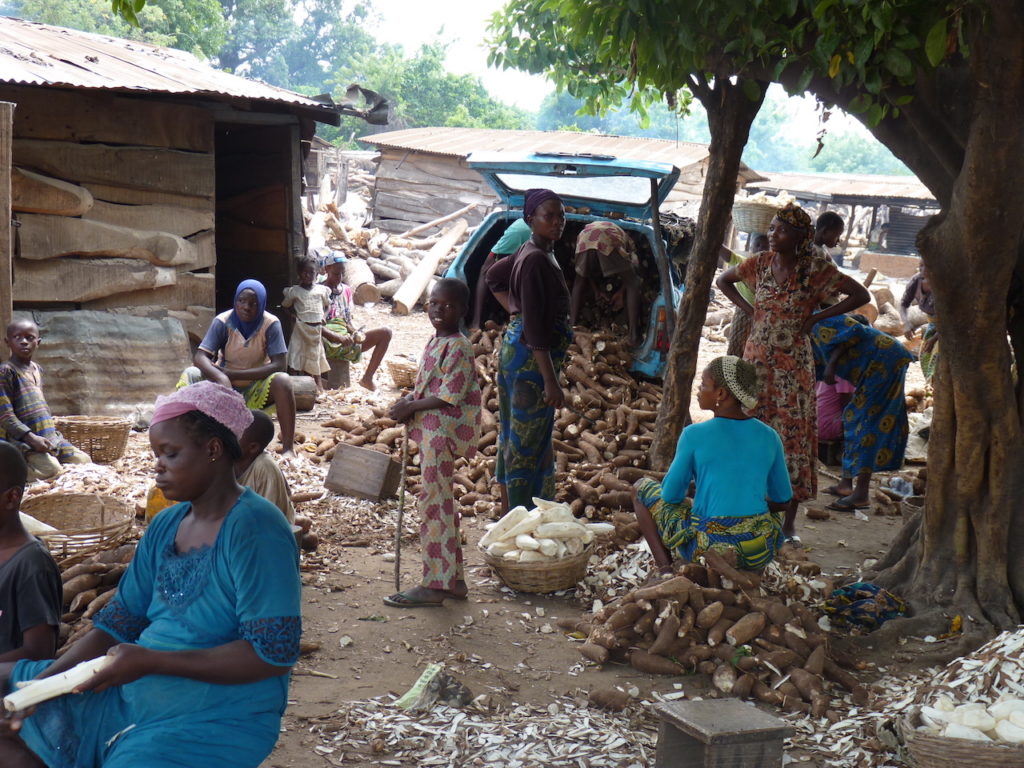
Now if you want a great reality TV show I propose the ‘Real Housewives of Ajegunle’: the acting will be real as they are the real salt-of-the-earth people where you’ll have Mama-Mulika waking up in her face-me-I-face-you room and parlour at the crack of dawn eefing and blinding at her lazy husband still in bed, dressing up and feeding her kids before shoving them out of the door for school. Not forgetting the punch-up for who gets to use the sole bathroom first: no catfights here for it’ll be the Real Anthony Joshua vs Tyson Fury thing.

The gossip will be equally interesting: who is sleeping with somebody else’s husband, who stole meat from somebody’s cooking pot, who votes APC and who votes PDP, who has a side chick and who’s using dubious means to make money.

And then there’s transportation to talk about. No flashy chauffeur-driven SUV or Rolls Royce or jaunts to Dubai or Paris flying first class on Emirates. Out of the house and out and about in Ajegunle it’s a ride in a danfo, BRT, keke nape or a bumpy ride on an okada or if you can get a cowry card you can ride the Blue Line to Marina.

Fancy dinner is at a Mama-put with more flies buzzing around than in a pit latrine and a drink with friends will be at a beer parlour, with lots of area boys and other undesirables for company and not some swish Lekki nightclub. Couple that with the high cost of living where your minimum wage Naira can’t even buy a box of tomatoes. Forget about flashing  Dollars or Euros for a facial.

So, if you want a real proper reality TV show with ‘real’ people bring on the ‘Real Housewives of Ajegunle’.

The ratings will go through the roof!

Follow me on Twitter: @Archangel641 or visit http://www.archangel641.blogspot.co.uk

Feature/OPED

David Ogbueli and the Emerging Framework for Value-Driven Global Leadership

Published

on

Ogbueli's pix 2

By Blaise Udunze

Milestones often invite reflection. Birthdays, especially, offer a pause to measure time not merely in years lived, but in lives shaped and systems influenced. This is especially true for David Ogbueli, who is celebrating his birthday. But instead of focusing on how old he is getting, it is more interesting to think about the impact he has had, not just building visible success, but the quiet, persistent architecture of transformation that his ministry has helped construct across continents.

Come to think of it, that in an era obsessed with visibility, metrics, and viral impact, Ogbueli’s work represents something different and distinguishing, slower, deeper, and far more enduring. Yes, multitude within and outside the country who know him either closely or from a distance definitely can attest that it is common with him, as this happens to be the kind of influence that rarely trends but steadily alters the trajectory of individuals, institutions, and nations.

To understand the global footprint of his work, one must first confront a fundamental shift he embodies, which emphatically is the redefinition of ministry itself. Through Dominion City International, founded from humble beginnings as a campus fellowship in 1991 at the University of Nigeria and later formalised in 1995 in Enugu, Ogbueli has built what is now a vast global movement. With over 2,000 chapters spanning Africa, Europe, Asia, the Middle East, and the Americas, alongside regional offices in the United States, the United Kingdom, and Nigeria, Dominion City has evolved into far more than a church network, into a leadership engine with an ambitious ongoing vision across Nigeria and beyond.

What distinguishes this expansion is not just its scale, but its philosophy. Beyond running a church, Dominion City was never designed merely to gather people; it was built to raise leaders who transform society. One emerging fact today is that the philosophy has shaped a generation of professionals, entrepreneurs, public servants, and ministers who carry its influence into boardrooms, government institutions, and grassroots communities across the world.

At the heart of this ecosystem is a deliberate investment in human capital development. Verifiably, through platforms like the Dominion Leadership Institute, which has produced over 30,000 graduates globally, Ogbueli has undeniably and consistently built a leadership pipeline that addresses one of Africa’s most persistent challenges. These prevailing challenges are the deficit of capable, values-driven leadership. At this point, this narrative definitely contradicts societal beliefs that his curriculum must be confined to spiritual formation; rather, it will interest society to know that his agenda integrates systems thinking, governance, productivity, and ethical leadership, equipping participants to function effectively in complex environments.

This emphasis on leadership extends into a broader scope and platforms. One of them is the Global Leadership Forum, and it would be of interest that it is not just designed for spiritual pursuit, but it is a mentorship and training hub designed to enhance performance and productivity across sectors, including business, politics, ministry, and enterprise. It reflects Ogbueli’s conviction that transformation must be holistic, that transcendence and cutting across every sphere of human endeavour.

Yet leadership, in his framework, is incomplete without economic empowerment. Across his ministry network, initiatives have been structured to move individuals from dependency to productivity. This is evident in large-scale interventions such as a N1 billion entrepreneurship support fund introduced to equip participants with the resources, skills, and networks required to succeed in business and career pursuits. At leadership retreats and empowerment programs, thousands are trained in areas ranging from agriculture and food security to innovation, healthcare, and global enterprise.

Beyond structured programs, his personal actions reinforce this philosophy.  has sparked widespread reactions following a remarkable act of generosity during a recent church service

From distributing financial support to individuals in need during church services to empowering teams within the ministry with significant financial gifts, as one recent such act sparked widespread reactions following a remarkable benevolence, gifting about 35 choristers N1 million each during a recent church service. With several other instances of generosity in the past, Ogbueli consistently underscores a critical principle that reveals that while immediate relief matters, sustainable change comes from enabling people to create value. In the course of one such intervention, which captures this ethos succinctly, he said that giving alone is not enough; people must be equipped to build.

With the right mindset, this approach aligns with a broader development truth that clearly states nations do not rise on charity, but on the strength of productive citizens. By embedding this mindset within a faith-based structure, Ogbueli is redefining how development can be pursued at scale.

Equally significant is his ability to mobilise faith as a development asset. It is an irony that in many parts of Africa and the global South, religious institutions remain among the most trusted social structures. Yet, their potential as vehicles for development often remains underutilised. Ogbueli’s model challenges that limitation by positioning the church as a hub for leadership incubation, economic activation, and social accountability.

Through initiatives like the Golden Heart Foundation, he has extended this vision into the nonprofit space. One of the good feats is that the foundation’s flagship program, the National Youth Summit, attracts over 50,000 participants annually from across Africa, focusing on leadership education, value reorientation and entrepreneurial development. These interventions target young people, especially a demographic that represents both Africa’s greatest asset and its most urgent responsibility.

His influence also extends into collaborative networks such as the Global Missions Network, which usher in developmental change, thereby bringing together leaders with a shared mandate of expanding the reach of the Gospel while driving national transformation. One important aspect of Ogbueli’s strategic drive for change is that through such alliances, his ideas are not confined to a single organisation but are disseminated across a broader ecosystem of leaders and institutions.

Beyond ministry and nonprofit initiatives, Ogbueli’s engagement with development takes on an institutional and structural dimension. This is driven through ventures like Huram Development, which is involved in large-scale projects including auditoriums, estates, and universities. Noteworthy also is that he is contributing to physical infrastructure that supports long-term growth. Similarly, Priesthood Institute is equipping ministry professionals with the competence and capacity required for modern-day leadership, while Shalom World ensures the distribution of knowledge resources through books and media.

Also, one significant dimension of Ogbueli’s influence lies in his intellectual contributions, which portray him as a prolific author with nearly a hundred published titles spanning leadership, personal development, spirituality, and nation-building. His more recent works include Pillars of King Solomon’s Wisdom & Wealth, Jewish Secrets, and The Laws of Proper Speech. Meanwhile, this reflects his continued effort to distil timeless principles into practical frameworks for contemporary living and reinforce his broader mission of transforming minds as a pathway to transforming societies.

Ogbueli is the host of the TV and Radio Program Expand Your World, which runs on TV and radio stations across Nigeria, extending his influence to seven continents, reinforcing his role not just as a pastor but as a global thought leader in transformation and leadership.

Importantly, Ogbueli’s credibility is not confined to religious circles only. Being a management and public policy consultant, an alumnus of institutions such as the Harvard Business School, Lagos Business School, and National Institute for Policy and Strategic Studies, he operates at the intersection of spirituality and strategy. It must be established that his engagements with governments, corporate organisations, and policy platforms reflect a rare ability to translate faith-based principles into actionable frameworks for development.

Unbeknownst to many, perhaps the most enduring feature of his model is its emphasis on multiplication. Rather than building a personality-driven movement, Ogbueli has focused on raising leaders who can replicate systems independently. This distributed approach ensures that his influence is not limited by geography or personal presence. It also guarantees continuity, a critical factor in sustainable development.

Of course, the challenge of measuring such an impact remains. Unlike infrastructure projects or economic indices, which are factors on which the government’s progress is reliant, the outcomes of leadership development and mindset transformation are not immediately quantifiable but have a greater impact. They unfold over time, often expressed in stories rather than statistics used for evaluation, a thriving business birthed from a training program, a principled leader emerging in public service, a community mobilised for collective progress.

Yes, in most cases, these outcomes may be difficult to measure, but they are foundational to nation-building and transformation beyond boundaries.

One important aspect the world must clearly know is that Pastor David Ogbueli’s contribution lies not merely in what he has built, but in what he has set in motion, which is transgenerational. This tells that his work challenges conventional development paradigms by emphasising that lasting change begins with people, their values, their thinking and their capacity to build systems that endure.

One of Ogbueli’s outstanding influences, beneath the surface, even in a world grappling with complex challenges, from economic instability to leadership crises, is such that his model offers a compelling reminder that transformation is not only engineered through policies and capital but through the deliberate cultivation of human potential.

His legacy is rapidly unfolding. But already, it is evident that the structures he has built, across ministry, leadership development, youth empowerment, and enterprise, are quietly shaping a future that extends far beyond the pulpit.

And perhaps that is the most powerful kind of transformation, the kind that is not always seen, but is deeply felt, widely spread, and ultimately, enduring.

Blaise, a journalist and PR professional, writes from Lagos and can be reached via: [email protected]

Continue Reading

Feature/OPED

3 Lessons Nigerian Marketers Can Learn from Top YouTube Creators

Published

on

Nigerian Marketers

By Olumide Balogun

The Nigerian digital landscape is evolving rapidly. Across the country, YouTube creators have become the new mainstream entertainment. They command millions of views, shape modern culture, and heavily influence purchasing decisions.

For digital marketers and advertisers, observing these creators provides a masterclass in modern audience engagement. Creators understand exactly how to hold attention and drive action in a crowded digital space. They know how to speak to their communities, keep them entertained, and build lasting loyalty.

By studying their methods, brands can transform their marketing strategies to build deeper, more profitable relationships with consumers. Here are three powerful lessons your brand can learn from the success of top YouTube creators.

1. Prioritise Authenticity and Relatability

Corporate videos typically rely on high budgets and perfect scripts. Top creators prove that raw, relatable content builds much stronger trust. Audiences connect deeply with real people sharing genuine experiences. They want to see the real faces behind the screen.

Brands can apply this by showing the human side of their business. You can share behind-the-scenes moments from your office, highlight real employee stories, or feature unscripted user-generated content. When you prioritise authenticity over absolute perfection, your message resonates perfectly with modern consumers. They begin to see your brand as a relatable partner rather than just a faceless corporation.

2. Master the Multiformat Storytelling Approach

Successful creators utilise the entire YouTube ecosystem to reach their fans. They use YouTube Shorts to attract new viewers quickly with bite-sized entertainment. They create long-form videos to explore topics in depth. Finally, they use Live streams to build real-time connections with their most dedicated followers.

Marketers need to adopt this exact mixed format strategy to stay relevant. You can capture attention quickly with an engaging short video and then lead those interested viewers to a comprehensive product review or tutorial. Utilising all available formats ensures you reach your customers exactly how they prefer to consume content on any given day. It allows you to tell a complete story from quick discovery to deep consideration.

3. Cultivate Community and Borrow Influence Safely

Traditional advertising relies heavily on one-way broadcasting. YouTube thrives on active community participation. Creators ask their viewers for input, respond to comments, and build fiercely loyal fandoms. This creates immense credibility. Viewers are 98% more likely to trust the recommendations of YouTube creators compared to other platforms.

Brands can mirror this interactive approach by hosting live Q&A sessions, asking for audience feedback, and making customers feel involved in the brand’s journey. Furthermore, marketers can tap into this existing loyalty by collaborating directly with trusted voices.

Using specific collaboration tools allows your brand to align seamlessly with popular channels. For example, Creator Takeovers give your brand a dedicated presence on a creator’s channel, while Partnership Ads let you boost creator-made content directly to a wider audience. This approach allows you to respect the creator’s unique voice while turning their authentic endorsements into highly effective marketing assets for your business.

The Bottom Line: YouTube is a dynamic, community-driven ecosystem. By adopting a creator mindset, Nigerian marketers can completely revitalise their digital video strategy. Embrace authenticity, utilise multiple video formats, and partner with trusted voices to turn casual viewers into loyal brand advocates.

Olumide Balogun is the Director of Google West Africa

Continue Reading

Feature/OPED

How Nigerians Search is Changing — and Why it Matters for our Businesses

Published

on

google AI Search

By Olumide Balogun

There was a time when using a search engine felt like cracking a code. You typed two or three carefully chosen keywords, hoped the machine understood, and waited to see what came back. People had to learn the language of machines, shrinking complex needs into stilted phrases.

That era is ending. Today, a person can ask a question the same way they would ask a colleague, and the technology is finally learning to respond in kind. Nowhere is this shift more visible than in Nigeria, where a young, mobile-first population expects tools to keep pace with how they actually think and speak.

This change carries weight far beyond convenience. It is reshaping how Nigerian businesses reach customers and how customers find what they need.

For years, marketing online meant wrestling with rigid keyword lists. A small business owner had to guess every possible phrase a customer might type. If you sold ankara dresses, you tried “ankara dress,” “Nigerian print fabric,” “traditional wear Lagos,” and a dozen variations, hoping you covered the gaps. Anything you missed was a missed customer

The new wave of conversational search makes those lists feel ancient. People now ask layered, specific questions: “Where can I find a sustainable tailor in Yaba who makes office wear?” Older systems would have stumbled on a query like that. Newer ones, powered by artificial intelligence, can read intent and stitch ideas together. They connect a question to a relevant local website that a basic keyword search might never have surfaced.

The shift is starting to show up in concrete tools. Google’s AI Max for Search ads, now a year old, is one of the more visible examples. In plain terms, it lets a business describe what it sells and who it serves in everyday language, and the system figures out which searches to match it to, instead of forcing the owner to write hundreds of keywords by hand. Early adopters report stronger revenue growth than peers, and users say results feel more useful because the technology connects ideas for them, often surfacing local sites that would not have appeared before.

There is a quieter benefit too. When advertising becomes more relevant, it stops feeling like an interruption. An ad that answers a real question is no longer noise; it is information. That changes the texture of the internet. The marketplace gets less cluttered, and people spend less time wading through results that do not fit what they were looking for.

None of this is automatic. The technology only works if it can understand human nuance, and human nuance in Nigeria is not the same as human nuance in California. A search for “owambe outfit” or “small chops for fifty people” demands cultural context, not just linguistic translation. Newer features try to bridge that gap. AI Brief, a part of the same Google toolkit, lets a business owner type plain instructions, like “focus on sustainable traditional wear, keep a premium tone,” and the system follows them. This is steering by intent, not by keyword bingo.

There are gains for businesses with deep catalogues too. A retailer with thousands of items no longer has to match every question to the right page by hand. Tools such as Google’s Final URL Expansion read the search and send the customer straight to the page that fits, in real time. In travel, finance, and healthcare, where compliance matters, the same systems can carry mandatory legal text into every ad automatically. Regulated industries can grow without cutting corners.

These are not abstract wins. They are the difference between a small business being found by a customer in Abuja at 9 p.m. and being lost in a sea of generic results, between a hospital reaching the right patient and a tailor in Surulere being discovered by a bride planning her wedding.

We should not pretend the transition is finished. AI is imperfect. It can misread context, amplify mistakes, and require careful oversight. Regulators, businesses, and users all have a role in shaping how it develops in our market. The broader direction, however, is clear, and it is one Nigeria should engage with rather than resist.

Nigeria is a nation of storytellers and traders. Our markets, physical and digital, have always been about conversation. The technology of search is finally beginning to mirror that. It is becoming less of a vending machine and more of a market stall, where you can ask a question, get a real answer, and discover something you did not know you needed.

That is the bigger story behind any single product launch. It is about how a country full of voices is finding new ways to be heard. For Nigerian businesses willing to adapt, the opportunity has never been clearer.

Continue Reading

Trending