Economy
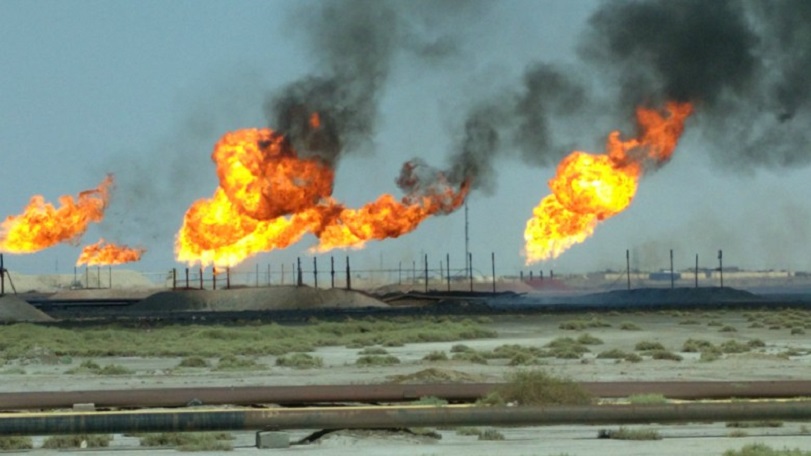
Nigeria Loses N1.493trn Potential Revenue to Gas Flaring in 2025
By Adedapo Adesanya
Nigeria lost $1.1 billion (N1.493 trillion) to gas flaring in 2025, as oil and gas companies operating in the country burnt 323 billion Standard Cubic Feet (SCF) of gas between January and December 2025.
This is according to the latest data released by the National Oil Spill Detection and Remediation Agency (NOSDRA).
The agency, in its gas flare report for 2025, released recently, disclosed that the volume of gas flared in 2025 was 7.2 per cent higher than the 301.3 billion SCF (BSCF) of gas flared in 2024, which was also valued at $1.1 billion, about N1.493 billion.
The environmental impact regulator further stated that the volume of gas flared in the 12-month period of 2025 contributed 17.2 million tonnes of carbon dioxide into the atmosphere; had the potential to generate 32,300 gigawatt-hours (GWh) of electricity; while the offending companies were liable for penalties payment of $646.1 million, about N876.622 billion.
NOSDRA maintained that in the 12-month period of 2024, the 301.3 billion SCF of gas flared by oil and gas firms was valued at $1.1 billion, about N1.493 trillion, with penalties payable at $602.7 million, about N818.271 billion, while it contributed 16 million tonnes of carbon dioxide emissions, and had power generation potential of 30,100 GWh.
Providing a breakdown of gas flared data across segments of the oil-producing space in 2025, the agency reported that 206.3 billion SCF of gas was flared by oil and gas firms operating in the country’s onshore oil space, accounting for 63.8 per cent of total gas flared in the period under review, and was 18.36 per cent higher than the volume lost to gas flaring in this same segment in 2024.
NOSDRA added that the volume of gas flared onshore caused the country a loss of 20,600 GWh of electricity, and the emission of 11 million tonnes of greenhouse gases; this was valued at $722 million, about N979.754 billion; while the companies were liable to pay penalties of $412.6 million, about N560.441 billion.
In comparison, the 174.3 billion SCF of gas flared in 2024 by companies operating onshore was valued at $610 million, about N827.77 billion; with penalties payable at $348.6 million, about N473.593 billion; caused the loss of power generation potential of 17,400 GWh; and contributed 9.3 million tonnes of carbon dioxide into the atmosphere.
On the other hand, companies operating offshore accounted for 36.2 per cent of total gas flared between January and December 2025, with 116.8 billion SCF of gas, valued at $408.7 million (N555.013 billion); penalties payable at $233.5 million (N317.538 billion); contributed 6.2 million tonnes of carbon dioxide emission; and eroded 11,700 GWh of electricity generation potential.
Similarly, in the same 12-month period in 2024, offshore operations emitted 6.7 million tonnes of carbon dioxide into the atmosphere, causing the loss of power generation capacity of 12,700 GWh, with 127.1 billion SCF of gas flared, valued at $444.7 million (N603.865 billion), and penalties payable at $254.1 million (N344.678 billion).
NOSDRA noted that the offending companies flared gas from Oil Mining Leases (OML) 04, 05, 11, 13, 14, 17, 18, 22, 28, 23, 24, 38, 40, 42, 43, 72, 49, 54, 86, 90, 95, 67, 70, 104, 59, 99, 100, 101, 102, 110 and Oil Prospecting Licences (OPL) 090, 209, 212, 216, 222, 246, 316 and 306, among others.
It identified the offending companies as Shell Petroleum, Development Company (SPDC), Nigerian Petroleum Development Company (NPDC), Chevron Nigeria, Mobil Oil, Elf Petroleum Nigeria, Nigeria Agip Oil Company (NAOC), Addax Petroleum, Texaco Overseas (Nigeria), Esso Exploration and Production Nigeria, Allied Energy Resources, Ultramar Petroleum, Atlas Petroleum; Cromwell, Afric Oil and Marketing, Famfa Oil, Moni Pulo, and South Atlantic Petroleum, Star Deep Water, Summit Oil, among others.
Economy
Naira Opens Week Stronger at N1,374/1$ in Official Market
By Adedapo Adesanya
The Naira appreciated against the US Dollar in the Nigerian Autonomous Foreign Exchange Market (NAFEX) by 54 Kobo or 0.04 per cent on Monday, May 25, to trade at N1,374.92/$1 compared to last Friday’s value of N1,375.46/$1.
However, it further depreciated against the Pound Sterling in the official market during the session by N6.01 to sell for N1,855.73/£1 versus the preceding session’s N1,849.72/£1 and lost N158.02 against the Euro to close at N1,755.06/€1, in contrast to the N1,590.04/€1 it was traded last Friday.
In the same vein, the Nigerian Naira weakened against the United States Dollar at the GTBank FX counter yesterday by N2 to quote at N1,383/$1 versus N1,381/$1, and gained N5 in the parallel market to settle at N1,385/$1 compared with the previous rate of N1,390/$1.
The performance of the domestic currency comes as the external reserves inched higher to $48.72 billion, indicating a complex mix of sustained FX demand pressures and modest reserve accretion.
The movement in the FX market underscores the continued tension between demand-side pressure and policy-driven attempts to stabilise the naira.
While recent monetary tightening measures by the Central Bank of Nigeria (CBN) have helped to moderate extreme volatility, market participants are struggling to navigate a landscape shaped by intermittent dollar inflows, import-related demand and shifting investor sentiment.
As for the cryptocurrency market, most tokens were up amid optimism of a near-term US-Iran peace deal, as Iranian negotiators arrived in Doha, Qatar, for talks.
The Strait of Hormuz has been largely blockaded since the US and Israel struck Iran on February 28, though traffic has partially resumed in recent days. The agenda would include the reopening as well as uranium control.
TRON (TRX) rose by 1.8 per cent to $0.3714, Cardano (ADA) added 1.2 per cent to trade at $0.2444, Bitcoin (BTC) improved by 0.9 per cent to $77,283.62, Binance Coin (BNB) jumped 0.8 per cent to $661.30, and Ripple (XRP) increased by 0.8 per cent to $1.35.
Further, Ethereum (ETH) grew by 0.7 per cent to $2,018.82, Solana (SOL) expanded by 0.6 per cent to $85.37, and Dogecoin (DOGE) appreciated by 0.6 per cent to $0.1001, while the US Dollar Tether (USDT) and the US Dollar Coin (USDC) remained unchanged at $1.00 apiece.
Economy
Oil Prices Crash 7% on Hopes of US-Iran Peace Deal
By Adedapo Adesanya
Oil prices fell nearly 7 per cent on Monday as optimism grew that the United States and Iran were moving closer to a peace deal that would reopen the Strait of Hormuz.
Brent crude futures were down by $7.24 or almost 7 per cent to $96.30 a barrel, and the US West Texas Intermediate (WTI) crude futures decreased by $6.30 or 6.5 per cent to trade at $90.88 per barrel.
Comments by President Donald Trump that diplomatic negotiations with Iran are advancing eased market fears of severe energy supply disruptions due to the Middle East conflict.
This is as a top negotiator of Iran, and its foreign minister was in Doha for talks with Qatar’s prime minister on a potential deal with the US to end the three-month-old war
Recently, both countries have downplayed expectations for an immediate peace agreement to end their three-month-old war, backing away from claims of an imminent breakthrough.
President Trump later revealed that he has instructed negotiators not to rush the process, asserting that the US naval blockade on Iranian ports will remain in full effect until a finalised accord is certified and signed.
Also, the US Secretary of State Marco Rubio has affirmed that the US government will exhaust diplomatic channels, also warning that it will handle Iran in “another way” if a good agreement cannot be secured, hinting at a potential return to active war.
The deal outlines a process to fully reopen the vital global shipping lane without tolls, resolving the global energy crunch. Iran would receive targeted sanctions relief and the gradual unfreezing of up to $20 billion to $25 billion in assets currently held in foreign banks.
Even if a peace deal is reached, analysts expect a return to normal oil flows through the strait will take months, while damaged oil and gas facilities are repaired. There is currently a supply shortfall of up to 11 million barrels per day of crude oil that does not go away immediately, even if a deal is reached soon.
Ship-tracking data showed three Liquefied Natural Gas (LNG) tankers passed through the strait in recent days, heading to Pakistan, China and India, as well as a supertanker with Iraqi crude for China after being stranded for nearly three months.
Economy
Nigeria Records 3.89% GDP Growth in Q1 2026
By Adedapo Adesanya
Nigeria’s economic growth rate eased in the first quarter of 2026 to 3.89 per cent year-on-year, as a slowdown in the oil sector offset gains recorded in the non-oil sector.
The economy, measured by Gross Domestic Product (GDP), slowed in the first three months of this year from the 4.07 per cent recorded in the previous quarter (Q4 2025), according to data released by the National Bureau of Statistics (NBS) on Monday. However, it was higher than the 3.13 per cent recorded in the first quarter of 2025.
In the first quarter of 2026, Nigeria recorded an average daily oil production of 1.55 million barrels per day, lower than 1.62 million barrels per day in the same quarter of 2025 and lower than the 1.58 million barrels per day in the fourth quarter of 2025.
The real growth of the oil sector was 2.57 (year-on-year) in Q1 2026, indicating an increase of 0.70 per cent compared with the 1.87 per cent in the corresponding quarter of 2025.
However, growth decreased by 4.22 per cent compared to 6.79 per cent in Q4 2025, and on a quarter-on-quarter basis, the oil sector recorded a growth rate of 9.31 per cent.
For the non-oil sector, it contributed 96.08 per cent to the nation’s GDP between January and March 2026, versus 96.03 per cent in the same period of last year and lower than 97.13 per cent in the fourth quarter of last year.
During the quarter under review, agriculture grew by 3.15 per cent. The growth of the industry sector stood at 3.50 per cent versus 3.42 per cent in the first quarter of last year, while the services sector recorded a growth of 4.31 per cent, in contrast to 4.33 per cent in the same quarter of 2025.
In terms of share of the GDP, the services sector contributed 57.73 per cent compared to 57.50 per cent in the first quarter of 2025.
In the quarter under review, aggregate GDP at basic price stood at N110.79 trillion in nominal terms, higher than N94.1 trillion in the first quarter of 2025 by 17.79 per cent.
-
Feature/OPED6 years agoDavos was Different this year
-
Travel/Tourism10 years ago
Lagos Seals Western Lodge Hotel In Ikorodu
-
Showbiz3 years agoEstranged Lover Releases Videos of Empress Njamah Bathing
-
Banking8 years agoSort Codes of GTBank Branches in Nigeria
-
Economy3 years agoSubsidy Removal: CNG at N130 Per Litre Cheaper Than Petrol—IPMAN
-
Banking3 years agoSort Codes of UBA Branches in Nigeria
-
Banking3 years agoFirst Bank Announces Planned Downtime
-
Sports3 years agoHighest Paid Nigerian Footballer – How Much Do Nigerian Footballers Earn