Economy
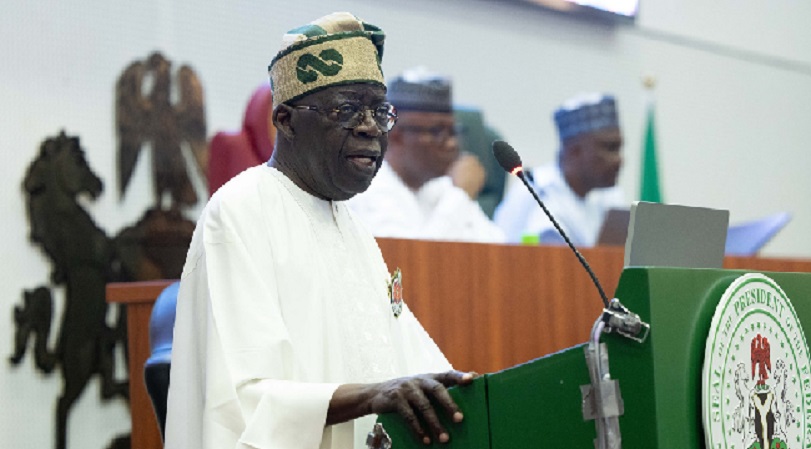
Full Text of President Tinubu’s 2024 Budget Presentation Speech
- In furtherance of my sacred duties and obligations as President of the Federal Republic of Nigeria, it is my honour to be here today to present my administration’s 2024 Budget Proposal to this Joint Session of the 10th National Assembly. This moment is especially profound and significant to me because it is my first annual budgetary presentation to the National Assembly.
- Distinguished Senators and Honourable Members of the National Assembly, I commend your swift consideration and passage of the 2023 Supplementary Appropriation Bills and the 2024-2026 Medium Term Expenditure Framework and Fiscal Strategy Paper. Your prompt action underscores your devotion to economic development and to the greater welfare of our people. It also highlights your desire to work in close collaboration with the Executive branch. We do not serve ourselves. We must always strive to work together to serve and benefit the people of our beloved country.
- I am confident that the National Assembly will continue to work closely with us to ensure that deliberations on the 2024 Budget are thorough but also concluded with reasonable dispatch. Our goal is for the Appropriation Act to come into effect on the 1st of January 2024.
- It is, by now, a matter of recorded history that my very first fiscal intervention as President of this great nation was to end the fuel subsidy regime which had proven to be so harmful to the overall health of our national economy. The second was to negotiate and subsequently present a supplementary budget to enable my government to fund the items needed to restore macroeconomic stability and mitigate the harsh impact of subsidy removal.
- The third was to secure a second supplementary budget, this time to enable us to keep our promises to promote national security, invest in infrastructure and provide much-needed support to the most vulnerable households in our society.
- In swearing in my cabinet and reflecting on the unique challenges facing us, I invited the Ministers to imagine that we are attempting to draw water from a dry well. Today, I stand before you to present our Budget of Renewed Hope; a budget which will go further than ever before in cementing macro-economic stability, reducing the deficit, increasing capital spending and allocation to reflect the eight priority areas of this Administration. The budget we now present constitutes the foundation upon which we shall erect the future of this great nation.
PREVAILING ECONOMIC ENVIRONMENT
- Economic conditions remain challenging both abroad and at home. Despite lingering post-COVID supply and production bottlenecks, armed conflict in various parts of the world and restrictive monetary policies in major economies, we expect global growth to hover around 3.0 per cent in 2024. This relatively low rate has significant implications for our economy due to our current reliance on importation.
- Distinguished Senators, Honourable Members: despite the global headwinds, the Nigerian economy has proven resilient, maintaining modest but positive growth over the past twelve months.
- Inflation has trended upward due to weak global conditions. To contain the rising domestic prices, we will ensure effective coordination of fiscal and monetary policy measures, and collaborate with sub-national governments to address structural factors driving inflation in Nigeria.
- The Budget proposal meets our goal of completing critical infrastructure projects which will help address structural problems in the economy by lowering the costs of doing business for companies and the cost of living for the average person, The Honourable Minister of Budget and Economic Planning will provide full details of this proposal.
PERFORMANCE OF THE 2023 BUDGET
- Distinguished Senators and Honourable Members, an aggregate revenue of 11.045 trillion naira was projected to fund the 2023 Budget of 24.82 trillion naira with a deficit of about 6.1 per cent of GDP.
- As of September 30, the Federal Government’s actual aggregate revenue inflow was 8.65 trillion naira, approximately 96 per cent of the targeted 8.28 trillion naira.
- Despite the challenges, we continue to meet our obligations.
THEME AND PRIORITIES OF THE 2024 BUDGET
- Distinguished Senators, Honourable Members, permit me to highlight key issues relating to the budget proposals for the next fiscal year. The 2024 Appropriation has been themed the Budget of Renewed Hope. The proposed Budget seeks to achieve job-rich economic growth, macro-economic stability, a better investment environment, enhanced human capital development, as well as poverty reduction and greater access to social security.
- Defence and internal security are accorded top priority. The internal security architecture will be overhauled to enhance law enforcement capabilities and safeguard lives, property and investments across the country.
- Human capital is the most critical resource for national development. Accordingly, the budget prioritizes human development with particular attention to children, the foundation of our nation.
- To improve the effectiveness of our budget performance, the government will focus on ensuring value for money, greater transparency and accountability. In this regard, we will work more closely with development partners and the private sector.
- To address long-standing issues in the education sector, a more sustainable model of funding tertiary education will be implemented, including the Student Loan Scheme scheduled to become operational by January 2024.
- A stable macroeconomic environment is important to catalyse private investment and accelerate economic growth. We have and shall continue to implement business and investment-friendly measures for sustainable growth.
- We expect the economy to grow by a minimum of 3.76 per cent, above the forecasted world average. Inflation is expected to moderate to 21.4 per cent in 2024.
- In preparing the 2024 Budget, our primary objective has been to sustain our robust foundation for sustainable economic development. A critical focus of this budget and the medium-term expenditure framework is Nigeria’s commitment to a greener future.
- Emphasizing public-private partnerships, we have strategically made provisions to leverage private capital for big-ticket infrastructure projects in energy, transportation and other sectors. This marks a critical step towards diversifying our energy mix, enhancing efficiency, and fostering the development of renewable energy sources. By allocating resources to support innovative and environmentally conscious initiatives, we aim to.
Economy
FG, States, Local Councils Share N1.969trn FAAC Allocation
By Adedapo Adesanya
A total of N1.969 trillion was shared to the federal government, the 36 state governments and the 774 local government councils from the gross revenue of N2.585 trillion generated by the nation in December 2025.
The money was disbursed to the three tiers of government at the January 2026 Federation Account Allocation Committee (FAAC) meeting held in Abuja.
In a statement issued on Monday by the Director of Press and Public Relations in the Office of the Accountant-General of the Federation (OAGF), Mr Bawa Mokwa, it was stated that the FAAC allocation comprised statutory revenue of N1.084 trillion, distributable Value Added Tax (VAT) revenue of N846.507 billion, and Electronic Money Transfer Levy (EMTL) revenue of N38.110 billion.
“Total deduction for cost of collection was N104.697 billion, while total transfers, refunds, and savings were N511.585 billion,” the statement partly read.
It was also revealed that from the N1.969 trillion total distributable revenue, the federal Government received the sum of N653.500 billion, and the state governments received N706.469 billion, the local government councils received N513.272 billion, and the sum of N96.083 billion was shared with the benefiting state as 13 per cent derivation revenue.
He said of the N1.084 trillion distributable statutory revenue, the central government received N520.807 billion, the state governments got N264.160 billion, the local councils were given N203.656 billion, and N96.083 billion was shared to the benefiting states as 13 per cent derivation revenue.
FAAC noted that from the N846.507 billion distributable VAT earnings, the federal government got N126.976 billion, the state governments received N423.254 billion, and the local government councils got N296.277 billion.
From the revenue from EMTL, Mr Mokwa explained that the national government was given N5.717 billion, the state governments got N19.055 billion, and the councils collected N13.338 billion.
He added that the companies’ Income Tax (CIT)/CGT and STD, Import Duty and Value Added Tax (VAT) increased significantly in December, while oil and gas royalty, CET levies and fees increase marginally, with excise duty, Petroleum Profit Tax (PPT)/Hydrocarbon Tax (HT), and EMTL considerably down.
Economy
Oil Exports to Drop as Shell Commences Maintenance on Bonga FPSO
By Adedapo Adesanya
Nigeria’s oil exports will drop in February following the shutdown of the Bonga Floating Production Storage and Offloading (FPSO) vessel scheduled for turnaround maintenance.
Shell Nigeria Exploration and Production Company (SNEPCo) Limited confirmed the development in a statement issued, adding that gas output will also decline during the maintenance period.
This comes as SNEPCo begun turnaround maintenance on the Bonga FPSO, the statement signed by its Communications Manager, Mrs Gladys Afam-Anadu, said, describing the exercise as a statutory integrity assurance programme designed to extend the facility’s operational lifespan.
SNEPCo Managing Director, Mr Ronald Adams, said the maintenance would ensure safe, efficient operations for another 15 years.
“The scheduled maintenance is designed to reduce unplanned deferments and strengthen the asset’s overall resilience.
“We expect to resume operations in March following completion of the turnaround,” he said.
Mr Adams said the scope included inspections, certification, regulatory checks, integrity upgrades, engineering modifications and subsea assurance activities.
“The FPSO, about 120 kilometres offshore in over 1,000 metres of water, can produce 225,000 barrels of oil daily.
“It also produces 150 million standard cubic feet of gas per day,” he said.
He said maintaining the facility was critical to Nigeria’s production stability, energy security and revenue objectives.
Mr Adams noted that the 2024 Final Investment Decision on Bonga North increased the importance of the FPSO’s reliability. He said the turnaround would prepare the facility for additional volumes from the Bonga North subsea tie-back project.
According to him, the last turnaround maintenance was conducted in October 2022.
“On February 1, 2023, the asset produced its one billionth barrel since operations began in 2005,” Mr Adams said.
SNEPCo operates the Bonga field in partnership with Esso Exploration and Production Nigeria (Deepwater) Limited and Nigerian Agip Exploration Limited, under a Production Sharing Contract with the Nigerian National Petroleum Company (NNPC) Limited.
The last turnaround maintenance activity on the FPSO took place in October 2022. On February 1, the following year, the asset delivered its 1 billionth barrel of oil since production commenced in 2005.
Economy
Nigeria Earns N1.17trn from Petroleum Sector in November 2025
By Adedapo Adesanya
Nigeria earned N1.17 trillion from the oil and gas industry in November 2025, lower than the N1.396 trillion generated in October 2025 by 16.2 per cent, according to data presented to the Federation Account Allocation Committee (FAAC) by the Central Bank of Nigeria (CBN).
The CBN, in the latest data available, noted that the N1.17 trillion earnings from the petroleum industry in November 2025 represented 96.4 per cent of the N1.214 trillion revenue budgeted for the sector for the month under review.
In comparison, revenue from the petroleum industry in October 2025 represented 94.71 per cent of the N1.474 trillion budgeted for the sector in the month.
In its breakdown of revenue from the oil and gas industry in November 2025, the central bank stated that the country earned N37.134 billion from crude oil sales, climbing by 395.58 per cent from N7.493 trillion recorded in the previous month; while revenue from gas sales appreciated by 25.22 per cent to N7.265 billion in November, compared with N5.802 billion recorded in October 2025.
Furthermore, the CBN noted that revenue from crude oil royalties dipped by 25.6 per cent, from N790.086 billion in October 2025 to N587.865 billion in November; while miscellaneous oil revenue more than doubled to N1.356 billion, from N447.279 million in October 2025.
Also, it stated that royalties from gas dipped by 38.1 per cent to N9.405 billion in November, from N15.195 billion in October, while the country earned N51.842 billion from gas flare penalties in November 2025, down from N61.898 billion recorded in the previous month.
The apex bank added that revenue from companies’ income tax (CIT) from upstream oil industry operations stood at N106.106 billion in the month under review, as against N73.025 billion in October 2025.
It also stated that revenue from Petroleum Profit Tax (PPT) stood at N301.471 billion; rentals – N775.162 million; while taxes stood at N67.242 billion in November 2025; as against N242.621 billion, N3.197 billion, and N196.277 billion in October 2025.
In addition, the apex bank reported that from the country’s oil earnings in November 2025, N18.163 billion was deducted for 13 per cent refund on subsidy, priority projects and Police Trust Fund from 1999 to 2021; while N2.872 billion was deducted by the Nigerian National Petroleum Company (NNPC) Limited in respect of its 13 per cent management fee and frontier exploration fund.
It added that N26.401 billion was deducted and collected by the Nigerian Upstream Petroleum Regulatory Commission (NUPRC) in October 2025, being four per cent cost of collection; while N49.768 billion was transferred to the Midstream and Downstream Gas Infrastructure Fund from gas flare penalties in the same month.
-
Feature/OPED6 years agoDavos was Different this year
-
Travel/Tourism9 years ago
Lagos Seals Western Lodge Hotel In Ikorodu
-
Showbiz3 years agoEstranged Lover Releases Videos of Empress Njamah Bathing
-
Banking8 years agoSort Codes of GTBank Branches in Nigeria
-
Economy3 years agoSubsidy Removal: CNG at N130 Per Litre Cheaper Than Petrol—IPMAN
-
Banking3 years agoSort Codes of UBA Branches in Nigeria
-
Banking3 years agoFirst Bank Announces Planned Downtime
-
Sports3 years agoHighest Paid Nigerian Footballer – How Much Do Nigerian Footballers Earn