Brands/Products
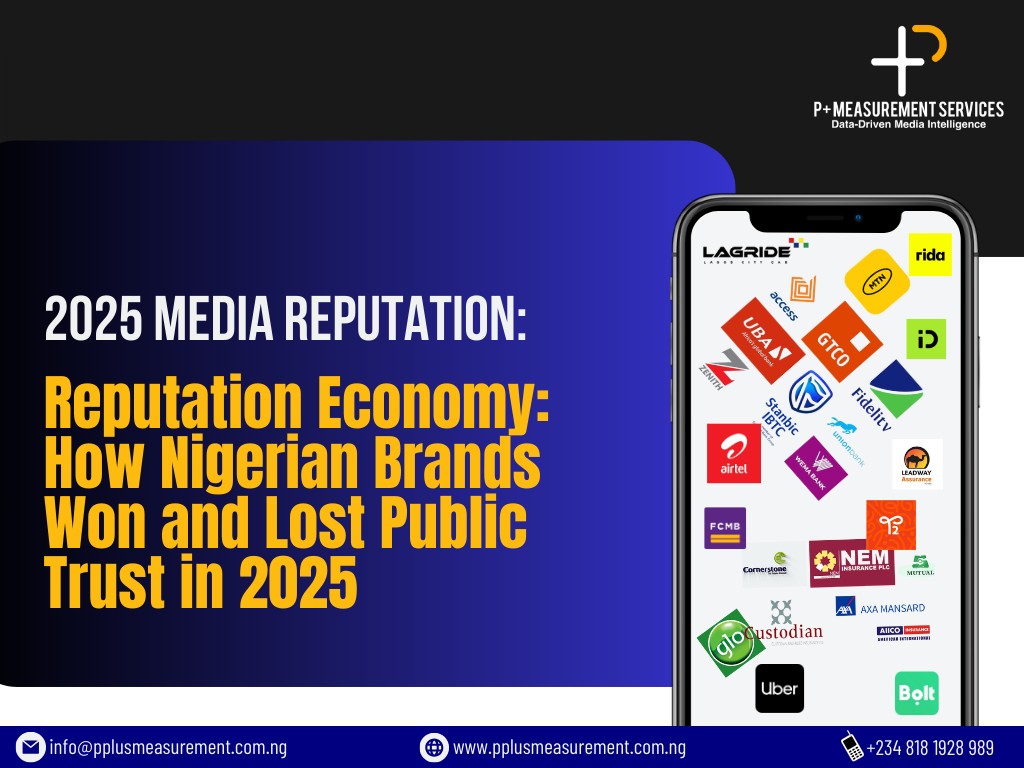
Reputation Economy: How Nigerian Brands Won and Lost Public Trust in 2025
Nigeria’s leading independent media intelligence consultancy, P+ Measurement Services, has released its 2025 Industry Media Reputation Report, revealing that corporate reputation has emerged as one of the most decisive assets for Nigerian companies, rivaling financial performance and market share in shaping public trust.
The report analysed and audited thousands of print and online news reports published in 2025 across the banking, insurance, telecommunications, and e-hailing sectors. In total, coverage of 29 commercial banks, 13 insurance companies, five e-hailing platforms, and four telecommunications operators was examined to determine how corporate actions translated into public perception.
According to the findings, rising operational costs, currency pressures, regulatory scrutiny, labour relations, and service reliability now directly influence how brands are judged in the media and by stakeholders.
“Reputation is no longer a soft outcome of publicity. It is a measurable business asset shaped by corporate behaviour, governance quality, customer experience, and crisis response,” said a Senior Analyst at P+ Measurement Services, Ms Tumininu Balogun.
She added, “For more than a decade, we have been at the forefront of media intelligence in Nigeria. Our commitment to the PR and communications industry is to ensure that reliable media data and actionable insight are always available, so professionals can move beyond intuition and make truly data-driven decisions.”
E-Hailing Industry: Driver Relations Reshaped Corporate Reputation
The e-hailing sector recorded one of the clearest shifts in reputation dynamics in 2025, driven largely by labour policies and platform economics.
inDrive Nigeria led the sector with 39% of positive reputation share, following extensive media coverage of its decision to reduce driver commission to 0.1% during peak hours in Abuja. Bolt Nigeria followed with 32%, supported by reports on its electric tricycle deployment in Lagos. LagRide recorded 17%, driven by coverage of its electric vehicle infrastructure partnership, while Uber Nigeria accounted for 11% and Rida 1%.
On the negative reputation scale, Bolt recorded the highest share at 40%, linked to driver protests following fare reduction policies. Uber accounted for 29%, inDrive 20%, LagRide 8%, and Rida 3%, largely associated with reports on strike threats, platform reliability concerns, and driver earnings disputes.
The report notes that how platforms treat drivers has become as influential to reputation as rider experience.
Banking Industry: Profitability Confronted by Governance Risk
Among commercial banks, Stanbic IBTC recorded the strongest positive reputation position at 26%, driven by recognition as KPMG’s top retail bank. Zenith Bank followed with 22%, supported by dividend payout coverage. Fidelity Bank (19%), UBA (17%), and FirstBank (16%) gained positive reputation visibility through education initiatives, digital service upgrades, and branch automation projects.
However, reputational exposure remained significant. GTCO recorded the highest negative reputation share at 28%, followed by FirstBank at 26%, FCMB at 18%, and both UBA and Ecobank at 14%, mainly due to media reports concerning legal disputes, fraud investigations, and customer-related controversies.
The report highlights that in the banking sector, strong earnings and digital innovation strengthen reputation, but governance failures can rapidly undermine it.
Insurance Industry: Financial Stability and Data Protection Define Trust
In the insurance sector, AXA Mansard led positive reputation share with 36%, followed by Leadway Assurance (29%), AIICO (16%), NEM Insurance (11%), and SanlamAllianz (8%).
AXA Mansard also accounted for the highest negative reputation exposure at 68%, driven by reports of a significant decline in pre-tax profit. AIICO recorded 18%, Leadway 12%, and NEM 2%, largely connected to regulatory matters and data protection concerns, including coverage of customer data breaches.
The findings indicate that insurers are now judged as much by financial resilience and cybersecurity posture as by product offerings.
Telecommunications Industry: Infrastructure Investment Meets Rising Public Expectations
MTN Nigeria led positive reputation share with 47%, driven by infrastructure expansion narratives and innovation campaigns. Glo followed with 28%, Airtel Nigeria with 16%, and T2 (formerly 9mobile) with 9%, largely supported by its rebranding coverage.
On the negative reputation side, MTN recorded 44%, T2 31%, Glo 13%, and Airtel 12%, influenced by reports on service quality challenges and the Nigeria Labour Congress boycott directive targeting telecommunications operators.
The sector’s results suggest that while capital investment enhances visibility, network reliability and customer experience increasingly determine long-term reputation.
Reputation Has Become a Strategic Business Asset
Across all four industries, the report finds a consistent pattern: reputation in 2025 closely followed corporate behaviour.
Brands that demonstrated transparency, operational fairness, financial discipline, digital reliability, and customer focus were more likely to build positive public trust. Companies facing labour unrest, legal disputes, regulatory sanctions, data breaches, or service disruptions saw these issues rapidly reflected in their reputation profile.
For brand owners, investors, regulators, and communication professionals, the implication is clear: reputation is no longer managed only through messaging, but through measurable actions that are permanently recorded in the media ecosystem and searchable online.
Brands/Products
PRovoke Media Crowns Woodrow Africa Agency of the Year
By Adedapo Adesanya
Woodrow has been named Africa Agency of the Year 2026 by PRovoke Media, one of the world’s leading authorities on the communications industry.
The award recognises Woodrow’s rapid growth across the continent and its work supporting clients navigating some of Africa’s most complex communication, policy, reputation and stakeholder challenges.
In announcing the award, PRovoke Media described Woodrow as “a different kind of communications firm for Africa. Built locally, but operating across borders, with a focus on high-stakes, high-complexity mandates that reflect the realities of the continent’s political and economic landscape.”
Founded five years ago by Mr Charlie Tarr, who has spent more than two decades working across African markets advising various organisations, Woodrow has grown from its Nairobi headquarters into a multi-market African consultancy. It now has teams and partners across Kenya, Nigeria, Ghana, Zambia, Senegal and South Africa, delivering work across 13 countries.
Since 2024, Woodrow has more than doubled revenue, expanded delivery across more African markets and supported assignments that have generated global audiences exceeding 70 million people in multiple markets.
Speaking on the recognition, Mr Charlie Tarr, Founder and CEO of Woodrow Communications, said, “When we started Woodrow, we believed Africa deserved communications advice built for Africa’s realities, not imported templates. This recognition is a testament to our people, our clients and our belief that world-class strategic communications can be built from the continent and compete with the very best anywhere in the world. This feels more like a beginning than an arrival.”
Adding his input, Mr David Karega, Head of East and Southern Africa, added, “This award belongs to the team and the clients who have trusted us with some of their most important moments. From major launches and investment announcements to reputation management, policy engagement and crisis situations, we have had the privilege of helping them achieve influence. It shows that globally recognised PR excellence can be built from Nairobi and delivered across Africa.”
Woodrow’s growth has been driven by its local-first operating model, combining deep in-market expertise with regional coordination and strategic advisory support. It supports organisations such as AGRA, Bupa Global, BIC and a range of international foundations, investors and development institutions working across Africa.
Looking ahead, Woodrow is investing in new capabilities around digital influence, audience intelligence and integrated stakeholder engagement to help clients navigate the media landscape in Africa.
“Africa has never been a side conversation for us,” Mr Tarr added, “It sits at the centre of our work and future. The continent is producing some of the world’s most important opportunities in technology, investment, food systems, climate and economic transformation. We are excited to continue helping clients shape those conversations, build influence and contribute to Africa’s growth.”
Brands/Products
SportyTV Joins DStv and GOtv Line-Up Across Africa
SportyTV has been added to select DStv and GOtv packages in Nigeria, expanding the sports content available to subscribers. The 24-hour sports channel offers a range of live sporting events alongside news, analyses, highlights and is available to DStv Yanga and GOtv Jolli customers. The channel is also available on GOtv in Kenya and Ghana.
The addition of SportyTV complements the existing sports offering on DStv and GOtv, providing subscribers with access to additional football, basketball and combat sports content.
“SportyTV is a valuable addition to the DStv Access and GOtv Value content offering across Africa,” said David Mignot, CEO of CANAL+ Africa. “It expands the range of sporting events available to customers at an accessible price point and reflects our commitment to making quality sports content available to audiences across the continent.”
Sudeep Ramnani, Founder and CEO of Sporty Group, said: “Our ambition has always been to provide African audiences with broad access to sports content and storytelling. Through this partnership with CANAL+, we are extending that offering to more households across the continent.”
“The SportyTV channel gives DStv and GOtv subscribers additional viewing options that complement SuperSport’s existing range of sports programming,” said Rendani Ramovha, Director of Sport Content for English and Portuguese-speaking Africa at CANAL+. “It broadens the overall sports proposition with additional live events and supporting content.”
SportyTV’s football schedule includes competitions such as the English Premier League, Carabao Cup, EFL Championship, Women’s FA Cup, La Liga, Bundesliga, Serie A and the Spanish Super Cup. The channel also carries South American competitions including the Copa Libertadores, Argentina League and Brazil Serie A, as well as select basketball and other international sports content.
Elias Gallego, Vice President of Business Development, Marketing and Media at Sporty Group, said: “Launching SportyTV on DStv and GOtv allows us to extend our reach and bring a broader range of sports content to viewers across Africa.”
SportyTV will also carry dedicated club channels including Real Madrid TV, Arsenal TV, Chelsea TV and Manchester City TV. Additional content includes coverage from leagues in Greece and Saudi Arabia, alongside basketball programming featuring the NBA.
The channel launched on 10 June 2026 and is available in HD on DStv channel 236 and GOtv channel 58 in Nigeria.
Brands/Products
Sachet Alcohol Ban: NAFDAC Targets Distributors, Retailers in Second Phase of Enforcement
By Adedapo Adesanya
The National Agency for Food and Drug Administration and Control (NAFDAC) has unveiled plans to commence the second phase of enforcement of its ban on sachet alcohol and small-pack alcoholic beverages, targeting distributors and retailers.
The regulator said it had completed the first phase of enforcement targeted at manufacturers, while plans were already in motion to begin the second phase of enforcement.
The agency began enforcement of the ban on sachet and 200ml PET bottle alcoholic drinks in January.
The enforcement, which generated mixed reactions, according to NAFDAC, was necessitated to align the country with global health standards and Sustainable Development Goal 3.5 on reducing harmful alcohol consumption.
The agency also said the decision was taken to ensure that children do not have access to alcohol and to prevent long-term health problems associated with its consumption.
Mr Martins Iluyomade, Director of Investigation and Enforcement at NAFDAC, warned at a news conference in Lagos that distributors and sellers found violating the law would face sanctions once the enforcement begins.
“We have finished removing the products from manufacturers, and we are now moving to the next phase, which is removing them from the market.
“We will investigate how these products are still finding their way into circulation and take appropriate action,” he said.
He emphasised that the nation’s law empowers NAFDAC not only to regulate the manufacture and sale of regulated products but also their use.
“The law gives us authority over manufacture, sale, distribution and use. Consumers should be aware that using products that have been prohibited also places them on the wrong side of the law,” he said.
The director urged market operators who still stock sachet alcohol and other prohibited products to discontinue sales before enforcement begins.
“We have given ample notice. Those who have invested money in these products should take steps now because nobody should accuse NAFDAC of economic sabotage when enforcement starts,” he added.
Mr Iluyomade, also Chairman of the Federal Taskforce, said that the agency would go after advertisers and online vendors promoting unregistered products or making unapproved health claims.
He explained that registered products could be advertised only after obtaining the necessary approvals from the agency.
“Before advertising a regulated product, marketers must obtain NAFDAC approval. This ensures that only approved claims are made about the product.
“Any advertisement that goes beyond what has been approved is a serious offence,” he said.
He further cautioned social media operators, e-commerce platforms and website owners against allowing their platforms to be used for the promotion of unregistered products.
“Whether you are a physical vendor or an online vendor, if your platform is used to advertise unregistered products or products without advertisement permits, we will come after you.
“Many false claims are being made online, and we are determined to stop them,” he said.
The agency reiterated its commitment to protecting public health through strict enforcement of existing regulations and urged Nigerians to comply with the law.
-
Feature/OPED6 years agoDavos was Different this year
-
Travel/Tourism10 years ago
Lagos Seals Western Lodge Hotel In Ikorodu
-
Showbiz3 years agoEstranged Lover Releases Videos of Empress Njamah Bathing
-
Banking8 years agoSort Codes of GTBank Branches in Nigeria
-
Economy3 years agoSubsidy Removal: CNG at N130 Per Litre Cheaper Than Petrol—IPMAN
-
Banking3 years agoSort Codes of UBA Branches in Nigeria
-
Banking3 years agoFirst Bank Announces Planned Downtime
-
Sports3 years agoHighest Paid Nigerian Footballer – How Much Do Nigerian Footballers Earn