Economy
NLC to Negotiate Cost of Living Reflective Minimum Wage
By Adedapo Adesanya
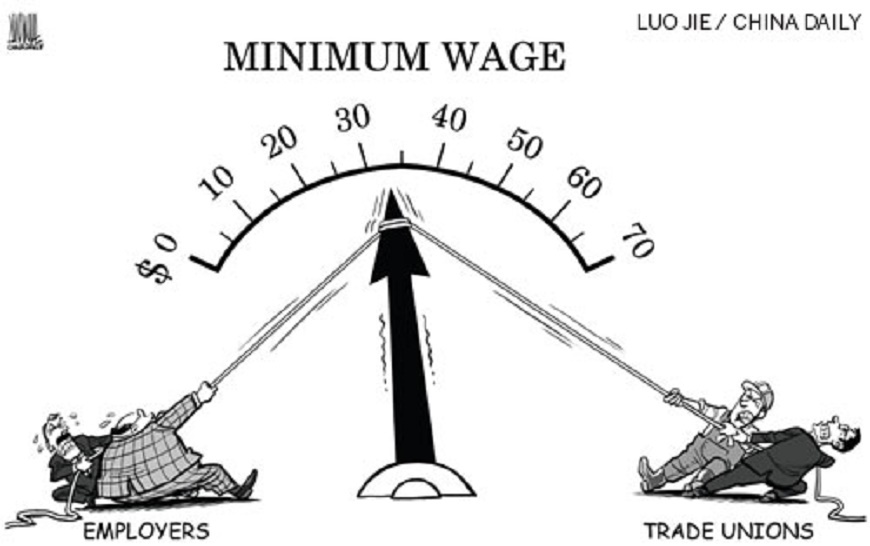
The Nigeria Labour Congress (NLC) has said it would ensure that the next national minimum wage to be negotiated in 2024 reflects the prevailing cost of living.
The union also lamented that following the removal of fuel subsidy by the federal government, life has become extremely unbearable for workers.
Addressing participants at the opening of the 19th edition of the NLC’s Harmattan School in Abuja, President of the NLC, Mr Joe Ajaero, said it had become necessary for governments at all levels to recognise that life and living conditions were exceedingly difficult, especially for working people in both the formal and informal sectors of the economy.
He said the removal of subsidies on petroleum products further exacerbated challenges faced by working people, unleashing severe pain and contributing to galloping inflation and increasing inequality and poverty.
“We must reckon that a well-motivated and well-remunerated workforce has a positive impact on productivity and national development.
“As we anticipate the commencement of negotiations for the national minimum wage in 2024, we seek the understanding of all stakeholders to ensure that we use this opportunity to arrive at a minimum wage commensurate with the prevailing cost of living,” he said.
Mr Ajaero, who was represented by the Deputy President of the NLC, Mr Benjamin Anthony, said the ultimate goal of negotiating a new minimum wage was to establish a living wage that covers the cost of living and makes allowance for some savings by the workers.
He noted that since the adoption of the Structural Adjustment Programme (SAP) in the mid-1980s and the subsequent wholesale adoption of the neoliberal economy framework, there has been a sustained disruption of the social pillars of society and a cut on public spending on the provision of social services.
According to him, the series of austerity measures adopted by the government have, “significantly impacted on the quality of life of workers, peasants and the poor, thus creating an urgent need for collaboration with a broad segment of the society to form a formidable force for sustained policy engagement with the governments at all levels.”
The NLC president also spoke on the face-off between organised labour and the Imo state government.
According to him, as far as the congress was concerned: “the thing that can assuage its pains is for the Imo State Government to address all labour issues and return the so-called ghost workers to their jobs, pay all outstanding salaries and pensions and call back all victimised workers to their jobs.”
On his part, NLC General Secretary, Mr Emma Ugboaja, said the situation was becoming highly unbearable for the workers and indeed most Nigerians.
“Up till now the federal workers are yet to receive their November salaries and that means December salary might be paid in January.
“This is not what it used to be and if we don’t combat this now, then it becomes absolutely difficult for the average worker to appreciate what is called policy engagement.”
He said payment of salary which was a primary function of government was now becoming difficult to fulfill. “It is unimaginable that payment of salaries will now become collective bargaining issues,” he said.
Economy
Nigeria Gets Fresh $500m World Bank Loan for Small Businesses
By Adedapo Adesanya
The World Bank has approved a $500 million facility for Nigeria to expand longer-term lending to small and medium sized businesses.
Approved under the Fostering Inclusive Finance for MSMEs in Nigeria (FINCLUDE) project, the package comprises a $400 million International Bank for Reconstruction and Development (IBRD) loan and a $100 million International Development Association (IDA) credit. Both IBRD and IDA are members of the World Bank Group.
The scheme will be implemented by the Development Bank of Nigeria (DBN), with credit guarantees provided through DBN’s subsidiary, Impact Credit Guarantee Limited (ICGL).
FINCLUDE is designed to address constraints faced by micro, small, and medium enterprises (MSMEs) in Nigeria which despite accounting for most businesses and nearly half of gross domestic product (GDP) face long-standing barriers to formal finance.
Fewer than one in 20 MSMEs have access to bank credit; loans are often short-term and costly; and collateral requirements exclude many viable firms. Women-led enterprises, which make up a substantial portion of MSMEs, are disproportionately affected, facing higher rejection rates and limited tailored products. Agribusinesses, central to food security and rural livelihoods, similarly struggle to obtain more extended‑tenor financing for equipment, processing, storage, and logistics.
However, FINCLUDE seeks to address these constraints by expanding access to affordable, longer-term finance and tailored solutions for segments with the most significant development impact.
Speaking on this, the World Bank Country Director for Nigeria, Mr Mathew Verghis, said, “FINCLUDE is about jobs, opportunity, and inclusion. By expanding access to finance for viable MSMEs—particularly women-led firms and agribusinesses—Nigeria can accelerate growth and deliver tangible benefits across communities nationwide.
“The project will make it easier for deserving small businesses to get the finance they need to grow and hire workers. With better support for lenders that practice inclusive finance and fairer, longer-term loans for entrepreneurs, we are backing the people who power Nigeria’s economy—especially women and those in agriculture.”
The FINCLUDE project will help to mobilise private investment and expand access to and usage of inclusive, innovative financial products for MSMEs nationwide.
Through DBN, the operation will strengthen the capacity of banks, including microfinance banks and non-bank financial institutions such as financial technologies (fintechs), to provide larger loans with more reasonable repayment periods, and—through ICGL—will scale partial credit guarantees so that lenders can extend credit to businesses they might otherwise consider too risky.
Targeted technical assistance will modernise loan appraisal by leveraging AI-enabled digital platforms to accelerate decision-making, improve data quality, strengthen impact measurement, and build capacity for both MSMEs and participating financial institutions.
According to the World Bank, a strong emphasis on inclusion will ensure that women-led businesses and agribusinesses benefit from these improvements.
Also commenting, Task Team Leader for FINCLUDE, Mrs Hadija Kamayo, said, “FINCLUDE will help to mobilize approximately $1.89 billion in private capital, expand debt financing to 250,000 MSMEs—including at least 150,000 women-led businesses and 100,000 agribusinesses—and issue up to $800 million in guarantees to catalyse lending.
“By extending the average maturity of MSME loans to about three years, it will help firms invest in equipment, factories, staff, and productivity, translating finance into jobs and growth.”
Economy
Nigerian Stocks Close 1.13% Higher to Remain in Bulls’ Territory
By Dipo Olowookere
The local stock market firmed up by 1.13 per cent on Friday as appetite for Nigerian stocks remained strong.
Investors reacted well to the 2026 budget presentation of President Bola Tinubu to the National Assembly yesterday, especially because of the more realistic crude oil benchmark of $64 per barrel compared with the ambitious $75 per barrel for 2025. This year, prices have been between $60 and $65 per barrel.
Business Post observed profit-taking in the commodity and energy sectors as they respectively shed 0.14 per cent and 0.03 per cent.
But, bargain-hunting in the others sustained the positive run, with the consumer goods index up by 3.82 per cent.
Further, the industrial goods space appreciated by 1.46 per cent, the banking counter improved by 0.08 per cent, and the insurance industry gained 0.04 per cent.
As a result, the All-Share Index (ASI) increased by 1,694.33 points to 152,057.38 points from 150,363.05 points and the market capitalisation chalked up N1.080 trillion to finish at N96.937 trillion compared with Thursday’s closing value of N95.857 trillion.
A total of 34 shares ended on the advancers’ chart, while 24 were on the laggards’ log, representing a positive market breadth index and bullish investor sentiment.
Austin Laz gained 10.00 per cent to close at N2.42, Union Dicon also jumped 10.00 per cent to N6.60, Tantalizers increased by 9.80 per cent to N2.69, Aluminium Extrusion improved by 9.78 per cent to N12.35, and Champion Breweries grew by 9.71 per cent to N16.95.
Conversely, Sovereign Trust Insurance dipped by 7.42 per cent to N3.87, Royal Exchange lost 6.84 per cent to trade at N1.77, Omatek slipped by 6.84 per cent to N1.09, Eunisell depreciated by 5.88 per cent to N80.00, and Eterna dropped 5.63 per cent to close at N28.50.
Yesterday, traders transacted 1.5 billion units worth N21.8 billion in 25,667 deals compared with the 839.8 million units sold for N32.8 billion in 23,211 deals in the preceding session, showing a surge in the trading volume by 76.61 per cent, an uptick in the number of deals by 10.58 per cent, and a shrink in the trading value by 33.54 per cent.
Economy
FrieslandCampina, Two Others Erase N26bn from NASD OTC Bourse
By Adedapo Adesanya
Three stocks stretched the bearish run of the NASD Over-the-Counter (OTC) Securities Exchange by 1.21 per cent on Friday, December 19, with the market capitalisation giving up N26.01 billion to close at N2.121 billion compared with the N2.147 trillion it ended a day earlier, and the NASD Unlisted Security Index (NSI) dropping 43.47 points to 3,546.41 points from 3,589.88 points.
The trio of FrieslandCampina Wamco Nigeria Plc, Central Securities Clearing System (CSCS) Plc, and NASD Plc overpowered the gains printed by four other securities.
FrieslandCampina Wamco Nigeria Plc lost N6.00 to sell at N54.00 per unit versus N60.00 per unit, NASD Plc shrank by N3.50 to N58.50 per share from N55.00 per share, and CSCS Plc depleted by N2.91 to N33.87 per unit from N36.78 per unit.
On the flip side, Air Liquide Plc gained N1.01 to close at N13.00 per share versus N11.99 per share, Golden Capital Plc appreciated by 70 Kobo to N7.68 per unit from N6.98 per unit, Geo-Fluids Plc added 39 Kobo to sell at N5.50 per share versus N5.11 per share, and IPWA Plc rose by 8 Kobo to 85 Kobo per unit from 77 Kobo per unit.
During the trading day, market participants traded 1.9 million securities versus the previous day’s 30.5 million securities showing a decline of 49.3 per cent. The value of trades went down by 64.3 per cent to N80.3 million from N225.1 million, but the number of deals jumped by 32.1 per cent to 37 deals from 28 deals.
Infrastructure Credit Guarantee Company (InfraCredit) Plc finished the session as the most active stock by value on a year-to-date basis with 5.8 billion units valued at N16.4 billion, followed by Okitipupa Plc with 178.9 million units transacted for N9.5 billion, and MRS Oil Plc with 36.1 million units traded for N4.9 billion.
The most active stock by volume on a year-to-date basis was still InfraCredit Plc with 5.8 billion units worth N16.4 billion, trailed by Industrial and General Insurance (IGI) Plc with 1.2 billion units sold for N420.7 million, and Impresit Bakolori Plc with 536.9 million units traded for N524.9 million.
-
Feature/OPED6 years agoDavos was Different this year
-
Travel/Tourism9 years ago
Lagos Seals Western Lodge Hotel In Ikorodu
-
Showbiz3 years agoEstranged Lover Releases Videos of Empress Njamah Bathing
-
Banking7 years agoSort Codes of GTBank Branches in Nigeria
-
Economy3 years agoSubsidy Removal: CNG at N130 Per Litre Cheaper Than Petrol—IPMAN
-
Banking3 years agoFirst Bank Announces Planned Downtime
-
Banking3 years agoSort Codes of UBA Branches in Nigeria
-
Sports3 years agoHighest Paid Nigerian Footballer – How Much Do Nigerian Footballers Earn