Economy
Selecting a Forex Turnkey Solution for Your Brokerage Business in 2024: Key Considerations
The exponential expansion and lucrative prospects within the Forex trading sector continue to attract numerous businesses annually. If you’re thinking of starting your own retail Forex brokerage, it’s important to understand all the unique merits offered by a Forex turnkey solution.
Let’s delve into the advantages associated with adopting such a solution and discuss pivotal factors while seeking the most fitting system tailored to your requirements in 2024.
Overview of Forex Turnkey Solutions
The concept of Forex turnkey solutions offers a comprehensive solution for enterprises aiming to establish a Forex brokerage with minimal effort and time investment. It encompasses secure payment gateways, access to modern technology, and guidance on regulatory compliance.
Within the turnkey Forex framework lie white-label platforms, social trading systems, risk management solutions, and automated trading modules, facilitating the swift establishment of an online Forex brokerage service without the need to construct it from the ground up.
Advantages of Utilising a Turnkey Solution for FX Brokerage Launch
An all-encompassing solution offers a wide variety of services and functionalities, assisting business owners in swiftly establishing their Forex brokerage with minimal initial expenses. This system offers numerous advantages during the inception of a new FX trading enterprise.
Accelerated Time-to-Market
A turnkey Forex solution is meticulously crafted to expedite your launch process. With this system, the entire setup procedures can be executed within days rather than weeks or months. This swifter setup duration can equip entrepreneurs with superiority over opponents who might still be dealing with constructing their infrastructure from scratch. Moreover, with a pre-fabricated platform boasting integrated features, you can promptly start revenue generation.
Decreased Overhead Expenses
Forex turnkey solutions effectively diminish overhead costs by supplying a pre-constructed trading platform. The necessity to recruit additional personnel, such as developers and designers, for platform creation becomes unnecessary. Risk management protocols, automated trading modules, and secure payment gateways are integrated into the system, thereby economising both time and financial resources typically expended during development.
Access to Leading-Edge Technology and Features
A Forex turnkey solution grants access to cutting-edge trading technologies, including sophisticated charting tools, automated trading robots, and analytics modules. This access helps in refining trading strategies, maintaining a competitive edge, and ensuring compliance with anti-money laundering regulations.
Enhanced Focus on Fundamental Business Operations
A turnkey system empowers business proprietors to swiftly launch their trading enterprises without delving into intricate technicalities. This enables them to concentrate on their fundamental business operations and generate revenue rather than allocating resources towards setup expenses.
Heightened Revenue Prospects and Profitability
Employing an FX turnkey system provides entrepreneurs with augmented revenue and profitability prospects by quickening time-to-market, capitalising on Forex market trends, and limiting costs through access to sophisticated tools like automated trading modules and risk management systems. When evaluating potential solutions, it’s crucial to thoroughly consider all available options to pinpoint the one that aligns best with your business requirements.
Making Your Decision in 2024
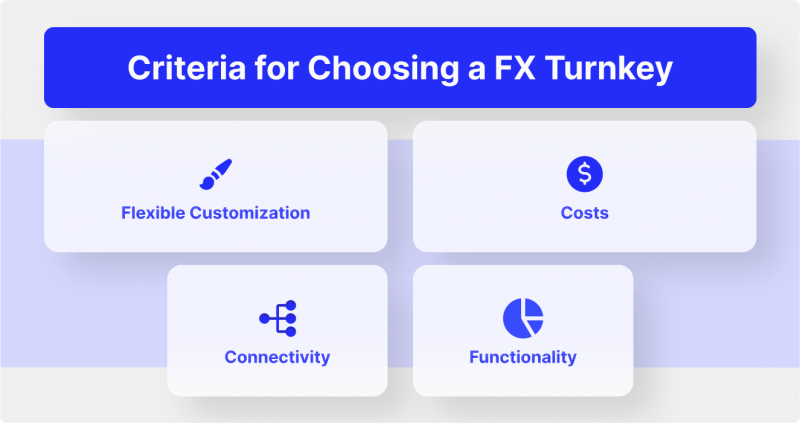
In 2024, there is a big choice of turnkey solution providers. Amidst this plethora of options, determining which features and technologies will best suit a company’s needs can be a daunting task. To ensure the selection of the most suitable option, businesses should take into account the following factors:
- The initial step in choosing a turnkey Forex broker involves defining the company’s goals and objectives. It’s imperative to consider the intended trading activities and ensure that the chosen solution possesses the necessary technology and capabilities to support them effectively.
- The alignment with the target audience is crucial when selecting a turnkey solution. Each solution caters to a different audience, emphasising the importance of choosing one that resonates well with the specific customer base.
- The evaluation of features and technology provided by a Forex broker turnkey solution is paramount. Paying particular attention to automated trading platform modules and risk management tools is crucial, as they can significantly impact trading performance and profitability.
- A dependable liquidity provider is vital for a Forex business. Therefore, understanding the available FX liquidity options and selecting the one that aligns best with business requirements is indispensable when choosing a turnkey solution.
- Compliance with relevant laws and regulations is of utmost importance. Opting for solutions licensed and regulated by reputable authorities helps ensure the business operates within legal boundaries.
- Thoroughly researching the cost and pricing structure of each turnkey solution is essential. Since options vary in features, services, and pricing, it’s crucial to select one that fits within the budget requirements.
- Choosing a reliable Forex turnkey solution that offers robust customer support and technical assistance is crucial. This ensures ongoing help in case of any system issues.
By carefully considering these factors while selecting a Forex turnkey solution in 2024, businesses can make informed decisions that align with their needs.
In Summary
Choosing the appropriate Forex turnkey solution holds immense importance for businesses in 2024. By carefully considering the key factors outlined above, companies can identify a solution that not only meets their needs but also empowers them to optimise profits. With the right turnkey system, companies can streamline their trading operations, leading to enhanced profitability and smoother overall performance.
Economy
NASD Exchange Extends Bearish Run After 0.56% Drop
By Adedapo Adesanya
The NASD Over-the-Counter (OTC) Securities Exchange extended its stay in the south territory with a decline of 0.56 per cent on Wednesday, April 2.
This brought down the market capitalisation by N13 billion to N2.417 trillion from N2.430 trillion, and downed the NASD Unlisted Security Index (NSI) by 22.57 points to 4,062.87 points from the previous session’s 4,062.87 points.
It was observed that the NASD exchange ended with three price gainers and three price losers during the trading day.
MRS Oil Plc depreciated by N19.00 to close at N171.00 per unit compared with the previous price of N190.00 per unit, NASD Plc lost N4.14 to trade at N37.36 per share compared with Wednesday’s N41.50 per share, and Central Securities Clearing System (CSCS) Plc gave up N2.00 to sell at N78.00 per unit versus N80.00 per unit.
On the flip side, FrieslandCampina Wamco Nigeria Plc appreciated by 19 Kobo to N93.00 per share from N92.81 per share, Food Concepts Plc expanded by 15 Kobo to N2.87 per unit from N2.72 per unit, and Great Nigeria Insurance (GNI) Plc improved by 2 Kobo to 52 Kobo per share from 50 Kobo per share.
Yesterday, the volume of securities dipped by 91.8 per cent to 260.2 million units from 3.2 billion units, the value of securities went down by 98.1 per cent to N154.2 million from N8.3 billion, while the number of deals soared by 53.3 per cent to 46 deals from 30 deals.
GNI Plc was the most active stock by value on a year-to-date basis with 3.4 billion units worth N8.4 billion, followed by CSCS Plc with 56.9 million units valued at N3.9 billion, and Okitipupa Plc with 27.5 million units traded for N1.8 billion.
The most traded stock by volume on a year-to-date basis was also GNI Plc with 3.4 billion units sold for N8.2 billion, trailed by Resourcery Plc with 1.1 billion units exchanged for N415.7 million, and Infrastructure Guarantee Credit Plc with 400 million units transacted for N1.2 billion.
Economy
Naira Slips to N1,380/$1 at Official Market, Remains N1,405/$1 at Black Market
By Adedapo Adesanya
The Naira dropped N2.09 or 0.15 per cent against the United States Dollar in the Nigerian Autonomous Foreign Exchange Market (NAFEX) on Thursday, April 2, to trade at N1,380.79/$1 compared with Wednesday’s rate of N1,378.70/$1.
However, it appreciated against the Pound Sterling in the official market by N2.77 to quote at N1,824.86/£1 versus the N1,836.57/£1 it was traded at midweek, and improved its value against the Euro by N10.54 to N1,591.92/€1 from N1,602.46/€1.
Yesterday was the last trading session of the week for the local currency in the spot market, as the market will be closed on Friday and Monday for the Easter Holiday.
At the black market, the Nigerian Naira maintained stability against the greenback yesterday at N1,405/$1, but gained N8 at the GTBank FX counter to settle at N1,388/$1, in contrast to the previous session’s N1,396/$1.
Pressure eased on the domestic currency as strong policy indicators have helped calm the majority of worries within the financial systems. Particularly in the remittance segment, the apex bank has directed all International Money Transfer Operators (IMTOs) to route remittance transactions through designated Naira settlement accounts in banks, a move aimed at boosting transparency and channelling more foreign exchange into the formal market.
This helps take off pressure from the foreign reserves, which have fallen below the $50 billion mark as they are gradually decreasing rather than falling sharply.
Meanwhile, the cryptocurrency market was bullish on Thursday, as macro sentiment shifted against recent optimism after reports that Iran is drafting a protocol with Oman to manage traffic through the Strait of Hormuz, easing concerns about disruptions to a key global oil route.
The remarks came after U.S. President Trump on Wednesday night vowed to hit Iran “extremely hard” in the coming weeks and that the Strait of Hormuz would “open naturally” once the war ends.
Cardano (ADA) chalked up 1.9 per cent to trade at $0.2435, Dogecoin (DOGE) grew by 1.2 per cent to $0.0912, Ethereum (ETH) appreciated by 0.8 per cent to $2,066.37, Bitcoin (BTC) added 0.5 per cent to sell at $67,080.53, Solana (SOL) increased by 0.5 per cent to $79.91, and Ripple (XRP) jumped 0.2 per cent to $1.31.
Conversely, Binance Coin (BNB) dipped 0.7 per cent to $586.90, and TRON (TRX) depreciated by 0.3 per cent to $0.3147, while the US Dollar Tether (USDT) and the US Dollar Coin (USDC) closed flat at $1.00 each.
Economy
Bulls, Bears Share Customs Street’s Spoils Amid Bullish Investor Sentiment
By Dipo Olowookere
The local stock market was relatively flat on Friday, as the bears and the bulls shared the spoils of war, though investor sentiment turned bullish compared with the preceding session’s bearish posture.
Data from the Nigerian Exchange (NGX) Limited showed that the All-Share Index (ASI) was marginally down by 4.66 points as it ended at 201,698.89 points versus Wednesday’s 201,703.55 points, and the market capitalisation slightly contracted by N3 billion to N129.806 trillion from N129.809 trillion.
Customs Street was shut on Friday because of the public holidays declared by the federal government today and next Monday.
Business Post reports that John Holt declined by 9.91 per cent to N15.45, Abbey Mortgage Bank shed 9.60 per cent to trade at N8.95, International Energy Insurance slipped by 6.48 per cent to N3.32, Chams shrank by 5.30 per cent to N3.75, and Tantalizers depreciated by 5.18 per cent to N4.03.
On the flip side, Unilever Nigeria improved by 10.00 per cent to N103.40, Fortis Global Insurance gained 9.82 per cent to trade at N1.23, Multiverse appreciated 9.81 per cent to N20.15, Legend Internet advanced by 9.38 per cent to N6.30, and Zichis grew by 9.02 per cent to N14.14.
The market breadth index was positive during the trading session, as there were 35 appreciating stocks and 24 depreciating stocks.
Yesterday, investors traded 560.0 million equities valued at N19.3 billion in 49,676 deals, in contrast to the 815.5 million equities worth N33.3 billion transacted in 52,641 deals in the preceding day, representing a drop in the trading volume, value, and number of deals by 31.33 per cent, 42.04 per cent, and 5.63 per cent, respectively.
Secure Electronic Technology dominated the activity log with 59.7 million shares valued at N61.1 million, Wema Bank exchanged 52.0 million equities worth N1.4 billion, VFD Group transacted 36.0 million stocks for N410.5 million, Access Holdings sold 35.3 million shares valued at N914.8 million, and Chams traded 31.0 million equities worth N115.0 million.
-
Feature/OPED6 years agoDavos was Different this year
-
Travel/Tourism10 years ago
Lagos Seals Western Lodge Hotel In Ikorodu
-
Showbiz3 years agoEstranged Lover Releases Videos of Empress Njamah Bathing
-
Banking8 years agoSort Codes of GTBank Branches in Nigeria
-
Economy3 years agoSubsidy Removal: CNG at N130 Per Litre Cheaper Than Petrol—IPMAN
-
Banking3 years agoSort Codes of UBA Branches in Nigeria
-
Banking3 years agoFirst Bank Announces Planned Downtime
-
Sports3 years agoHighest Paid Nigerian Footballer – How Much Do Nigerian Footballers Earn