General
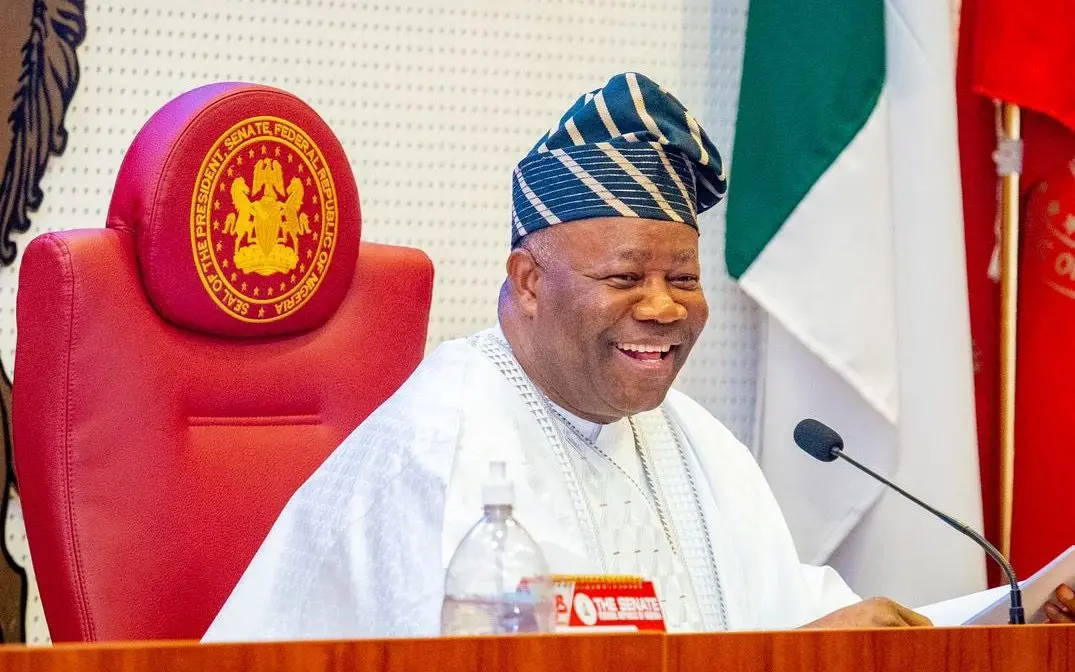
Senate Forms Seven-Man Committee to Harmonise Electoral Act Amendment Bill
By Adedapo Adesanya
The Senate has constituted a seven-man committee to harmonise contributions and opinions on the Electoral Act Amendment Bill, 2026, with a mandate to present a consolidated report to the chamber next Tuesday.
The decision followed over two hours of consideration of the bill’s provisions during a closed-door session on Thursday.
The committee is chaired by the Chairman of the Senate Committee on Judiciary, Human Rights and Legal Matters, Mr Niyi Adegbomore.
Other members are Senators Adamu Aliero, Aminu Tambuwal, Adams Oshiomhole, Danjuma Goje, Tony Nwoye, and Titus Zam.
The group has three days to conclude its assignment and submit its report for consideration at the next plenary session scheduled for next week.
The Senate on Thursday commenced consideration of the Electoral Act 2022 (Repeal and Re-enactment) Bill 2026, moving into a closed-door session to review documents submitted by the Chairman of the Senate Committee on Electoral Matters, Mr Simon Lalong.
The Electoral Act (Repeal and Enactment) Bill, 2025 would expand voter participation, safeguard against electoral fraud, and strengthen institutional capacity of the Independent National Electoral Commission (INEC).
The closed session was convened to allow lawmakers to thoroughly examine the proposed amendments and supporting documents before engaging in further legislative debate on the bill.
This development comes after the upper chamber deferred consideration of the bill on Wednesday, giving lawmakers time to prepare for a detailed review.
Although the House of Representatives has already passed the bill, Senate President Senator Godswill Akpabio underscored the need for thorough scrutiny, given the bill’s implications for the nation’s electoral process.
“This is a very important bill, especially as it is election time. We must take our time to ensure justice is done to all, so that we do not end up at the tribunal,” he said.
According to the committee’s findings, a clause-by-clause analysis of the bill indicates that enacting the legislation would leave Nigerians with an enduring legacy of electoral integrity, enhance transparency, and boost public confidence.
The bill contains more than 20 key innovations distinguishing it from previous electoral frameworks, including provisions recognising the voting rights of prisoners and mandating INEC to register eligible inmates in correctional facilities nationwide.
It also prescribes sanctions for vote-buying ranging from a fine of N5 million to a two-year jail term, as well as a 10-year ban from contesting elections. It also recommends mandatory jail terms and higher fines for offences such as result falsification and obstruction of election officials.
Others include standardising delegates for indirect party primaries to prevent arbitrary determination of delegate criteria by party leaders, while addressing perennial funding challenges to the Independent National Electoral Commission (INEC) by mandating the release of election funds at least one year before polling day.
General
Tinubu Seeks Senate Approval to Borrow $516m from Deutsche Bank
By Modupe Gbadeyanka
President Bola Tinubu has asked the Senate to allow him to borrow about $516.3 million for the Sokoto-Badagry highway.
In a letter addressed to the Senate President, Mr Godswill Akpabio, on Thursday, Mr Tinubu said the loan would be obtained from Deutsche Bank, as the Federal Executive Council (FEC) has already approved the financing plan in one of its meetings.
The President begged the upper chamber of the National Assembly for a quick authorisation of the fresh loan to fast-track work on the project, which is expected to further boost the nation’s economy.
According to him, the superhighway project is a flagship initiative under his administration’s Renewed Hope Agenda designed to enhance national connectivity, reduce travel time, and improve the movement of goods across key economic corridors.
He informed the Senate in the letter that the loan is structured for nine years, including a three-year grace period, with an interest rate pegged at the Chicago Mercantile Exchange SOFR plus 5.3 per cent per annum.
Speaking on the request, the Senate President, who referred the letter to the Committee on Local and Foreign Debts for legislative action and a report back in one week, emphasised that it is better to borrow for projects to improve road safety and foster national integration.
The proposed 1,000-kilometre road will link Sokoto, Kebbi, Niger, Kwara, Oyo, Ogun, and Lagos States, connecting Illela to Badagry.
General
NNPC, Sonatrach Sign Decarbonisation, Innovation MoU
By Adedapo Adesanya
The Nigerian National Petroleum Company (NNPC) Limited and Algeria’s Sonatrach have partnered through a Memorandum of Understanding (MoU) to drive decarbonisation and innovation in Africa’s oil sector.
The agreement, signed by NNPC’s Executive Vice President for Business Services, Mrs Sophia Mbakwe, and Sonatrach’s Managing Director, Ms Khodjah Mohamed, establishes collaboration in research, technology exchange, and development.
The agreement signed by the state oil companies of both nations took place during the opening ceremony of the 3rd Meeting of the African Petroleum Producers’ Organisation (APPO) Forum for R&D Directors at the PTDF Tower in Abuja, Nigeria. The event brought together research and development directors from APPO member countries.
The minister of state for Petroleum Resources (Oil), Mr Heineken Lokpobiri, said the forum was one of four measures introduced by APPO to address challenges from the global energy transition, which centre on funding, technology and markets.
“The R&D forum tackles technology and expertise needs, the African Energy Bank addresses funding constraints, and the Central African Pipeline System supports regional oil and gas market integration,” Mr Lokpobiri, who was represented by former secretary general of APPO, Mr Omar Farouk Ibrahim, stated.
On his part, the Group chief executive officer, NNPC Limited, Mr Bayo Ojulari, represented by the company’s chief financial officer, Mr Adedapo Segun, said research and development must form a central part of the overall strategy in the African oil and gas industry.
He called for research and development centres to function as engines of industrial competitiveness. “Collaboration in research and development is of strategic importance. The cost of innovation might be high, but the cost of obsolescence would be greater,” he stressed.
Mr Ojulari called for a unified strategic framework through which resources could be pooled, data integrated and risks shared across member countries. He further urged the rapid adoption of digital technologies, artificial intelligence and advanced engineering to improve upstream, midstream and downstream operations.
On his part, the APPO Secretary General, Mr Farid Ghezali, urged African petroleum-producing countries to ensure research in the oil and gas sector produced solutions that are practical and directly relevant to the continent. “We must ensure that our research delivers solutions that are practical and of direct use to Africa,” he stated.
Also speaking, Executive Secretary of the Petroleum Technology Development Fund (PTDF), Mr Shu’aibu Shehu Aliyu, highlighted the value of the partnership between NNPC Limited and PTDF in support of decarbonisation and environmental protection work across APPO member countries.
Chief innovation officer of NNPC Research, Technology and Innovation and incoming chairman of the APPO R&D Directors Forum, Mr Rasheed Ojulari, said the forum would give immediate priority to joint programmes in the core areas of upstream optimisation, artificial intelligence, decarbonisation processes and industrial systems development.
General
Adelabu Proposes Creation of Coordinating Minister for Energy
By Adedapo Adesanya
The Minister of Power, Mr Adebayo Adelabu, has resigned from office and proposed the creation of a Coordinating Minister for Energy to drive integrated reforms across Nigeria’s power and gas sectors.
The former deputy governor of the Central Bank of Nigeria (CBN), in a resignation letter dated April 22, 2026, and addressed to President Bola Tinubu, said his resignation will take effect from April 30, 2026, to enable him to pursue his governorship ambition in Oyo State.
He noted that his decision is in line with the provisions of the Amended Electoral Act 2026, which bars serving political office holders from contesting elections.
Confirming the development, the Minister’s Special Adviser on Strategic Communications and Media Relations, Bolaji Tunji, said Mr Adelabu expressed appreciation to the President for the opportunity to serve, describing his tenure as a privilege to contribute to national development.
The outgoing minister stressed the need for stronger coordination in the energy sector, recommending the establishment of a Coordinating Minister for Energy to harmonise policies and ensure effective implementation across power, gas and related sectors.
Mr Adelabu highlighted key achievements recorded during his tenure, including the implementation of the Electricity Act 2023, which decentralised the electricity market and improved the investment climate.
He added that peak power generation increased to over 6,000 megawatts, driven by the integration of the Zungeru Hydropower Plant and the rehabilitation of thermal plants.
He also noted improvements in transmission capacity through grid upgrades under the Presidential Power Initiative, as well as progress in the distribution segment, including enhanced regulatory oversight, improved revenue collection and efforts to reduce Aggregate Technical, Commercial and Collection (ATC&C) losses.
According to him, strides were also made in closing the metering gap through the Presidential Metering Initiative and the World Bank-supported Distribution Sector Recovery Programme.
On the financial side, Mr Adelabu said tariff reforms and a N4 trillion debt restructuring programme boosted market revenues from N1 trillion in 2023 to N2.3 trillion in 2025, helping to restore investor confidence in the sector.
Despite these gains, he acknowledged ongoing challenges such as gas supply constraints, infrastructure vandalism and the need for full commercialisation of the electricity value chain.
To address these issues, he proposed measures including the implementation of cost-reflective tariffs with targeted subsidies, recapitalisation of distribution companies, accelerated nationwide metering, sustained investment in transmission infrastructure and stronger regulatory enforcement.
Mr Adelabu emphasised that the creation of a Coordinating Minister for Energy would provide the strategic oversight needed to improve gas supply for power generation, optimise hydroelectric resources and accelerate renewable energy development.
He assured that he would ensure a smooth handover process and thanked the President for his support throughout his time in office.
-
Feature/OPED6 years agoDavos was Different this year
-
Travel/Tourism10 years ago
Lagos Seals Western Lodge Hotel In Ikorodu
-
Showbiz3 years agoEstranged Lover Releases Videos of Empress Njamah Bathing
-
Banking8 years agoSort Codes of GTBank Branches in Nigeria
-
Economy3 years agoSubsidy Removal: CNG at N130 Per Litre Cheaper Than Petrol—IPMAN
-
Banking3 years agoSort Codes of UBA Branches in Nigeria
-
Banking3 years agoFirst Bank Announces Planned Downtime
-
Sports3 years agoHighest Paid Nigerian Footballer – How Much Do Nigerian Footballers Earn

Pingback: Amupitan Says 2027 Elections Timetable Ready Despite Electoral Act Delay | Business Post Nigeria