Connect with us

Economy

UN Deputy Scribe Urges Developing Countries to Embrace Green Bond

Published

on

By Modupe Gbadeyanka

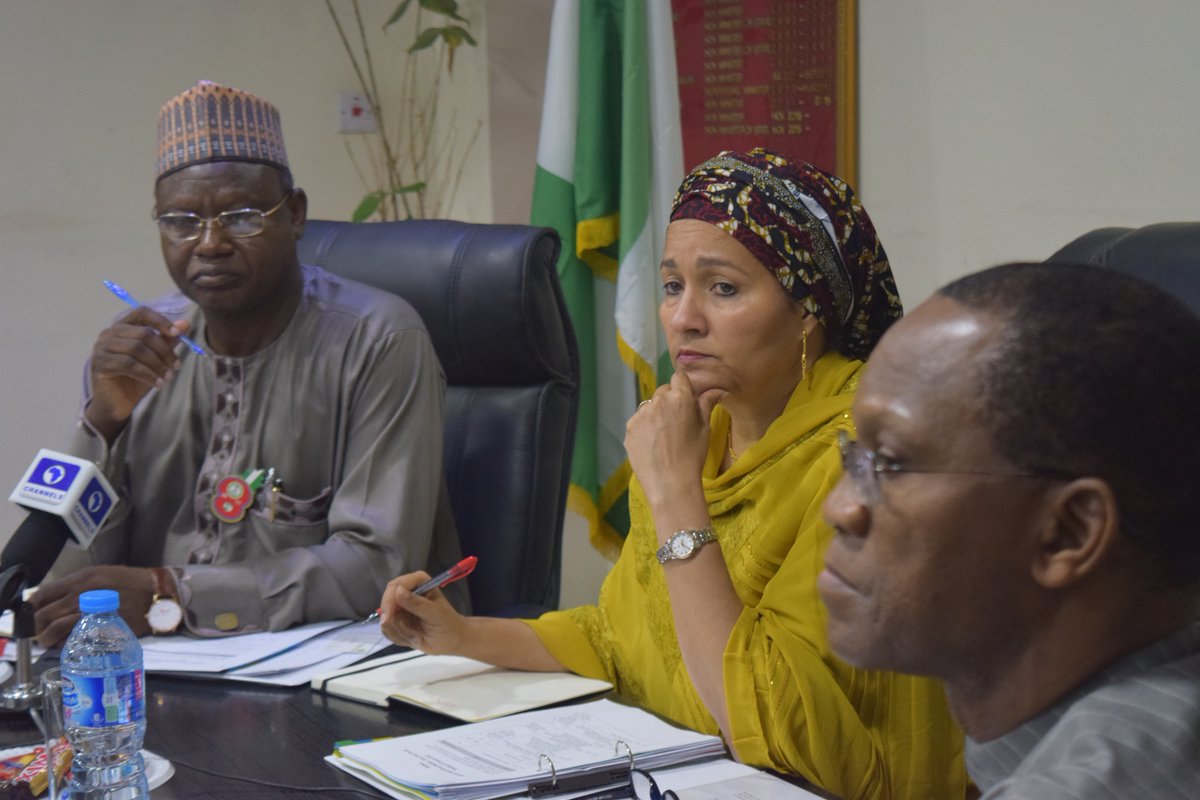
Deputy Secretary-General of the United Nations, Mrs Amina Mohammed, has advised developing countries to take advantage of the Green Bond market in financing some projects.

The former Nigeria’s Minister of Environment said her experience of the Green Bond in Nigeria was an “exciting initiative to use, to leverage, the implementation of the Nationally Determined Contributions (NDC).

Mrs Mohammed, while addressing members of the press in New York on Tuesday, noted that the “sovereign Green Bond, which will be the first ones issued at the end of March in emerging countries is very exciting, and I think that the model that should be taken there is that countries themselves need to go through a process that strengthens integration and that they institutionally can then rise to the opportunities of other financing coming into the international Green Bond market.”

She described the initiative as “huge”, stressing that it has “brought in a lot of the private sector into this, in a way, I think, that is constructive and gets government providing the enabling environment but the private sector really taking things to scale.

“It has to be about jobs and our economies improving in Africa, so yes, I do think that that is important.”

The UN Deputy Scribe also used the occasion to express her total commitment to the vision of the Secretary General of the global body, Mr
António Guterres.

Mrs Mohammed, while thanking Mr Guterres for the privilege to work with him, said she will be “focusing primarily on helping (her boss) to reposition sustainable development at the United Nations and as he has stated, sustainable development is an end in itself but it is also the best way that we feel that we can achieve universal peace.”

She further stated that, “I’m attaching great importance to the promise of leaving no one behind, so starting with those that are furthest behind, really looking to see how we can address that in a robust manner that brings everyone into the sustainable development agenda, addressing gender barriers that we’ve seen constantly; that we have achieved some success in that, not enough.

“We need to go to scale at this point. We also need to empower youth, agents of peace and development.

“I can say that in the recent 15 months that I have been home, after helping to shape the 2030 Agenda, youth have been the greatest challenge that we have faced but also the greatest potential to finding solutions for peace and development.

“I will be supporting the SG in the comprehensive review of the UN development system; this will be in close consultation with Member States.

“We have the advantage that the three major agendas that we agreed in 2015, were really from an inclusive process where Member States owned it and lead on it.

“And so supporting them to get an ambitious response at the country level is one that I believe will have a much easier task than we would have had previously, so therefore, those consultations will be given utmost priority.

“We shall become as the United Nations much more fit for purpose.”

Commenting on the $4 billion famine drive, Mrs Mohammed said, “We need to be ahead of the curve and not behind it, and so we do press for the support we need in those four countries.

“This famine is not just going to be limited to them if we don’t address it in a very urgent way. I think that the results that we saw in Oslo recently are warming and I think that this is showing that there is a way forward on some of this.

“We need to listen to some of the issues that were raised there.

“Again, bringing agencies and partnerships together in a much more coordinated and coherent manner, will help us get further, leveraging resources from different constituencies now, different partnerships in a global agenda, this is becoming more complex, but it is bringing in more returns and so again, we are not taking our foot off the urgency pedal, it is really urgent that we get much more, much more quickly, but so far the [outings?] have proved to be positive.”


Modupe Gbadeyanka is a fast-rising journalist with Business Post Nigeria. Her passion for journalism is amazing. She is willing to learn more with a view to becoming one of the best pen-pushers in Nigeria. Her role models are the duo of CNN's Richard Quest and Christiane Amanpour.

Click to comment

Leave a Reply

Your email address will not be published. Required fields are marked *

Economy

MRS Oil, FrieslandCampina Wamco Shrink NASD Index by 0.68%

Published

on

MRS Oil voluntary delisting

By Adedapo Adesanya

The duo of MRS Oil and FrieslandCampina Wamco Nigeria Plc weakened the NASD Over-the-Counter (OTC) Securities Exchange by 0.68 per cent on Friday, June 5.

MRS Plc lost N19.00 during the session to sell at N171.00 per share compared with Thursday’s value of N190.00 per share, and FrieslandCampina Wamco Nigeria Plc depreciated by N8.70 to finish at N181.68 per unit compared with the preceding session’s N190.38 per unit.

As a result, the market capitalisation further lost N22.59 billion to close at N2.607 trillion versus the N2.630 trillion it ended a day earlier, and the NASD Unlisted Security Index (NSI) dropped 37.76 points to settle at 4,358.32 points, in contrast to the previous day’s 4,396.08 points.

The alternative stock market closed the last trading day of this week with a price gainer, Central Securities Clearing System (CSCS) Plc, which gained 6 Kobo to quote at N78.40 per share compared with the preceding session’s N78.34 per share. However, it could not prevent the market from going down at the close of business.

Yesterday, the volume of securities bought and sold by investors went down by 50.0 per cent to 140,345 units from the preceding day’s 280,714 units, the value of stocks decreased by 16.5 per cent to N17.9 million from the previous session’s N21.5 million, and the number of deals carried out by market participants fell by 35.7 per cent to 27 deals from the 42 deals recorded on Thursday.

When trading activities closed for the day, Great Nigeria Insurance (GNI) Plc remained the most active stock by value on a year-to-date basis, with 3.4 billion units exchanged for N8.4 billion, trailed by Infrastructure Credit Guarantee (Infracredit) Plc with 2.3 billion units sold for N6.5 billion, and CSCS Plc with 64.7 million units traded for N4.4 billion.

GNI Plc also ended the session as the most traded stock by volume on a year-to-date basis, with 3.4 billion units worth N8.4 billion, followed by Infracredit Plc with 2.3 billion units transacted for N6.5 billion, and Resourcery Plc with 1.1 billion units valued at N415.7 million.

Continue Reading

Economy

NGX Index Rebounds 0.15% on Renewed Interest in Financial Stocks

Published

on

Financial Stocks

By Dipo Olowookere

Renewed interest in financial stocks and others lifted the Nigerian Exchange (NGX) Limited by 0.15 per cent on Friday.

Customs Street closed higher yesterday despite the 1.37 per cent loss recorded by the consumer goods sector as a result of profit-taking.

This was offset by gains in the other key sectors of the local bourse, as the insurance counter chalked up 1,14 per cent. The banking space appreciated by 0.90 per cent, the industrial goods segment grew by 0.46 per cent, and the energy sector expanded by 0.01 per cent.

Consequently, the All-Share Index (ASI) went up by 366.00 points to 242,593.31 points from 242,227.31 points, and the market capitalisation gained N235 billion to close at N155.594 trillion compared with the previous day’s N155.359 trillion.

The trio of International Energy Insurance, Abbey Mortgage Bank, and DAAR Communications improved by 10.00 per cent each yesterday to N7.26, N9.35, and N1.98, respectively, while Zichis advanced by 9.39 per cent to N32.38, with Sovereign Trust Insurance up by 8.70 per cent to N2.50.

On the flip side, Academy Press lost 9.84 per cent to quote at N8.25, University Press depreciated by 9.73 per cent to N5.10, Africa Prudential dipped by 2.63 per cent to N12.95, Chams crumbled by 2.44 per cent to N4.00, and International Breweries slipped by 1.59 per cent to N12.35.

Business Post reports that the market breadth index was positive during the session after recording 37 appreciating equities and 14 depreciating equities, implying strong investor sentiment.

Abbey Mortgage Bank led the activity chart with a turnover of 164.1 million units worth N1.5 billion, Ellah Lakes sold 76.7 million units for N767.2 million, Access Holdings transacted 44.8 million units valued at N1.1 billion, Linkage Assurance exchanged 23.0 million units worth N41.2 million, and The Initiates traded 20.2 million units for N562.1 million.

At the close of trades, market participants transacted 608.5 million units worth N32.0 billion in 53,826 deals versus the 588.5 million units valued at N27.9 billion executed in 57,352 deals in the previous session. This showed that the number of deals eased by 6.15 per cent, the volume of transactions rose by 3.40 per cent, and the value of transactions soared by 14.70 per cent.

Continue Reading

Economy

Naira Depreciates to N1,362/$1 at Official Market

Published

on

Naira 4 Dollar

By Adedapo Adesanya

The Naira further depreciated against the United States Dollar by N3.46 or 0.25 per cent to N1,362.21/$1 from N1,358.75/$1 in the Nigerian Autonomous Foreign Exchange Market (NAFEX) on Friday, June 5.

However, it appreciated against the Pound Sterling in the same market window during the session by N4.47 to trade at N1,823.59/£1 compared with the previous day’s N1,828.06/£1, and gained N7.00 against the Euro to sell at N1,574.58/€1, in contrast to Thursday’s closing price of N1,581.58/€1.

For another trading session, the Nigerian Naira maintained stability against the Dollar in the parallel market and the GTBank forex counter on Friday at N1,375/$1 and N1,372/$1, respectively.

The Naira is expected to remain strong in the near term, backed by a rise in external reserves, which are nearing $50 billion, enhancing analysts’ confidence about its outlook in the second half of 2026.

Heightened global uncertainty has reduced the incentive for importers and corporates to demand FX, as cautious trade weighs on import needs. Analysts estimate a $40 billion net FX position for the year, a projection anchored in oil windfall gains.

As for the cryptocurrency market, prices remained depressed following a strong US jobs report that spurred markets to price in higher-for-longer interest rates, sending Treasury yields and the dollar up while hammering stocks, especially AI-related names. Crypto markets saw heavy leverage washouts with about $1.6 billion in positions liquidated over 24 hours.

Ethereum (ETH) gave up 4.9 per cent to trade at $1,584.68, Solana (SOL) fell by 3.3 per cent to $63.22, Bitcoin (BTC) crashed by 1.9 per cent to $61,333.23, Dogecoin (DOGE) slipped by 1.8 per cent to $0.0821, and Ripple (XRP) moderated by 1.8 per cent to $1.09.

Further, TRON (TRX) dropped 1.6 per cent to sell at $0.3197, Binance Coin (BNB) slumped by 1.0 per cent to $581.18, and  Cardano (ADA) declined by 0.4 per cent to $0.1589, while the US Dollar Tether (USDT) gained 0.07 to sell at $0.9997, and US Dollar Coin (USDC) closed flat at $0.9998.

Continue Reading

Trending