Connect with us

Economy

Refinery: How Dangote Chose Nigeria Over Saudi Arabia, UAE

Published

on

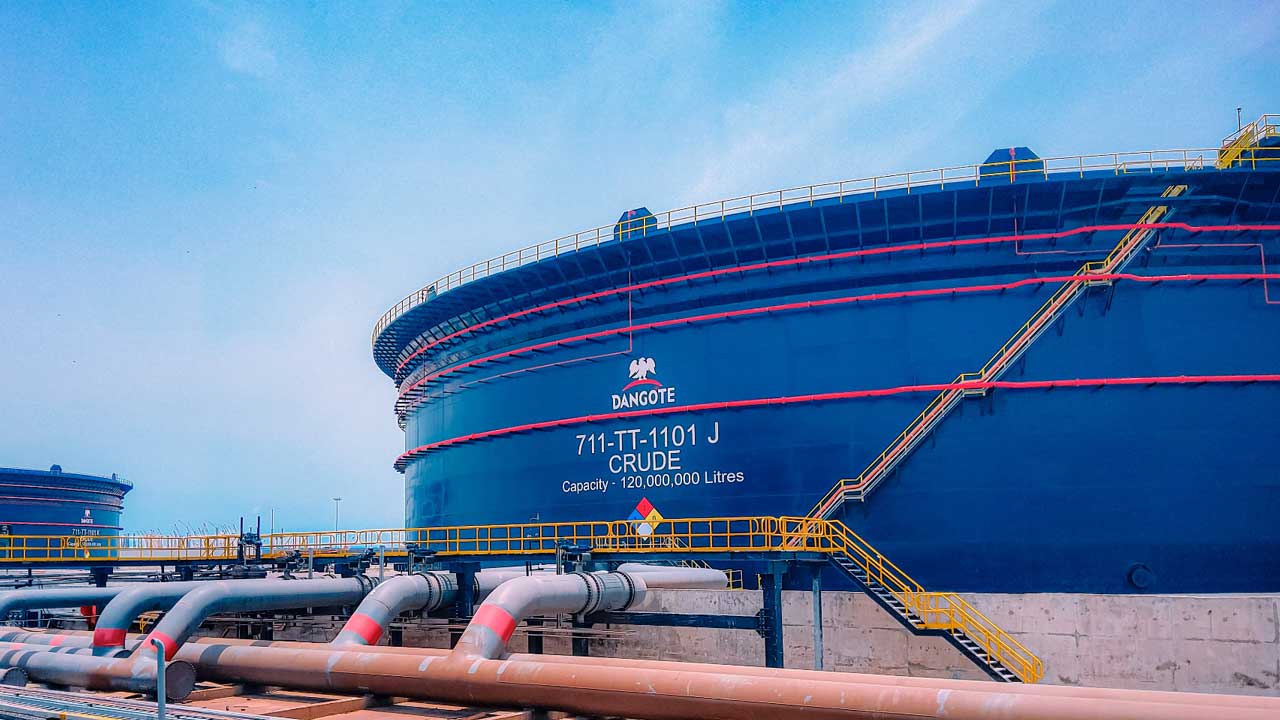
Dangote Refinery Crude Supply to Local Refineries

By Adedapo Adesanya

The Vice-President of Dangote Industries Limited, Mr Devakumar Edwin, has claimed that the $20 billion Dangote Refinery in the Lekki area of Lagos State, Nigeria, could have cited in Saudi Arabia or the United Arab Emirates (UAE) but the owner, Mr Aliko Dangote, decided to establish it in his home country.

He made this disclosure when a coalition of 28 Civil Society Organisations (CSOs) recently visited the facility, which can refine 650,000 barrels of crude per day.

The group was set up to monitor the compliance of the Nigeria National Petroleum Company (NNPC) Limited to the presidential directive to sell crude oil to Dangote Refinery in Naira.

Recall that last week, President Bola Tinubu directed the NNPC to sell crude oil to the refinery and others in local currency.

He described Dangote Refinery as a value-adding facility as it would stop the exportation of Nigeria’s crude and importation of finished products and wondered why the government would be against such a vision for Nigeria.

He said the disposition of the NNPC Limited and the regulatory agencies was a clear indication that they deliberately held down the nation’s refineries so that they could continue importing petroleum products.

According to him, many African countries have minerals but do not add value to their economies because those minerals are exported raw and the finished products are imported back into the country whereas vice versa should have been the order of the day.

“This is what Dangote refinery seeks to correct, we did the same in the cement and sugar sectors where Nigeria was a leading importer of those products and with the coming of Dangote leading the backward integration programme of the government, others came into the sector and together Nigeria now exports cement to other countries.

“What we want to do in Refinery, we have done it other businesses, Nigeria used to be the biggest importer of sugar, we came in and changed the narrative. We led the backward integration scheme of the federal government, and we now produce sugar locally for domestic consumption and others have joined us. We did the same in Cement by opening up a production plant and today Nigeria exports cement to other countries.

“In a business, no one was interested in investing in, Dangote delved into it determined to ensure Nigeria no longer imports fuel, invested massively and came up with the world’s largest single train refinery.

“He said he would not take his money to Dubai or Swiss banks as others are doing, he decided to invest at home and now they are saying he wants to create a monopoly.

“We didn’t ask for any favour other than that we want to buy crude to produce, first they said there was no crude, later they said we would have to pay some dollars above the prevailing crude market price. And this is a global market where you can track crude prices anytime.

“We resorted to buying crude from Brazil and the United States. Later they said we should not be announcing the price of the products.

“Even the US, the leading proponent of a free market economy protects its local industries by imposing huge duties on imports just to protect local industries. This is a man that Saudi Aramco once approached to come and cite his refinery in Saudi Arabia, promising a steady supply of cruse.

“Abu Dhabi also invited him to do the same on their soil but he rejected insisting he would build at home, now he did that and a facility that is supposed to add value to Nigeria’s economy is being frustrated,” he said.

Speaking on behalf of the CSOs, Mr Solomon Adodo of the Rise Up for A United Nigeria said what his group had seen was a world-class facility and wondered how a regulatory agency of the government could take sides with importers of petroleum products when a local refinery is now available to bail the nation out of the forex quagmire which has made the price petroleum products to skyrocket.

He disclosed that the CSOs have concluded to petition the Presidency on the need to adopt Dangote Refinery as a national asset that should be used to liberate the country from the shackles of importation of fuel while it exports crude.

“We are ready to defend this facility with everything as civil society organizations. We are not speaking on our behalf but on behalf of all Nigerians and on behalf of our fatherland. It leaves much to be desired how an agency of government with oversight function to guide to grow such a project as this would now be disparaging same project. This is too bad.

“We have seen for ourselves and we have cleared all doubt as to the completion of this refinery and the readiness to supply all our domestic needs. We will expose them all. Anyone who is not ready to ensure Nigerians have a new lease of life must give way. Now it is a fight to finish.

“Going forward, we are going to set up a situation room to monitor the compliance of the NNPCL with the directive of Mr President that Dangote Refinery would be supplied with Crude in Naira because we know that the enemies of the people would want to adopt another strategy to sabotage the presidential directive.

Mr Adodo said that the CSOs would mount serious advocacy to make the government accede to the demands of Nigerians which is not just granting the sale of crude to Dangote Refinery in Naira but also ensuring Dangote fuel is available at petrol stations for Nigerians to buy.

The group appealed to the management of Dangote Refinery not to be discouraged but to trudge on as the group would mount a serious campaign in favour of the refinery.

“Even if it means we should protest, we will. We can’t allow this international embarrassment to stand.”

He also argued that all the claims about monopoly against Dangote Refinery were wrong.

Adedapo Adesanya is a journalist, polymath, and connoisseur of everything art. When he is not writing, he has his nose buried in one of the many books or articles he has bookmarked or simply listening to good music with a bottle of beer or wine. He supports the greatest club in the world, Manchester United F.C.

Click to comment

Leave a Reply

Your email address will not be published. Required fields are marked *

Economy

Naira Depreciates to N1,362/$1 at Official Market

Published

on

Naira 4 Dollar

By Adedapo Adesanya

The Naira further depreciated against the United States Dollar by N3.46 or 0.25 per cent to N1,362.21/$1 from N1,358.75/$1 in the Nigerian Autonomous Foreign Exchange Market (NAFEX) on Friday, June 5.

However, it appreciated against the Pound Sterling in the same market window during the session by N4.47 to trade at N1,823.59/£1 compared with the previous day’s N1,828.06/£1, and gained N7.00 against the Euro to sell at N1,574.58/€1, in contrast to Thursday’s closing price of N1,581.58/€1.

For another trading session, the Nigerian Naira maintained stability against the Dollar in the parallel market and the GTBank forex counter on Friday at N1,375/$1 and N1,372/$1, respectively.

The Naira is expected to remain strong in the near term, backed by a rise in external reserves, which are nearing $50 billion, enhancing analysts’ confidence about its outlook in the second half of 2026.

Heightened global uncertainty has reduced the incentive for importers and corporates to demand FX, as cautious trade weighs on import needs. Analysts estimate a $40 billion net FX position for the year, a projection anchored in oil windfall gains.

As for the cryptocurrency market, prices remained depressed following a strong US jobs report that spurred markets to price in higher-for-longer interest rates, sending Treasury yields and the dollar up while hammering stocks, especially AI-related names. Crypto markets saw heavy leverage washouts with about $1.6 billion in positions liquidated over 24 hours.

Ethereum (ETH) gave up 4.9 per cent to trade at $1,584.68, Solana (SOL) fell by 3.3 per cent to $63.22, Bitcoin (BTC) crashed by 1.9 per cent to $61,333.23, Dogecoin (DOGE) slipped by 1.8 per cent to $0.0821, and Ripple (XRP) moderated by 1.8 per cent to $1.09.

Further, TRON (TRX) dropped 1.6 per cent to sell at $0.3197, Binance Coin (BNB) slumped by 1.0 per cent to $581.18, and  Cardano (ADA) declined by 0.4 per cent to $0.1589, while the US Dollar Tether (USDT) gained 0.07 to sell at $0.9997, and US Dollar Coin (USDC) closed flat at $0.9998.

Continue Reading

Economy

Crude Oil Prices Fall as Fears of US-Iran Conflict Ease

Published

on

crude oil prices

By Adedapo Adesanya

Crude oil ​prices fell on Friday as traders gained confidence that renewed conflict between the United States and Iran ‌was growing less likely.

The price of Brent crude futures settled at $93.09 a barrel, down $1.94 or 2.04 per cent, and the US West Texas Intermediate (WTI) crude futures finished at $90.54 a barrel, down $2.50 or 2.69 per cent.

President Donald Trump said the US will win the conflict with Iran either “militarily or on paper,” referring to the fitful negotiations with the Iranian government, and he suggested he could meet with Iran’s reclusive supreme leader “if it was to make a deal.”

He also said he had no desire to meet with Iranian Supreme Leader Mojtaba Khamenei, who has not been seen since the outbreak of violence on February 28 and was reportedly seriously injured in US-Israeli air strikes. He, however, added that if the two sides reached a deal, it was possible the two leaders would meet.

Meanwhile, Hezbollah leader Naim Qassem rejected on Thursday a US-brokered agreement between Israel and the Lebanese government to halt the fighting. Iran has made a ceasefire in Lebanon a ​condition for any peace deal ​with America.

Oman said ⁠operations at Mina al Fahal port were unaffected after it was reported that oil loading had been ​suspended following an explosion near its mooring berths. Oman exports 800,000 to 900,000 barrels per day of crude from the ​terminal.

As the US-Iran war peace talks dragged on, traffic in the Strait of Hormuz, where a fifth of the world’s oil passes, remained limited. Gains have been capped by oil inventories lasting longer than expected, rerouted exports and falling demand.

The Organisation of the Petroleum Exporting Countries and its allies (OPEC) is ⁠sticking to its oil demand growth forecast of 1.2 million barrels per day for this year, its Secretary General Haitham Al Ghais said, despite the Middle East conflict and closure of the Strait of Hormuz.

OPEC crude output fell last month, hitting its lowest level in decades as the US blockade of Iran and disruption in the Persian Gulf continued to curb production.

Output from its 11 current members dropped by 1.22 million barrels per day to 16.33 million a day in May, with Iran accounting for more than half of the decline, according to a Bloomberg survey. That was the lowest in at least 37 years. The data excludes the United Arab Emirates, which left the organisation last month after six decades.

Key members of the OPEC+ are expected to nudge up targets by a modest 188,000 barrels again in July during a video conference on Sunday. The session is one of four online meetings OPEC and its allies are due to hold that day.

Continue Reading

Economy

OPEC Crude Output Falls to 37-Year Low Amid Iran Disruptions

Published

on

OPEC output cut

By Adedapo Adesanya

Crude production under the collective Organisation of the Petroleum Exporting Countries (OPEC ) fell in May to its lowest level in at least 37 years as the blockade of Iran by the United States and disruptions in the Persian Gulf, continued to limit output.

According to a Bloomberg survey released on Friday, output from the organisation’s 11 current members, including Nigeria, dropped by 1.22 million barrels per day to 16.33 million barrels per day last month.

Iran accounted for more than half of the decline. The data excludes the United Arab Emirates (UAE), which departed the cartel last month after six decades of membership.

War between a US-Israeli alliance and Iran has reduced oil supplies from the Middle East, largely closing the Strait of Hormuz waterway. Saudi Arabia, Iraq, the UAE and Kuwait have been forced to cut crude production. Iranian shipments face additional pressure following a US blockade of its ports imposed in mid-April.

Iranian output fell by 710,000 barrels per day to a five-year low of 2.34 million barrels per day in May, the survey showed. Central Command reported that US forces have redirected 127 commercial vessels to enforce the blockade of all maritime traffic entering and exiting Iranian ports.

Kuwait recorded the second-largest decline last month, with production falling by 310,000 barrels per day to 490,000 barrels per day, less than one-fifth of pre-war levels. Saudi Arabia, the group’s leader, saw output decrease by 240,000 barrels per day to 6.57 million barrels per day.

The production reductions have not prevented OPEC and its allies from raising quotas over recent months, continuing a year-long process of restoring output halted several years ago.

This comes ahead of a meeting scheduled to be held on Sunday, June 7, where a sub-group of seven members is expected to increase targets by 188,000 barrels again in July. The session is one of four online meetings OPEC and its partners plan to hold that day.

Delegates indicated the alliance has plans for two additional monthly quota increases in August and September. UAE output rose by 300,000 barrels per day to 2.44 million barrels per day in May, according to the survey.

Continue Reading

Trending