Connect with us

Economy

Naira Trades N1,348/$1 as CBN Opens Official Market to BDC Operators

Published

on

naira street value

By Adedapo Adesanya

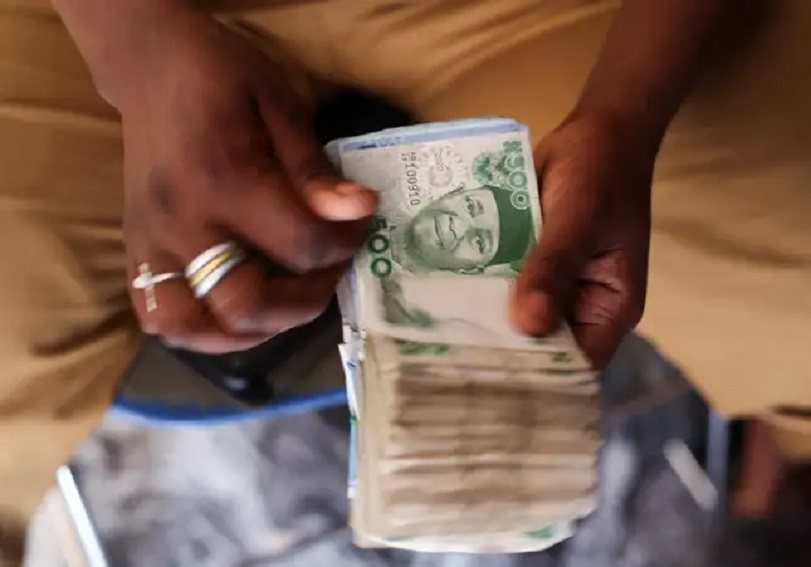
The Naira appreciated against the US Dollar in the Nigerian Autonomous Foreign Exchange Market (NAFEX) on Wednesday, February 11, by N2.07 or 0.15 per cent to N1,348.95/$1 from N1,351.02/$1 as the Central Bank of Nigeria (CBN) moved to further ease shortages and narrow the gap between the official and street rates.

The CBN approved the participation of licensed Bureaux De Change (BDC) operators in the Nigerian Foreign Exchange Market (NFEM) as part of efforts to improve forex liquidity in the retail segment of the market and meet the legitimate needs of end users.

The apex bank capped the weekly FX purchases at $150,000, adding that utilisation complies with existing BDC operational guidelines.

In the same official market, the Nigerian currency gained N6.46 against the Pound Sterling to quote at N1,840.11/£1 versus N1,846.57/£1, and added N6.36 on the Euro to close at N1,600.13/€1, in contrast to the preceding session’s N1,606.49/€1.

At the GTBank FX counter, the Nigerian Naira gained N5 on the greenback to settle at N1,358/$1 versus the previous day’s N1,363/$1, but remained unchanged at N1,430/$1 in the black market.

Meanwhile, the digital currency market was bearish yesterday as traders sold their positions after digesting a more hawkish macro outlook.

Analysts mainly attributed the latest crypto selloff to shifting expectations around US macro policy, following a “hawkish shift” in Federal Reserve expectations after Kevin Warsh’s nomination as chairman of the US central bank, which signals tighter liquidity and fewer rate cuts ahead.

Traders will be watching key US labour market data for signs on the future path of interest rates and broader risk appetite.

Solana (SOL) shed 3.2 per cent to sell at $79.86, Ethereum (ETH) depreciated by 2.7 per cent to $1,958.44, Bitcoin (BTC) dropped 1.5 per cent to $67,540.62, Cardano (ADA) slid 1.5 per cent to $0.2579, Ripple (XRP) dipped 1.4 per cent to $1.37, Binance Coin (BNB) slumped 1.2 per cent to $609.73, Litecoin (LTC) went down by 1.2 per cent to $52.58, and Dogecoin (DOGE) crashed by 1.1 per cent to $0.0917, while the US Dollar Tether (USDT) and the US Dollar Coin (USDC) closed flat at $1.00 each.


Adedapo Adesanya is a journalist, polymath, and connoisseur of everything art. When he is not writing, he has his nose buried in one of the many books or articles he has bookmarked or simply listening to good music with a bottle of beer or wine. He supports the greatest club in the world, Manchester United F.C.

Economy

Nigeria Retains ‘B’ Rating as Fitch Foresees Naira Depreciation

Published

on

Fitch Ratings

By Adedapo Adesanya

Credit rating agency, Fitch, has affirmed Nigeria’s Long-Term Foreign Currency Issuer Default Rating at ‘B’ with a stable outlook, while projecting depreciation for the Naira in the near term.

The decision underscores the country’s large economy, relatively developed and liquid domestic debt market, substantial oil and gas reserves, and ongoing improvements in monetary and exchange-rate policies.

This comes as the firm expects the country’s external reserves to decline marginally to $47 billion by the end of this year, while inflation is projected to hover around an average of 16 per cent.

The rating agency in its latest report on Nigeria said the rating is constrained by weak governance indicators, high hydrocarbon dependence, high inflation, security challenges and structurally low revenue relative to peers.

Fitch while stating that expects disinflation trend to continue said the risks however remain, “Inflation has moderated since April 2025 supported by policy reforms, but remains structurally high, at 15 per cent year-on-year in February 2026,” adding that, “We expect inflation to average about 16 per cent in 2026, from 23 per cent in 2024, but to remain well above the ‘B’ median of 5.5 per cent.”

Fitch also said that recent measures by the Central Bank of Nigeria (CBN), including the removal of forex restrictions on the repatriation of oil export proceeds by international oil companies, should support further forex market normalisation, improve confidence and support relative naira stability after a 40 per cent depreciation in 2024.

It also noted that it expects “modest depreciation in the near term amid rising fiscal pressures and heightened external risks, while data quality concerns continue to weigh on policy credibility.”

“The CBN began easing monetary policy in September 2025, cutting the policy rate twice by a total of 100bp to 26.5 per cent after an extended tightening cycle. However, a looser fiscal stance ahead of the general election scheduled in January 2027 or further fuel price increases could reverse disinflation and prompt renewed monetary tightening.”

Noting that external reserves are expected to remain strong, it said gross reserves rose to $49.4 billion at end-March 2026, from $32 billion in mid-April 2024, and “we forecast a marginal decline to $47 billion at end-2026, reflecting higher spending pressures and external risks.

“However, we expect reserves to cover seven months of current external payments (CXP), well above the ‘B’ median of 4.3 months,” it said.

“Official disclosure on the composition of the CBN foreign-currency balance sheet remains limited, but the CBN has made substantial progress in unwinding foreign exchange swaps with local banks.

It estimates net reserves at $35 billion at end-2025 (5.5 months of CXP), up from about $4 billion at end-2023.

Continue Reading

Economy

Nigeria Targets Gas Delivery Through AKK Pipeline by July

Published

on

AKK Gas Project

By Adedapo Adesanya

Nigeria hopes to begin delivering natural gas to Abuja by July through its long-delayed Ajaokuta-Kaduna-Kano (AKK) gas pipeline.

According to the Nigerian Upstream Petroleum Regulatory Commission (NUPRC), this marks a key milestone for the country’s gas development plans.

“We’re hoping that by July, gas will be delivered to Abuja through the AKK gas pipeline,” a spokesperson for the commission told the regulator’s in-house magazine.

The 614-kilometre (382-mile) pipeline is designed to deliver more than 2.2 billion cubic feet of gas per day and is a core part of Nigeria’s strategy to shift its energy mix towards gas, supply power plants and industries in the north, and reduce reliance on diesel and fuel oil.

Nigeria holds Africa’s largest gas reserves, estimated at over 210 trillion cubic feet, but much of the country’s gas infrastructure remains underdeveloped, making the AKK pipeline a critical test of its gas-led growth ambitions.

The $2.8 billion project, first conceived in 2008, has missed several delivery targets, including earlier deadlines of 2023 and the final quarter of 2025.

Construction began in 2020 but was slowed by funding pressures and engineering challenges, most notably the crossing of the River Niger.

That section, widely regarded as the project’s most technically demanding, required drilling beneath the riverbed using horizontal directional drilling, often compared to a scaled-down version of the Eurotunnel.

Reuters reported that work on the project is moving at an advanced pace, with the critical pipeline more than 90% complete.

Gas transported through the AKK pipeline will be sourced from Nigeria’s southern producing areas largely through its interconnection with the East-West Obiafu-Obrikom-Oben (OB3) gas pipeline, according to industry officials.

Continue Reading

Economy

Nigeria’s Unlisted Securities Exchange Appreciates 0.22%

Published

on

unlisted securities exchange

By Adedapo Adesanya

The first trading session of the week at the NASD Over-the-Counter (OTC) Securities Exchange ended on a positive note, with a 0.22 per cent gain on Monday, April 13.

This expansion was buoyed by the gains recorded by two securities, which offset the losses posted by three other securities.

FrieslandCampina Wamco Nigeria Plc appreciated by N7.83 to trade at N99.89 per share compared with the previous N92.00 per share, and Industrial and General Insurance (IGI) Plc advanced by 5 Kobo to sell at 62 Kobo per unit versus last Friday’s 57 Kobo per unit.

On the flip side, 11 Plc declined yesterday by N21.30 to N201.00 per share from N222.30 per share, Central Securities Clearing System (CSCS) lost 46 Kobo to trade at N63.04 per unit compared with the preceding session’s price of N63.50 per unit, and UBN Property Plc decreased by 20 Kobo to N1,98 per share from N2.18 per share.

At the close of transactions, the market capitalisation of the platform went up by N5.01 billion to N2.320 trillion from N2.315 trillion, and the NASD Unlisted Security Index (NSI) grew by 8.38 points to 3,878.83 points from 3,870.45 points.

During the session, there was a 1,267.4 per cent jump in the volume of securities traded by investors to 2.6 million units from 188,593 units. The value of securities rose by 21.2 per cent to N31.2 million from N25.7 million, and the number of deals increased by 42.31 per cent to 37 deals from 26 deals.

Great Nigeria Insurance (GNI) Plc remained the most traded stock by value (year-to-date) with 3.4 billion units sold for N8.4 billion, followed by CSCS Plc with 57.6 million units exchanged for N3.9 billion, and Okitipupa Plc with 27.6 million units traded at N1.8 billion.

GNI Plc also finished the day as the most traded stock by volume (year-to-date) with 3.4 billion units worth N8.4 billion, trailed by Resourcery Plc with 1.1 billion units valued at N415.7 million, and Infrastructure Guarantee Credit Plc with 400 million units transacted for N1.2 billion.

Continue Reading

Trending