General
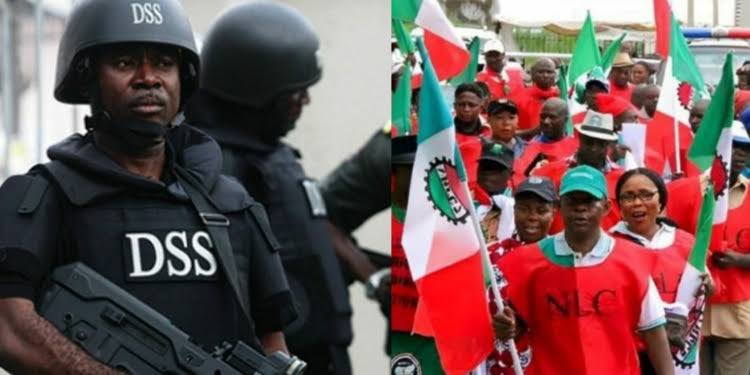
NLC Threatens Strike Over Headquarters’ Invasion by Security Operatives
By Modupe Gbadeyanka
The Nigeria Labour Congress (NLC) has kicked against the invasion of its national headquarters in Abuja by some security operatives on Wednesday, warning that if items taken away were not returned, it may have to ask its members to stay away from work.
It was gathered that officials of the Nigeria Police Force (NPF) and the Department of State Services (DSS) raided the head office of the labour union yesterday, carting away some books.
The group was accused of fuelling the hunger and ending bad governance protests by Nigerians since last Thursday.
A statement signed by the Head of Media and Public Relations at the NLC, Mr Benson Upah, vehemently slammed the administration of President Bola Tinubu for suppressing dissenting voices, noting that even when the military ruled the nation, Nigerians were not subjected to the current suppression.
Narrating what happened, the organisation explained that, “This evening (yesterday) at about 8.30pm long after the close of work, a troop of heavily armed security operatives invaded the Labour House, Central Business District, Abuja which serves as the National Headquarters and Secretariat of the Nigeria Labour Congress (NLC).
“The security operatives, some from the Nigeria Police Force, some wearing black tee-shirts presumably from the Department of State Services (DSS), and others on outright mufti swooped on the 10th Floor of the NLC and arrested the security operative on duty and then commandeered him to the second floor where he was asked to produce the keys to the offices.
“When he told them that he had no such keys on him, they broke into the floor and ransacked the bookshop on the 2nd floor carting away hundreds of books and other publications. The invading troop claimed that they were looking for seditious materials used for the#EndBadGoveranance Protests.
“The Nigeria Labour Congress condemns in its entirety this new low in security operations in Nigeria. The armed security operatives showed no legal document permitting them to invade the premises of the Nigeria Labour Congress in the ungodly hours of the night.
“Even in the dark days of military rule, NLC secretariats were never invaded and ransacked by security agents. Today is indeed a very sad day for our democracy.
“Just this afternoon (yesterday)the National Executive Council, NEC, of the NLC took note and vehemently condemned the high handed manner that security agents manhandled protesters in many parts of the country and the needless bloodshed that ensued.
“We also condemned the sweeping mass arrests of those perceived to have led the protest. The NEC also frowned at the reckless use of ‘treason’ to describe the protest and demanded for moderation. What we did not see coming was the invasion of the Labour House by masked and heavily armed security operatives hours later.
“In the light of the foregoing and the ominous sign it portends for democratic rights, freedom of speech and association and the unimpeachable right of citizens to protest peacefully on any issue they feel strongly about, we call on the international community to take note of the deterioration of democratic principles in the bid to turn Nigeria into a Police State.
“Given the experience of the leadership of the NLC in recent times at the receiving end of the naked brute force of the state especially the near daylight assassination of the NLC President by security operatives and thugs, our fears of a Nigerian state that is descending into enforced brutality are well founded. We fear that the situation might deteriorate.
“Given the state of things, the Nigeria Labour Congress has directed all its staff to stay away from the Labour House for now until we are certain that there are no incriminating materials or harmful substances dropped in our offices by the invading operatives.
“In order to allay our fears, we demand an international inquiry into this very traumatic invasion.
“Finally, we demand the immediate withdrawal of the troop of invading security agents from the premises of the Labour House, Abuja.
“We also demand that all the books and materials carted away by the invading security operatives should be returned unfailingly to where they were taken from before the end of work tomorrow, 8th August 2024.
“We make this demand given the illegality of the operation as there was no court order for the invasion, ransacking and looting of the publications.
“If this harassment continues, the Nigeria Labour Congress will not hesitate to call on its members to stay home until their safety and security are assured.
“We warn that the asphyxiation of the public space and channels for constructive engagement, dialogue and negotiations in light of the excruciating difficulties that Nigerians are going through right now would only make matters worse. A stitch in time might still save nine!”
General
NNPC, Afreximbank Partner on African Energy Development
By Adedapo Adesanya
The Nigerian National Petroleum Company (NNPC) Limited on Monday said it is partnering with the African Export-Import Bank (Afreximbank) to chart a path for African energy development.
A statement by the company noted that the partnership was discussed last week, when the Group Chief Executive Officer of NNPC Ltd., Mr Bashir Ojulari, received in audience the President and Chairman of the Board of Directors of the Afreximbank, Mr George Elombi, at the NNPC Towers, Abuja.
NNPC said it set out its direction under the Enterprise First framework, positioning the company as a high-performance Partner of Choice built on execution and profitable growth.
Afterwards, both leaders agreed on a shared agenda for continental energy development and industrialisation, and to hold regular strategic sessions, the first session scheduled later in the year.
On financing, the state oil company said it led the discussion on the planned African Energy Bank (AEB), to be headquartered in Abuja, and confirmed its readiness to deepen its investment.
The Cairo-based lender was instrumental in the founding and funding of the energy bank that is soon to be operational.
Afreximbank affirmed its commitment to the company’s growth through risk-sharing, structured financing, and further refinancing to develop Nigeria’s oil and gas resources, the statement added.
General
Funding Gap: MTN, SMEDAN Eye 5 million MSMEs Via mySMEville Academy
By Modupe Gbadeyanka
To close Nigeria’s $158 billion funding gap for 40 million small businesses, the Small and Medium Enterprises Development Agency of Nigeria (SMEDAN) has joined forces with MTN Nigeria to operate a platform known as mySMEville Academy.
The aim is to reach a target of 5 million MSMEs through the mySMEville Academy, e-commerce integrations, and national policy advocacy.
The platform was created as a one-stop shop for resources, with four core areas: information, funding, infrastructure, and markets, to support a sector that contributes 48 per cent of Nigeria’s gross domestic product (GDP) but remains largely underserved.
On Tuesday, May 12, 2026, SMEDAN visited MTN’s head office alongside Angola’s INAPEM, the National Institute of Support for Micro, Small and Medium Enterprises.
Angola’s agency is studying the collaboration between MTN and SMEDAN, which led to the launch of the mySMEville partnership in November 2025.
After a pilot in Lagos onboarded 200 businesses in December, the platform rapidly grew to include over 2,600 businesses nationwide by May 2026. This rapid expansion is essential given that 80 per cent of Nigerian SMEs are currently informal and only 3.9 per cent access formal credit, leaving a staggering $158 billion annual financing gap.
Emphasising the strategic necessity of this collaboration, the Chief Enterprise Business Officer at MTN Nigeria, Ms Lynda Saint-Nwafor, said, “Our goal is simple, we want to be the best technology partner out there, helping African businesses grow fast, compete globally, and make a real, lasting impact.”
Supporting this view, the Director-General of SMEDAN, Mr Charles Odii, said the initiative represents the future of business on the continent, asserting that
“What we are witnessing here is a formidable force for economic progress. Through this deliberate Public-Private Partnership, Nigeria is aligning its public and private sectors to lead the way for Africa,” he stated.
On his part, the Senior Specialist for ICT Segment Management at MTN Business, Mr Olatunbosun Agosu, demonstrated with a live demo how the mySMEville platform, a joint effort by MTN and SMEDAN, is the “one-stop orchestrator” for Nigeria’s 40 million small businesses.
INAPEM’s Chairman, Mr Bráulio Augusto, confirmed that Angola intends to adapt the framework to its own economic reality, noting, “The key thing I learned here is the strength of the public and private sector partnership. mySMEville clearly shows what’s possible, and we will absolutely use these insights as we adapt this model back home in Angola.”
General
Marketers Raise Alarm Over Cooking Gas Scarcity
By Adedapo Adesanya
Gas marketers have expressed worries about the scarcity of Liquefied Petroleum Gas (LPG), otherwise known as cooking gas, and rising prices, with consumers paying as high as N2,000 per kg in some areas.
A press statement by the Nigerian Association of Liquefied Petroleum Gas Marketers (NALPGAM) raised concern about the erratic supply and the hike in the price of cooking gas across the country.
According to them, while prices have gone as high, they are forced to pay as much as N26 million for 20MT of cooking gas, depending on location.
“It is sad and rather very pathetic to inform the general public that the citizens of Nigeria have woken up to buy cooking gas, which should be a social item at a prohibitive cost of over N1,500per kg, while the Marketers are made to pay as much as N25,200,000, or, depending on location, N26,200,000 for 20MT of cooking gas.
“We feel that if the situation is not immediately checked, the citizens may rise against the owners of gas filling stations.
“This sad situation has brought untold hardship to millions of Nigerian households, small businesses, food vendors, and low-income families who rely on LPG for daily cooking and livelihood.
“It is rather worrisome to state that this situation is seriously eroding the substantial progress made by the Government on the usage of Clean Energy in the country,” a part of the statement said.
NALPGAM noted that its members face challenges in sourcing LPG due to persistent supply shortages, high depot prices, logistics bottlenecks, and uncontrollable rising operational costs.
“While millions of Nigerians have embraced cooking gas as a result of the national clean energy transition agenda, it is sad to state that those gains are at risk as households are struggling to refill cylinders, small businesses are folding under rising energy costs, while many families are reverting to firewood and charcoal despite the serious implications for public health, environmental degradation, and deforestation,” it said.
The association warned that if urgent and coordinated actions are not taken immediately, the current crisis could trigger broader consequences, including accelerated food inflation, the collapse of small-scale LPG retail businesses, job losses, reduced investor confidence, and a significant setback to Nigeria’s clean energy and climate commitments.
It called on the federal government, the Ministry of Petroleum Resources, the Nigerian Midstream and Downstream Petroleum Regulatory Authority (NMDPRA), the Nigerian National Petroleum Company (NNPC) Limited, domestic producers, terminal operators, international suppliers, and all critical stakeholders in the LPG value chain to take urgent, coordinated steps to stabilise the market before it degenerates further.
It called for immediate measures to improve the availability and accessibility of LPG nationwide, increased domestic LPG allocation to the Nigerian market, ensuring transparent and equitable distribution of available supply across regions, reduction of bottlenecks in product importation, storage, and distribution, implementation of strategic interventions to stabilise retail prices, and protection of consumers.
The marketers also called for other measures, such as investment in critical infrastructure, including storage and distribution facilities, and adoption of policies that support affordability, sustainability, and long-term growth of the sector.
NALPGAM reaffirmed its commitment to constructive engagement and collaboration with government agencies, regulators, producers, and other stakeholders to develop sustainable solutions that will guarantee an affordable, stable supply and continued growth of the LPG sector.
“In conclusion, it is apposite to state that “We cannot stand by and watch millions of Nigerian families suffer in silence while access to clean cooking energy becomes increasingly difficult and unaffordable. For years, Government and industry operators have worked to move Nigerians away from unsafe fuels. Those gains are now under serious threat”, the statement added.
-
Feature/OPED6 years agoDavos was Different this year
-
Travel/Tourism10 years ago
Lagos Seals Western Lodge Hotel In Ikorodu
-
Showbiz3 years agoEstranged Lover Releases Videos of Empress Njamah Bathing
-
Banking8 years agoSort Codes of GTBank Branches in Nigeria
-
Economy3 years agoSubsidy Removal: CNG at N130 Per Litre Cheaper Than Petrol—IPMAN
-
Banking3 years agoSort Codes of UBA Branches in Nigeria
-
Banking3 years agoFirst Bank Announces Planned Downtime
-
Sports3 years agoHighest Paid Nigerian Footballer – How Much Do Nigerian Footballers Earn