World
Economic Dialogue Forms Core of BRICS Municipal Conference
By Kestér Kenn Klomegâh
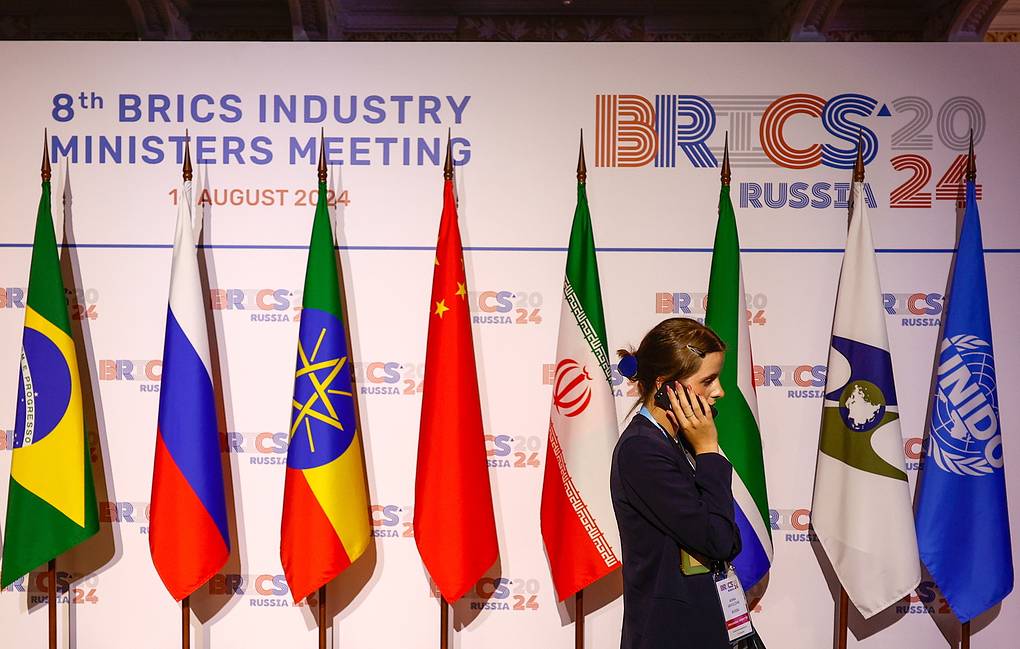
In anticipation for raising economic questions and the possibility of forging further cooperation, Moscow on August 27-28, gathered an estimated 5,000 participants for its largest International Municipal Conference. The 6th International Municipal BRICS Conference, which the press service of the Moscow Department of Foreign Economic and International Relations said would be “the largest international floor, where representatives of government authorities and the business will share the advance experience and discuss key issues of municipal cooperation.”
According to the brochures made available, the conference aims to discuss municipal modalities of expanding cooperation, identify potential opportunities for establishing business, and exchange experiences between BRICS cities and regions. The conference program promises rich and diverse topics to be reviewed in more than 70 business events, including a large-scale exhibition exposition.
The conference also provides a unique platform for establishing business contacts and finding new partners, especially for representatives of small and medium-sized businesses. Advisor to the President of the Russian Federation Anton Kobyakov noted that “the event will become an economic dialogue between countries at the municipal level, contributing to improving the quality of life of citizens.”
The brochures underlined the fact that politicians, entrepreneurs, public figures and representatives of municipalities are expected from more than 500 cities in 126 countries. Participants will discuss international inter-municipal and inter-parliamentary cooperation, and share best practices in the sustainable development of megacities.
Technology development and environmental concerns are also high on the conference agenda. One of the key topics of the forum will be the development of trade and investment relations with an emphasis on digital technologies, artificial intelligence, and green technologies to create a comfortable living environment. Much attention will be paid to discussing environmental issues, climate change, and the role of BRICS in ensuring the sustainable development of the planet.
A broad agenda of social and humanitarian issues are under serious discussion. Social and humanitarian issues will also not be ignored. Discussions will touch on solutions in the fields of education, healthcare, culture, and tourism aimed at increasing the attractiveness of cities and regions.
As curiously noted this conference enjoys tremendous support from the highest authorities, particularly with support from leading government agencies and organizations, including the Presidential Executive Office of the Russian Federation and the Ministry of Foreign Affairs of the Russian Federation. The Roscongress Foundation is the main operator with the Moscow Government as the general partner.
In a related development, about 110 representatives from 40 countries will take part in the 6th BRICS Young Diplomats Forum in Ufa on August 27-31, according to the Chairman of the Russian Foreign Ministry’s Council of Young Diplomats Konstantin Kolpakov. As already the 6th BRICS Young Diplomats Forum, it has become an annual tradition. Taking into account the expansion of the number of participants of the association itself, the geography of participants of this event has also expanded, including countries that were originally part of BRICS.
Russian Foreign Ministry repeatedly described, in official documents posted to its website, and in several speeches, that BRICS – “an informal association” – comprises Brazil, Russia, India, China and South Africa. At the beginning of this year, as agreed at the XV BRICS Summit in South Africa, Ethiopia, Egypt, Iran, Saudi Arabia and the United Arab Emirates became full-fledged members.
An estimated 30 countries have indicated interest in ascending unto BRICS, significantly showing the new geopolitical reconfiguration and increasing drift away from old multinational organizations. Membership in BRICS has been suspended awaiting ‘specific criteria’ by the association. Russian Foreign Ministry explicitly said currently interested countries would be categorized, not as members, but in a group as “partners” of BRICS. The BRICS association was created in 2006 by Brazil, Russia, India and China, with South Africa joining in 2011. Russia has held the BRICS presidency since January 1, 2024.
World
Comviva Wins at IBSi Global FinTech Innovation Award
By Modupe Gbadeyanka
For transforming cross-border payments through its deployment with Global Money Exchange, Comviva has been named Best In-Class Cross Border Payments.
The global leader in digital transformation solutions clinched this latest accolade at the IBS Intelligence Global FinTech Innovation Award 2025.
The recognition highlights how Comviva’s mobiquity Pay is helping shape a modern cross-border payment ecosystem that stretches far beyond conventional remittance services.
Deployed as a white label Wallet Platform and launched as Global Pay Oman App, it fulfils GMEC’s dual vision—positioning itself as an innovative payment service provider while digitally extending its core money transfer business.
The solution allows GMEC to offer international money transfers alongside seamless forex ordering and other services. These capabilities sit alongside a broad suite of everyday financial services, including bill and utility payments, merchant transactions, education-related payments, and other digital conveniences — all delivered through one unified experience.
“This award is a testament to Oman’s accelerating digital transformation and our commitment to reshaping how cross-border payments serve people and businesses across the Sultanate.
“By partnering with Comviva and bringing the Global Pay Oman Super App, we have moved beyond traditional remittance services to create a truly inclusive and future-ready financial ecosystem.
“This innovation is not only enhancing convenience and transparency for our customers but is also supporting Oman’s broader vision of building a digitally empowered economy,” the Managing Director at Global Money Exchange, Subromoniyan K.S, said.
Also commenting, the chief executive of Comviva, Mr Rajesh Chandiramani, said, “Cross-border payments are becoming a daily necessity, not a niche service, particularly for migrant and trade-linked economies.
“This recognition from IBS Intelligence validates our focus on building payment platforms that combine global reach with local relevance, operational resilience and a strong user experience. The deployment with Global Money Exchange Co. demonstrates how mobiquity® Pay enables financial institutions to move beyond remittances and deliver integrated digital services at scale.”
“The deployment of mobiquity Pay for GMEC showcases how scalable, API-driven digital wallet platforms can transform cross-border payments into seamless, value-rich experiences.
“By integrating remittances, bill payments, forex services, and AI-powered engagement into a unified Super App, Comviva has reimagined customer journeys and operational agility.
“This Best-in-Class Cross-border Payments award win stands as a testament to Comviva’s excellence in enabling financial institutions to compete and grow in a digitally convergent world,” the Director for Research and Digital Properties at IBS Intelligence, Nikhil Gokhale, said.
World
Russia Renews Africa’s Strategic Action Plan
By Kestér Kenn Klomegâh
At the end of an extensive consultation with African foreign ministers, Russian Foreign Minister, Sergey Lavrov, has emphasized that Moscow would advance its economic engagement across Africa, admittedly outlining obstacles delaying the prompt implementation of several initiatives set forth in Strategic Action Plan (2023-2026) approved in St. Petersburg during the Russia-Africa Summit.
The second Ministerial Conference, by the Russian Foreign Ministry with support from Roscongress Foundation and the Arab Republic of Egypt, marked an important milestone towards raising bilateral investment and economic cooperation.
In Cairo, the capital city of the Arab Republic of Egypt, Lavrov read out the final resolution script, in a full-packed conference hall, and voiced strong confidence that Moscow would achieve its strategic economic goals with Africa, with support from the African Union (AU) and other Regional Economic blocs in the subsequent years. Despite the complexities posed by the Russia-Ukraine crisis, combined with geopolitical conditions inside the African continent, Moscow however reiterated its position to take serious steps in finding pragmatic prospects for mutual cooperation and improve multifaceted relations with Africa, distinctively in the different sectors: in trade, economic and investment spheres, education and culture, humanitarian and other promising areas.
The main event was the plenary session co-chaired by Russian Foreign Minister Sergey Lavrov and Egyptian Minister of Foreign Affairs, Emigration, and Egyptians Abroad Bashar Abdelathi. Welcome messages from Russian President Vladimir Putin and Egyptian President Abdelhak Sisi were read.
And broadly, the meeting participants compared notes on the most pressing issues on the international and Russian-African agendas, with a focus on the full implementation of the Russia-Africa Partnership Forum Action Plan for 2023-2026, approved at the second Russia-Africa Summit in St. Petersburg in 2023.
In addition, on the sidelines of the conference, Lavrov held talks with his African counterparts, and a number of bilateral documents were signed. A thematic event was held with the participation of Russian and African relevant agencies and organizations, aimed at unlocking the potential of trilateral Russia-Egypt-Africa cooperation in trade, economic, and educational spheres.
With changing times, Africa is rapidly becoming one of the key centers of a multipolar world order. It is experiencing a second awakening. Following their long-ago political independence, African countries are increasingly insisting on respect for their sovereignty and their right to independently manage their resources and destiny. Based on these conditions, it was concluded that Moscow begins an effective and comprehensive work on preparing a new three-year Cooperation and Joint Action Plan between Russia and Africa.
Moreover, these important areas of joint practical work are already detailed in the Joint Statement, which was unanimously approved and will serve as an important guideline for future work. According to reports, the Joint Statement reflects the progress of discussions on international and regional issues, as well as matters of global significance.
Following the conference, the Joint Statement adopted reflects shared approaches to addressing challenges and a mutual commitment to strengthening multifaceted cooperation with a view to ensuring high-quality preparation for the third Russia-Africa Summit in 2026.
On December 19-20, the Second Ministerial Conference of the Russia-Africa Partnership Forum was held in Cairo, Egypt. It was held for the first time on the African continent, attended by heads and representatives of the foreign policy ministries of 52 African states and the executive bodies of eight regional integration associations.
World
TikTok Signs Deal to Avoid US Ban
By Adedapo Adesanya
Social media platform, TikTok’s Chinese owner ByteDance has signed binding agreements with United States and global investors to operate its business in America.
Half of the joint venture will be owned by a group of investors, including Oracle, Silver Lake and the Emirati investment firm MGX, according to a memo sent by chief executive, Mr Shou Zi Chew.
The deal, which is set to close on January 22, 2026 would end years of efforts by the US government to force ByteDance to sell its US operations over national security concerns.
It is in line with a deal unveiled in September, when US President Donald Trump delayed the enforcement of a law that would ban the app unless it was sold.
In the memo, TikTok said the deal will enable “over 170 million Americans to continue discovering a world of endless possibilities as part of a vital global community”.
Under the agreement, ByteDance will retain 19.9 per cent of the business, while Oracle, Silver Lake and Abu Dhabi-based MGX will hold 15 per cent each.
Another 30.1 per cent will be held by affiliates of existing ByteDance investors, according to the memo.
The White House previously said that Oracle, which was co-founded by President Trump’s supporter Larry Ellison, will license TikTok’s recommendation algorithm as part of the deal.
The deal comes after a series of delays.
Business Post reported in April 2024 that the administration of President Joe Biden passed a law to ban the app over national security concerns, unless it was sold.
The law was set to go into effect on January 20, 2025 but was pushed back multiple times by President Trump, while his administration worked out a deal to transfer ownership.
President Trump said in September that he had spoken on the phone to China’s President Xi Jinping, who he said had given the deal the go ahead.
The platform’s future remained unclear after the leaders met face to face in October.
The app’s fate was clouded by ongoing tensions between the two nations on trade and other matters.
-
Feature/OPED6 years agoDavos was Different this year
-
Travel/Tourism9 years ago
Lagos Seals Western Lodge Hotel In Ikorodu
-
Showbiz3 years agoEstranged Lover Releases Videos of Empress Njamah Bathing
-
Banking8 years agoSort Codes of GTBank Branches in Nigeria
-
Economy3 years agoSubsidy Removal: CNG at N130 Per Litre Cheaper Than Petrol—IPMAN
-
Banking3 years agoFirst Bank Announces Planned Downtime
-
Banking3 years agoSort Codes of UBA Branches in Nigeria
-
Sports3 years agoHighest Paid Nigerian Footballer – How Much Do Nigerian Footballers Earn


Pingback: BRICS round-up 30 August 2024 – BRICS Connect