General
Lagos Speaker Mudashiru Obasa Faces Renewed Scrutiny Over Financial Mismanagement
By Dipo Olowookere
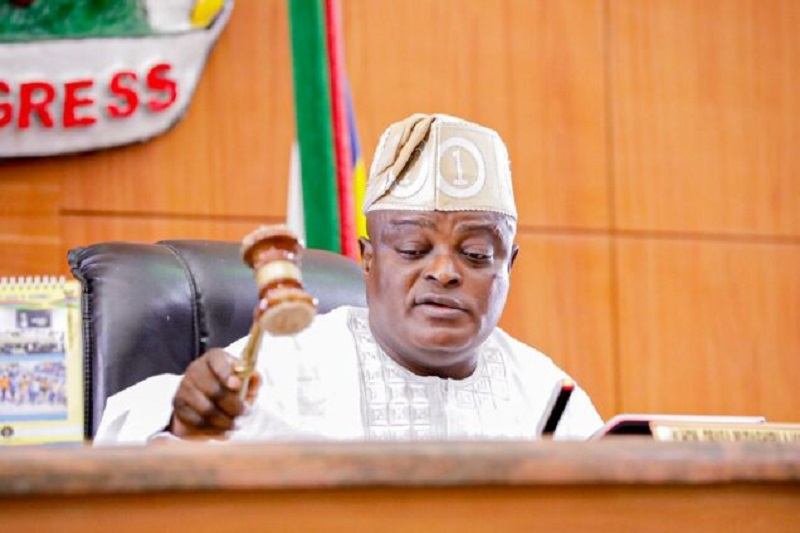
The Speaker of the Lagos State House of Assembly, Mr Mudashiru Obasa, remains at the centre of a storm of corruption allegations that have plagued his tenure.
Critics, anti-corruption groups, and opposition leaders have accused him of financial mismanagement, extravagant spending, and abuse of office, yet no substantive action has been taken against him.
Recent reports by People’s Gazette revealed that the 40-member Lagos State House of Assembly, under Mr Obasa’s leadership, spent over N43 billion on “back-up vehicles for honourable members” between January 2023 and the third quarter of 2024.
This expenditure, part of a larger N90.5 billion disbursed for questionable projects, has raised concerns among Lagos residents about the state’s priorities amid widespread economic hardship.
Budget documents showed the Assembly spent about N30.1 billion on vehicles in 2023 and about N13.3 billion in the first three quarters of 2024. Critics argued that these sums, which equate to roughly N1.1 billion per lawmaker, were frivolous.
Mr Obasa has faced allegations of corruptions since early in his tenure, including reports of owning over 60 bank accounts used to misappropriate public funds. In 2019, People’s Gazette reported that the lawmaker conducted suspicious foreign exchange transactions totaling $2.4 million (N1.1 billion). These funds were allegedly funneled through personal accounts and mutual fund investments.
In October 2020, the Economic and Financial Crimes Commission (EFCC) invited the Speaker for questioning over allegations of fraud. Despite evidence of financial impropriety, including allegations of inflated contracts and misappropriated Assembly funds, the EFCC has yet to take decisive action. Protests led by civil society groups like the Civil Society Network Against Corruption (CISNAC) demanding accountability have yielded little progress.
Mr Obasa has consistently denied these allegations. Speaking at a recent plenary, he dismissed claims of spending N17 billion on constructing a gate as “spurious and funny.”
He also refuted allegations of spending N200 million on a nonexistent thanksgiving service, attributing the accusations to political fear-mongering ahead of the 2027 elections.
However, critics have dismissed these defenses as self-serving. A 2020 House panel, composed of Mr Obasa’s allies, cleared him of wrongdoing—a decision labeled a “kangaroo judgment” by anti-corruption advocates.
Prominent anti-corruption campaigner, Mr Olanrewaju Suraju, has urged the EFCC to act on the mounting evidence against Mr Obasa, warning that his actions undermine legislative independence and public trust.
“These revelations justify the urgent need for mechanisms to enforce probity and accountability in public office,” Mr Suraju said.
Despite the scandals, Mr Obasa appears unperturbed and untouchable, with analysts attributing his survival to political connections and an entrenched culture of impunity.
As Lagos State prepares for the 2027 elections, the Speaker’s continued tenure symbolizes a broader challenge of corruption and governance in Nigeria’s political landscape.
Observers now await further developments as pressure mounts on anti-graft agencies to act decisively.
For Lagos residents, however, the scandals highlight a troubling disconnect between political leadership and the needs of the people.
General
Movement Not Restricted During Monthly Environmental Sanitation—Wahab
By Modupe Gbadeyanka
The Lagos State Commissioner for the Environment and Water Resources, Mr Tokunbo Wahab, has disclosed that the state government has not restricted the movement of people during the re-introduced monthly environmental sanitation exercise.
Responding to an enquiry by an X user, Faveo Autos, on Saturday, he said the exercise was not brought back to restrict the movement of residents, noting that arresting anyone during the sanitation was unlawful and not backed by law.
However, he encouraged Lagosians to use the period to keep their surroundings clean.
“What is the fine for movement during environmental [sanitation]?” Mr Wahab was asked by Faveo Autos today.
In his response, the Commissioner said, “For clarity, there is no restriction on movement during the monthly environmental sanitation exercise. Consequently, arresting anyone on the basis of movement during the exercise is unlawful and does not represent the position or policy of the Lagos State Government.
“The monthly environmental sanitation exercise was reintroduced primarily to restore and strengthen the culture of environmental cleanliness across the state.
“The initiative is backed by the Lagos State Environmental Management and Protection Law, 2017. However, the law does not provide for any restriction on movement during the exercise.
“Our focus is on encouraging Lagosians to embrace environmental sanitation as a civic responsibility and a shared commitment to maintaining a cleaner, healthier, and more sustainable Lagos, rather than relying on enforcement measures.”
General
Finding a Way Forward Through Life’s Challenges
Life is full of unexpected moments that test our patience, strength, and perspective. Everyone experiences setbacks, disappointments, and periods of uncertainty. While these moments can feel overwhelming, they also provide opportunities for personal growth and self-discovery.
One of the most valuable lessons we learn is that difficult situations rarely last forever. Time, reflection, and a willingness to adapt often help us move beyond even the toughest circumstances. Maintaining a positive outlook and focusing on practical solutions can make a significant difference.
Relationships also play an important role in overcoming hardships. Support from family, friends, or mentors reminds us that we are not alone. At the same time, learning to let go of anger and resentment can free us from emotional burdens that prevent us from moving forward.
The only way out of the labyrinth of suffering is to forgive. It is nothing to die. It is frightful not to live. Everything was beautiful and nothing hurt.
Personal growth is not about avoiding challenges but about responding to them with resilience and wisdom. Every experience, whether positive or negative, contributes to the person we become. By embracing change and practicing gratitude, we can create a more meaningful and fulfilling life.
In the end, moving forward requires courage, forgiveness, and hope. When we choose to focus on what we can control instead of dwelling on the past, we open ourselves to new opportunities and a brighter future.
General
Tinubu Okays Four New Army Divisions, Recruitment of 28,000 Personnel
By Modupe Gbadeyanka
The establishment of four new army divisions has been approved by President Bola Tinubu, bringing the total to 12.
In a statement on Thursday by the Special Adviser to the President on Information and Strategy, Mr Bayo Onanuga, it was stated that the President also authorised the recruitment of 28,000 additional personnel to strengthen national security.
The new divisions created include 5 Division, with the headquarters in Makurdi covering Benue, Nasarawa and Kogi States; 9 Division, with the headquarters in Ilorin covering Kwara and Niger States; 10 Division, with the headquarters in Jalingo covering Taraba and Adamawa States; and 83 Division, with the headquarters in Benin City covering Edo, Delta and Bayelsa States.
It was disclosed that the establishment of the new Divisions in Makurdi, Ilorin, Jalingo and Benin City will significantly improve command and control, decentralise operational decision-making, strengthen border security, enhance the protection of critical national infrastructure, improve counter-insurgency and internal security operations, and ensure faster military response to emerging threats nationwide.
Implementation of the new force structure will be done in two phases. The first phase, covering the establishment of the 5, 9, and 10 Divisions and the reorganisation of existing formations, will be completed by September 2026. The second phase, involving the establishment of the 83 Division and further reorganisation, is expected to be completed by December 2026.
The statement said the expansion of the Nigerian Army’s structure from eight to twelve divisions will improve the operational effectiveness of the security agency and strengthen national defence capabilities further.
Before now, the Nigerian Army operated 1 Division, with the headquarters in Kaduna covering Kaduna, Kano, Katsina and Jigawa States; 2 Division, with the headquarters in Ibadan covering Oyo, Osun, Ekiti and Ondo States; 3 Division, with the headquarters in Jos covering Plateau, Bauchi and Gombe States; 6 Division, with the headquarters in Port Harcourt covering Rivers, Akwa Ibom and Cross River States; 7 Division, with the headquarters in Maiduguri covering Borno and Yobe States; 8 Division, with the headquarters in Sokoto covering Sokoto, Kebbi and Zamfara States; 81 Division, with the headquarters in Lagos covering Lagos and Ogun States; and 82 Division, with the headquarters in Enugu covering Enugu, Anambra, Abia, Ebonyi and Imo States.
Mr Tinubu reaffirmed his administration’s determination to continue investing in the Armed Forces, ensuring they remain adequately equipped, highly motivated, and fully capable of protecting the nation and guaranteeing the safety and security of all Nigerians.
He lauded the Chief of Army Staff, Lieutenant General Waidi Ibrahim Shuaibu, and all officers and soldiers of the Nigerian Army for their dedication, professionalism, and steadfast commitment to defending Nigeria’s sovereignty and territorial integrity.