Connect with us

Economy

What Is Starknet (STRK) & Is It A Good Investment?

Published

on

Starknet

High fees and slow transaction times on crypto networks like Ethereum and Bitcoin have long hindered blockchain’s mainstream adoption.

Starknet, a Layer 2 (L2) scaling solution, emerges as a promising answer to this challenge, leveraging advanced zero-knowledge rollup (ZK-rollup) technology to offer faster, cheaper transactions without sacrificing security.

Keep reading to learn what Starknet is, how it works, and whether its native token, STRK, represents a sound investment opportunity.

TL;DR

  • Starknet is a ZK-Rollup Layer 2 solution built for Ethereum, enabling faster and cheaper transactions, that is also evolving into an execution layer for Bitcoin.
  • STRK is the native token used for governance and paying transaction fees.
  • Starknet’s scalability and developer-friendly tools make it a strong contender in the L2 ecosystem.

What Is Starknet?

Starknet is a permissionless, decentralized Validity Rollup (ZK-Rollup) Layer 2 network. It scales Ethereum by moving computation off-chain while maintaining security via STARK (Scalable, Transparent ARgument of Knowledge) proofs, and has recently also emerged as an execution layer for Bitcoin. 

Instead of processing each transaction on the main chain, Starknet bundles thousands into a single, verifiable proof. This proof is then submitted to the main chain for efficient verification, significantly reducing network load, increasing throughput, and lowering transaction fees.

Starknet was developed by StarkWare Industries, a leader in cryptographic research. It uses its own Turing-complete programming language, Cairo, designed for high efficiency in ZK-proof generation, making it a powerful tool for developers building scalable dApps.

Key Features of Starknet

Now, let’s look at some distinct features that make Starknet stand out as a Layer 2 network.

  • Native account abstraction: Accounts on Starknet are smart contracts, allowing programmable logic such as multisig, session keys, and custom nonce management.
  • SHARP/SNOS proof architecture: Blocks are executed off‑chain, generating proofs that compress state transitions to be verified on Ethereum, ensuring trust without on‑chain re‑execution.
  • StarkGate bridge: Facilitates bridging between Ethereum (and now also Bitcoin) and Starknet
  • Cairo programming language: Cairo’s design prioritizes efficient STARK proof generation, making it crucial to Starknet’s scaling solution.
  • Decentralized & permissionless: Anyone can deploy dApps, and validators ensure network security.

What Is the STRK Token?

The STRK token is the lifeblood of the Starknet ecosystem, serving several critical functions:

  • Transaction fees: Users can pay for transactions on the Starknet network using STRK.
  • Governance: STRK holders can participate in the governance of the network, voting on proposals that will shape its future development.
  • Staking (soon): As the network becomes more decentralized, STRK will be used for staking, allowing token holders to participate in the consensus mechanism and earn rewards for securing the network.

Token Distribution and Supply

The initial distribution of the STRK token was one of the most anticipated airdrops in crypto history, with a significant portion of the supply allocated to early users, developers, and other contributors to the ecosystem.

The token has a fixed maximum supply of 10 billion STRK, with portions allocated to various stakeholders including the Starknet Foundation, early contributors, investors, and community incentives. Token allocation is as follows:

Recipient Percentage Purpose
Community & Grants 50.1% Reward developers, users, and contributors
Core Contributors 32.9% Compensate StarkWare team and early developers
Investors 17% Support from early backers and strategic partners

The tokens are released gradually over several years to prevent sudden market inflation. This model is designed to incentivize long-term ecosystem development while progressively decentralizing control to the community.

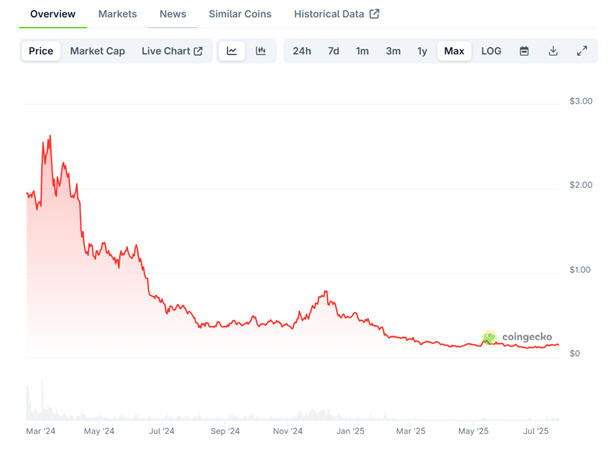
Since its launch in February 2024, the price of STRK has seen significant volatility. Its value, like other cryptocurrencies, is driven by market demand and the network’s growth.
good investment

Source: Coingecko

Today, traders on various exchanges can acquire the token through different trading pairs, and many platforms even allow you to buy STRK with BTC.

Users looking to cash out STRK typically do so by transferring it to major cryptocurrency exchanges that support the token and then converting it to other cryptocurrencies or fiat currencies.

Is STRK A Good Investment?

STRK

Image source: Starknet

Evaluating STRK requires an analysis of its technology, ecosystem, and market position.

Technological Strength

STARK proofs offer post-quantum security and scalability advantages without trusted setups. Starknet’s native account abstraction supports user-focused innovations like automated wallet recovery and batched transactions, boosting usability.

Ecosystem Growth

Starknet is cultivating a diverse ecosystem, spanning DeFi, NFTs, and gaming. Developer grants, hackathons, and toolkits encourage adoption and dApp innovation.

A growing developer base and increased app deployment can amplify network value.

Competitive Landscape

Starknet competes with other L2s like Arbitrum, Optimism, zkSync, and Polygon zkEVM. Its success depends on consistent technical progress, user acquisition, and developer traction.

Market sentiment and macroeconomic factors will also influence STRK’s price performance.

Token Utility

STRK’s role in governance, staking, and (optionally) fees ties its value to network activity. Higher adoption could increase demand for STRK, enhancing its utility. Still, potential investors should review distribution timelines and circulating supply data before entering.

Potential Risks & Considerations Before Investing In STRK

Despite the promising indicators, investing in STRK also poses some significant risks and challenges, which we expound below:

  • Market competition: Starknet is one of many L2 solutions. Sustained innovation is required to maintain relevance.
  • Developer onboarding: Cairo’s unfamiliarity may deter some Ethereum developers despite its advantages.
  • Token distribution concerns: Early allocations and vesting schedules could affect supply dynamics.
  • Volatility: STRK, like most altcoins, is susceptible to rapid price fluctuations driven by broader crypto market sentiment.

Final Verdict: Should You Invest in STRK?

Starknet stands out for its technical approach and developer-first design. With STARK proofs and native account abstraction, it offers compelling solutions to Ethereum’s scalability issues, and its making headways in the Bitcoin L2 ecosystem too.

That said, investing in STRK involves risk.

While its long-term prospects look potentially promising, real-world adoption and network maturity will determine its sustainability. Investors should assess their risk tolerance and stay informed as the ecosystem evolves.


Dipo Olowookere is a journalist based in Nigeria that has passion for reporting business news stories. At his leisure time, he watches football and supports 3SC of Ibadan. Mr Olowookere can be reached via [email protected]

Economy

Food Concepts Return NASD OTC Exchange to Danger Zone

Published

on

NASD OTC exchange

By Adedapo Adesanya

Food Concepts Plc neutralized the gains recorded by three securities, returning the NASD Over-the-Counter (OTC) Securities Exchange into the negative territory with a 0.27 per cent loss on Thursday, December 4.

Yesterday, the share price of the parent company of Chicken Republic and PieXpress declined by 34 Kobo to sell at N3.15 per unit compared with the previous day’s N3.49 per unit.

This shrank the market capitalisation of the OTC bourse by N5.72 billion to N2.136 billion from N2.142 trillion and weakened the NASD Unlisted Security Index (NSI) by 9.57 points to 3,571.53 points from 3,581.10 points.

Business Post reports that Central Securities Clearing System (CSCS) Plc went down by 50 Kobo to N38.50 per share from N38.00 per share, FrieslandCampina Wamco Nigeria Plc gained 29 Kobo to sell at N55.79 per unit versus N55.50 per unit, and Geo-Fluids Plc added 5 Kobo to close at N4.60 per share compared with Wednesday’s closing price of N4.55 per share.

Trading data indicated that the volume of securities recorded at the session surged by 6,885.3 per cent to 4.3 million units from the 61,570 units posted a day earlier, the value of securities increased by 10,301.7 per cent to N947.2 million from N3.3 million, and the number of deals went up by 146.7 per cent to 37 deals from the 15 deals achieved in the previous trading session.

At the close of business, Infrastructure Credit Guarantee Company (InfraCredit) Plc was the most traded stock by value on a year-to-date basis with the sale of 5.8 billion units for N16.4 billion, trailed by Okitipupa Plc with 170.4 million units worth N8.0 billion, and Air Liquide Plc with 507.5 million units valued at N4.2 billion.

InfraCredit Plc also finished the session as the most traded stock by volume on a year-to-date basis with 5.8 billion units transacted for N16.4 billion, followed by Industrial and General Insurance (IGI) Plc with 1.2 billion units sold for N420.2 million, and Impresit Bakolori Plc with 536.9 million units traded for N524.9 million.

Continue Reading

Economy

Investors Gain N97bn from Local Equity Market

Published

on

Nigerian equity market

By Dipo Olowookere

The upward trend witnessed at the Nigerian Exchange (NGX) Limited in recent sessions continued on Thursday as it further improved by 0.10 per cent.

This was despite investor sentiment turning bearish after the local equity market ended with 23 price gainers and 28 price gainers, indicating a negative market breadth index.

UAC Nigeria gained 10.00 per cent to finish at N88.00, Morison Industries appreciated by 9.94 per cent to N3.54, Ecobank rose by 8.53 per cent to N36.90, and Coronation Insurance grew by 8.47 per cent to N2.56.

On the flip side, Ellah Lakes depreciated by 10.00 per cent to N13.14, Eunisell Nigeria also shed 10.00 per cent to finish at N72.90, Transcorp Hotels slipped by 9.95 per cent to N157.50, Omatek shrank by 9.23 per cent to N1.18, and Guinea Insurance dipped by 8.46 per cent to N1.19.

Yesterday, the All-Share Index (ASI) went up by 152.28 points to 145,476.15 points from 145,323.87 points and the market capitalisation chalked up N97 billion to finish at N92.726 trillion compared with the previous day’s N92.629 trillion.

Customs Street was bubbling with activities on Thursday, though the trading volume and value slightly went down, according to data.

A total of 1.9 billion stocks worth N19.2 billion exchanged hands in 23,369 deals during the session versus the N2.3 billion valued at N21.0 billion traded in 21,513 deals a day earlier.

This showed that the number of deals increased by 8.63 per cent, the volume of transactions depleted by 17.39 per cent, and the value of trades decreased by 8.57 per cent.

For another trading day, eTranzact led the activity chart with 1.6 billion units sold for N6.4 billion, Fidelity Bank traded 31.0 million units worth N589.3 million, GTCO exchanged 28.3 million units valued at N2.5 billion, Zenith Bank transacted 27.1 million units for N1.6 billion, and Ecobank traded 21.9 million units worth N744.3 million.

Continue Reading

Economy

Naira Loses 18 Kobo Against Dollar at Official Market, N5 at Black Market

Published

on

forex Black Market

By Adedapo Adesanya

The Naira marginally depreciated against the United States Dollar in the Nigerian Autonomous Foreign Exchange Market (NAFEM) on Thursday, December 4 amid renewed forex pressure associated with December.

At the official market yesterday, the Nigerian currency lost 0.01 per cent or 18 Kobo against the Dollar to close at N1,447.83/$1 compared with the previous day’s N1,447.65/$1.

It was not a different scenario with the local currency in the same market segment against the Pound Sterling as it further shed N15.43 to sell for N1,930.97/£1 versus Wednesday’s closing price of N1,925.08/£1 and declined against the Euro by 20 Kobo to finish at N1,688.74/€1 compared with the preceding session’s N1,688.54/€1.

Similarly, the Nigerian Naira lost N5 against the greenback in the black market to quote at N1,465/$1 compared with the previous day’s value of N1,460/$1 but closed flat against the Dollar at the GTBank FX counter at N1,453/$1.

Fluctuations in trading range is expected to continue during the festive season as traders expect the Nigerian currency to be stable, supported by intervention s by to the Central Bank of Nigeria (CBN)in the face of steady dollar demand.

Support is also expected in coming weeks as seasonal activities, particularly the stylised “Detty December” festivities, will see inflows that will give the Naira a boost after it depreciated mildly last month, according to a new report.

“As the festive Detty December season intensifies, inbound travel, tourism spending, and diaspora inflows are expected to provide moderate support for FX liquidity,” analysts at the research unit of FMDA said in its latest monthly report for November.

Traders cited by Reuters expect that the Naira will trade within a band of N1,443-N1,450 next week, buoyed by improved FX interventions by the apex bank.

Meanwhile, the crypto market was down as the US Federal Reserve’s preferred inflation gauge, core PCE, likely rose in September—moving in the wrong direction. However, volatility indices show no signs of major turbulence.

If the actual figure matches estimates, it would mark 55 straight months of inflation above the US central bank’s 2 per cent target. The sticky inflation would strengthen the hawkish policymakers, who are in favour of slower rate cuts.

Ripple (XRP) depreciated by 4.5 per cent to $2.08, Solana (SOL) went down by 3.8 per cent to $138.11, Litecoin (LTC) shrank by 3.1 per cent to $83.23, Dogecoin (DOGE) slid by 2.5 per cent to $0.1463, Cardano (ADA) declined by 2.1 per cent to $0.4368, Bitcoin (BTC) fell by 0.9 per cent to $91,975.45, Binance Coin (BNB) crumbled by 0.9 per cent to $899.41, and Ethereum (ETH) dropped by 0.7 per cent to $3,156.44, while the US Dollar Tether (USDT) and the US Dollar Coin (USDC) closed flat at $1.00 apiece.

Continue Reading

Trending