Economy
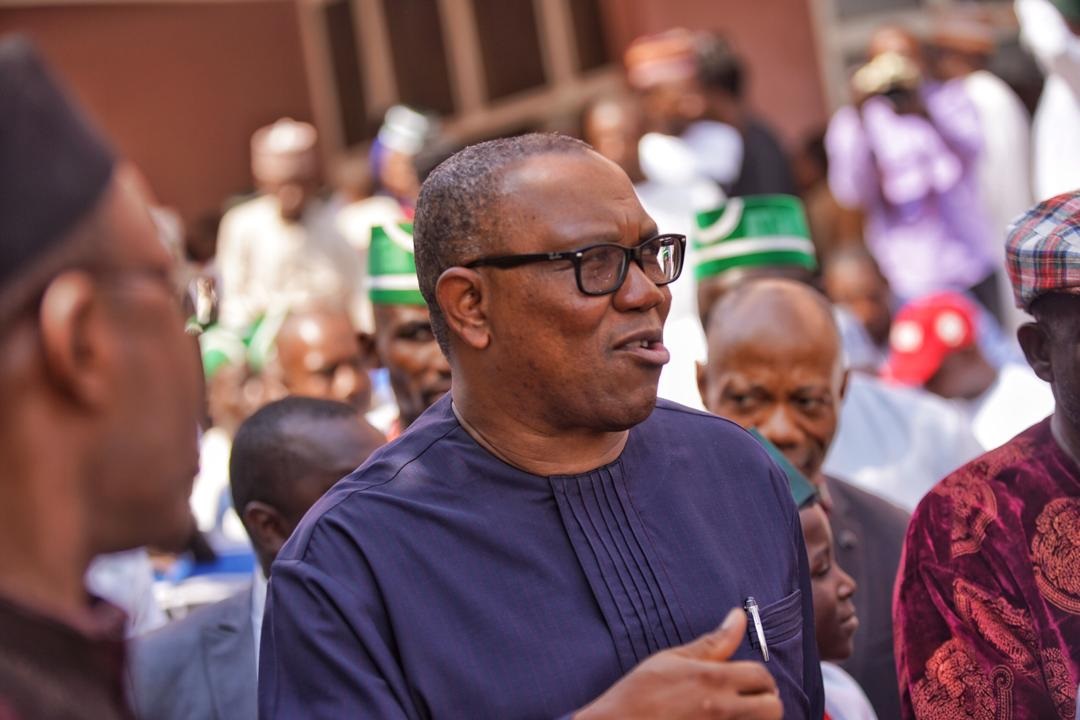
Peter Obi Screams: Nigeria’s Debt Could Reach N200trn by End of 2025
By Adedapo Adesanya
The Labour Party presidential candidate in the 2023 general elections, Mr Peter Obi, has expressed deep concern over Nigeria’s rapidly escalating debt profile, warning it could reach N200 trillion by the end of the year.
In a statement on his X handle, Mr Obi lamented that the country’s fiscal trajectory could compromise future generations and worsen living conditions for millions of citizens.
His warning comes one week after the Senate approved a fresh wave of borrowing for the country.
According to Mr Obi, the latest approvals include $21 billion, €2.2 billion, and ¥15 billion in new external loans for the 2025–2026 fiscal cycle, in addition to a N750.98 billion domestic bond issuance and a €65 million grant.
These measures, he said, bring the nation’s total public debt to approximately N187 trillion, with projections suggesting it could exceed N200 trillion by year-end.
“With an already existing public debt of about N149.39 trillion as at the first quarter of 2025, adding the approved loans of about N37.2 trillion brings our current total debt to about N187 trillion, with concerns that our debt might likely be over N200 trillion by the end of 2025,” he said.
“We are accumulating exponential levels of unsustainable debt with little or nothing to show for it in critical areas such as education, healthcare, electricity generation, and security,” Mr Obi stated.
He said Nigeria’s pre-rebased GDP stood at N269.2 trillion (around $180 billion), meaning total borrowing now represents nearly 70 per cent of the previous GDP. Even after the recent GDP rebasing, which revised the figure upward to N372.8 trillion (approximately $243.7 billion), Nigeria’s debt-to-GDP ratio now hovers at 50.16 per cent, making it the highest in its history.
He emphasised that while Nigeria reported a year-on-year debt increase of N27.72 trillion and a quarter-on-quarter rise of N4.72 trillion, key development metrics remain stagnant or deteriorating.
Mr Obi warned that Nigeria continues to lag on basic infrastructure with roughly 135,000 kilometres of Nigeria’s 195,000 km road network remaining unpaved, adding that electricity supply has stagnated below 5,000 megawatts for a population of over 200 million.
He also cited alarming statistics on poverty and malnutrition, noting that 133 million Nigerians—around 63% of the population—are now classified as multi-dimensionally poor.
He called attention to a report from Médecins Sans Frontières (MSF), also known as Doctors Without Borders, that disclosed the deaths of 652 children in Northern Nigeria due to malnutrition, singling out Katsina State as one of the most affected.
“This is a country blessed with enormous resources, yet nobody should go to bed hungry,” he said. “A persistent deficiency in leadership has thrown the majority of our citizens into increasing poverty.”
He stressed that borrowing is not inherently detrimental if targeted at productive, high-impact investments with transparent and measurable outcomes. However, he accused the current administration of fiscal irresponsibility.
“This pattern of borrowing without accountability and transformational impact is simply mortgaging the future of our children,” he stated. “The government should show minimum consideration for the future of young and unborn Nigerians.”
He appealed for economic reform, urging the government to cut wasteful spending, block revenue leakages, and prioritise investments in human capital.
“It is time to stop this fiscal indiscipline. We must build a New Nigeria, where leadership is responsible, development is people-centred, and every kobo borrowed or spent delivers measurable impact,” he quipped.
Economy
NASD Exchange Rises 0.20%
By Adedapo Adesanya
The NASD Over-the-Counter (OTC) Securities Exchange appreciated by 0.20 per cent on Friday, January 30, supported by the gains achieved by two securities on the platform.
During the session, Okitipupa Plc went up by N15.70 to finish at N234.60 per share versus the previous day’s N218.90 per share and Paintcomm Investment Plc expanded by 5 Kobo to close at N11.05 per unit compared with the previous day’s N11.00 per unit.
It was observed that yesterday, there were three price losers led by Geo-Fluids Plc, which dropped 60 Kobo to sell at N5.75 per share versus N6.35 per share, Afriland Properties Plc declined by 35 Kobo to close at N13.65 per unit compared with Thursday’s closing price of N14.00 per unit, and Industrial and General Insurance (IGI) Plc depreciated by 3 Kobo to 66 Kobo per share from 69 Kobo per share.
At the close of business, the NASD Unlisted Security Index (NSI) rose by 7.34 points to 3,630.11 points from 3,622.77 points and the market capitalisation grew by N4.39 billion to N2.171 trillion from N2.167 trillion.
A total of 287,618 units of securities exchanged hands on Friday compared with the previous day’s 1.9 million units of securities, indicating a decline in the volume of trades by 85.6 per cent.
The value of transactions, according to data, was down by 77.2 per cent to N3.1 million from N13.4 million, but the number of deals increased by 31.3 per cent to 21 deals from 16 deals.
Central Securities Clearing System (CSCS) Plc remained the most traded stock by value (year-to-date) with 15.4 million units exchanged for N623.0 million, followed by FrieslandCampina Wamco Nigeria Plc with 1.6 million units traded for N108.5 million, and Geo-Fluids Plc with 9.1 million units valued at N61.1 million.
CSCS Plc also ended the session as the most active stock by volume (year-to-date) with 15.4 million units sold for N623.0 million, followed by Mass Telecom Innovation Plc with 10.1 million units worth N4.1 million, and Geo-Fluids Plc with 9.1 million units valued at N61.1 million.
Economy
Naira Now N1,386/$1 at Official FX Market, N1,465/$1 at Black Market
By Adedapo Adesanya
The Naira maintained its positive performance against the United States Dollar in the different segment of the foreign exchange (FX) market on Friday, January 30.
In the black market, the Nigerian currency appreciated against the greenback yesterday by N5 to sell for N1,465/$1 compared with the previous day’s N1,470/$1, and at the GTBank forex desk, it gained N7 to close at N1,419/$1 compared with Thursday’s closing price of N1,426/$1.
In the the Nigerian Autonomous Foreign Exchange Market (NAFEX) segment, the local currency firmed up against the Dollar during the session by N10.44 or 0.75 per cent to trade at N1,386.55/$1 versus N1,396.99/$1.
Also, the domestic currency appreciated against the Pound Sterling in the official FX market by N25.81 to end at N1,906.23/£1 compared to the N1,932.04/£1 quoted on Thursday, and gained N19.56 on the Euro to close at N1,652.22/€1, in contrast to the preceding session’s closing price of N1,671.78/€1.
The Naira continues to pick form, boosted by stronger FX liquidity, enhanced price discovery at the NAFEX, and a gradual restoration of offshore investor confidence.
Nigeria’s external reserves, which provide the Central Bank of Nigeria (CBN) with the capacity to defend the Naira and stabilise the foreign exchange market, have continued to grow steadily. According to data from the apex bank, gross external reserves rose to $46.17 billion as of January 29, 2026.
FX supply is further supported by strong oil-related inflows and resilient diaspora remittances, which continued to average around $5 billion per quarter, providing a stable and non-cyclical source of foreign exchange liquidity.
Market traders expect the Naira to remain fairly stable and could strengthen further with a bond auction in the coming week.
Nigeria’s external reserves, which provide the CBN with the capacity to defend the naira and stabilise the foreign exchange market, have continued to grow steadily. According to CBN data, gross external reserves rose to $46.17 billion as of January 29, 2026.
In the cryptocurrency market, it further weakened as the US Dollar recovered from a four-year low decline.
Friday’s Dollar strength followed President Donald Trump’s announcement that he would pick former Federal Reserve Governor Kevin Warsh to head the US central bank when Mr Jerome Powell’s term ends in May.
Cardano (ADA) fell by 3.9 per cent to $0.3118, Ethereum (ETH) declined by 2.1 per cent to $2,676.83, Ripple (XRP) depreciated by 1.6 per cent to $1.72, Dogecoin (DOGE) lost 0.9 per cent to sell for $0.1130, and Litecoin (LTC) slid by 0.1 per cent to $64.03.
However, Solana (SOL) added 2.0 per cent to close at $117.67, Bitcoin (BTC) appreciated by 1.0 per cent to $83,416.99, and Binance Coin (BNB) gained 0.6 per cent to sell for $847.49, while the US Dollar Tether (USDT) and the US Dollar Coin (USDC) remained unchanged at $1.00 each.
Economy
Crude Oil Rises as Market Observes US-Iran Tensions
By Adedapo Adesanya
Crude oil rose marginally on Friday, consolidating recent gains and holding near six-month highs on Friday, supported by tensions between the United States and Iran.
Brent crude futures settled at $70.69 a barrel after it chalked up 2 cents or 0.03 per cent and the US West Texas Intermediate (WTI) crude futures finished at $65.21 a barrel after adding 21 cents or 0.32 per cent.
US President Donald Trump has threatened to strike Iran and repeatedly called on the oil producer to make a deal, which will see it end its nuclear program, limit its ballistic missile capabilities, and sever ties with armed proxies in the Middle East.
If the Islamic Republic does not accept those terms, President Trump has warned that the country will suffer consequences “far worse” than last year, when the United States joined Israel in bombing Iran’s nuclear sites.
The possibility of the American president weighing actions against Iran that included targeted strikes, raised concerns about supply disruptions.
The US, which has strengthened its military position in the Middle East in recent weeks, issued new sanctions targeting seven Iranian nationals and at least one entity.
A rise in the Dollar from four-year put some pressure on oil prices after President Trump announced that he would pick former Federal Reserve Governor Kevin Warsh to head the US central bank when Mr Jerome Powell’s term ends in May.
A stronger Dollar can limit demand from oil buyers paying in other currencies because it will be more expensive.
More pressure came from rising US crude oil output after shutdowns and Kazakhstan nearing the resumption of production at the Tengiz oilfield.
The Organisation of the Petroleum Exporting Countries and allies (OPEC+) is likely to keep its pause on oil output increases for March when it meets on Sunday, February 1.
The eight producers – Saudi Arabia, Russia, the United Arab Emirates, Kazakhstan, Kuwait, Iraq, Algeria and Oman – raised production quotas by about 2.9 million barrels per day from April through December 2025, roughly 3 per cent of global demand. They then froze further planned increases for January through March 2026 because of seasonally weaker consumption.
Also on Sunday, a separate OPEC+ panel called the Joint Ministerial Monitoring Committee is scheduled to meet. The JMMC does not have decision-making authority on production policy.
-
Feature/OPED6 years agoDavos was Different this year
-
Travel/Tourism9 years ago
Lagos Seals Western Lodge Hotel In Ikorodu
-
Showbiz3 years agoEstranged Lover Releases Videos of Empress Njamah Bathing
-
Banking8 years agoSort Codes of GTBank Branches in Nigeria
-
Economy3 years agoSubsidy Removal: CNG at N130 Per Litre Cheaper Than Petrol—IPMAN
-
Banking3 years agoSort Codes of UBA Branches in Nigeria
-
Banking3 years agoFirst Bank Announces Planned Downtime
-
Sports3 years agoHighest Paid Nigerian Footballer – How Much Do Nigerian Footballers Earn