Media OutReach
Solar power project transforms desert into energy hub
Seen from the air, 196,000 solar panels stretch across the Kubuqi Desert in a striking horse-shaped mosaic, while on the ground, visitors to Chaideng Village, Ordos City, stroll along the solar station and nearby farmstays, savouring local delicacies in what was once the desolate “sea of death.”
The Kubuqi Desert, China’s seventh-largest, located in Inner Mongolia Autonomous Region, was once known as the “sea of death.” However, it boasts abundant solar resources and is an ideal place to build a solar power station.
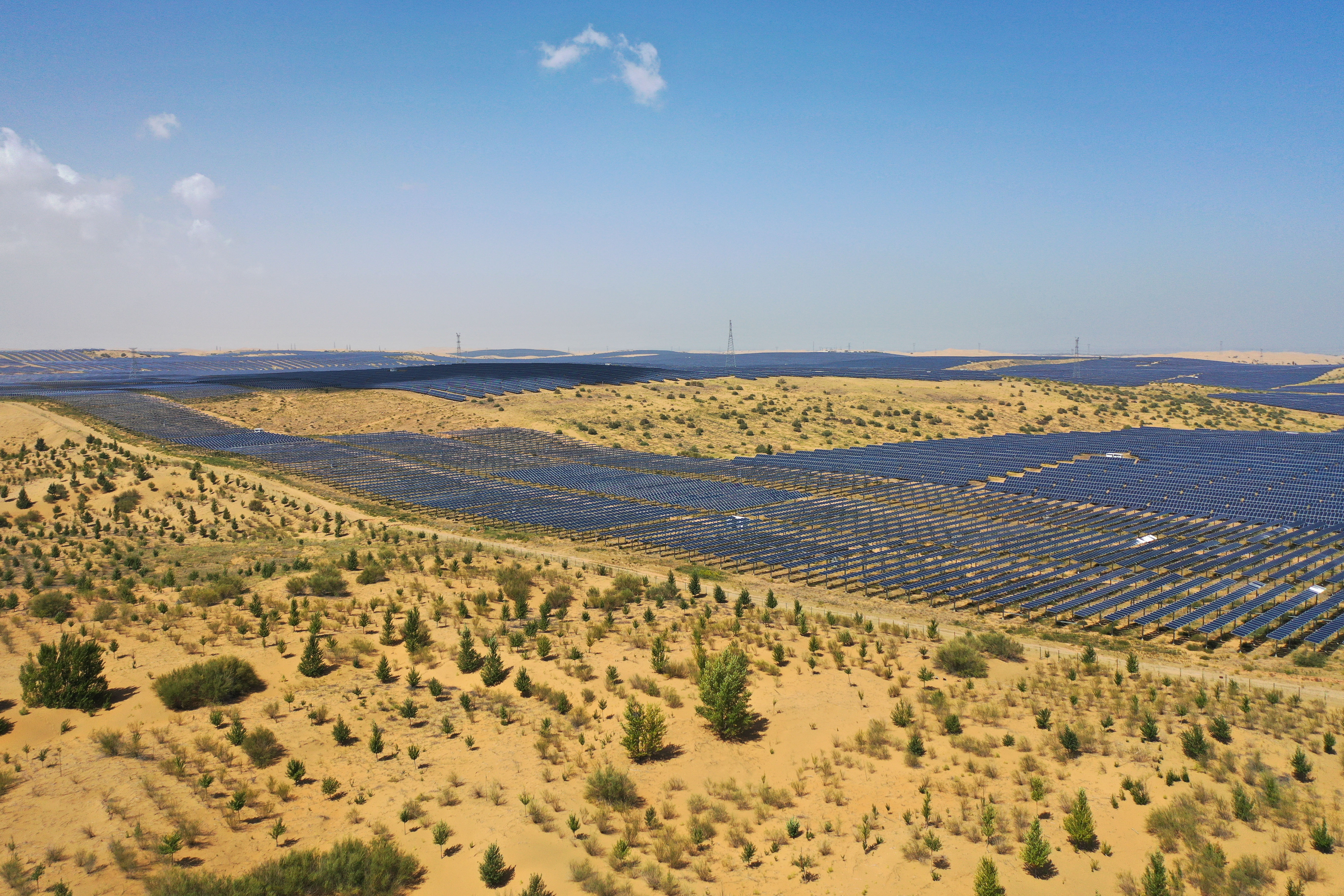
The Junma solar power station — “Junma” meaning “fine horse” in Chinese — is part of an ambitious desert reclamation project known as the “great photovoltaic wall,” stretching along the northern edge of the Kubuqi Desert.
The grand project is planned to extend about 400 kilometers with an average width of five kilometers. Upon completion, it is set to have an installed capacity of 100 million kilowatts.
At the Kubuqi Desert Ordos Central-Northern New Energy Base project, located in the central section of the “great photovoltaic wall,” rows of blue solar panels glisten under the sun.
“The first and second phases of the project, each with an installed capacity of one gigawatt, have been successfully connected to the grid, transforming over 63,000 mu (about 4,200 hectares) of desert into a sea of solar panels,” said Na Guiting, deputy president of Inner Mongolia Three Gorges Mengneng Energy Co., Ltd., the company responsible for the project.
As one of China’s first large-scale renewable energy bases with a capacity exceeding 10 gigawatts, the base is set to develop eight gigawatts of solar power, four gigawatts of wind power, and four gigawatts of supporting coal power.
Once the project is completed, it will deliver approximately 40 billion kilowatt-hours of electricity annually to the Beijing-Tianjin-Hebei region, with over 50 percent coming from clean energy sources, according to Na.
It is equivalent to saving about 6 million tonnes of standard coal and reducing carbon dioxide emissions by around 16 million tonnes each year, Na added.
Beneath the solar panels, various sand-fixing plants are thriving.
The panels provide shade, cut groundwater evaporation and reduce wind speeds, all of which support plant growth, said Hong Guangyu, a researcher with the Academy of Forestry Sciences of Inner Mongolia Autonomous Region, adding that the plants prevent dust from rising, which in turn benefits solar power generation.
The city of Ordos, also known for its abundant coal resources, has several large coal mines around the Kubuqi Desert. The treated drainage water from the coal mines is channeled to the solar power base and used to clean the solar panels and water the plants.
Local residents are also reaping the benefits of the solar projects. “These projects shield us from wind and sand, allowing our village to cultivate over 10,000 mu of high-standard farmland this year. If leased out, the land can bring villagers 900 yuan (about 126.6 U.S. dollars) per mu each year,” said Han Rongkuan, a local farmer.
At the 16th Conference of the Parties to the United Nations Convention to Combat Desertification, Ordos shared its experience in photovoltaic-based desertification control with other cities.
“The story of solar power projects in Kubuqi Desert embodies Chinese wisdom and solutions, demonstrating a sustainable path that combines ecological and economic benefits in the fight against desertification,” Hong said.
Under China’s Three-North Shelterbelt Forest Program (TSFP), the world’s largest afforestation initiative launched in 1978 to combat desertification across the country’s northwestern, northern and northeastern regions, a total of 480 million mu of forests have been planted and preserved, while 1.28 billion mu of degraded grasslands have been successfully restored.
At the Central Economic Work Conference in 2024, China urged efforts to push for major progress in the landmark projects of the TSFP and promote faster construction of new energy bases in sandy areas, rocky areas and deserts.
The issuer is solely responsible for the content of this announcement.
Media OutReach
Holistic Way Unveils New Plant-Based Menopause Relief Supplement
As awareness around women’s health continues to grow, menopause remains a life stage that is frequently underserved by mainstream health solutions. JR Life Sciences is responding to this gap with a science-backed, plant-derived formulation that offers a natural alternative to conventional hormone-based therapies, one that is both accessible and aligned with the preferences of today’s health-conscious consumer.
Menopause Relief is a once-daily capsule containing three plant-based phytoestrogens, each selected for their clinically studied benefits in managing menopause symptoms and supporting long-term health. The formulation is free from synthetic hormones and is suitable for both vegetarian and vegan diets, making it broadly accessible across diverse consumer lifestyles.
Key active ingredients include:
- Lifenol Hops Extract (8-PN phytoestrogen): Shown to lessen hot flushes, night sweats, sleep disturbances, restlessness and irritability while helping to maintain total-body bone-mineral density.
- Flax Lignan (SDG phytoestrogen): Provides gentle hormonal support that helps balance oestrogen levels during the transition.
- Soy Isoflavone (genistein and daidzein): Supports bone strength, reduces hot flashes and steadies mild mood swings.
The launch of Menopause Relief reflects a broader strategic priority for JR Life Sciences: to expand its women’s health portfolio in response to growing consumer demand for natural health solutions. In Singapore, where an ageing population is driving increased interest in preventive health and targeted supplementation, the company sees a significant opportunity to better serve women navigating the menopause transition.
Holistic Way currently distributes a comprehensive range of nutraceuticals across key health categories, including:
- Musculoskeletal Health: Products categorised under joint supplements to address knee pain and mobility concerns in ageing demographics.
- Immunity & General Health: Daily essentials ranging from Vitamin C tablets and multivitamin supplements to vitamins for the immune system.
- Specialised Care: Targeted formulations including eye health supplements, probiotics supplements, and heart health supplements.
- Beauty & Wellness: Functional supplements such as collagen shots, hair growth supplements, and anti-ageing supplements.
As JR Life Sciences prepares for 2027, its focus remains on addressing unmet market needs and evolving consumer expectations. Guided by a commitment to science-backed innovation and quality, the company continues to invest in building a future-ready product pipeline that supports long-term well-being and reinforces trust among consumers in Singapore and beyond.
Menopause Relief is now available through Holistic Way’s retail and digital channels. For more information, visit https://holisticway.com.sg/.
Hashtag: #HolisticWay
The issuer is solely responsible for the content of this announcement.
About Holistic Way
Holistic Way is a leading Singapore-based health supplement brand under JR Life Sciences, committed to supporting holistic wellbeing through science-led nutrition. The brand offers a comprehensive range of supplements formulated to support key health areas, including immunity, hormonal balance, joint health, digestive wellness, and healthy ageing. Guided by evidence-based research and stringent quality standards, Holistic Way focuses on delivering effective, reliable solutions that address both everyday wellness needs and specific life-stage concerns. Through its emphasis on scientific integrity and product excellence, Holistic Way empowers individuals to take proactive control of their health and well-being.
Media OutReach
VinFast’s Expansion Mirrors the Global Shift in EV Growth
Emerging economies are becoming the EV industry’s fastest-growing markets, creating new opportunities for automakers with an international footprint. VinFast’s latest expansion reflects that shift.
DUBAI, UNITED ARAB EMIRATES – Media OutReach Newswire – 5 August 2026 – For much of the past decade, the global electric vehicle conversation has revolved around three markets: China, the United States, and Europe. But recent industry data suggests the next chapter may be written elsewhere.
According to the International Energy Agency (IEA), global car sales fell about 5% in the first half of 2026 as economic pressures, fuel price volatility and policy changes weighed on demand in China and the US. Yet electric vehicle sales rebounded strongly in the second quarter, reaching record levels in 50 countries. Markets including Vietnam, India, Australia and South Korea roughly doubled EV sales compared with a year earlier, while more than 90 countries posted year-on-year growth during the first half of the year.
The shift reflects a broader change in where future industry growth is likely to come from. While China remains the world’s largest EV market, the IEA expects sales there to stagnate this year for the first time this decade, even as electric vehicles account for more than 60% of new car sales. Meanwhile, emerging markets are becoming increasingly important, supported by expanding policy incentives, growing charging infrastructure and rising consumer interest.
The agency also notes that China and other emerging economies are expected to account for around 60% of global car demand over the next decade, making success in these markets an increasingly important determinant of future automotive leadership.
VinFast’s latest performance reflects this changing landscape.
The Vietnamese automaker delivered 70,085 electric vehicles globally in the second quarter of 2026, up 96% year-on-year, bringing first-half deliveries to 128,662 vehicles, a 78% increase from the same period last year. The company’s two-wheel business also continued to expand rapidly, with 286,039 electric scooters and e-bikes delivered during the quarter, up 311% year-on-year.
The delivery mix also highlights the importance of products designed for diverse market needs. Models ranging from the compact VF 3 and VF 5 to the Limo Green MPV and the newly introduced VF MPV 7 all contributed meaningfully to second-quarter volumes, suggesting demand is spread across both personal mobility and commercial transportation segments.
Just as significant is where those vehicles are going.
In July, VinFast exported more than 5,000 electric vehicles aboard two dedicated vessels. One shipment, consisting of approximately 1,500 VF 6 SUVs, was designated for partner Green SM’s planned expansion in Europe, while another transported more than 3,500 vehicles to the Philippines and Indonesia. The voyages marked VinFast’s 37th and 38th international export shipments in fewer than four years, underscoring the increasing operational scale behind its global expansion.
VinFast’s effort in international market, including in the Middle East, shows that as growth becomes more geographically diversified, automakers can no longer rely on a handful of mature markets to drive expansion. Instead, success will increasingly depend on building products, distribution networks and operations that can compete across a wide range of emerging economies.
For the global EV industry, the center of gravity is not disappearing from established markets. It is becoming far more distributed. VinFast’s recent momentum suggests that companies positioned across multiple high-growth regions may be among the best placed to benefit from that shift.
Hashtag: #VinFast
The issuer is solely responsible for the content of this announcement.

Media OutReach
EM Services and SPTel Partner to Advance Smart Estate Management Through Digital Connectivity and IoT Solutions
- Faster detection of estate issues
- Faster response and resolution times
- Better use of manpower and resources
- Better services and living environments for residents
CEO
EM Services
Chief Executive Officer
SPTel
Hashtag: #EMServices #SPTel
The issuer is solely responsible for the content of this announcement.