Connect with us

Economy

Dangote Refinery Exports 1.1 billion Litres of PMS in Over 60 Days

Published

on

Dangote refinery fuel queues

By Aduragbemi Omiyale

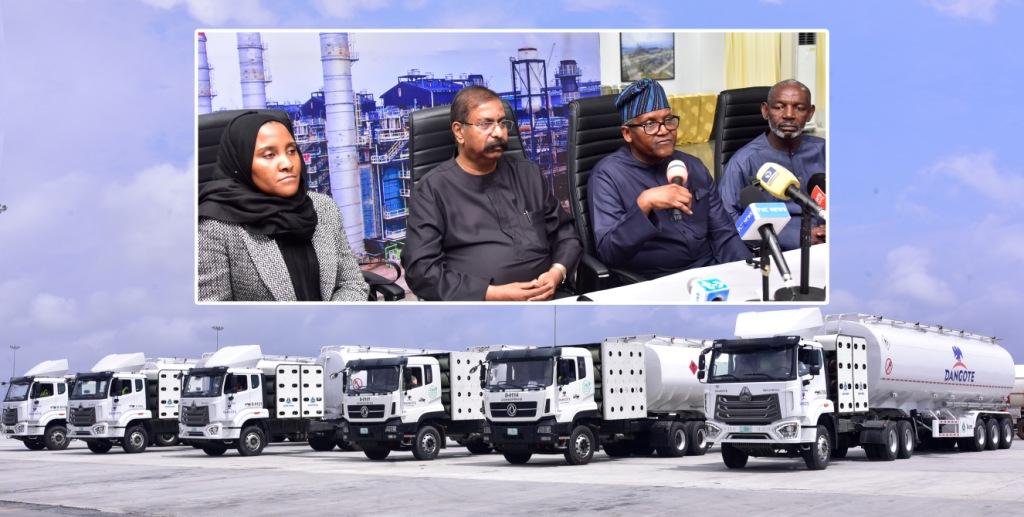
Over 1.1 billion litres of Premium Motor Spirit (PMS), otherwise known as petrol, have been exported by Dangote Refinery.

The owner of the facility, Mr Aliko Dangote, revealed this to newsmen during a chat with them at an event to mark the first anniversary of the launch of petrol from the 650,000 barrels-per-day refinery.

Dangote Refinery, located in the Lekki area of Lagos, commenced production on September 3, 2024, and has helped the nation to solve the persistent fuel queues since 1975.

He revealed that between June and first week of September 2025, the facility had exported over 1.1 billion litres of PMS, underscoring its capacity to meet domestic demand and contribute significantly to foreign exchange earnings, noting that the refinery has sufficient capacity to meet Nigeria’s domestic demand while also generating foreign exchange through exports.

The businessman described the journey as “challenging because we sought to transform the downstream sector in Nigeria.”

“Some believed we were taking food from their tables, which simply isn’t true. What we have done is to make our country and continent proud. Previously, only two African countries were not importing petrol, but regrettably, they have since resumed imports. This is detrimental to Africa,” he added.

However, he stressed that the inspiration to continue with the project was because of his love for the country, saying he received repeated warnings from industry experts, investors, local and foreign government officials, who argued that only sovereign nations undertook such large-scale refinery ventures, admitting that had the project failed, he would have lost all his assets to lenders.

He reaffirmed his commitment to Nigeria’s industrialisation, describing it as essential for the continent’s development, stressing the urgent need for Nigeria to protect its local industries and discourage the dumping of cheap foreign goods, citing the collapse of the once-thriving textile sector as a cautionary example.

“Other nations were not industrialised by outsiders. We must build and industrialise our own economies. Without this, how can others invest? That is why I believe the National Assembly should enact legislation to support the Federal Government’s ‘Nigeria First’ policy. My goal is to see Africa prosper, as we have the fastest-growing population in the world. Relying on imports means exporting jobs and importing poverty. Many individuals with greater financial resources than myself want to invest, but the challenges we face discourage them. Numerous sectors are still in urgent need of industrialisation,” he said

Mr Dangote reiterated that the refinery remains open to partnerships and collaborations with other stakeholders in the downstream sector, stressing that the industry stands to gain more through collective effort and cooperation.


Economy

Nigerian Senate to Pass 2026 Budget March 17

Published

on

Tinubu 2026 Budget presentation

By Adedapo Adesanya

The Senate, through its Committee on Appropriations, has fixed March 17, 2026, as the tentative date for the final consideration and passage of the N58.472 trillion 2026 Appropriation Bill.

This was made known after a special session on Friday, where February 2 to 13, 2026, was approved for the consideration of budget estimates at the committee level.

The committee equally fixed Monday, February 9, 2026, for a public hearing on the budget proposal.

Chairman of the committee, Mr Solomon Olamilekan Adeola, further disclosed that Thursday, March 5, 2026, has been scheduled for an interactive session between members of the committee and key economic managers of the federal government, including the Ministers of Finance and Coordinating Minister of the Economy, Mr Wale Edun, as well as the Minister of Budget and National Planning, Mr Atiku Bagudu.

According to him, February 16 to 23, 2026, has been earmarked for the submission of reports on budget defence by various standing committee chairmen, ahead of the presentation of the Appropriations Committee’s report to the Senate on March 17.

He disclosed that while the Senate leadership initially preferred the budget to be passed by March 12, 2026, he successfully appealed for an additional week to allow for more thorough scrutiny.

To aid detailed examination of the estimates, Senator Adeola said hard copies of the 2026 budget have been printed and distributed to chairmen and members of the Senate’s standing committees.

On December 19, 2025, President Bola Tinubu presented a budget proposal of N58.47 trillion for the 2026 fiscal year titled Budget of Consolidation, Renewed Resilience and Shared Prosperity to a joint session of the National Assembly.

The budget has a capital recurrent (non‑debt) expenditure standing at N15.25 trillion, and the capital expenditure at N26.08 trillion, while the crude oil benchmark was pegged at $64.85 per barrel.

Mr Tinubu said the expected total revenue for the year is N34.33 trillion, and the proposal is anchored on a crude oil production of 1.84 million barrels per day, and an exchange rate of N1,400 to the US Dollar.

In terms of sectoral allocation, defence and security took the lion’s share with N5.41 trillion, followed by infrastructure at N3.56 trillion, education received N3.52 trillion, while health received N2.48 trillion.

Continue Reading

Economy

Airtel Africa Grows Earnings to $4.7bn in Nine Months

Published

on

Airtel Africa nine-month results

By Aduragbemi Omiyale

About $4.7 billion was generated by Airtel Africa Plc in nine-month period ended December 31, 2025, details of the company’s financial statements revealed.

The telco disclosed that in the period under review, mobile services revenue grew by 23.3 per cent in constant currency, as data revenues, the largest contributor to group revenues, increased by 36.5 per cent, with voice revenues growing by 13.5 per cent.

In the same vein, EBITDA grew by 35.9 per cent in reported currency to $2.3 billion, with EBITDA margins expanding further to 48.9 per cent from 46.2 per cent in the prior period.

The third quarter of the fiscal year witnessed a further sequential increase in EBITDA margins to 49.6 per cent, driving EBITDA growth of 31.0 per cent in constant currency and 40.8 per cent in reported currency.

The financial results showed that profit after tax of $586 million improved from $248 million in the prior period. Higher profit after tax in the current period was driven by higher operating profit and derivative and foreign exchange gains of $99 million versus the $153 million derivative and foreign exchange losses in the prior period.

Commenting, the chief executive of Airtel Africa, Mr Sunil Taldar, said, “These results highlight the strength of our strategy, with strong operating and financial trends across the business. During the quarter, we accelerated investment to enhance coverage and data capacity while also expanding our fibre network.

“Coupling this investment with innovative partnerships, strengthens our customer proposition and positions us to capture the considerable growth opportunity across our markets.

“Digitisation, technology innovation and embedding AI in our processes will also optimise the customer experience with increased digital offerings and closer integration of GSM and Airtel Money services allowing us to unlock the strong demand across our markets. Smartphone adoption continues to increase with penetration of 48.1 per cent, and we are seeing solid progress in the development of our home broadband business, reflecting the need for reliable, high-speed connectivity across our markets.

“Our push to enhance financial inclusion across the continent continues to gain momentum with our Mobile Money customer base expanding to 52 million, surpassing the 50 million milestone. Annualised total processed value of over $210 billion in Q3’26 underscores the depth of our merchants, agents and partner ecosystem, and remains a key player in driving improved access to financial services across Africa. We remain on track for the listing of Airtel Money in the first half of 2026.

“Disciplined execution on cost efficiency, alongside accelerating revenue growth has enabled another sequential improvement in our quarterly EBITDA margin to 49.6 per cent, – underpinning constant currency EBITDA growth of 31 per cent – and we remain focussed on driving further incremental margin improvements.

“Our strategic priorities remain clear: to keep investing in best in class connectivity, accelerate financial inclusion through our mobile money platform and deliver a great customer experience. These results reinforce our confidence in the long term potential of our markets and our ability to create value for all our stakeholders.”

Continue Reading

Economy

Interest Rates May Remain Elevated Despite Inflation Cooling—PwC

Published

on

interest rate hike

By Adedapo Adesanya

According to PricewaterhouseCoopers (PwC), Nigeria’s benchmark interest rate is likely to remain elevated in 2026 even as inflation shows signs of easing.

Speaking at the PwC–BusinessDay Executive Roundtable on Nigeria’s 2026 budget and economic outlook in Lagos on Thursday, the Chief Economist and Head of Strategy at PwC, Mr Olusegun Zaccheaus, said expectations of aggressive interest rate cuts might be premature even with the core factor – inflation – seen cooling.

“Interest rates may remain elevated despite inflation cooling for most of 2025,” Mr Zaccheaus said. “Perhaps not by the 500 basis points some hope for, due to the need to manage liquidity.”

The Central Bank of Nigeria (CBN) had more than doubled its policy rate from 2022 levels in a bid to rein in inflationary pressures, before implementing a 50 basis-point cut in September that brought the monetary policy rate to 27 per cent.

The move followed a sharp moderation in inflation from its late-2024 peak. Inflation slowed to 15.15 per cent in December 2025, while the economy expanded by 3.98 per cent in the third quarter, its strongest quarterly growth in years.

At the last Monetary Policy Committee (MPC) meeting of the CBN in November 2025 voted to keep the interest steady.

The PwC official warned that warned that underlying risks, including exchange-rate volatility, fiscal pressures and global uncertainty, continue to complicate the outlook.

Mr Zaccheaus said that a major challenge for the apex bank will be to control the volume of money circulating in the economy.

He advised that liquidity management remains critical as excess cash can quickly undermine dis-inflation efforts particularly as the 2027 election cycle is around the corner.

He said that Nigeria typically experiences rapid growth in money supply ahead of election cycles, driven by increased government spending and political activity, adding that without careful coordination, such expansions risk fueling inflation and weakening investor confidence.

“The responsibility of the central bank is to ensure liquidity does not grow in a way that has a negative macroeconomic impact,” Mr Zaccheaus said.

He noted that a stable currency environment would support improved capital allocation and investment planning.

“FX stability is crucial,” Mr Zaccheaus said. “It gives investors confidence and allows businesses to plan. But that stability depends on disciplined policy execution.”

Continue Reading

Trending