Connect with us

Economy

Trump Threats Weaken Naira by 1.02% at Official FX Market

Published

on

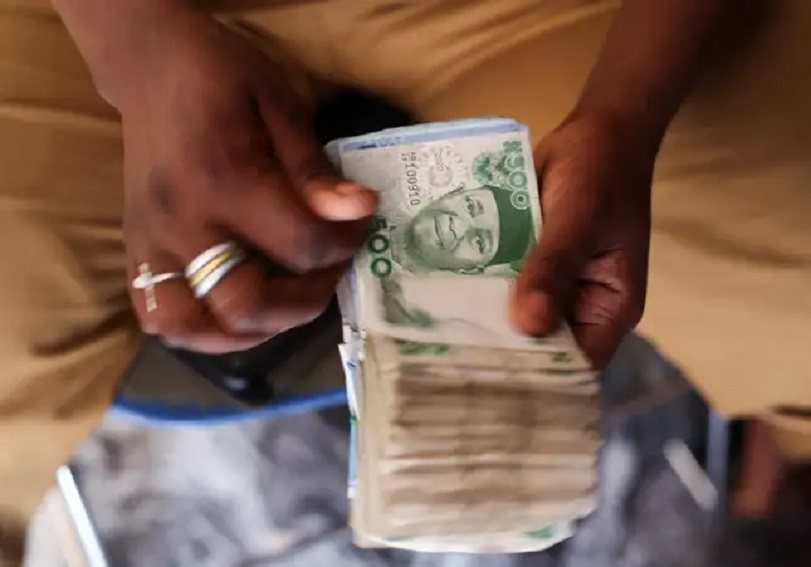
naira street value

By Adedapo Adesanya

Recent threats by US President Donald Trump to carry out military actions in Nigeria spooked the financial markets, with the foreign exchange (FX) market not left out, as the value of the Naira weakened across various windows on Monday, November 3.

The local currency declined against the United States Dollar in the Nigerian Autonomous Foreign Exchange Market (NAFEM) during the session by N14.56 or 1.02 per cent to N1,436.34/$1 from the N1,421.78/$1 it ended last Friday.

Also, the domestic currency lost N22.11 against the Pound Sterling in the official FX market to close at N1,885.77/£1 versus the preceding session’s N1,863.66/£1 and depleted against the Euro by N12.98 to settle at N1,653.37/€1, in contrast to the N1,640.39/€1 it traded at the last trading session.

At GTBank, the exchange rate of the Nigerian Naira to the US Dollar remained unchanged at N1,440/$1 yesterday, but tumbled against the greenback in the black market by N4 to close at N1,445/$1 compared with the N1,440/$1 it was exchanged in the previous trading day.

President Trump said he had instructed the US Defense Department “to prepare for possible action” and threatened an immediate cutoff in aid and assistance to Nigeria.

President Bola Tinubu has since rejected Mr Trump’s characterization of the country, saying he was disregarding “the consistent and sincere efforts of the government to safeguard freedom of religion and beliefs for all Nigerians.”

A possible dialogue between the country is expected in coming weeks, according to the Nigerian government.

Regardless of this, outlook for the Naira remained optimistic with the recent introduction of a 15 per cent import tariff on petrol and diesel expected to ease dependence on FX. Coupled with increased inflows from exporters, non-bank corporate, individuals and foreign investors, the local currency’s pros outweigh cons.

In the cryptocurrency market, investors’ sentiments remained negative after the worst October in a decade with over $100 billion loss printed among major assets.

The US Federal Reserve’s recent actions and cautious messaging have been identified as contributing to the broader risk aversion.

Solana (SOL) slipped by 11.1 per cent to $157.00, Binance Coin (BNB) slid by 8.5 per cent to $943.72, Litecoin (LTC) slumped by 7.7 per cent to $86.20, Cardano (ADA) depreciated by 7.4 per cent to $0.5340, and Ripple (XRP) went down by 7.0 per cent to $2.42.

Further, Dogecoin (DOGE) shrank by 6.7 per cent to $0.1662, Ethereum (ETH) depleted by 6.2 per cent to $3,490.37, and Bitcoin (BTC) depreciated by 2.9 per cent to $104,537.05, while the US Dollar Tether (USDT) and the US Dollar Coin (USDC) traded flat at $1.00 each.


Adedapo Adesanya is a journalist, polymath, and connoisseur of everything art. When he is not writing, he has his nose buried in one of the many books or articles he has bookmarked or simply listening to good music with a bottle of beer or wine. He supports the greatest club in the world, Manchester United F.C.

Economy

MTN, Oando, RT Briscoe 35 Others Sink Local Stock Exchange by 0.33%

Published

on

RT Briscoe money market fund

By Dipo Olowookere

The Nigerian Exchange tasted another defeat on Wednesday after it closed lower by 0.33 per cent due to profit-taking, especially in MTN Nigeria, Oando, UBA, and others.

The selling pressure was triggered by the desire of investors to recaliberate their portfolios and this saw 38 shares end in the red territory as only 32 shares finished in the green side, implying a negative market breadth index and weak investor sentiment.

According to data from Customs Street, RT Briscoe suffered the heaviest lost after it shed 9.97 per cent to trade at N6.50, May and Baker depreciated by 9.96 per cent to N35.25, Ikeja Hotel slumped by 9.92 per cent to N32.25, Living Trust Mortgage Bank lost 9.90 per cent to settle at N4.64, and eTranzact dipped by 9.16 per cent to N17.35.

At the other side of the coin, Union Homes REIT was the biggest price gainer after it improved its value by 9.97 per cent to N94.85, Deap Capital grew by 9.97 per cent to N9.49, Tantalizers appreciated by 9.92 per cent to N3.88, and SAHCO advanced by 9.91 per cent to N128.60.

Leading the activity chart yesterday was Neimeth, which traded 58.1 million equities for N590.6 million, Chams sold 39.4 million stocks worth N190.6 million, Access Holdings exchanged 33.4 million shares valued at N757.5 million, Zenith Bank transacted 32.4 million equities worth N2.3 billion, and Tantalizers recorded a turnover of 29.2 million shares valued at N109.8 million.

At the close of transactions, 631.2 million stocks exchanged hands for N16.5 billion in 42,172 deals at midweek compared with the 483.1 million stocks worth N17.4 billion recorded in 41,499 deals a day earlier, showing a fall in the trading value by 5.17 per cent, and an increase in the trading volume and number of deals by 30.66 per cent and 1.62 per cent apiece.

As for the key performance indices, they were down, with the All-Share Index (ASI) losing 549.44 points to settle at 165,164.38 points compared with the preceding say’s 165,713.82 points and the market capitalisation giving up N352 billion to end at N105.737 trillion versus Tuesday’s N106.089 trillion.

Continue Reading

Economy

Iran Concerns, Weak Dollar Lift Brent Crude to $68 Per Barrel

Published

on

Brent crude futures

By Adedapo Adesanya

The Brent crude grade gained 1.23 per cent or 83 cents to trade at $68.40 per barrel on Wednesday amid looming Iran concerns, supported by a weak US Dollar.

In the same vein, the US West Texas Intermediate (WTI) crude appreciated by 82 cents or 1.31 per cent to trade at $63.21 per barrel.

US President Donald Trump urged Iran on Wednesday to come to the table and make a deal on ‌nuclear weapons or the next US attack would be far worse, but Tehran said that if ​that happened it would fight back as never before.

“A massive Armada is heading to Iran. It is moving quickly, with great power, enthusiasm, and purpose,” President Trump said in a post on his social media platform Truth Social on Wednesday.

US Central Command said Monday that the Abraham Lincoln Carrier Strike Group had arrived in the Middle East “to promote regional security and stability.”

The American President had threatened to attack Iran if it killed protestors during a mass uprising earlier this month. Thousands of people died after the Islamic Republic cracked down on the unrest. But the U.S. president has held back from military intervention so far.

He also warned Iran that a possible attack would be worse than the bombing campaign he ordered last June on the Islamic Republic’s nuclear facilities.

A weak US Dollar kept the prices elevated as it neared four-year lows against a basket of other currencies, making ‍dollar-denominated commodities such as oil cheaper for those holding other currencies.

Meanwhile, in its first monetary policy decision of 2026, the Federal Reserve elected to hold the federal funds rate steady at 3.50 per cent–3.75 per cent, pausing further cuts after three reductions late last year.

The decision, made at the January 27–28 Federal Open Market Committee meeting, reflects a cautious stance amid mixed economic signals and persistent inflation above target.

The FOMC statement shows that while economic activity “has been expanding at a solid moderate pace,” job gains have slowed and the unemployment rate has only “shown some signs of stabilization,” leading policymakers to resist further easing for now.

Negotiations between Russia, Ukraine and the US are set to resume in Abu Dhabi, the United Arab Emirates (UAE) on February 1.

Crude oil inventories in the US decreased by 2.3 million barrels during the week ending January 24, according to new data from the US Energy Information Administration (EIA) released on Wednesday. The EIA’s data release follows figures by the American Petroleum Institute (API) that were released a day earlier, which suggested that crude oil inventories fell by 247,000 barrels.

Continue Reading

Economy

Persistent Grid Collapse Poses Direct Threat to Manufacturers, MSMEs—LCCI

Published

on

LCCI

By Adedapo Adesanya

The Lagos Chamber of Commerce and Industry (LCCI) has decried the frequent grid disturbances, saying they pose a grave threat to the economy, particularly to manufacturers and small businesses.

The LCCI concern came after the second national grid collapse within four days on Tuesday, which plunged the country into widespread outage and disrupted economic activity nationwide. It followed up from the 12 of such occurrences which were recorded in 2025.

Speaking about the issue, the director general of LCCI, Mrs Chinyere Almona, said, “This recurrence underscores deep structural and operational weaknesses in the power transmission system and poses a direct threat to manufacturers, MSMEs, and Nigeria’s overall business environment at a critical moment when the economy is expected to move from crisis management and stabilisation (2023–2025) into a consolidation phase in 2026.”

According to her, based on recent patterns and in the absence of urgent structural fixes, the LCCI estimates that Nigeria could experience tens of grid collapses in 2026 under a ‘business-as-usual’ scenario.

She noted that with immediate reforms, system upgrades, and strict operational discipline, this figure can be reduced to zero incidents, moving the country closer to grid reliability benchmarks required for economic consolidation.

Mrs Almona noted that repeated grid failures impose severe costs on businesses through lost production hours, damaged equipment, increased reliance on self-generation, higher operating expenses, and reduced competitiveness, saying that these disruptions weaken investor confidence, worsen inflationary pressures, and undermine the credibility of economic reforms.

She called on the federal government to take a decisive and transparent position by instituting an independent forensic audit of the national grid covering transmission infrastructure integrity, system protection schemes, operational protocols, and governance of grid management, adding that the findings should form a critical part of a grid performance system reform in the short term.

“Without urgent intervention, recurring grid collapses will continue to undermine the government’s objective of entering a consolidation phase in 2026, while constraining productivity, exports, and job creation. A reliable power supply is foundational to industrialisation, competitiveness, and macroeconomic stability.

“The Chamber reiterates that restoring grid stability must be treated as an economic emergency, not merely a technical issue. At this stage, the causes of these collapses should be well understood, better managed, and effectively prevented. What we are witnessing today is therefore unacceptable and calls for decisive, coordinated action to safeguard national economic performance,” the LCCI DG said.

Continue Reading

Trending