Connect with us

Economy

Nigerian Exchange Ricochets 0.10% on CBN Rate Decision

Published

on

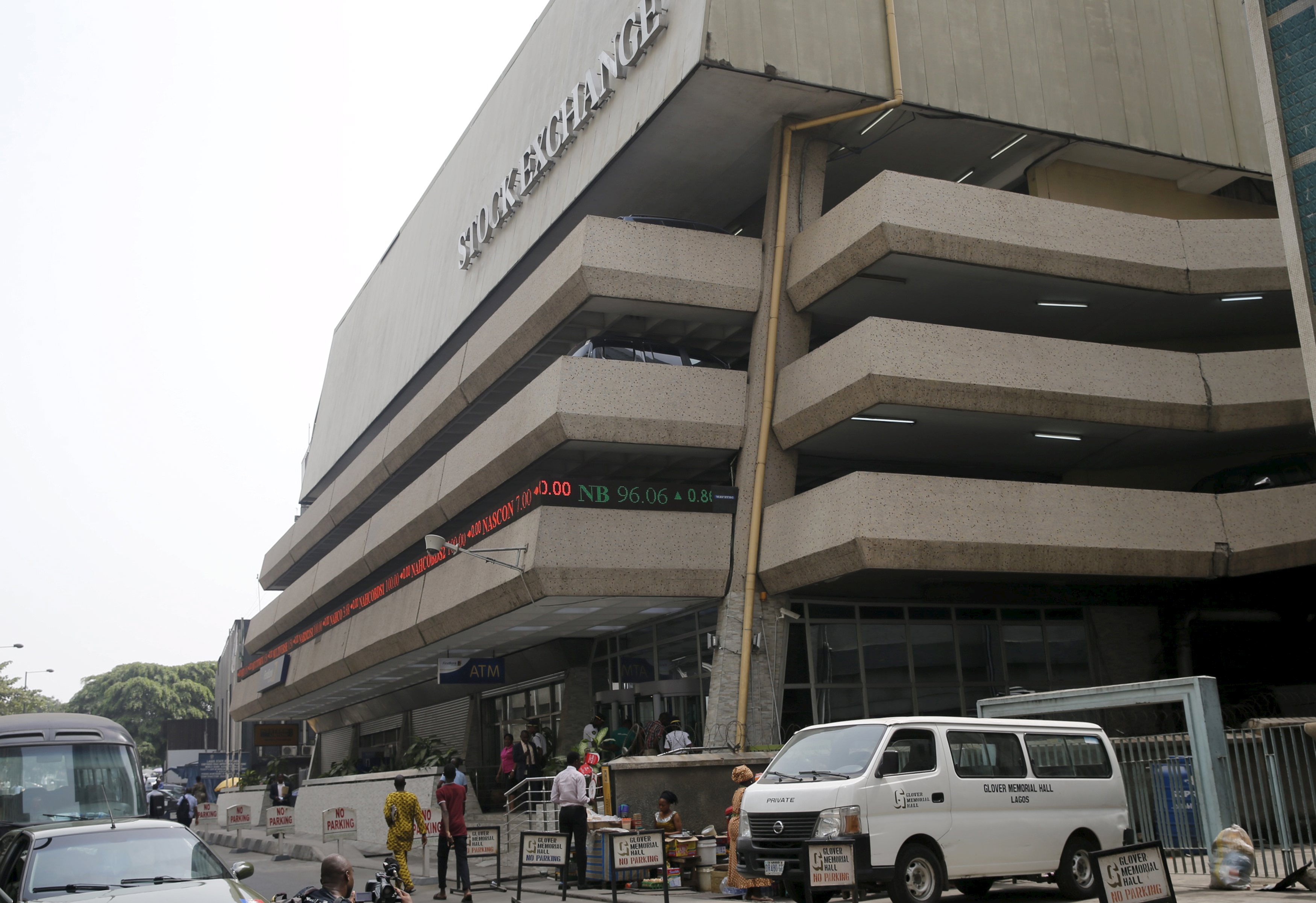
Customs Street Nigerian Stock Exchange

By Dipo Olowookere

For the first time in seven straight trading sessions, the Nigerian Exchange (NGX) Limited recorded its first closure in green territory.

The local bourse ricocheted by 0.10 per cent on Tuesday after the Central Bank of Nigeria (CBN) retained the Monetary Policy Rate (MPR) at 27 per cent.

Also, Business Post observed that investors had keen interest in some banking equities, which helped to lift Customs Street at the close of business despite profit-taking in other key sectors of the market.

The banking index was up by 0.38 per cent, and the consumer goods counter improved by a marginal 0.01 per cent, while the insurance space lost 0.84 per cent and the energy industry weakened by 0.17 per cent, with the commodity and the industrial goods sectors closing flat.

When the stock market closed for the day, the All-Share Index (ASI) went up by 148.52 points to 143,763.13 points from 143,614.61 points and the market capitalisation grew by N95 billion to N91.441 trillion from N91.346 trillion.

The market breadth index was positive during the second trading day of the week after finishing with 26 price gainers and 20 price losers, indicating strong investor sentiment.

NCR Nigeria gained 9.98 per cent to settle at N45.20, Ikeja Hotel appreciated by 9.86 per cent to N22.85, Prestige Assurance improved by 9.56 per cent to N1.49, Eunisell rose by 9.49 per cent to N86.50, and Sterling Holdings soared by 8.96 per cent to N7.30.

However, Union Dicon slipped by 10.00 per cent to N6.30, Caverton also crashed by 10.00 per cent to N4.95, Sunu Assurance tumbled by 4.78 per cent to N4.38, Lasaco Assurance declined by 4.58 per cent to N2.50, and AXA Mansard lost 4.23 per cent to close at N12.45.

Despite the growth achieved by the NGX yesterday, the level of activity waned as traders transacted 556.2 million stocks for N18.7 billion in 19,500 deals versus the 694.8 million stocks valued at N28.7 billion traded in 24,041 deals a day earlier, implying a shortfall in the trading volume, value, and number of deals by 19.95 per cent, 34.84 per cent and 18.89 per cent apiece.

First Holdco was the most active with 93.7 million shares sold for N2.9 billion, Access Holdings traded 81.8 million stocks for N1.7 billion, Fidelity Bank exchanged 41.8 million equities worth N796.4 million, FCMB transacted 38.0 million shares valued at N386.8 million, and UBA traded 32.0 million stocks worth N1.2 billion.


Dipo Olowookere is a journalist based in Nigeria that has passion for reporting business news stories. At his leisure time, he watches football and supports 3SC of Ibadan. Mr Olowookere can be reached via [email protected]

Click to comment

Leave a Reply

Your email address will not be published. Required fields are marked *

Economy

Three Securities Drag NASD OTC Market Down by 1.01%

Published

on

Nigeria's Unlisted Securities Market Sheds 0.78%, NASD Shares up 8.31%

By Adedapo Adesanya

Three securities weakened the NASD Over-the-Counter (OTC) Securities Exchange by 1.01 per cent on Tuesday, June 23, dragging the market capitalisation down by N25.91 billion to N2.544 trillion from Monday’s N2.570 trillion. Also, the NASD Security Index (NSI) decreased by 43.17 points to 4,239.34 points from 4,282.51 points.

The triplet price losers were Central Securities Clearing System (CSCS) Plc, which gave up N4.82 to trade at N75.00 per unit versus Monday’s closing price of N79.82 per unit. NASD Plc depreciated by N3.70 to close at N33.30 per share compared with the preceding day’s N37.00 per share, and Nitrox Industrial Gases Plc marginally lost 1 Kobo to sell at N21.41 per unit, in contrast to the previous session’s N21.42 per unit.

Tuesday’s trading data showed that the volume of securities traded by investors retreated by 35.9 per cent to 211,671 units from 330,034 units, and the value of securities fell by 82.9 per cent to N5.6 million from N32.7 million, while the number of deals doubled to 38 deals from 19 deals.

At the close of trades, Great Nigeria Insurance (GNI) Plc was the most traded stock by value on a year-to-date basis, with 3.4 billion units worth N8.4 billion, followed by Infrastructure Credit Guarantee (Infracredit) Plc with 2.3 billion units valued at N6.5 billion, and CSCS Plc with 68.1 million units transacted for N4.7 billion.

GNI Plc also closed the trading day as the most traded stock by volume on a year-to-date basis, with 3.4 billion units valued at N8.4 billion, trailed by Infracredit Plc with 2.3 billion units exchanged for N6.5 billion, and Resourcery Plc with 1.1 billion units sold for N415.7 million.

Continue Reading

Economy

Naira Weakens to N1,370/$1 at Official FX Window

Published

on

weakening Naira

By Adedapo Adesanya

A 0.11 per cent or N1.53 loss was recorded by the Nigerian Naira against the US Dollar in the Nigerian Autonomous Foreign Exchange Market (NAFEX) on Tuesday, June 22, closing at N1,370.64/$1 compared with the previous day’s value of N1,369.11/$1.

However, the domestic currency appreciated against the Pound Sterling in the official FX window during the session by N4.69 to trade at N1,810.75/£1 versus the previous day’s N1,815.44/£1, and gained N5.37 on the Euro to sell at N1,561.02/€1 versus Monday’s exchange rate of N1,566.39/€1.

At the black market segment, the Naira traded flat against the Dollar yesterday at N1,395/$1, and at the GTBank forex desk, it also closed flat at N1,380/$1.

Daily FX update from the Central Bank of Nigeria (CBN) indicated that forex liquidity improved, but dollar volume was surpassed by strong dollar outflows on Tuesday.

Interbank FX turnover among financial institutions and market makers experienced a significant surge, reaching $125.314 million across 106 deals at the official window, 92 per cent higher than the $65.206 million the previous day, highlighting robust market activity and growing investor confidence.

Also, Nigeria’s foreign reserves continue to grow, reaching $51.142 billion, up from $51.060 billion reported the previous day, according to the CBN’s latest update.

In the cryptocurrency market, digital currencies fell amid heavy selling in technology stocks, which kept pressure on risk assets worldwide. Also, the gauge of the Dollar climbed to a seven-month high as investors moved toward safer assets.

Leading the losers was Cardano (ADA), as it slid 2.1 per cent to $0.1511. Dogecoin (DOGE) lost 1.3 per cent to quote at $0.0789, Ethereum (ETH) shrank 0.9 per cent to $1,673.38, Ripple (XRP) declined by 0.7 per cent to $1.10, TRON (TRX) also fell by 0.7 per cent to $0.3285, Solana (SOL) dipped by 0.3 per cent to $69.83, Bitcoin (BTC) went down by 0.2 per cent to $62,756.99, and Binance Coin (BNB) tumbled by 0.01 per cent to $579.20, while the US Dollar Tether (USDT) and the US Dollar Coin (USDC) remained unchanged at $1.00 apiece.

Continue Reading

Economy

Claims of PMS Export, Re-importation Not True—Dangote Refinery

Published

on

Fifth Crude Cargo Dangote Refinery

By Aduragbemi Omiyale

Dangote Petroleum Refinery and Petrochemicals has refuted allegations that its premium motor spirit (PMS), otherwise known as petrol, exported to other countries, is being re-imported into Nigeria.

It was claimed that the private crude oil refiner sells PMS to other African nations, especially Togo, at a lower price to the extent that when re-imported into the country, it is still cheaper than what Dangote Refinery sells to Nigerian marketers.

Reacting via a statement on Tuesday night, the management described the allegations as “baseless and unsubstantiated” because they are not “supported by verifiable trade data, commercial logic, or the operational realities of Dangote Refinery.”

The company noted that its core mandate is to strengthen domestic supply and remains a leading provider of petroleum products in Nigeria.

“Any practice that enables imports to compete directly with its own production clearly contradicts this objective,” it stated.

Dangote Refinery said “all sales contracts and tender agreements expressly prohibit the resale or re-importation of Dangote Refinery products into Nigeria,” emphasising that “the economics of the purported trade route are fundamentally flawed.”

The organisation stated that estimated logistics costs for transporting products from the refinery to Lomé and back into Nigeria range between $82–90 per metric ton. Such additional costs would significantly erode margins and render the transaction commercially unviable.

“Dangote Refinery does not provide export discounts sufficient to offset these costs or create arbitrage opportunities between export and domestic markets. Simply put, no rational producer would incur additional shipping, storage, financing, and handling costs only for products to re-enter and compete in its primary market,” it pointed out.

The management also highlighted that the refinery maintains stringent product traceability protocols, including detailed records of lifting points, nominated vessels, counterparties, and declared destinations. These measures ensure full visibility and accountability across the supply chain.

The statement insisted that any “claim suggesting that the refinery facilitates or tolerates re-importation is inconsistent with its contractual safeguards and established compliance standards.”

The refinery said it has consistently advocated for reducing Nigeria’s dependence on imported petroleum products, underscoring that encouraging or enabling re-importation would undermine local refining efforts, strain foreign exchange reserves, and weaken national industrial growth, positions that are contrary to its core objectives.

Dangote Refinery reiterated that there is no strategic, economic, or operational basis for the claim that it exports products for re-importation into Nigeria, stressing that the allegation is entirely unfounded and does not withstand scrutiny when measured against market logic, contractual frameworks, and industry practices.

The statement concluded that “Dangote Refinery remains focused on its mission to enhance energy security, support local refining, and contribute meaningfully to Africa’s industrial development.”

Continue Reading

Trending