Connect with us

Economy

SEC to Prioritise Mobilisation of Long Term Funds, Others in 2026

Published

on

SEC FF Tiffany

By Aduragbemi Omiyale

One of the main goals of the Securities and Exchange Commission (SEC) for 2026 is prioritising the mobilisation of long-term capital to bridge Nigeria’s infrastructure and sectoral gaps while also streamlining regulatory frameworks and aggressively facilitating the issuance of innovative financial instruments that channel disciplined capital into productive sectors.

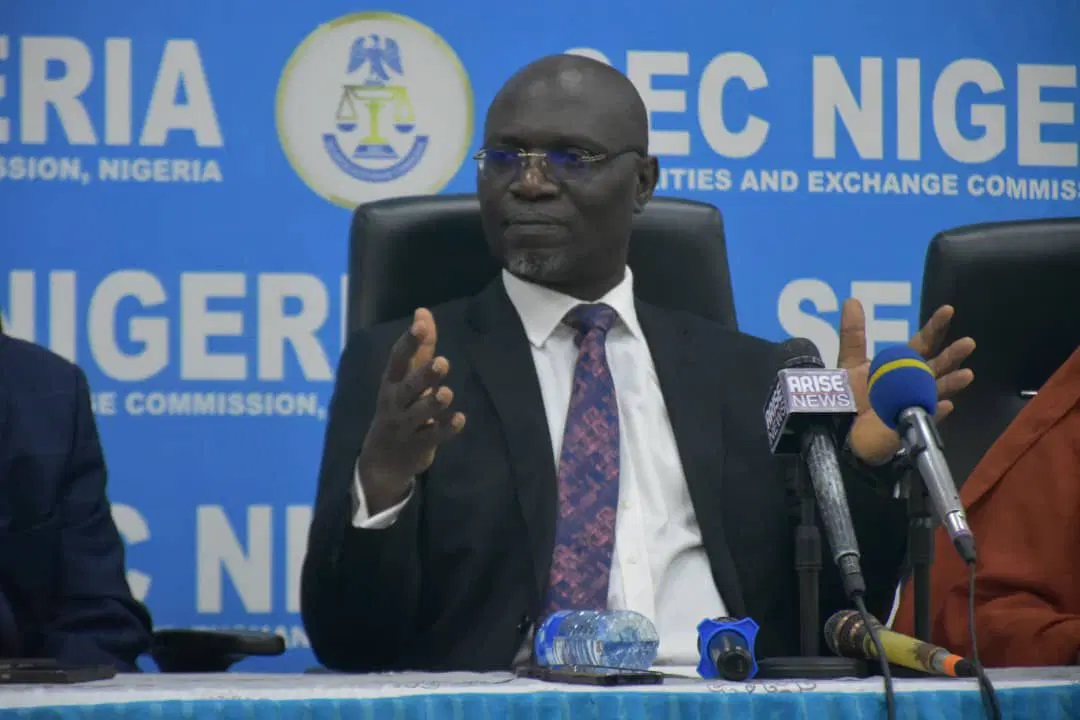
In his New Year message on Thursday in Abuja, the Director General of the agency, Mr Emomotimi Agama, also disclosed that SEC intends to facilitate the issuance of infrastructure bonds, green bonds, municipal bonds, and infrastructure-focused funds.

He further disclosed that efforts would be made to drive the revitalisation of Real Estate Investment Trusts (REITs) and introduce innovative affordable housing bonds.

According to him, these initiatives will unlock capital for mass housing delivery, create new asset classes for investors, and move millions of Nigerians closer to homeownership.

“Our goal is to attract long-term domestic and international capital into roads, power, rail, housing, and digital infrastructure, while making it easier for state governments and infrastructure companies to access the market efficiently.

“We will promote the listing of agribusiness firms and create tailored listing windows for agricultural cooperatives and value-chain companies.

“Through commodity exchanges, agricultural investment trusts, and commodities-linked financial instruments, we will de-risk agriculture, ensure fair pricing for farmers, strengthen food security, and allow Nigerians to own a stake in the nation’s breadbasket,” he stated.

“We are reviewing our rules to incentivize listings from small and medium-scale industries, with special focus on manufacturing, automotive, pharmaceuticals, and finished goods.

“By providing patient capital through the capital market, we will revitalize factories, reduce import dependency, create jobs, and position Made in Nigeria as a global brand.

“The SEC will support Nigeria’s power sector through infrastructure bonds, green energy bonds, project-backed securities, and public–private investment vehicles.

“We will help unlock long-term capital for grid expansion, renewable energy projects, embedded power solutions, and energy transition initiatives. By improving bankability structures and attracting patient capital into the power value chain, the capital market will support energy security,” he added.

Mr Agama noted that as the new year begins, the SEC is  not merely turning a page on the calendar; but is embracing a profound opportunity—an opportunity to redefine the very purpose and power of the Nigerian capital market.

“We look back at a year of transformation and look forward to a future where our capital market becomes the definitive solution provider for Nigeria’s most pressing economic and developmental needs,” he added.


Advertisement
Click to comment

Leave a Reply

Your email address will not be published. Required fields are marked *

Economy

NASD Unlisted Security Index Climbs 0.88%

Published

on

NASD Unlisted Security Index

By Adedapo Adesanya

The NASD Over-the-Counter (OTC) Securities Exchange maintained its upward trajectory with a further 0.88 per cent rise on Wednesday, March 3.

The expansion increased the NASD Unlisted Security Index (NSI) by 36.94 points to 4,256.41 points from 4,219.47 points, and lifted the market capitalisation by N22.10 billion to N2.546 trillion from Tuesday’s N2.524 trillion.

The six price gainers were responsible for the growth achieved by the unlisted securities market yesterday, with MRS Oil Plc adding N20.00 to trade at N230.00 per unit versus the previous day’s N210.00 per share.

Further, FrieslandCampina Wamco Nigeria Plc surged by N11.07 to N128.83 per share from N117.76 per share, Lagos Building Investment Company (LBIC) Plc grew by 37 Kobo to N4.12 per unit from N3.75 per unit, First Trust Mortgage Bank Plc advanced by 19 Kobo to N2.11 per share from N1.92 per share, Acorn Petroleum Plc rose by 1 Kobo to sell at N18.75 per unit versus the preceding day’s N18.74 per unit, and Acorn Petroleum Plc also gained 1 Kobo rise to sell at N1.35 per share versus N1.34 per share.

It was observed that two securities were in red at midweek, with Central Securities Clearing System (CSCS) Plc down by N1.56 to N82.59 per unit from N84.05 per unit, and Industrial and General Insurance (IGI) Plc down by 2 Kobo to 47 Kobo per share from 49 Kobo per share.

Yesterday, the volume of trades went up by 86.2 per cent to 2.6 million units from 1.4 million units, but the value of transactions deflated by 31.4 per cent to N64.1 million from N93.4 million, and the number of deals declined by 22.0 per cent to 46 deals from 59 deals.

CSCS Plc remained the most traded stock by value (year-to-date) with 36.4 million units valued at N2.2 billion, trailed by Okitipupa Plc with 6.3 million units traded for N1.1 billion, and Geo-Fluids Plc with 122.8 million units transacted for N480.4 million.

Resourcery Plc ended the day as the most traded stock by volume (year-to-date) with 1.05 billion units sold for N408.7 million, followed by Geo-Fluids Plc with 122.8 million units traded for N480.4 million, and CSCS Plc with 36.4 million units worth N2.2 billion.

Continue Reading

Economy

Naira Falls to N1,387/$ at Official Market, N1,390/$1 at Parallel Market

Published

on

Naira parallel market

By Adedapo Adesanya

For the 11th straight trading session, the Naira closed lower against the United States Dollar in the Nigerian Autonomous Foreign Exchange Market (NAFEX) on Wednesday, March 4.

At the official market, it lost N2.80 or 0.2 per cent against the greenback to close at N1,387.09/$1, i contrast to the N1,384.29/$1 it was traded a day earlier.

It also depreciated against the Pound Sterling in the same market window at midweek by N12.88 to quote at N1,855.10/£1 versus Tuesday’s rate of N1,842.22/£1, and weakened against the Euro by N9.08 to N1,615.27/€1 from N1,606.19/€1.

The Nigerian Naira depreciated against the US Dollar yesterday at the GTBank forex counter by N12 to sell for N1,385/$1 compared with the previous day’s N1,373/$1, and tumbled by N5 in the parallel market to close at N1,390/$1 compared with the preceding day’s N1,385/$1.

The exchange rate has been trending downward for almost two weeks, though it has been resistant to being in panic mode because it is still within its projected N1,350 to N1,450 per Dollar band.

Nigeria’s gross external reserves climbed to $49.693 billion from $49.604 billion, based on the latest data from the Central Bank of Nigeria (CBN).

Meanwhile, the cryptocurrency market recovered after weeks of consolidation, but traders remain divided over whether the move marks a genuine breakout or another trap for late buyers.

Analysts have pointed to heavy overhead supply and positioning in derivatives markets as potential risks, with some suggesting a rally could only attract sellers rather than confirm a sustained recovery.

Dogecoin (DOGE) gained 8.3 per cent to trade at $0.0962, Ethereum (ETH) appreciated by 7.9 per cent to $2,122.87, Bitcoin (BTC) added 6.3 per cent to sell for $72,438.50, Solana (SOL) improved by 6.2 per cent to $90.37, and Cardano (ADA) jumped 5.1 per cent to $0.2733.

Further, Ripple (XRP) rose by 4.9 per cent to $1.41, Binance Coin (BNB) soared by 3.2 per cent to $652.64, and Litecoin (LTC) surged by 2.7 per cent to $56.09, while the US Dollar Tether (USDT) and the US Dollar Coin (USDC) traded flat at $1.00 each.

Continue Reading

Economy

Crude Oil Steady Despite Rising Iran War Risks, Shipping Disruption

Published

on

Utapate crude oil blend

By Adedapo Adesanya

Crude oil prices were largely unchanged on Wednesday as escalating US and ​Israel strikes against Iran widened regional tensions and halted shipping through the Strait of Hormuz.

Brent crude was at $81.40 per barrel, while the US West Texas Intermediate (WTI) crude gained 10 cents or 0.1 per cent to trade at $74.66 per barrel.

Despite not much movement in midweek, analysts say prices remain elevated as markets grapple with the prospect of a prolonged ​war and lingering supply disruptions.

The US government has signalled a four- to five-week campaign, but Iran ​is seeking to regionalise the conflict, and the crucial Strait of Hormuz chokepoint is effectively shut.

The New York Times reported that operatives from Iran’s Ministry of Intelligence signalled openness to ​the US Central Intelligence Agency to talks on ending the war.

On Wednesday, US Defence Secretary Pete Hegseth said America was winning the war against Iran and that the US military could fight as long as needed.

While all other options are being explored, forces from both the US and Israel have struck targets across Iran, prompting Iranian retaliatory strikes against energy infrastructure in a ​region that accounts for just under a third of global oil production.

Iraq, the second-largest crude producer in the Organisation of the Petroleum Exporting Countries (OPEC), has cut ​output by nearly 1.5 million barrels a day due to storage limits and the lack of an export route.

The US said it was working on plans to secure the ​Strait of Hormuz to ensure safety for ​oil tankers amid the war ⁠with Iran.

President Donald Trump on Tuesday said the country’s Navy could begin escorting oil tankers through the strait if necessary. He added that he had ordered the US International Development Finance Corporation to provide political risk insurance and financial guarantees for maritime trade in the Gulf.

Meanwhile, countries and companies have begun seeking alternative routes ​and supplies of crude. India and Indonesia said they were looking for other supplies, while some Chinese refineries ​were shutting or moving up ⁠maintenance plans.

The Energy Information Administration (EIA) said on Wednesday that crude stocks rose by 3.5 million barrels in the last week to their highest in three and a half years.

Continue Reading

Trending