Connect with us

Economy

Tinubu Signs N68.32trn 2026 Budget into Law, Extends Implementation Period

Published

on

Tinubu 2026 budget

By Adedapo Adesanya

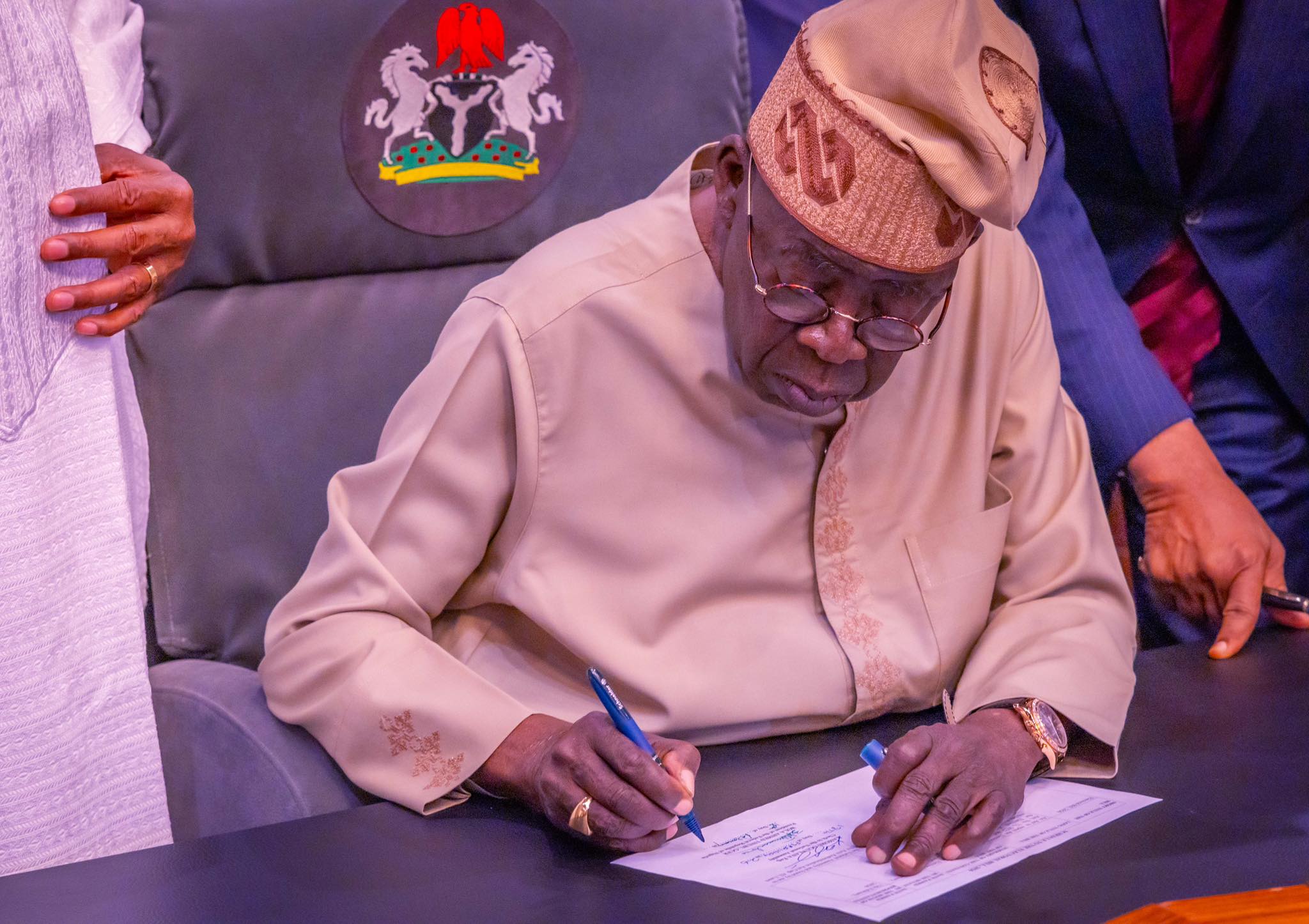
President Bola Tinubu has signed the 2026 Appropriation Bill into law, authorising an aggregate expenditure of N68.32 trillion for the current fiscal year.

He also signed a separate bill extending the implementation period of the 2025 budget from March 31 to June 30, 2026.

The budget allocates N4.799 trillion for statutory transfers and N15.8 trillion for debt service.

It further sets aside N15.4 trillion for recurrent expenditure and N32.2 trillion for capital expenditure through the Development Fund.

In a statement signed by Special Adviser to the President on Information and Strategy, Mr Bayo Onanuga, on Friday, it was that, “The N68.32 trillion budget for this year earmarks N4.799 trillion for statutory transfers and N15.8 trillion for debt service. It allocates N15.4 trillion to recurrent expenditure and N32.2 trillion to the Development Fund for Capital Expenditure.”

“With capital expenditure accounting for about 50 per cent, the 2026 budget underscores the administration’s continued commitment to economic stability, national security, infrastructure development, and inclusive growth.

“The allocations reflect a strategic balance between statutory obligations, debt servicing, recurrent expenditure, and capital investments critical to driving productivity and improving the quality of life for Nigerians,” it added.

The 2026 Appropriation Act took effect on April 1, with the federal government commencing full implementation in line with what the presidency describes as the Renewed Hope Agenda.

President Tinubu also assented to the Appropriation (Repeal and Enactment) (Amendment) Bill, 2026, which extends the capital component of the 2025 Appropriation Act by three months to June 30.

The presidency said the extension would ensure the full utilisation of appropriated funds, particularly for critical infrastructure projects at advanced stages of implementation.

“The extension will ensure the full and effective utilisation of appropriated funds, particularly for critical infrastructure and development projects that are at advanced stages of implementation across the country.

“It will enable Ministries, Departments, and Agencies (MDAs) to consolidate ongoing works, enhance project completion rates, and maximise value for public expenditure,” the statement read.

He directed MDAs to ensure disciplined, transparent, and efficient utilisation of allocated resources, with strong emphasis on value for money and timely project delivery.

The President reaffirmed the importance of sustained collaboration between the Executive and Legislative arms of government in advancing national development objectives, the statement noted.

President Tinubu also assured Nigerians of his administration’s resolve to deepen fiscal reforms and boost revenue generation.


Adedapo Adesanya is a journalist, polymath, and connoisseur of everything art. When he is not writing, he has his nose buried in one of the many books or articles he has bookmarked or simply listening to good music with a bottle of beer or wine. He supports the greatest club in the world, Manchester United F.C.

1 Comment

1 Comment

  1. Pingback: UAE OPEC Exit Presents Operational, Financial Test for Nigeria’s Oil | Business Post Nigeria

Leave a Reply

Your email address will not be published. Required fields are marked *

Economy

NGX RegCo Lifts Embargo on Trading in Thomas Wyatt Nigeria Shares

Published

on

Thomas Wyatt Nigeria

By Aduragbemi Omiyale

The embargo earlier placed in the trading of Thomas Wyatt Nigeria shares has been lifted by the Nigerian Exchange (NGX) Regulation Limited.

The regulatory subsidiary of NGX Group lifted the suspension on Monday, July 6, 2026, via a notice signed by Bonaventure Onwuji on behalf of the Head of the Issuer Regulation Department of NGX RegCo.

Investors were earlier prevented from buying and selling equities of the organisation after it failed to submit its relevant financial statements as required by the listing rules.

The embargo was placed on October 31, 2025, in line with the provisions of Rule 3.1: Rules for Filing of Accounts and Treatment of Default Filing, which provides that if an issuer fails to file the relevant accounts by the expiration of the cure period, the exchange will: a) send to the issuer a second filing deficiency notification within two business days after the end of the cure period, b) suspend trading in the issuer’s securities, and c) notify the Securities and Exchange Commission (SEC) and the market within 24 hours of the suspension.

After filing the results with NGX Limited, and pursuant to Rule 3.3 of the Default Filing Rules, which states that the suspension of trading in the issuer’s securities shall be lifted upon submission of the relevant accounts provided the exchange is satisfied that the accounts comply with all applicable rules of the exchange. The exchange shall thereafter also announce through the medium by which the public and the SEC was initially notified of the suspension, that the suspension has been lifted, the suspension was lifted.

Continue Reading

Economy

Renaissance Hits Oil in OML 74 Exploration Well to Lift Nigeria’s Production Outlook

Published

on

Renaissance Africa Energy

By Adedapo Adesanya

Nigerian domestic oil producer Renaissance Energy has recorded its first major oil discovery since taking over Oil Mining Lease (OML) 74 last year, following the successful drilling of an exploration well offshore Nigeria in a development that could support the country’s efforts to boost crude oil production and replenish reserves.

Preliminary results showed about 1,000 feet (305 metres) of crude oil-bearing reservoirs across seven zones, with data and fluid tests confirming light oil in high-quality reservoirs, Renaissance said in a statement, without providing further details.

OML 74 is a large shallow-water block in the eastern Niger Delta off Nigeria’s coast and holds at least eight previously undeveloped discoveries.

Renaissance, which now owns Shell’s former onshore and shallow-water assets, operates Nigeria’s largest upstream joint venture with 18 oil leases, two export terminals and a FPSO vessel in the oil-rich delta.

Commenting on Tuesday, Mr Tony Attah, the managing director/chief executive of Renaissance, said the discovery reflects the company’s renewed focus on exploration and its commitment to boosting Nigeria’s long-term oil production.

“The success of JK-004, just over one year after assuming operatorship of these assets, demonstrates the strength of our exploration programme,” he said.

He lauded the Nigeria Upstream Petroleum Regulatory Commission (NUPRC), adding that the exploration performance reflected the collaboration with the company’s joint venture partners comprising the Nigerian National Petroleum Company Limited (NNPC), TotalEnergies Limited and Agip Energy and Natural Resources.

He added that the NNPC Group Chief Executive Officer, Mr Bayo Ojulari, and the Executive Vice President, Upstream, Mr Udobong Ntia, provided the needed strategic guidance with commitment for value delivery across the joint venture assets.

On his part, the Vice President of Exploration and Chief Explorer at Renaissance, Mr Johnbosco Uche, said the exploration success was due to the company’s subsurface excellence, technical rigour, and disciplined approach to reserve replacement.

“The JK-004 well provides a strong foundation for accelerated maturation with clear pathways to early development and value realisation,” the Chief Explorer said, adding that the strategic location of JK-004 near an existing field would enable rapid commercialisation.

The chief executive of the Nigerian Upstream Petroleum Regulatory Commission (NUPRC), Mrs Oritsemeyiwa Eyesan, described the feat as a perfect alignment with the commission’s vision of growing the nation’s reserves “to future-proof sustainable national growth,” and pledged to continue building the enabling regulatory environment required to support the Nigerian oil and gas industry.

Continue Reading

Economy

Xenergi Begins Mandatory Takeover of 1.63% Premier Paints Shares

Published

on

Premier Paints Plc1

By Aduragbemi Omiyale

The mandatory takeover bid of about 1.63 per cent shares held by minority shareholders of Premier Paints Plc by Xenergi has been launched.

Business Post learned that the exercise will open at 8 am on Monday, July 13, 2026, and close on Friday, August 7, 2026, and it concerns shareholders of Premier Paint, excluding Xenergi Plc, whose names appear in the register of members of Premier Paint on the qualification date, which was Monday, July 6, 2026.

Xenergi is looking to acquire a total of 2 million shares of Premier Paints at N38 per unit, amounting to N76 million.

The reason for this offer is to enable Xenergi comply with Section 142(4) of the ISA Act 2025 and Rules 445 – 448 of the SEC New Rules and Amendment dated August 30, 2021, following its acquisition of a 49.60 per cent majority equity stake in Premier Paint.

On June 8, 2026, Xenergi Plc acquired 61,003,350 ordinary shares in Premier Paint, representing a 49.60 per cent equity stake.

Xenergi Plc and Premier Paint Plc executed a Share Sale and Purchase Agreement detailing the terms and conditions of the acquisition. The acquisition was concluded following receipt of the required regulatory approvals from the Federal Competition & Consumer Protection Commission (FCCPC), the Securities and Exchange Commission (SEC) and the Nigerian Exchange (NGX) Limited.

In accordance with Section 142(4) of the ISA Act 2025, Xenergi is required to make a takeover bid to all the other shareholders of Premier Paint.

Consequently, on May 25, 2026, the board of Xenergi granted approval for a Takeover to be made to all qualifying shareholders, for the acquisition of the offer shares.

Continue Reading