Economy
FRTX Web Review: A Research-Based Look at the Platform, Website, and Licensing
After spending time reviewing the FRTX website, its platform pages, and the company’s public disclosures, my impression is that FRTX is trying to present itself not just as a brokerage brand with a landing page, but as a structured trading service built around a browser-based platform, analytics, onboarding flow, and client support. That matters because with newer financial brands, the real question is rarely whether the homepage looks polished. The real question is whether the service has enough visible structure behind the branding to feel like an actual operating environment rather than a marketing shell. In FRTX’s case, there is enough public material on the site to form a practical first impression.
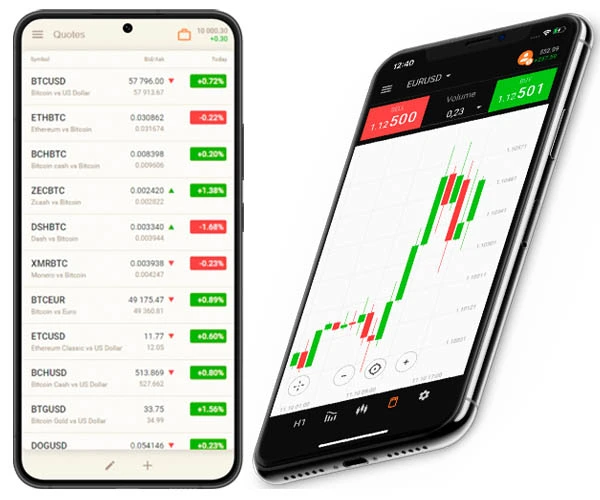
The platform itself is clearly one of the central selling points. FRTX Web is presented as a modern browser terminal for CFD trading, designed to work without mandatory downloads or long setup. The site emphasizes direct browser access, desktop and mobile usability, a quick trading panel, real-time quotes in the order book, MarketCheese forecasts, a MarketCheese economic calendar, and built-in indicators for market analysis in the mobile version. From a product-review perspective, that is a sensible combination. It tells me the company understands that many users want access, analysis, and execution in one place without installing heavy software first.
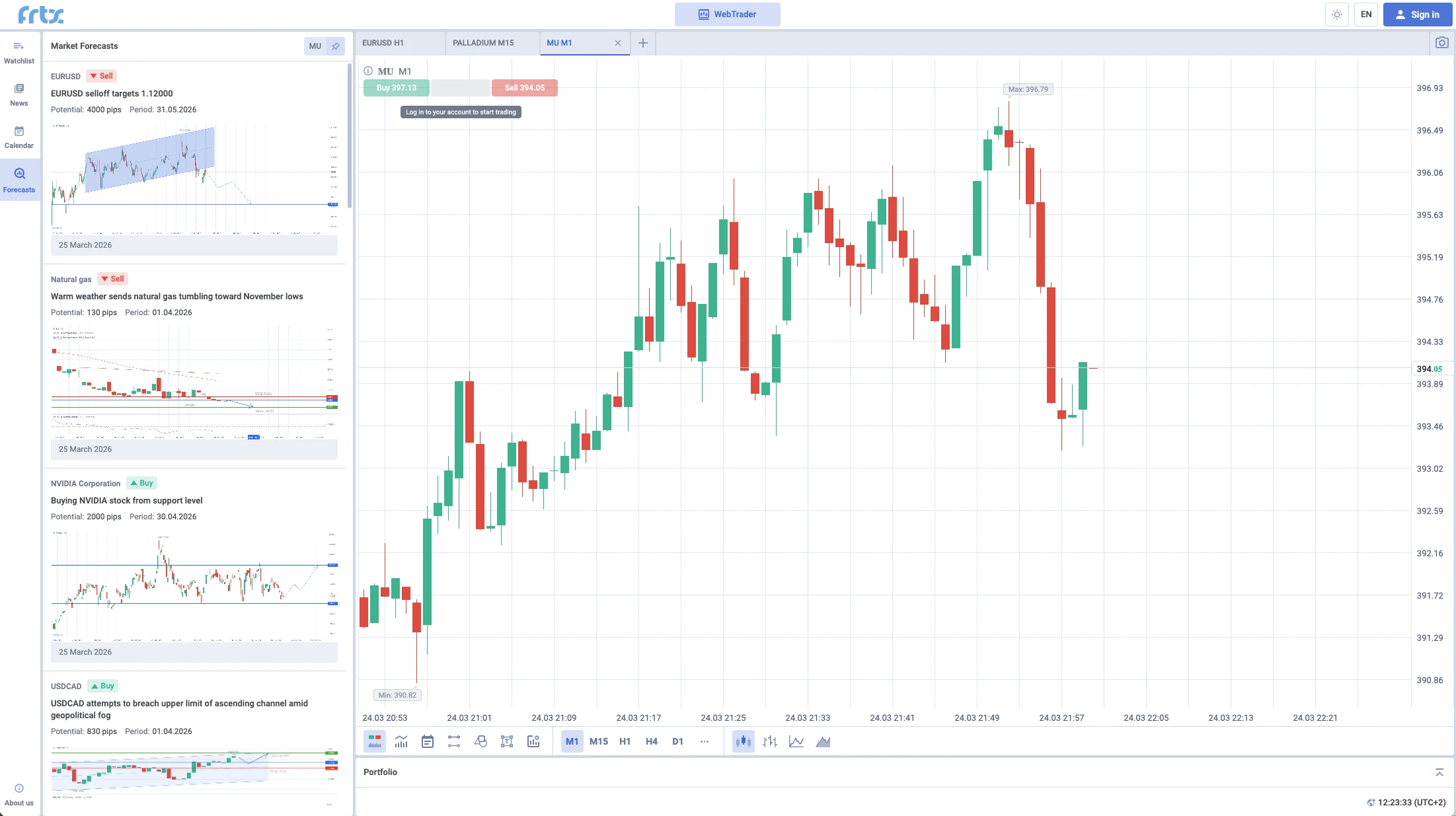
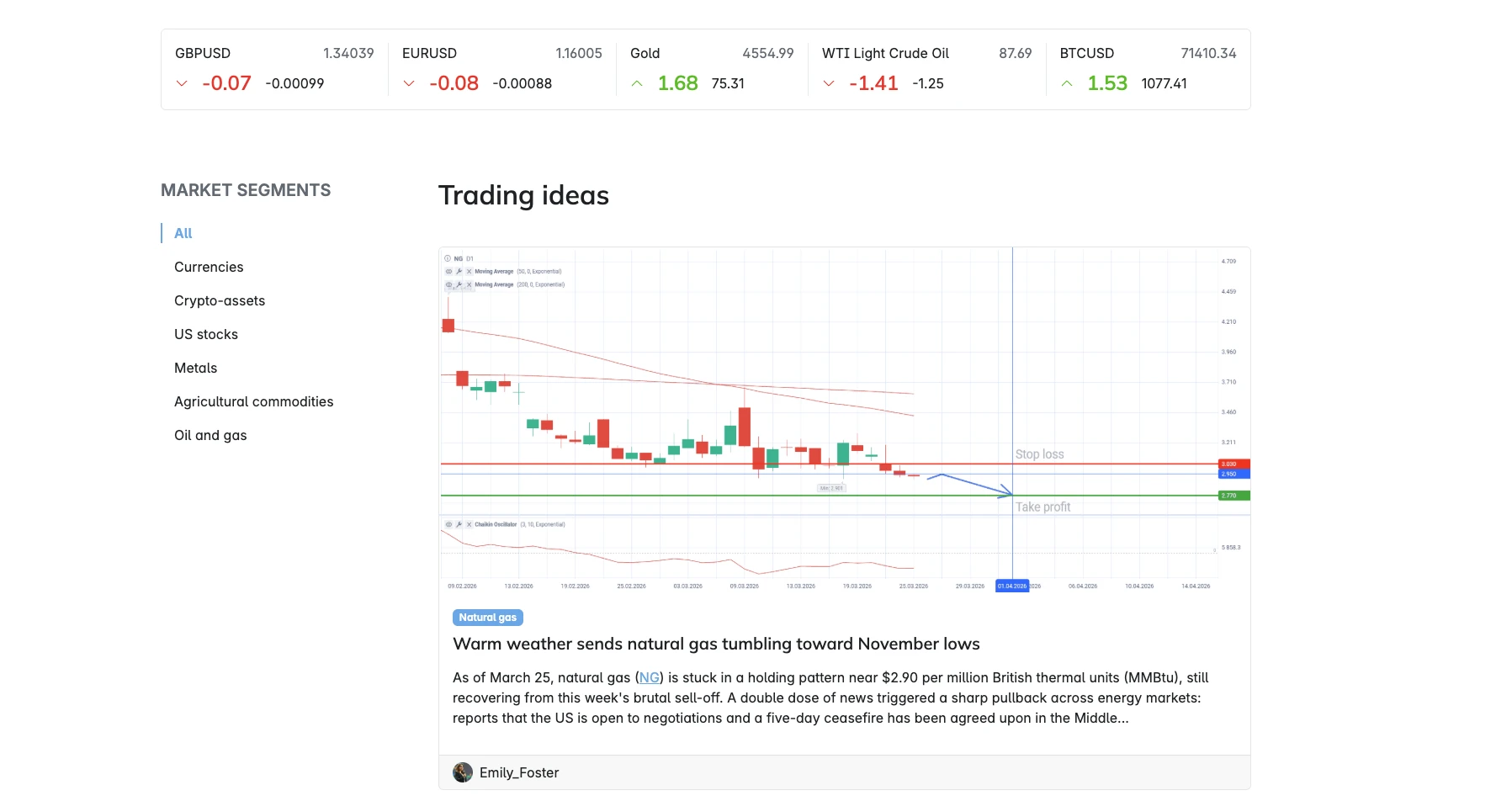
What also stood out to me is that FRTX is not positioning the platform as a bare terminal. The broader website connects the trading interface to supporting sections such as Analytical Tools, Trading Ideas, the Economic Calendar, Tutorials, News and Views, FAQ, and Online Support. In practice, that gives the impression of a service trying to build a full client environment rather than relying on the terminal alone to do all the work. From a reviewer’s standpoint, that is usually a better sign than when a broker has a flashy login page but very little else around it.
Another point in favor of the platform narrative is that FRTX does not present the terminal in isolation. The website ties the platform to a broader analytical environment. On the Analytical tools page, FRTX describes its Chart tool as a space to build lines and levels, use indicators, and analyze market behavior. The same section includes Market watch, described as a widget for tracking grouped instruments and price dynamics across different periods. This makes the platform look less like a standalone order-entry screen and more like the center of a wider trading workspace.
In terms of usability, the platform pitch is fairly direct. FRTX says the terminal can be launched on PC or in a mobile browser, with no need to download an app, and describes it as fully customizable. The homepage repeats the same practical advantages: quick start without pre-installation, access in any browser, color scheme customization, market-analysis tools, and protection from DDoS attacks. That is the kind of language I would expect from a company trying to appeal to users who care less about technical ceremony and more about speed of access and a clean workflow.
The award messaging is also very visible, and it is part of the platform story whether one likes awards or not. On the trading platform page, FRTX states that the platform received “Best Trading App” at Money Expo Mexico 2025 and “Best Trading Platform” at Wiki Finance Expo 2023 in Sydney. The homepage separately repeats the “Best Trading App of 2025 at Money Expo Mexico” line. I would not treat awards alone as the basis for judgment, but in a review they are still relevant because they show how the company is choosing to position its platform publicly.
Another point worth mentioning is the technology layer behind the experience. Based on the platform structure, browser-first workflow, integrated analysis modules, and the overall execution logic, FRTX appears to be using a mature software product from one of the established players in the trading technology market rather than trying to pass off a rough in-house prototype as a full solution. For users, that is generally a better look. It suggests the company is building on proven market infrastructure instead of improvising where stability matters most. This is an inference from the platform setup and feature mix rather than a direct statement published by FRTX, but it is a meaningful one when assessing the overall product presentation.
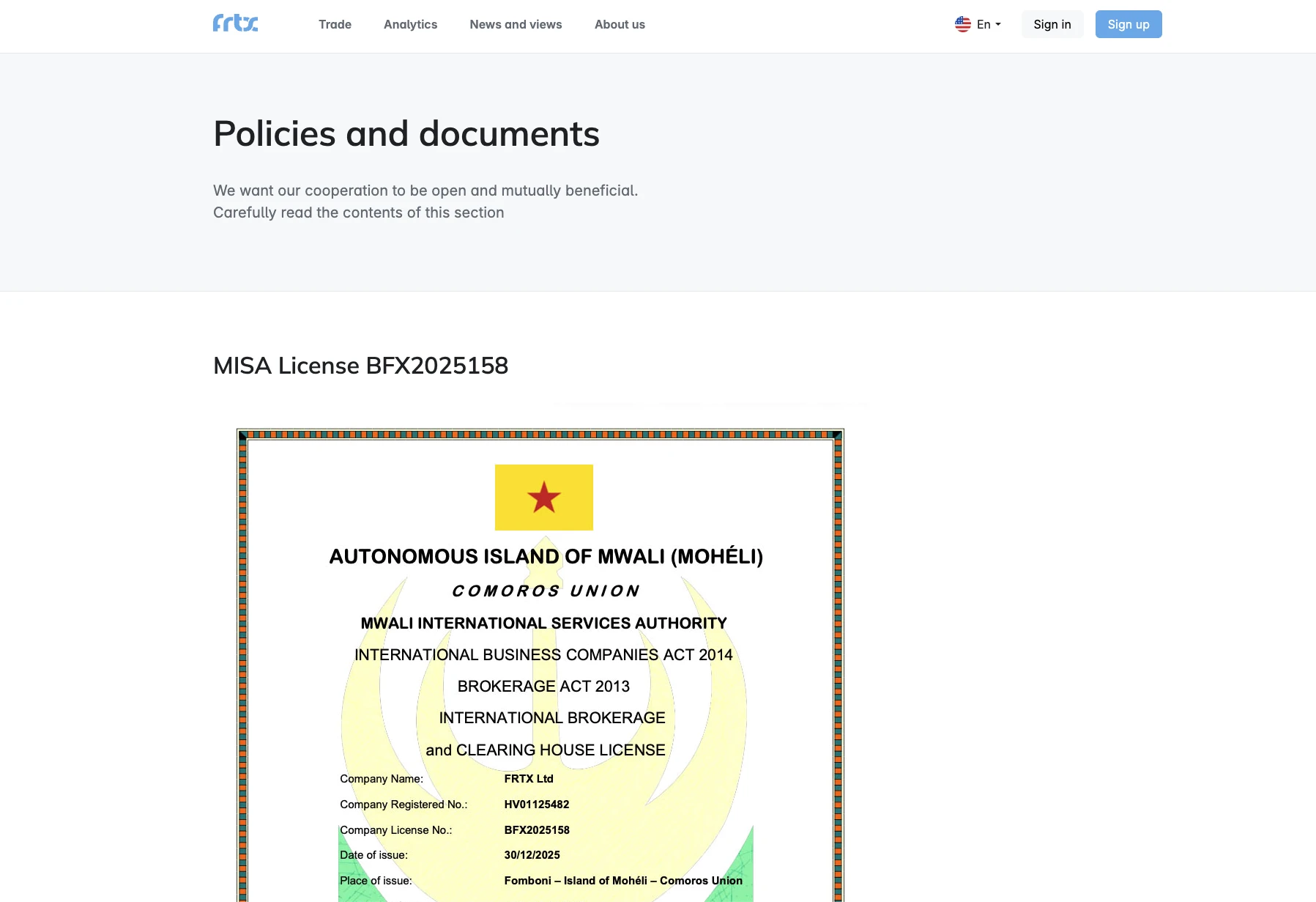
What strengthens the credibility of the overall picture is that FRTX does not rely only on platform marketing. The company also publishes public legal and licensing identifiers on the website. According to the platform page footer, the FRTX brand and the names frtx.global, frtx.org, and FRTX Web are owned and operated by FRTX Ltd, registered under number HV01125482 and licensed by the Mwali International Services Authority as an international brokerage company under license number BFX2025158. In a review context, this matters because it gives readers something concrete to verify beyond slogans and design.
The onboarding structure on the website also looks reasonably coherent. FRTX presents a path that starts with sign-up, continues through verification, then moves to account opening, funding, platform access, and eventually withdrawals. The support page adds two visible contact routes: the internal request system for clients and a callback form on the website. That does not automatically answer every operational question, but it does make the service feel more complete. A lot of online doubt around financial brands comes from missing practical detail, and here the company at least tries to show the user journey in a readable way.
That said, a serious review should keep one foot on the ground. FRTX also states that it does not provide services to citizens of the United States, Japan, Canada, Australia, the European Union, the United Kingdom, and several other jurisdictions. The site further includes a risk warning explaining that leveraged trading in CFDs and other derivatives involves a high level of risk and that losses may exceed the original deposit. In my view, this is the correct balance for a brokerage website: platform strengths and access convenience on one side, but a clear reminder that the product itself remains high-risk on the other.
My overall conclusion after reviewing the FRTX platform and website is that the brand is trying to position itself as a usable, modern, browser-first trading service with a visible support structure, integrated analytics, and publicly stated licensing details. The platform presentation is stronger than a generic brochure-style broker site, and the use of established trading technology gives the product a more mature feel. At the same time, the right way to read FRTX is not through hype but through verification: look at the legal entity, look at the license number, look at the service structure, and then decide whether the platform fits your needs and risk tolerance.
Disclaimer:
This material is for informational purposes only and does not constitute investment advice. Trading CFDs and other derivative instruments involves a high level of risk and may not be suitable for all users. Users should review the company’s terms, jurisdictional restrictions, and risk disclosures before using the service.
Economy
Naira Slips 0.03% to N1,375/$ at NAFEX, Remains N1,385/$1 at Black Market
By Adedapo Adesanya
The Naira recorded a loss of 49 Kobo or 0.03 per cent against the United States Dollar in the Nigerian Autonomous Foreign Exchange Market (NAFEX) on Tuesday, May 26, trading at N1,375.41/$1 compared with the preceding day’s N1,374.92/$1.
However, the local currency appreciated against the Pound Sterling in the official market during the session by N3.47 to close at N1,852.26/£1 versus Monday’s closing price of N1,855.73/£1, and gained N1.37 against the Euro to finish at N1,599.32/€1, in contrast to the previous session’s N1,600/€1.
As for the black market, the Naira traded flat against the US Dollar yesterday at N1,385/$1, and also maintained stability at the GTBank forex counter at N1,383/$1.
Interbank FX turnover increased to $73.598 million across 110 deals, indicating a significant rise from $55.786 million that passed through local banks’ records the previous day.
Market analysts noted that the Naira outlook remains stable, citing the latest round of FX inflows, which have lifted gross external reserves to $49.259 billion.
Largely, the domestic currency will close the first half of 2026 stronger as the CBN continues to inject FX inflows into the official market, due to a significant increase in FX receipts from elevated oil prices in the global commodity market.
Meanwhile, the cryptocurrency market was down on Tuesday as global stocks hit record highs, widening a recent divergence between crypto and equities.
There were also outflows as retail traders added leverage, raising the risk of sharp liquidations despite new SEC-approved bitcoin index options aimed at institutions.
Bitcoin (BTC) fell by 1.4 per cent to $75,737.18, Ethereum (ETH) depleted by 1.2 per cent to $2,075.39, Ripple (XRP) lost 1.0 per cent to sell at $1.33, Binance Coin (BNB) slumped by 0.9 per cent to $651.75, Solana (SOL) depreciated by 0.8 per cent to $83.86, Cardano (ADA) dipped 0.7 per cent to $0.2402, and TRON (TRX) dropped 0.2 per cent to settle at $0.3726, while the US Dollar Tether (USDT) and the US Dollar Coin (USDC) closed flat at $1.00 each.
Economy
Dangote Sugar N485.9bn Rights Issue for Expansion Commences
By Aduragbemi Omiyale
To support its expansion drive, which aims to boost the Nigerian economy by ensuring sufficient sugar production in the country, Dangote Sugar Refinery Plc has opened its rights issue.
The sugar refiner hopes to raise up to N485.9 billion from the exercise, which commenced on Monday, May 25, 2026, and will close on Wednesday, June 24, 2026.
A note specifically said the net proceeds will be used to materially deleverage the company’s balance sheet, strengthen liquidity and reposition the organisation on a more sustainable capital structure.
The rights issue size is 8,097,918,827 ordinary shares of 50 Kobo each at N60.00 per share, and would be offered to shareholders on the basis of two new ordinary shares for every three existing ordinary shares held as at the close of business on April 20, 2026.
Dangote Sugar, a subsidiary of Dangote Industries Limited, refines, distributes, and markets granulated sugar to wholesalers and major players within the food and beverage, pharmaceutical, and personal care industries.
It operates the largest sugar refinery in Sub-Saharan Africa, with a combined installed refining capacity of 1.49 million metric tonnes per annum. Through its backward integration strategy, DSR is advancing plans to produce an additional 1.5 million metric tonnes of locally sourced sugar, further strengthening its position as a leading integrated sugar producer globally.
At its 20th Annual General Meeting (AGM) held last month in Lagos, shareholders approved the floating of a N500 billion rights issue to fund its strategic expansion, especially for its ambitious backward integration projects.
According to the firm’s chief executive, Mr Thabo Mabe, efforts are being made to secure approximately $1.3 billion needed to fulfil the commitment to achieving a production target of at least 600,000 tonnes annually by 2030.
“We have revised our strategic development plan to meet the 2030 objectives, leveraging the combined potential of DSR Numan Operation and Nasarawa Sugar Company Limited estates.
“This integrated plan targets substantial cane production of around 6.05 million tonnes across 45,000 hectares from both sites,” he said at the meeting.
Economy
NGX Performance Indices Tumble 0.55% on Weak Investor Sentiment
By Dipo Olowookere
The key performance indices of the Nigerian Exchange (NGX) Limited tumbled by 0.55 per cent as a result of sell-offs across the major sectors of the market.
The bourse witnessed weak investor sentiment and low activity level during the trading day ahead of a two-day Sallah break on Wednesday and Thursday.
Analysis of the data showed that investors embarked on profit-taking yesterday, as traders liquidated their shares for holiday spending.
The banking space went down by 1.83 per cent, the insurance counter decreased by 1.41 per cent, the consumer goods index shed 0.77 per cent, the energy sector crashed by 0.14 per cent, and the industrial goods sector closed flat with an insignificant contraction.
Consequently, the All-Share Index (ASI) dropped 1,386.18 points to settle at 249,738.84 points compared with the previous day’s 251,125.02 points, and the market capitalisation crumbled by N889 billion to N160.094 trillion from N160.983 trillion.
There were 18 price gainers and 39 price losers on Customs Street at the close of transactions, representing a negative market breadth index.
Dangote Sugar depreciated by 10.00 per cent to N78.30, Transcorp Power lost 9.97 per cent to trade at N245.50, The Initiates slipped by 9.85 per cent to N27.45, Abbey Mortgage Bank dipped by 9.49 per cent to N6.20, and Fidelity Bank gave up 9.05 per cent to close at N21.60.
On the flip side, Austin Laz and McNichols gained 10.00 per cent each to sell for N4.40 and N7.92, respectively. International Energy Insurance chalked up 9.89 per cent to trade at N4.11, Learn Africa improved by 9.44 per cent to N12.75, and Haldane McCall jumped 8.06 per cent to N3.89.
The busiest stock for the day was Access Holdings with 80.6 million units worth N2.0 billion. Zenith Bank traded 33.8 million units valued at N4.5 billion, Mutual Benefits transacted 31.8 million units for N138.9 million, Neimeth exchanged 22.3 million units worth N233.0 million, and Sterling Holdings sold 22.2 million units valued at N172.4 million.
In all, market participants bought and sold 564.1 million units for N27.2 billion in 65,666 deals versus the 629.4 million units valued at N40.9 billion executed in 82,434 deals a day earlier. This showed that the trading volume, value, and number of deals went down by 10.38 per cent, 33.50 per cent, and 20.34 per cent, respectively.
-
Feature/OPED6 years agoDavos was Different this year
-
Travel/Tourism10 years ago
Lagos Seals Western Lodge Hotel In Ikorodu
-
Showbiz3 years agoEstranged Lover Releases Videos of Empress Njamah Bathing
-
Banking8 years agoSort Codes of GTBank Branches in Nigeria
-
Economy3 years agoSubsidy Removal: CNG at N130 Per Litre Cheaper Than Petrol—IPMAN
-
Banking3 years agoSort Codes of UBA Branches in Nigeria
-
Banking3 years agoFirst Bank Announces Planned Downtime
-
Sports3 years agoHighest Paid Nigerian Footballer – How Much Do Nigerian Footballers Earn