Economy
IGR of N1.3trn Accounts for 60% of Lagos Budget—Governor
By Dipo Olowookere
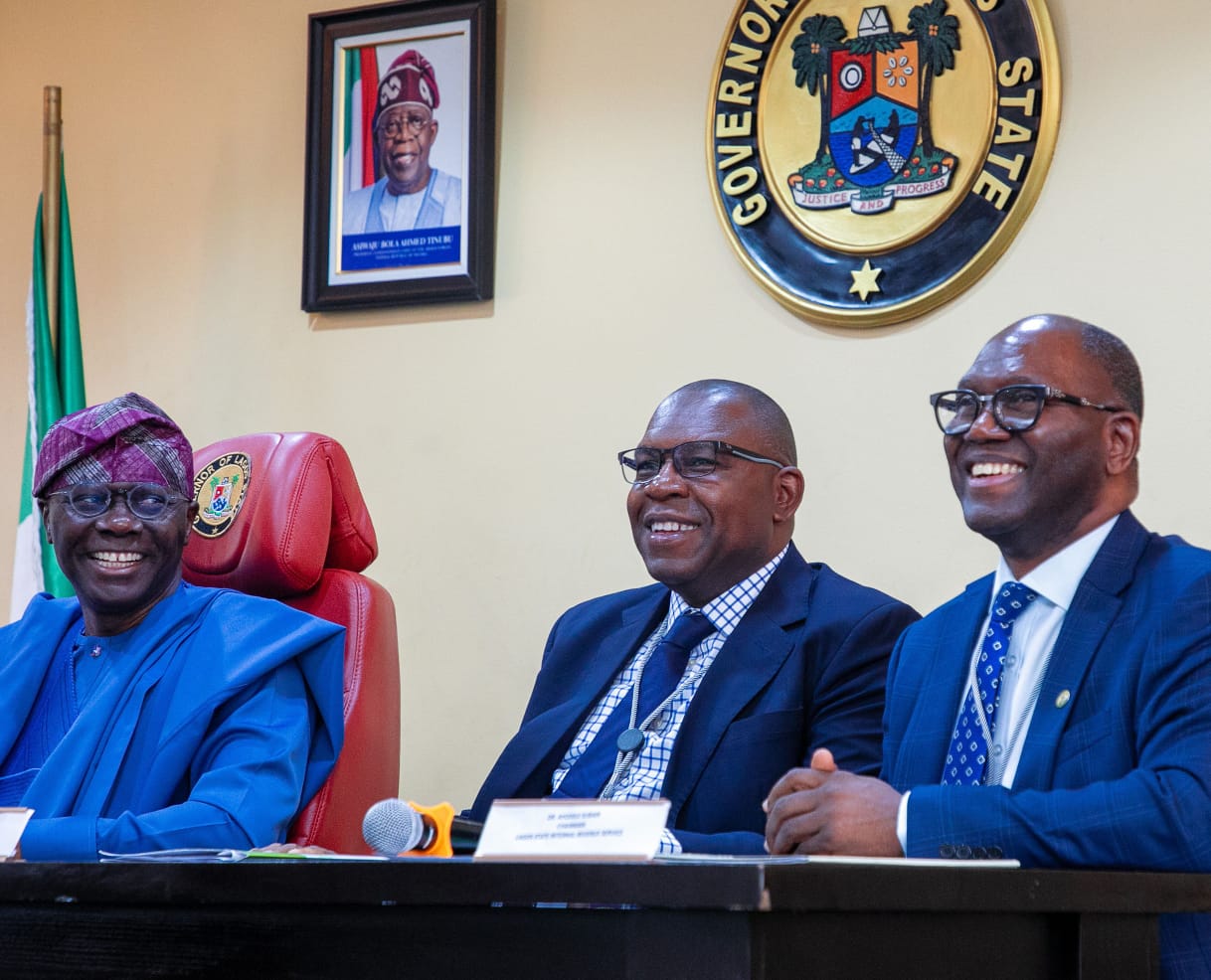
Governor Babajide Sanwo-Olu of Lagos State has revealed that the annual budget of the state is now being funded largely by Internally Generated Revenue (IGR).
Speaking on Wednesday at the State House in Marina, Lagos, the Governor said revenue generated in the state from taxes specifically accounts for over 60 per cent of the appropriation act.
He also disclosed that in 2024, Lagos State earned over N1.3 trillion from IGR, allowing the government to provide basic amenities and others to residents.
Governor Sanwo-Olu attributed this achievement to the stable leadership at the Lagos State Inland Revenue Service (LIRS), charging his colleagues to emulate this.
“Governors need to give revenue agencies clear space to work. They need to give them that independence. They need to give them full tenure to do their work.
“It should not be a situation where a governor comes and wants to disrupt the tenure of the chairman. It is only when they do all of this that the confidence of taxpayers, the confidence of workers and subordinates in the system will be enhanced.
“I will be pushing my brother governors again for them to understand and appreciate that it is only when they give you what you need to work that they can get the benefits of the expertise that you all have,” Mr Sanwo-Olu said at the 159th meeting of the Joint Revenue Board (JRB) in the state.
The JRB, formerly known as the Joint Tax Board (JTB), is made up of the chairman of the Nigeria Revenue Service (NRS), chairmen of the 36 State Internal Revenue Services and the Chairman of the Federal Capital Territory (FCT), as well as representatives of key agencies including the Federal Ministry of Finance, National Identity Management Commission, Revenue Mobilisation, Allocation and Fiscal Commission, Nigeria Customs Service, Nigeria Immigration Service and the Federal Road Safety Corps.
Speaking further, the Governor said the 45 per cent increase in the IGR for 2024 was driven by reforms spearheaded by the LIRS, sustained investment in digital tax systems, expansion of the tax base, and improved engagement with taxpayers.
“We can say that our internally generated revenues now account for well over 60 per cent of our budget. It has not happened by sheer luck. It is the result of years of investment in digital tax systems, a push to expand our tax net, and building trust with our taxpayers,” he stated.
“For us, it is really about our citizens. It is about the people who have given us the trust to believe in us and to pay these taxes. My deputy and I are consistently committed to ensuring that we leave this place a lot better than we met it,” he added.
The chairman of LIRS, Mr Ayodele Subair, noted that Lagos’ hosting of the meeting again after five years reflected its economic importance.
“After a five-year interval, Lagos State is once again honoured to host this important gathering. This reflects the state’s leadership as Nigeria’s economic nerve centre,” he said.
On his part, the chairman of JRB, Mr Zacch Adedeji, represented by the Executive Secretary of JRB, Mr Olusegun Adesokan, commended Lagos for its revenue performance and governance reforms, noting that, “Prior to this, the state’s annual internal revenue was less than N94 billion. But today, Lagos generates over N1.7 trillion annually.”
“These achievements clearly demonstrate how strong revenue performance, when effectively managed, translates into tangible development outcomes for citizens,” he added.
Economy
NASD Exchange Gains 0.88% as CSCS, FrieslandCampina Lead Advancers
By Adedapo Adesanya
Four price gainers extended kept the NASD Over-the-Counter (OTC) Securities Exchange in the green territory by 0.88 per cent on Wednesday, April 22.
The advancers were led by Central Securities Clearing System (CSCS) Plc, which went up by N3.33 to close at N66.48 per share compared with the preceding day’s N63.15 per share. FrieslandCampina Wamco Plc added N1.79 to sell at N99.00 per unit versus N97.21 per unit, Afriland Properties Plc appreciated by 16 Kobo to N16.00 per share from N15.84 per share, and UBN Property Plc rose by 7 Kobo to N2.25 per unit from N2.18 per unit.
Consequently, the market capitalisation chalked up N12.99 billion to close at N2.375 trillion compared with Tuesday’s N2.354 trillion, and the NASD Unlisted Security Index (NSI) increased by 34.69 points to 3,969.96 points from 3,935.27 points.
At midweek, the value of securities traded by investors surged by 11,468.9 per cent to N21.5 million from N5.7 million, the volume of securities ballooned by 708.1 per cent to 49.5 million units from 185,420 units, and the number of deals soared by 21.7 per cent to 28 deals from 23 deals.
At the close of business, Great Nigeria Insurance (GNI) Plc was the most traded stock by value on a year-to-date basis with 3.4 billion units sold for N8.4 billion, trailed by CSCS Plc with 58.9 million units exchanged for N3.9 billion, and Okitipupa Plc with 27.8 million units traded for N1.9 billion.
GNI Plc also ended the trading session as the most traded stock by volume on a year-to-date basis with 3.4 billion units worth N8.4 billion, followed by Resourcery Plc with 1.1 billion units transacted for N415.7 million, and Infrastructure Guarantee Credit Plc with 400 million units valued at N1.2 billion.
Economy
Naira Rebounds to N1,348/$ at Official Market
By Adedapo Adesanya
The Naira halted its recent depreciations against the US Dollar in the Nigerian Autonomous Foreign Exchange Market (NAFEX) on Wednesday, April 22.
According to data, the domestic currency chalked up 0.17 per cent or N2.29 against the greenback at midweek to exchange for N1,348.45/$1 compared with the previous day’s rate of N1,350.74/$1 despite concerns over liquidity pressures, policy transparency, and confidence in Nigeria’s FX market, especially as the country’s foreign reserves are expected to decline further amid fluctuations in crude oil prices in the global commodity market.
However, the Naira appreciated against the Pound Sterling yesterday in the official market by N4.72 to trade at N1,821.75/£1 versus Tuesday’s price of N1,826.47/£1, and gained N7.42 against the Euro to sell at N1,582.00/€1 versus N1,589.12/€1.
The Nigerian currency maintained stability against the Dollar in the parallel market during the session at N1,375/$1, but depreciated by N9 at the GTBank forex counter to N1,363/$1 from N1,354/$1.
The Central Bank of Nigeria (CBN) announced a decline in interbank liquidity to N66.084 million across 87 deals from N91.866 million across 106 deals the previous day, a signal that FX payment requests eased on Wednesday.
Traders say weak fiscal discipline and budget overlaps are key drivers of pressure on the Naira in the black market. They raised worries, including excessive spending, delayed budgets, and the running of overlapping budget cycles.
Meanwhile, Bitcoin briefly touched $79,388 the cryptocurrency market on Wednesday before easing back to about $78,201.31.
The rally’s concentration in BTC, alongside negative funding rates that have persisted for roughly 47 days, suggests a narrow, derivatives-sceptical bid rather than broad-based enthusiasm across digital assets.
Geopolitical tensions, including a U.S. naval blockade near Iran, Iranian gunboat fire in the Strait and stalled cease-fire diplomacy, are feeding market uncertainty, with Cardano (ADA) down by 3.2 per cent to $0.2474.
Further, Solana (SOL) fell by 2.5 per cent to $85.97, Ripple (XRP) slipped by 2.3 per cent to $1.42, Ethereum (ETH) shrank by 1.7 per cent to $2,352.18, TRON (TRX) slid by 1.4 per cent to $0.3281, Dogecoin (DOGE) tumbled by 1.1 per cent to $0.0961, and Binance Coin (BNB) dropped 0.8 per cent to sell for $637.46, while the US Dollar Tether (USDT) and the US Dollar Coin (USDC) traded flat at $1.00 each.
Economy
Brent Returns to $100 Per Barrel Amid Fresh Hormuz Attacks
By Adedapo Adesanya
Oil prices increased by more than $3 on Wednesday on fresh attacks on at least three container ships in the Strait of Hormuz amid a lack of progress in peace talks between the US and Iran.
Brent crude futures gained $3.43 or 3.48 per cent to trade at $101.91 a barrel, while the US West Texas Intermediate (WTI) crude futures appreciated by $3.29 or 3.67 per cent to $92.96 per barrel.
At least three container ships were hit by gunfire in the Strait of Hormuz on Wednesday.
Iran’s Revolutionary Guards Navy (IGRC) seized two vessels for what it described as maritime violations and transferred them to Iranian shores. The two ships – the Panama-flagged MSC Francesca and Liberia-flagged Epaminondas – were seized for “attempting to exit the Strait of Hormuz covertly”.
Iran and the US have imposed restrictions on ships using the strait, which carried about 20 per cent of global oil and liquefied natural gas supplies until the war began at the end of February. The standoff over the strait has raised doubts about whether stalled peace negotiations will resume.
The seizures mark the first time Iran has taken control of ships since the beginning of the war, which started on February 28, and come after the US fired on and seized an Iranian cargo vessel and boarded an Iranian oil tanker in the Indian Ocean.
In the latest in a series of about-turns, President Donald Trump threatened violence on Tuesday, hours before announcing he was unilaterally extending a ceasefire.
Previously, the American President Trump said he would indefinitely extend the ceasefire with Iran, hours before it was due to expire. Neither side showed up for peace talks in Pakistan.
Countries in Asia that are dependent on Gulf oil have been badly hit, with shortages of fuel, fertiliser and other raw materials that pass through the strait. While the West is better insulated, it is not immune, with Germany, Europe’s largest economy, slashing its 2026 growth forecast to 0.5 per cent on Wednesday, while Greece announced €500 million in extra aid for households and farmers.
Crude oil inventories in the US increased by 1.9 million barrels during the week ending April 17, according to new data from the U.S Energy Information Administration (EIA) released on Wednesday. The increase brings commercial stockpiles to 465.7 million barrels according to government data.
The EIA’s data release follows figures by the American Petroleum Institute (API) that were released on Tuesday, which reported that crude oil inventories saw a draw of 4.4 million barrels in the period.
-
Feature/OPED6 years agoDavos was Different this year
-
Travel/Tourism10 years ago
Lagos Seals Western Lodge Hotel In Ikorodu
-
Showbiz3 years agoEstranged Lover Releases Videos of Empress Njamah Bathing
-
Banking8 years agoSort Codes of GTBank Branches in Nigeria
-
Economy3 years agoSubsidy Removal: CNG at N130 Per Litre Cheaper Than Petrol—IPMAN
-
Banking3 years agoSort Codes of UBA Branches in Nigeria
-
Banking3 years agoFirst Bank Announces Planned Downtime
-
Sports3 years agoHighest Paid Nigerian Footballer – How Much Do Nigerian Footballers Earn