Connect with us

Banking

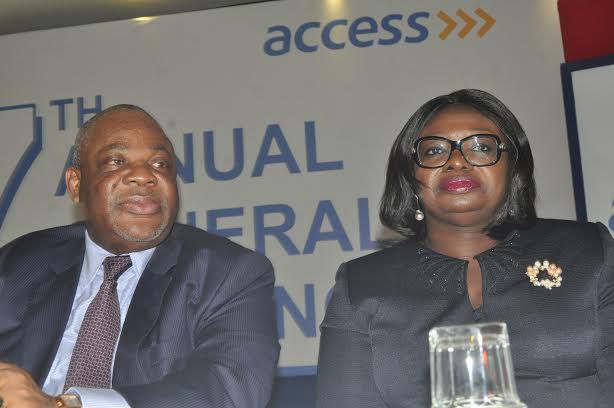
Emmanuel Chiejina Retires from Access Bank Board

Published

on

Emmanuel Chiejina (L)

By Dipo Olowookere

One of the Directors of Access Bank Plc, Mr Emmanuel Chiejina, has retired from the financial institution.

Mr Chiejina left the firm after spending the maximum term limit of 12 years on the board as a non-executive director of Access Bank as stipulated by the Code of Corporate Governance for Banks of the Central Bank of Nigeria (CBN).

According to a statement issued on Friday by the lender, Mr Chiejina’s retirement took effect from June 23, 2017 (yesterday).

With the retirement of Mr Chiejina, Access Bank Plc is now left with 14 directors comprising six Executives and eight non-Executives, including four independent directors.

In the statement, the bank said “Mr Chiejina has confirmed that he has no disagreement with the board and there is no issue relating to his retirement that needs to be brought to the attention of the shareholders of the company or the regulatory authorities.”

“The board would like to express its appreciation to Mr Chiejina for his contributions and services to the company,” the statement said.


Dipo Olowookere is a journalist based in Nigeria that has passion for reporting business news stories. At his leisure time, he watches football and supports 3SC of Ibadan. Mr Olowookere can be reached via [email protected]

Click to comment

Leave a Reply

Your email address will not be published. Required fields are marked *

Banking

Paystack Rolls Out Small Business Programme with Funding, Growth Support

Published

on

Paystack

 By Adedapo Adesanya

African payments technology giant, Paystack, has launched the Paystack Small Business Programme to support Nigerian small businesses through a range of initiatives designed to help them grow, connect with relevant opportunities, and access funding for their next stage of growth.

The initiative will support businesses as they start, manage and grow their operations, starting with the Paystack Small Business Bundle.

The bundle gives eligible Nigerian merchants access to up to N4 million in discounts on tools and services from selected partners across key areas of business operations, including commerce, bookkeeping, logistics, design, workspace, customer communication, and digital tools.

In the pilot phase, Paystack is targeting 2,000 Nigerian SMBs for the Small Business Bundle, with additional partner offers expected over time.

According to the company, in a statement on Monday, small businesses play a significant role in Nigeria’s economy, but many still face everyday operational challenges, from managing sales and records, reaching customers, handling deliveries, and accessing affordable tools.

As a result, the programme has been developed to provide practical support for these businesses as they manage daily operations and plan for their next stage of growth. Through the Small Business bundle, eligible merchants can access offers from partners including Bumpa, Ijeworks, Wiicreate, Flowcart, Simplebks, Africaworks, Paystack, Kindlybook, FezDelivery, Gamp, Pressone, Mercurie, Shuttlers and Canva.

The Paystack Small Business Programme will commence with three key initiatives designed to support the growth and sustainability of small businesses. These include the Paystack Small Business Bundle, which offers a range of tools, services, resources, and partner benefits to help businesses operate more efficiently and scale sustainably; the Paystack Small Business Launchpad, which provides dedicated, hands-on support to high-potential businesses, enabling them to maximize the value of Paystack’s solutions and accelerate growth; and the Paystack Small Business Grant, which offers financial support to promising businesses to help fund their next phase of expansion and development.

The Bundle is available to eligible Nigerian merchants with a live Paystack account, at least 10 Paystack transactions in the last 30 days, and operations in Nigeria.

Eligible merchants can visit the Small Business Bundle Page to browse available partner offers, submit their business details and receive redemption instructions once their eligibility has been confirmed.

Continue Reading

Banking

Why Access to Structured Merchant Financing Matters for SME Growth

Published

on

Seun Oyediran

By Seun Oyediran

The Nigerian economic landscape is defined by the resilience of its micro, small, and medium-sized enterprises (SMEs). From the high-traffic supermarkets of Lagos to the critical distribution hubs supporting the hinterlands, millions of entrepreneurs drive our domestic commerce. Yet, a recurring theme persists in our boardroom discussions and macroeconomic reviews: the “missing middle.” While demand remains robust across various sectors, limited access to financing remains one of the several constraints affecting SME growth, effectively putting a limit on how much the country’s economy can grow.

The data provided by the Small and Medium Enterprises Development Agency of Nigeria (SMEDAN) is unequivocal. SMEs constitute approximately 96% of all domestic businesses, contributing nearly 50% of the national GDP and employing over 80% of the workforce. They are not merely a segment of the economy; they are the economy. However, the International Finance Corporation (IFC) continues to highlight a staggering credit gap. This structural bottleneck means that even businesses with proven product-market fit are often unable to fulfill orders, optimize inventory, or expand their footprint, simply because traditional capital remains inaccessible.

Merchant credit represents one financing option available to support working capital and inventory management needs. Unlike the rigid structures of traditional commercial lending, merchant credit is purpose-built for the velocity of trade. By injecting capital directly at the point of need, specifically for inventory replenishment, business expansion and equipment acquisition, it may help address short-term liquidity requirements for eligible businesses. For a merchant, the inability to stock goods is not just a missed sale; it is a loss of market share and a regression in cash flow momentum. Merchant credit may help eligible businesses address short-term liquidity constraints and support inventory management.

From a risk management and credit perspective, the evolution of digital financial services has revolutionised how we view SME creditworthiness. Historically, the absence of collateral or formal credit histories led to the systemic exclusion of many viable businesses. A data-driven approach shifts the focus from static assets to dynamic performance, enabling lenders to deploy capital into businesses demonstrating sustainable operational performance.

The macroeconomic implications of optimising merchant credit are profound. Access to appropriately structured financing may contribute to broader economic activity, employment, and business expansion. In the context of Nigeria’s urgent need to diversify away from hydrocarbon dependence, the private sector, and SMEs in particular, must remain an important contributor to economic development. To build globally competitive brands and export-led enterprises, we must move beyond the rhetoric of “supporting” small businesses and transition toward integrating them into modern credit value chains.

The strategic imperative is clear. The chasm between a local business and a regional champion is rarely a lack of ambition; it is access to capital that remains a significant constraint for many businesses. If we are to foster a new generation of African industry leaders, we must prioritise the deployment of flexible, data-driven financing solutions. When responsibly structured and appropriately deployed, merchant credit can support business growth, inventory management, and operational continuity for eligible enterprises.

Seun Oyediran, Director, Merchant Lending

Continue Reading

Banking

e-Payment Fraud Drains N134.48bn in Six Years Amid Digital Transactions Growth

Published

on

e-payment system

By Adedapo Adesanya

Nigeria’s rapid shift towards electronic payments has come with a steep cost, as banks and their customers lost a combined N134.48 billion to fraud between 2020 and 2025.

This is according to data contained in the Central Bank of Nigeria’s Nigeria Payments System Vision 2028 document.

The report showed that fraudsters attempted to steal a total of N187.79 billion during the six-year period, with actual losses amounting to N134.48 billion across the banking and payments ecosystem.

The losses were recorded through a range of electronic and traditional payment channels, including internet banking, mobile banking, Point of Sale (PoS) terminals, e-commerce platforms, Automated Teller Machines, web-based transactions, over-the-counter services and cheques, underscoring the persistent security risks accompanying Nigeria’s expanding digital finance landscape.

An analysis of the data revealed a steady rise in fraud-related losses over the period. Losses increased from N11.61 billion in 2020 to N12.77 billion in 2021 and N14.32 billion in 2022. The figure climbed further to N17.67 billion in 2023 before surging to a record N52.26 billion in 2024.

According to the apex bank, the sharp increase recorded in 2024 occurred despite reductions in fraud amounts linked to internet banking, mobile banking and Point of Sale channels.

“Fraud amounts in Internet Banking, Mobile, and POS channels declined, yet overall losses rose by 196 per cent, primarily due to a major internal case involving N30 billion. Web fraud incidents also increased by 169 per cent,” the report stated.

The CBN noted that the development highlighted the outsized impact a single large-scale fraud incident could have on industry-wide loss figures, even when security measures were yielding positive results across several electronic payment channels.

The report also tracked changing fraud patterns across the digital payments ecosystem over the years.

In 2021, web-based fraud declined by 43 per cent, but total losses still rose as point-of-sale-related fraud incidents increased by 276 per cent. In 2022, overall fraud losses grew by 12 per cent, largely driven by major incidents involving corporate accounts, while ATM fraud jumped by more than 2,000 per cent despite declines across mobile banking, Point of Sale and web channels.

By 2023, e-commerce emerged as a major vulnerability within the electronic payments space. Fraud losses rose by 23 per cent during the year, driven largely by a spike in online shopping-related fraud cases.

“Fraud losses rose by 23 per cent, largely due to a spike in e-Commerce incidents, which escalated by 1,961 per cent. Mobile, POS, and Web channels recorded moderate increases,” the CBN said.

However, the report indicated that the industry made significant progress in 2025, as stronger controls and enhanced collaboration among financial institutions helped curb electronic payment fraud.

“In 2025, electronic payment fraud declined by 51 per cent, demonstrating the success of stricter regulations, increased industry cooperation, enhanced prevention strategies, and improved monitoring,” the document stated.

The apex bank added that it had worked closely with industry stakeholders to strengthen oversight, improve fraud monitoring systems and introduce collaborative safeguards aimed at reducing vulnerabilities across Nigeria’s increasingly digital payment ecosystem.

Continue Reading

Trending