

Connect with us

Media OutReach

Hong Kong SMEs Face “Triple Squeeze” from Rising Costs, Weak Demand and Interest Rates Fluctuations, Dah Sing Bank Survey

Published

on

Consumption Outflow Continues to Weigh on Revenues As Local Business Environment Enters Adjustment Phase

HONG KONG SAR – Media OutReach Newswire – 8 July 2026 – Dah Sing Bank, Limited (“Dah Sing Bank”) today announced the results of its 2026 SME Survey (“the Survey”), which revealed that Hong Kong SMEs are facing a “triple squeeze” of rising costs, weakening demand and interest rates fluctuations. At the same time, outbound consumption continues to affect business revenues, reflecting local business environment enters adjustment phase.

Dah Sing Bank remains committed to staying close to the needs of SMEs and understanding the challenges and opportunities they face in a rapidly changing business landscape. To gain deeper insights into the latest operating conditions of local SMEs, the Bank commissioned a survey[1] in May 2026 through a major local media outlet, interviewing over 340 Hong Kong SMEs to understand how they are responding to changing consumption patterns and advancing environmental, social and governance (ESG) initiatives under the current economic environment.

Operating Pressures Intensify Under “Triple Squeeze”

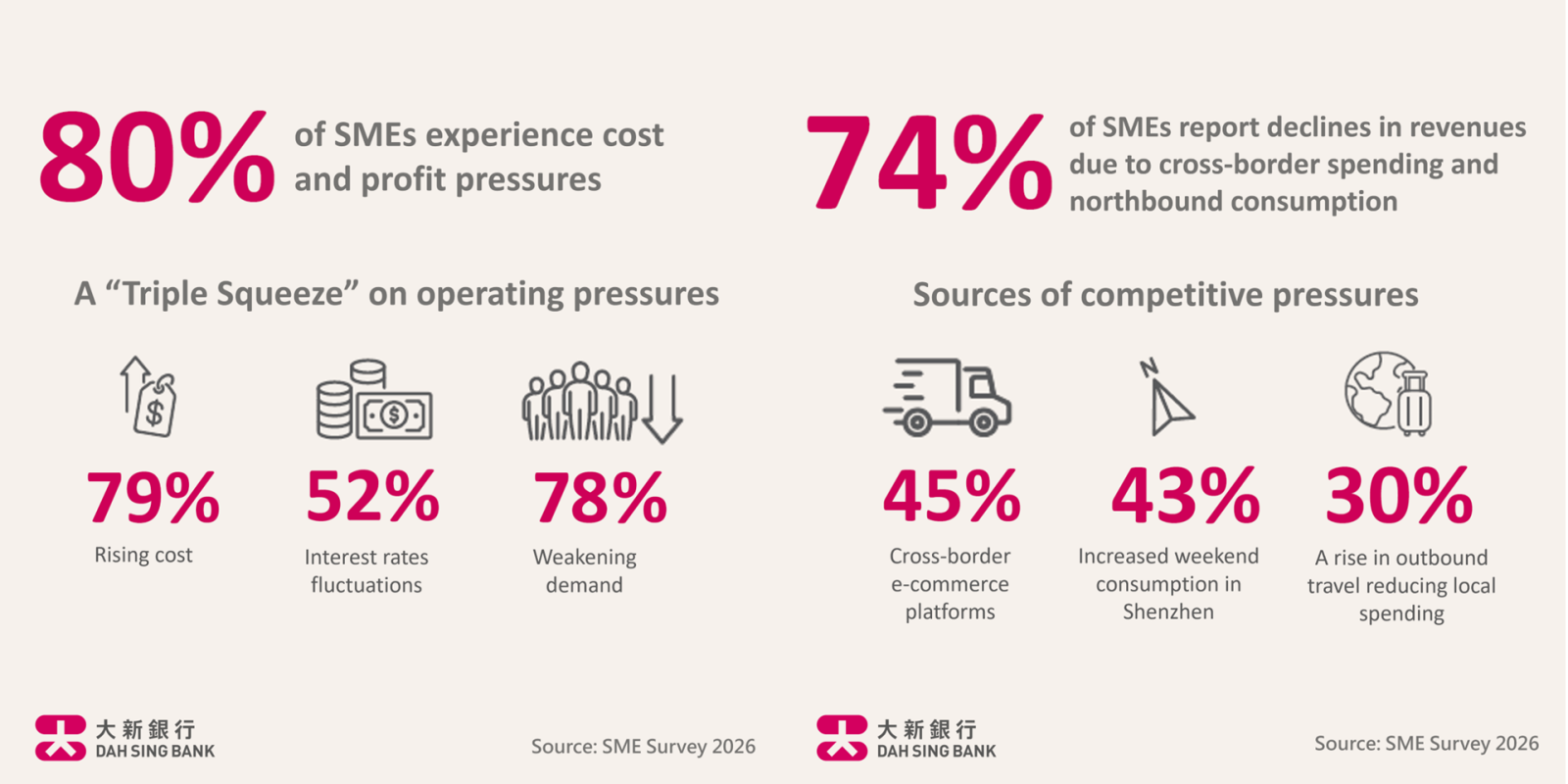
The Survey shows that 80% of respondents indicated that their operating costs and profit margins have been affected this year by geopolitical developments, energy price fluctuations or global supply chain instability. Rising costs (79%), weakening market demand (78%) and fluctuations in interest rates (52%) were identified as the most significant external risks.

With cross-border spending and northbound consumption becoming increasingly prevalent, approximately 74% of SMEs reported that their revenues have been negatively impacted, with nearly one in five experiencing declines of more than 20%. Key competitive pressures stem from cross-border e-commerce platforms offering lower-priced daily necessities (45%), increased weekend consumption in Shenzhen (43%), and a rise in outbound travel reducing local spending (30%).

SMEs Step Up Measures to Adapt

In response to the rising costs, SMEs are actively adopting various strategies to stabilise operations, including renegotiating supplier terms (26%), adjusting pricing (24%), and optimising inventory management (20%). At the same time, in light of outbound consumption trends, businesses are strengthening customer retention strategies. While price promotions remain the most common approach (34%), SMEs are also increasingly introducing experiential elements (29%) and strengthening digital marketing efforts (25%) to improve competitiveness.

Against a backdrop of ongoing uncertainty, SMEs are placing greater emphasis on business stability. A stable customer base (30%) and predictable cash flow (22%) are seen as key factors in sustaining operations, alongside lowering operating cost (22%). This reflects growing attention on financial resilience and liquidity management.

Constraints Persist Amid Rising Support Needs

Despite these efforts, SMEs continue to face resource and information constraints in navigating challenges and pursuing transformation. More than half of the respondents have never applied for or are unfamiliar with government support schemes. In addition, while some SMEs are interested in advancing ESG initiatives, 37% consider them burdensome due to costs, and 32% are unsure where to begin, indicating a cautious pace of adoption overall.

Dah Sing Bank Supports SMEs Resilience

In a rapidly changing business environment, Dah Sing Bank believes that enhancing cash flow efficiency and operational flexibility is key for SMEs to address business pressures. The Bank is committed to supporting SMEs through diversified and flexible lending and financing solutions tailored to their business needs. These include a wide range of import/export trade finance services and payment options, as well as the Merchant Receivables Loan – a service designed to provide merchants with quicker access to capital. Such initiatives enable SMEs to strengthen cash flow management and improve the predictability and efficiency of their daily operations.

Furthermore, Dah Sing Bank offers comprehensive hedging tools to help enterprises manage foreign exchange and interest rate risks. This support enables businesses to mitigate financial exposure arising from global economic volatility, enhance resilience, and expand their businesses in both local and global markets steadily. In addition, the newly launched Dah Sing Business Multi-Currency Mastercard Debit Card helps SMEs reduce transaction costs and manage expenses more effectively, providing a one-stop and seamless experience for local and overseas transactions.

Dah Sing Bank Deputy Chief Executive, Senior Executive Director and Head of Group Personal Banking, Ms Phoebe Wong, said: “The Survey shows that Hong Kong SMEs are facing multiple challenges, including rising costs, shifting demand and evolving consumption patterns. At the same time, it is encouraging to see businesses actively adopting measures such as optimising cost structures and enhancing customer experience. In an environment of heightened uncertainty, stable cash flow and operational agility has become even more important. Dah Sing Bank has long been a trusted partner to SMEs, and we remain committed to combining financial services with practical support to help enterprises improve capital efficiency and resilience. Our goal is to empower SMEs to maintain stability in a constantly changing market and lay a solid foundation for sustainable long-term growth.”


[1] The Survey was conducted through online questionnaires from 19 to 26 May 2026, interviewing 342 Hong Kong SMEs.

To borrow or not to borrow? Borrow only if you can repay!
The service(s) / product(s) mentioned in this document are not targeted at customers in the European Union.
Risk Disclosure Statement Foreign Exchange Transactions: Foreign exchange involves risk. Currency investments are subject to exchange rate fluctuations, which may result in gains or losses. Customers converting foreign currencies into HKD or other currencies may incur losses due to exchange rate movements. Investors should read and understand all offering documents, including risk disclosures and warnings, before making any investment decisions.
Currency Risk (RMB): Conversion of RMB into HKD or other currencies is subject to exchange rate fluctuations. Customers may experience gains or losses due to RMB exchange rate movements. RMB is currently subject to exchange controls imposed by the PRC government, and its exchange rate may be affected by policy changes.
Unless otherwise specified, this promotional material does not constitute an offer, solicitation, or recommendation to engage in any foreign exchange transaction, nor does it predict future exchange rate movements. This material has not been reviewed by the Securities and Futures Commission or any other regulatory authority in Hong Kong.

Hashtag: #DahSingBank

The issuer is solely responsible for the content of this announcement.

About Dah Sing Bank

Dah Sing Bank, Limited (the “Bank”) is a wholly-owned subsidiary of Dah Sing Banking Group, Limited (HKG:2356). Founded in Hong Kong over 75 years ago, the Bank has been providing quality banking products and services to its customers with a vision to be “The Local Bank with a Personal Touch”. Over the years, the Bank has been rigorous in delivering on its brand tagline to grow with its customers in Hong Kong, the Greater Bay Area and beyond – “Together We Progress and Prosper”. Building on our experience and solid foundation in the industry, our scope of professional services now spans retail banking, private banking, business and commercial banking. Meanwhile, the Bank is also making significant investments in its digital banking capabilities to stay abreast with smart banking developments in Hong Kong and to support financial inclusion at large.

In addition to its Hong Kong banking operations, the Bank has wholly-owned subsidiaries including Dah Sing Bank (China) Limited, Banco Comercial de Macau, S.A., and OK Finance Limited. It is also a strategic shareholder of Bank of Chongqing with a shareholding of about 13.5%. Dah Sing Bank and its subsidiaries now have 63 operating locations in Hong Kong, Macau and Chinese Mainland.

Media OutReach

Thailand Approves $1.99 Billion in New Investment, Led by AI and Advanced Electronics

Published

on

BANGKOK, THAILAND – Media OutReach Newswire – 8 July 2026 – Thailand has approved nine major investment projects worth a combined USD 1.99 billion (66.3 billion baht) in high-value sectors, including artificial intelligence (AI), advanced electronics, aviation, clean energy, and food as global manufacturers reposition their supply chains across Southeast Asia.

Thailand Board of Investment Meeting

The approvals, cleared during a meeting of the Thailand Board of Investment (BOI) chaired by Mr. Ekniti Nitithanprapas, Deputy Prime Minister and Minister of Finance, highlight the country’s appeal to multinational corporations seeking reliable production hubs.

“These investments by leading multinationals signal strong global confidence in our industrial capacity,” said Mr. Narit Therdsteerasukdi, Secretary General of the BOI. “By locating key parts of the AI and advanced electronics value chain here, we are connecting our economy directly to the core of next-generation global technology.”

To sustain this influx of high-tech investment, the BOI has restructured and expanded the mandate of its specialized energy panel into the “Subcommittee on Energy Management for Data Center Investment and Project Screening.” Chaired by the Minister of Energy, this body will serve as a one-stop regulatory filter to evaluate data center proposals on resource consumption, environmental impact, and clean energy sourcing before investors can apply for tax incentives, thereby providing policy transparency for international operators.

The largest share of the approvals covers Thailand’s advanced electronics and digital sector, led by companies from East Asia’s technology supply chains. In the AI infrastructure sector, Datasection (Thailand) Co., Ltd., a subsidiary of Japan’s Datasection Inc., will invest USD 235.2 million (7.8 billion baht) to establish high-performance GPU server infrastructure for data hosting in Bangkok and Pathum Thani. This specialized hardware will directly power advanced AI applications and digital businesses in the region.

Doosan Electro-Materials (Thailand) Co., Ltd., a unit of South Korean conglomerate Doosan Corp. and a global leader in non-flow prepregs, will also invest USD 180.2 million (6 billion baht) in Samut Prakan to manufacture copper-clad laminate (CCL) and prepreg, which serve as critical inputs for printed circuit boards (PCBs).

Similarly, Taiwan Union Technology (Thailand) Co., Ltd. is set to invest USD 189.2 million (6.3 billion baht) in Chonburi to manufacture CCL and prepreg designed specifically for high-demand AI servers and data centers. Fulltech Fiber Glass (Thailand) Co., Ltd. will invest USD 99.4 million (3.3 billion baht) to produce specialized glass fiber fabric, a raw material for PCB manufacturing, in Chachoengsao.

Beyond technology, multinational brands and critical infrastructure providers committed major investments to serve regional demand. In the consumer goods sector, Switzerland’s Nestlé (Thai) Co., Ltd. is committing USD 688.7 million (22.9 billion baht) to expand its Samut Prakan production facilities for instant, mixed, and ready-to-drink coffee, targeting both domestic and regional Southeast Asian markets.

National carrier Thai Airways International PCL secured approvals for two expansion projects totaling USD 430.2 million (14.3 billion baht) to lease eight passenger aircraft for its international flight networks.

For the infrastructure sector, Lomrak Green Energy Co., Ltd. will invest USD 168.7 million (5.6 billion baht) across two wind power projects in Lopburi province. The facilities will deliver a combined capacity of 120 megawatts to Thailand’s electrical grid, supporting the clean energy needs of high-demand industrial users.

To accommodate hyper-scale projects, the government has fast-tracked a seven-point energy action plan. This includes establishing a dedicated utility tariff rate for data centers, aligning data centers’ green energy targets with the Power Development Plan, facilitating clean power trading via Direct PPAs, introducing electricity usage guarantee rules, exploring direct high-voltage transmission for major operators, accelerating grid investment, and mapping water and power availability to guide site selections.

“We are building the infrastructure needed for the next wave of future-industry investment,” said Mr. Narit. “The government is aligning resource management with its green transition goals to ensure long-term operational security and give global investors confidence.”


Note: Currency conversions are based on the Bank of Thailand’s average selling rate of approximately 1 USD = 33.30 THB.

Hashtag: #Thailandboardofinvestment #BOI #FDI #Investment

The issuer is solely responsible for the content of this announcement.

Thailand Board of Investment (BOI)

Established in 1966, the Office of the Board of Investment (BOI) has continuously played an essential role for over 60 years in promoting value-adding investment for the country, from both foreign and Thai investors, to enhance national competitiveness and drive towards a new era of sustainable and balanced growth.

Investment Services Center — PR Section, The Office of the Board of Investment (BOI)

555 Vibhavadi-Rangsit Road, Chatuchak Bangkok 10900 Tel. +66 (0) 2553 8111, Fax: +66 (0) 2553 8222

Continue Reading

Media OutReach

Genetic Study Reveals Multiple Introductions and Human-Mediated Spread of Invasive Blackchin Tilapia in Thailand

Published

on

BANGKOK, THAILAND – Media OutReach Newswire – 8 July 2026 – Researchers from Aquatic Resources Research Institute (ARRI), Faculty of Science, Chulalongkorn University have recently uncovered new genetic evidence explaining how the invasive blackchin tilapia (Sarotherodon melanotheron), a species native to West Africa, became established throughout Thailand.

Based on genetic analysis of 466 fish samples collected nationwide, the study identified high genetic diversity, including 19 distinct haplotypes, revealing that the species originated from multiple introduction events rather than a single release. The findings also show that subsequent human-mediated translocations within Thailand played a major role in the species’ rapid spread.

The study represents one of the most comprehensive genetic assessments of blackchin tilapia in Thailand to date. Researchers confirmed that the invasive populations belong to Sarotherodon melanotheron melanotheron subspecies and identified 13 private haplotypes unique to specific populations. Several of these occurred at relatively high frequencies in Samut Songkhram, Prachuap Khiri Khan and Surat Thani, indicating multiple introduction sources and limited mixing among some regional populations.

Using haplotype distribution patterns, network analysis and phylogenetic comparisons, the researchers traced the origins of Thailand’s blackchin tilapia to multiple geographic sources, including Ghana and Côte d’Ivoire, as well as potentially other unsampled native populations in West Africa.

The study also found that blackchin tilapia populations in different parts of Thailand are genetically distinct, particularly in Samut Songkhram, which is believed to be the earliest site of the invasion. At the same time, researchers discovered that fish sharing the most common genetic signature were found in provinces across eastern and southern Thailand, including Chachoengsao, Rayong, Chanthaburi, Chumphon, Nakhon Si Thammarat and Songkhla, suggesting they were transported by human activities rather than spreading naturally through connected waterways.

The researchers said “The findings provide valuable scientific evidence for strengthening surveillance and management of the invasive species. By identifying introduction pathways and patterns of dispersal, the study offers important guidance for preventing further spread, improving biosecurity measures and mitigating ecological impacts on Thailand’s freshwater ecosystems.”

Link to the research paper https://www.sciencedirect.com/science/article/pii/S2352513426002152

Hashtag: #ChulalongkornUniversity

The issuer is solely responsible for the content of this announcement.

Continue Reading

Media OutReach

Aurora Mobile’s EngageLab Showcases AI-First Omnichannel Customer Engagement Solutions at The MarTech Summit Hong Kong

Published

on

Wechat: 极光Jiguang

The issuer is solely responsible for the content of this announcement.

About EngageLab

EngageLab is an AI-first customer engagement platform that helps you build stronger customer relationships with AI agents, unified customer data, and reliable delivery across channels.
For more information, please contact: ma*******@*******ab.com

Aurora Mobile Limited

Founded in 2011, Aurora Mobile (NASDAQ: JG) is a leading provider of customer engagement and marketing technology services. The Company is dedicated to empowering global enterprises with stable, efficient, and intelligent customer interaction solutions. Leveraging its first-mover advantage in mobile messaging, Aurora Mobile has evolved into a comprehensive platform that integrates Omnichannel Engagement, AI-Driven Marketing, Advanced AI Customer Support, and Frictionless Identity Security. Through its flagship brand EngageLab and its robust AI infrastructure GPTBots.ai, the Company helps businesses achieve seamless customer reach, automate complex marketing journeys, and optimize service efficiency with AI agents, accelerating digital transformation for clients worldwide.

Continue Reading

Trending

