Feature/OPED
Biafra Restoration and the Social Contract Restructuring
By Omoshola Deji
The most embraced notion on the evolution of the state is the social-contract thought promulgated by Thomas Hobbes in the ‘Leviathan’, published in 1651.
Hobbes posits that the state is a product of the society; each individual submits a portion of their rights to a consented authority in interchange for an assured protection of their other rights.
The consented authority presides over the equitable distribution of resources, justice, fairness and the rule of law.
Uncomplicated, the consented authority in this case is the Nigerian government and Hobbes’ social-contract theory is employed to unmask the factors provoking the disintegration of Nigeria.
There is a national consensus that the over 250 ethnic groups inhabiting the Northern and Southern protectorates did not assent to be amalgamated into a nation called Nigeria in 1914. For that reason, one may contend that Hobbes’ social-contract theory does not appropriately rationalize the evolution of the Nigerian state. Inside out, one may also backtrack to the pre-colonial era and contend that the social contract principle had already been endorsed in the amalgamated protectorates before the advent of colonialism.
Virtually every ethnic group had a monarch and a traditional mode of worship before the Islamic and Christian missionaries cajoled and compelled us to shift faith.
Our progenitors submitted their right of choice to the oracle whom they believe is in the best position to select the right ruler for them. Everyone wholly obey whoever the oracle selects based on the conviction that he is the representative of the gods on earth.
Like a wisp of smoke, this conviction is fast fading due to the emergence of alternative and modern forms of governance, civilization and political impositions. To aptly ground the theoretical position of this piece, a bit of flashback is essential to justify the subsistence of Nigeria as a social contract.
Colonialism is the aftermath of the resolutions reached at the Berlin 1884 scramble and partition for Africa conference organized by Otto Von Bismark, the then Chancellor of Germany. Out of sheer meanness to dominate and exploit Africa’s resources, the European nations partitioned Africa into colonies without considering her ethno-religious and socio-cultural diversities.
Inconsiderately, the African rulers were not invited to the 1884 conference that sealed the political-economic fate of Africa.
In point of fact, our existence as a nation kicked off when Britain gained possession of the territories amalgamated to institute Nigeria. Lord Lugard only named and formalized it in 1914.
Observingly, it rarely surfaced in the history books that the amalgamated ethnic groups protested against the 1914 amalgamation.
To be fair, Lugard’s amalgamation may not have been protested due to the fear of the colonial master’s brutality.
Fast-forward to after four decades, during the struggle for independence, the Nigerian nationalists, from every region, teamed up to demand the independence of the Nigerian state as structured by Lord Lugard.
After Nigeria’s independence on October 1, 1960, the nationalists virtually made no attempt to dissolve the amalgamation. This ultimately infers that the foremost nationalists, tacitly or explicitly, resolved that we all shall cohabit together as one Nigeria. The social-contract principle naturally takes effect under such circumstance.
If the nationalists, from every region, abstain from disbanding Nigeria, then it’s not right for anyone to proclaim that we Nigerians never agreed to live together. Not for long, our diversity crushed the unity sooner than expected.
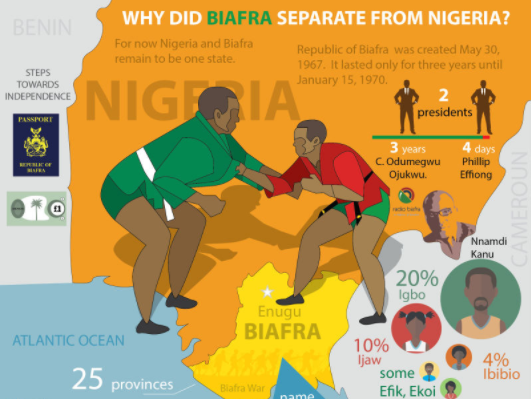
Ethnic rivalry and power struggle impelled the late Odumegwu Ojukwu to declare the secession of Biafra from Nigeria on 30 May, 1967. The decision to secede was apparently due to the wanton inter-ethnic killings and tension that brewed from the alleged Igbo coup of January 1966 and the alleged Hausa counter-coup of July 1966.
The 1967 Biafra secession activated a civil war between the Biafran forces and the Hausa-Fulani largely populated Nigerian army. After 30 months of intense battle and the loss of over a million lives, Biafra surrendered to ‘go on with one Nigeria’ – Gowon.
Unambiguously, the defeated forces upon surrendering Biafra were covertly or overtly re-entering into a social contract with Nigeria on the basis of political, economic and social equity.
The Biafra secession quest recently resurrected and gathered momentum due to President Muhammadu Buhari’s earlier disregard for a court order granting Nnamdi Kanu bail after he was accused and arraigned for treason.
The prolonged detention of Kanu earned him an unprecedented sympathy from the people of Igbo extraction who picture Buhari as anti-Igbo.
Unfortunately, Buhari’s oration that the North’s 97 percent and Southeast’s 5 percent voting pattern would influence government’s conduct and the subsequent conspicuous marginalization of the Igbos rained fuel in the burning fire.
The more Buhari ring-fence himself with people from the northern extraction, the more the other southern regions, especially the southeast would become suspicious and continue to play the last card of secession.
An overview of the top political offices and vital appointments reveals that the North is overpoweringly favoured against the South thus:
President – North; Senate President – North; Speaker of the House of Representatives – North; Independent National Electoral Commission (INEC) – North; Acting Secretary to the Government of the Federation – North; Army – North; National Security Adviser – North; Department Of Petroleum Resources (DPR) – North; Economic and Financial Crimes Commission (EFCC) – North; Air Force – North; Police – North; Nigeria Security and Civil Defense Corps (NSCDC) – North; Nigeria Ports Authority (NPA) – North; Department of State Security (DSS) – North; Nigeria Immigration Service (NIS) – North; Fire Service – North; National Insurance Commission – North; National Emergency Management Agency (NEMA) – North; Customs – North; State Chief of Protocol – North; Accountant General of the Federation – North; Asset Management Company of Nigeria (AMCON) – North; Chief of Staff to the President – North; Aide de Camp to the President – North; …the list continues.
It is bewildering that Buhari, a former Head-of-State, who is conversant with ethno-religious sensitivity of Nigeria, could commit the sacrilege of being sectional and nepotistic. Ask no further, Biafra is a reaction to the marginalization the Igbo’s are getting from their social-contract with Nigeria.
Recall the lop-sidedness in the Department of State Security (DSS) recruitment exercise. More individuals were recruited from Katsina state (51) than the entire Southeast states (44). Katsina is the home state of Buhari and Lawal Daura, the Director General of the DSS.
The geographic details of the enrolment exposed that out of 474 recruited cadet officers, 331 were from the North while 143 were from the South. Justifying the lop-sidedness, the DSS and the federal government claimed that the recruitment imbalance was purposely done to rectify the disproportion in previous enrolments.
This excuse holds no water for a government that came to power on the mantra of change. Where is the change promised, if previous leaders were sectional and Buhari is also sectional?
Apparently, no Nigerian democratically elected president has vigorously displayed sectionalism like Buhari.
Cast no doubt, protests and hate speeches would have popped up from the North if an Igbo president ever emerges and decides to impose an ethno-religious, sectional and nepotistic institutional arrangement.
Contravening section 21(2) of the Pension Reform Act 2014, Buhari removed a south-eastern woman, Chinelo Anohu-Amazuan as the Director General of National Pension Commission, PenCom, and replaced her with Aliyu Abdulrahman Dikko, a northerner.
Section 21(2) of the PenCom act stipulates that if the Director General of the commission is sacked before the expiration of his/her tenure, the president shall appoint a replacement from the same geopolitical zone.
Buhari’s parochialism, insularism, nepotism and sectionalism fertilized the Igbo’s consciousness to revive Biafra.
Any intention to crush Biafra without addressing the basic issue of inequality is to be sheepishly applying force without focus. The much-needed first step to national unity is to reassign the political appointments to reflect the pluralism of Nigeria.
In power, but limited in power, Acting President Yemi Osinbajo cannot effect the essential adjustments; he is tactically acting Mr Nice Guy in order not to appear disloyal, power-centric and desperate.
Quite ignoble, top government functionaries are pretending not to know the meaning of restructuring.
To get them educated, the restructuring of Nigeria means effecting three basic things: the devolution of powers to reflect true federalism; ratifying the states to control their resources and; rectifying the lop-sidedness of crucial government appointments to reflect regional equity and fairness.
If truth be told, the Igbo disaffection and the right to self-determination doesn’t mean Nnamdi Kanu’s approach is right. He lacks the strategy of attainment and the essential qualities of a credible leader. His orations are uncouth, obtuse, provocative and indeed treasonable.
Kanu should be enlightened that his ranting, hate speeches, confrontations and threats of war cannot bring forth Biafra; persuasion and dialogue is key.
Deficient in intelligence, Kanu fails to reason that his disciples cannot withstand the viciousness of a police acting on a court or presidential orders. Kanu fails to reason that his admirers shouting “oh yeah, oh yeah, oh yeah Nnamdi Kanu is another saviour” cannot influence his release if the court orders him back to prison. His admirers would quickly forget him like he has allegedly forgotten the other Biafran agitators that were refused bail.
Kanu’s episode might end in tragedy if he doesn’t change strategy. The Judas in his disciples or the south-eastern political bigwigs feeling outshined by his growing popularity might decimate him.
Why always unfortunate? Nigeria recorded virtually no progress under the sixteen year rule of the Peoples Democratic Party (PDP) whose chiefs ruthlessly looted the commonwealth.
Disheartening, the All Progressives Congress (APC) change mantra is manifesting as a political gimmick and deceit. APC promised change, but virtually nothing has changed positively.
Without further ado, Buhari needs to review or order the review of his kith-kin-and-kindred, extremely lopsided, political appointments to reflect regional equity. Appointing prominent and competent Igbos into crucial positions would pacify frayed nerves, promote national unity and the quest for Biafra will naturally fade.
The solution to Nigeria’s disintegration is hidden in the federal government’s readiness to abide by Hobbes’ social-contract principle of ensuring the equitable distribution of resources, political offices, justice, fairness and the rule of law.
Only political and regional parity can sustain a sovereign Nigeria’s unity for another 57 years multiply by 57.
Omoshola Deji is a political and public affairs analyst. He wrote in via mo******@***oo.com
Feature/OPED
Building 234 Solutions: A Response to Everyday Workforce Challenges
By Owoloye Emmanuel
Every business starts with a problem. For us, that problem was hiding in plain sight.
Across organisations, we kept seeing HR professionals, payroll teams, and business leaders spend significant time navigating processes that should be simpler. Employee records sat across multiple systems, payroll processes required manual intervention, and routine workforce tasks often became more complicated than they needed to be.
As businesses grow, workforce operations naturally become more complex. Yet many organisations still rely on disconnected tools and workflows that create unnecessary friction for both employers and employees.
The consequence is more than operational inefficiency. HR teams spend valuable time managing systems instead of supporting people. Business leaders struggle to access timely workforce insights, while employees experience delays in processes that should be seamless.
These weren’t isolated challenges. They were recurring realities across workplaces, regardless of industry or size.
That observation led us to a simple question: what if workforce management could be easier?
What if HR, payroll, and workforce operations could work together within a single, connected experience?
That question became the foundation for 234 Solutions.
We are building 234 Solutions with a clear belief that workplace technology should reduce complexity, not add to it. Our goal is to help organisations spend less time navigating processes and more time focusing on productivity, growth, and people.
As we prepare for launch, our focus remains simple: building practical solutions for real workplace challenges and helping organisations create better experiences for the people who power them every day.
Owoloye Emmanuel is the founder of 234 Solutions
Feature/OPED
The Role of TV in Preserving African Stories and Identity
Scroll through social media today, and you will notice something interesting: everyone is either reacting to a series, quoting a movie line, or debating a character as though they personally know them. Beneath the memes and binge-watch culture, however, lies something deeper. Television remains one of the most powerful tools shaping how Africans see themselves, remember their history, and tell their own stories. In a continent as diverse and expressive as Africa, that matters more than ever.
TV as a Cultural Archive, Not Just Entertainment
Long before streaming algorithms began shaping our viewing habits, television was already preserving African identity. From Nollywood dramas that capture the rhythm of everyday Lagos life to documentaries exploring Maasai traditions and Ghanaian folklore, TV has served as a living archive of the continent’s stories.
It preserves more than entertainment; it preserves language, culture, humour, values, and shared experiences. Unlike fleeting social media content, television allows stories to unfold with depth, exploring the realities of family, tradition, ambition, and modern African life without reducing them to stereotypes. That is the power of TV: preserving not just stories, but perspective.
Why Representation on TV Still Matters
There is a subtle but important truth: if people do not see themselves on screen, they may begin to believe their stories are not worth telling. This is why African TV content is more than entertainment; it is affirmation.
Seeing a character who speaks like you, struggles like you, or celebrates like your community does something powerful. It validates identity and challenges outdated narratives that have historically defined Africa through external lenses.
This is where MultiChoice Group, through platforms such as DStv and GOtv, plays an important role. They do not simply broadcast content; they help distribute cultural memory at scale.
GOtv, DStv, and the Everyday African Viewer
Think about a typical evening in many African homes: the TV is on in the background, someone is laughing at a comedy show, another person is watching a local series, and someone else is catching up on the news. That shared viewing experience remains very real.
Through platforms such as DStv and GOtv, African households are exposed to a blend of local storytelling and global content. More importantly, they have helped amplify African-produced content by bringing Nollywood films, African reality shows, talk shows, and documentaries into mainstream rotation.
It is not just about access. It is about visibility.
A young filmmaker in Lagos today is more likely to believe their story matters because they have seen similar stories broadcast widely. A child in Accra grows up hearing familiar accents and seeing environments that look like their own on screen, not as exceptions, but as the norm.
TV Is Also Shaping Modern African Identity
African identity is not static; it is evolving. Television reflects that evolution in real time.
Today, audiences see:
-
Young Africans balancing tradition and modern dating culture
-
Stories tackling mental health in African households
-
Fashion and music influences spreading through TV series
-
Political satire shaping public conversation
Conversations that were once confined to homes are now being explored on screen, giving audiences the language to discuss issues that were previously unspoken.
In many ways, television is doing what oral tradition has always done: passing stories, values, humour, warnings, and history from one generation to the next. The difference is that today’s griots are writers, directors, and broadcasters.
The Future: From Watching to Owning Our Narratives
The next stage of African storytelling is not just about being seen; it is about ownership.
As more African creators produce content and platforms continue to invest in regional storytelling, television becomes more than a mirror. It becomes a tool for shaping how Africa is represented to itself and to the world.
While streaming continues to grow, television, particularly accessible platforms such as GOtv, remains one of the most effective ways to reach everyday audiences across different income levels and regions. After all, storytelling only matters if people can access it.
African stories are not new. They have always existed in families, on streets, in markets, in history books, and through oral traditions. What television has done, and continues to do, is give those stories a stage wide enough for millions to experience them at once.
The next time you watch a local series or documentary on DStv or GOtv, remember that you are not just being entertained. You are participating in the preservation of African identity itself.
Feature/OPED
The Future of AI in Nigerian SMEs: Overcoming Barriers to Implementation
By Kehinde Ogundare
Ask a tech entrepreneur in San Francisco what AI means for their business, and they are likely to talk about competitive advantage, product differentiation, and scale. Ask a small business owner in Kano or Onitsha the same question, and the conversation shifts entirely.
For many Nigerian SMEs, the priority is keeping the lights on, managing costs, and finding sustainable ways to grow in a challenging economic environment. This difference in perspective explains why the global AI conversation, often shaped by assumptions about stable infrastructure, deep capital, and abundant technical talent, frequently fails to address the realities facing Nigerian SMEs.
This matters because Nigerian SMEs are not a peripheral concern. In 2024 alone, MSMEs contributed 46.32% to Nigeria’s GDP, accounting for 96.9% of businesses and 87.9% of employment. These businesses are the backbone of the Nigerian economy, and if AI is going to mean anything for Nigeria’s development, it has to work for them in the daily conditions they actually operate in.
However, research drawing on empirical data from 144 Nigerian SMEs found that inadequate infrastructure, low digital literacy, skills shortages, and regulatory gaps are collectively preventing them from meaningfully engaging with AI. Awareness of AI is high and growing. What is missing is a clear and honest conversation about what adoption actually requires in this specific context. The barriers are real, but none of them are insurmountable. The question is whether the tools, pricing models, and support structures being offered to Nigerian SMEs are designed with those barriers in mind, or whether they have been built for another market entirely.
Subscription models making AI affordable for small businesses
When most small business owners hear “AI,” they imagine expensive software, specialist consultants, and a hefty upfront bill.
That assumption is not entirely wrong, but it describes a particular way of buying technology, not AI itself. The shift that makes AI genuinely accessible at the SME level is the move away from large, one-time capital purchases towards tools that charge a predictable monthly subscription. Businesses can pay for what they use, scale back when necessary, and avoid the debt that a major technology investment can create.
The deeper opportunity here is consolidation. Many SMEs are already spending money across multiple disconnected tools—one for invoicing, another for customer records, another for stock tracking—none of which talk to each other. An integrated platform that handles several of these functions together, with AI built in, can actually cost less than the sum of those separate subscriptions while giving business owners a clearer picture of their operations.
With margins already under pressure, any technology a business adopts needs to visibly show an increase in productivity or bottom line. Subscription-based, integrated platforms, priced transparently and honestly, are the model that best fits this reality.
Infrastructure challenges demand a mobile-first approach
No conversation about technology in Nigeria is complete without confronting the infrastructure problem, and AI is no exception. Nigeria continues to face major infrastructure barriers, including limited broadband access, unreliable power supply, and high data costs, all of which constrain deeper AI adoption. These are structural features of the operating environment that any sensible technology strategy must account for today.
The electricity situation alone is significant. The World Bank estimates that the lack of stable electricity costs Nigeria’s economy approximately $26.2 billion annually, equivalent to about 2% of GDP, forcing many businesses to run on expensive diesel generators. That cost ripples outward.
In practical terms, AI tools built for Nigeria cannot assume a stable broadband connection or a computer that is always powered on. The tools that will actually get used are the ones that work on a smartphone, consume minimal data, and can function offline when connectivity drops, syncing back up when it returns. The mobile phone is already how many Nigerian SME owners run their businesses. AI that meets them there, rather than demanding infrastructure they do not have, is AI that has a genuine future in this market.
The direction is clear: build capability from within, using tools that make that possible. Recent AI performance research reveals that 64% of African workers are already actively using AI at work, signalling massive grassroots readiness and driving forward-thinking organisations across Nigeria, Kenya, and South Africa to aggressively prioritise internal upskilling frameworks to bridge the talent gap.
As the policy groundwork is being laid, the commercial ecosystem is beginning to respond. What remains is a clear-eyed acceptance that AI tools built for this market need to look different from those built for markets with different realities. Low cost, low bandwidth, and usability for non-technical people are not modest ambitions; they are the actual requirements. Build for those realities, and AI has a real future in Nigeria’s SME economy.
-
Feature/OPED6 years agoDavos was Different this year
-
Travel/Tourism10 years ago
Lagos Seals Western Lodge Hotel In Ikorodu
-
Showbiz3 years agoEstranged Lover Releases Videos of Empress Njamah Bathing
-
Banking8 years agoSort Codes of GTBank Branches in Nigeria
-
Economy3 years agoSubsidy Removal: CNG at N130 Per Litre Cheaper Than Petrol—IPMAN
-
Banking3 years agoSort Codes of UBA Branches in Nigeria
-
Banking3 years agoFirst Bank Announces Planned Downtime
-
Sports3 years agoHighest Paid Nigerian Footballer – How Much Do Nigerian Footballers Earn