Connect with us

Banking

Heritage Bank, RIMAN, FDC Task Firms on Modern Risk Mgt. Practices

Published

on

By Modupe Gbadeyanka

Heritage Bank Plc, Risk Managers Association of Nigeria (RIMAN) and Financial Derivatives Company Limited have called on corporate organizations to adopt systemic and cultural changes to embed risk management into their organisations in a bid to manage uncertainties that may arise at any given time.

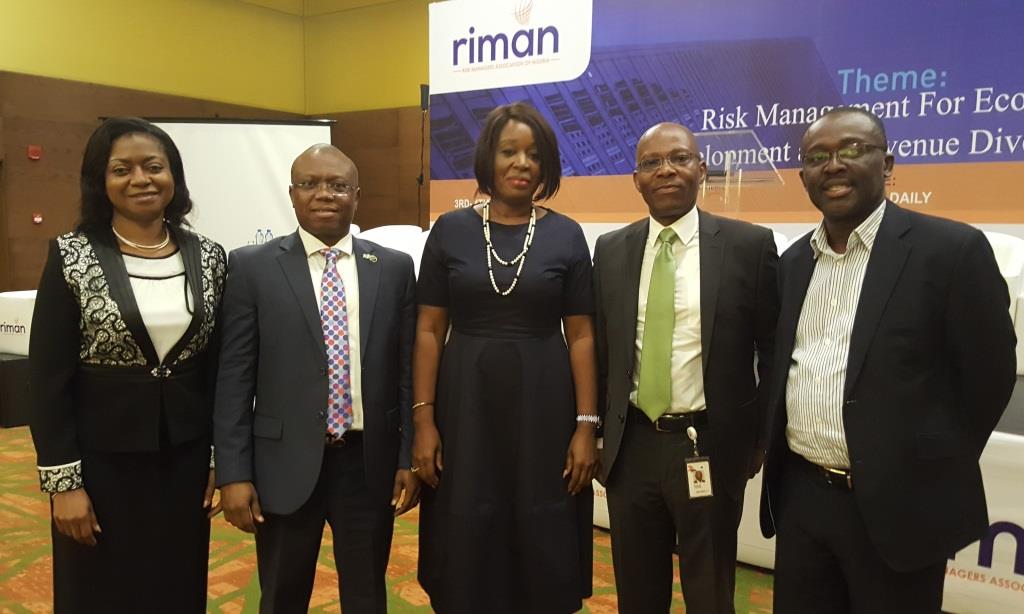
This call was made at the 17th Annual Conference organized by RIMAN in partnership with Heritage Bank Plc, which was attended by eminent personalities including Oba of Lagos, Mr Rilwan Akiolu; President of the Chartered Institute of Bankers of Nigeria (CIBN), Professor Segun Ajibola; among others.

CEO of Financial Derivatives Company Limited, Mr Bismarck Rewane, stated this in a keynote address, remarking that risk advantage is the ability to systematically manage the uncertainty inherent in any given strategic position in order to generate an attractive return with less risk.

He said the Boston Consulting Group (BCG) risk advantage framework could be used to establish competitive strength in an age of uncertainty and that the components of the framework are expansive, anticipation, discipline and resilience.

He remarked that regular scenario planning helped to establish expansive anticipation and also hold managers accountable for factoring risk and uncertainty into their planning.

Mr Rewane whose keynote address was titled: Risk Management for Economic Development and Revenue Diversification also enjoined them to take into account risks taken when reviewing the results achieved because linking risk to human resources and corporate governance builds resilience.

The keynote speaker who looked at risk from a multidimensional perspective but mainly from a policy maker perspective noted that the business cycle is a natural economic phenomenon of boom to slowdown to bust.

Quoting Matthew Bishop, Mr Rewane defined risk as the chance or probability that things not turning out as expected, adding that risk taking lies in the heart of capitalism and is responsible for a large part of economic growth.

Other definitions of risk he proffered are: profit is the reward for risk taking; risk management is the process of bearing the risk of tolerance and minimizing the risk one does not want and risk is also hedging, diversification and buying insurance.

He remarked that economies were vulnerable to both exogenous and domestic shocks s as they go through business cycles, noting that in the last 100 years, there have been no less than 14 recessions, one depression in 1929 and at least two times when economic, financial and market crisis happened.

Mr Rewane noted that a stress test of the Nigerian banking industry presently would measure exposure to oil and gas (N1.62 trillion), telecoms (N673 billion) and power (N306 billion) which showed the industry non-performing loans were on the rise and thereby necessitating additional capital raising.

In his address of welcome, the President of RIMAN, Mr Jude Monye welcomed delegates and participants to the conference with the theme: The Role of Risk Managers in Economic Development and Revenue Diversification.

According to him, the global oil crisis has left a bitter taste with most oil producing nations and Nigeria in particular, due to its heavy reliance on oil revenue and non-diversification of its revenue base among others.

He said RIMAN has been at the fore front of best practice in risk management in Nigeria for more than 16 years, adding that the resolve of the association to ensure best practice in risk management and risk advocacy remain unshaken.


Modupe Gbadeyanka is a fast-rising journalist with Business Post Nigeria. Her passion for journalism is amazing. She is willing to learn more with a view to becoming one of the best pen-pushers in Nigeria. Her role models are the duo of CNN's Richard Quest and Christiane Amanpour.

Banking

Onafriq, PAPSS to Launch Wallet-Based Outbound Payments from Nigeria to Ghana

Published

on

Onafriq PAPSS

By Modupe Gbadeyanka

A platform to enable cross-border intra-Africa payments for individuals, merchants, and traders in Nigeria and Ghana is being designed by Onafriq Nigeria Payments Limited in partnership with the Pan-African Payment and Settlement System (PAPSS).

The platform, currently in its pilot stage, is the first wallet-based outbound payments scheme, which is fully in Naira and instant, without relying on hard currency conversion.

The parties are working together with banks and mobile money operators in the West Africa nations.

The Central Bank of Nigeria (CBN) has already approved this initiative, which will benefit small and medium enterprises (SMEs), the real engine of intra-African trade, as they will now have access to a faster, cheaper way to reach customers and suppliers across the border.

By reducing barriers to cross-border trade, the new service will allow these businesses to grow their addressable markets and activity. From December 1, this service will be fully operational for a 6-month period.

Through the partnership with PAPSS, Onafriq, which is a CBN licensed payment service provider, is supporting the operationalization of the Africa Continental Free Trade Area (AfCFTA) mandate. The mandate itself is driving tariff-free trade for the 54 member states of AfCFTA. Within the partnership itself, Onafriq provides the mobile money rails, with an ecosystem consisting of over 1 billion mobile wallets.

Meanwhile, PAPSS brings a network of over 160 commercial banks, representing an ecosystem of more than 400 million bank accounts across its 19 African countries of operation. The two partners are essentially seamlessly connecting two worlds: mobile money and banking. As a consequence, intra-African trade transactions will take place more easily and opportunities will be created.

Currently, Africa is made up of bank and mobile-led markets, with siloes often inhibiting transactions between these economies. However, this partnership will remove these boundaries. With over one billion mobile wallets and 500 million bank wallets across Africa, this partnership will allow for cross-border collaboration at scale.

This partnership builds on Onafriq and PAPSS’ existing partnership for payments into Ghana, announced earlier this year.

“Our work with PAPSS shows what collaboration at scale can unlock—seamless, secure connections between banking systems and mobile money ecosystems. This is how we open bi-directional trade corridors, reduce costs for businesses, and give African enterprises the rails they need to trade with confidence in their own currencies. The vision is continental, but it starts with practical steps like this one,” the Managing Director for Anglophone West Africa, Mxolisi Msutwana, said.

The Chief Information Officer for PAPSS, Ositadimma Ugwu, added, “Too often, African businesses and individuals see borders as roadblocks instead of opportunities. With this step, we’re challenging that mindset, giving Nigerians the ability to send value next door with the same ease as sending a text message. Our vision is simple: make Africa’s borders invisible to payments. This pilot makes that a reality, moving us closer to a continent where payments don’t pause at the border.”

Continue Reading

Banking

Access Bank Appoints Ifeyinwa Osime as Board Chair

Published

on

Ifeyinwa Osime

By Adedapo Adesanya

Mrs Ifeyinwa Osime has been appointed as the chairman of the board of Access Bank Plc, following the retirement of Mr Paul Usoro on January 29, according to a statement to the Nigerian Exchange (NGX) Limited.

Mrs Osime, an accomplished legal practitioner, joined Access Bank’s board in November 2019 as an independent non-executive director and had chaired the Board Human Resources and Sustainability Committee and the Governance, Nomination, and Remuneration Committee.

This role made her contribute significantly to bank’s corporate governance, leadership development, and sustainability initiatives.

In addition to her role at Access Bank, Mrs Osime is a Director at Ebudo Trust Limited and a Partner at McPherson Legal Practitioners, where she advises on corporate and commercial matters and contributes to strategic leadership.

She is also a member of the Nigerian Bar Association, Women Corporate Directors, Nigeria Chapter, and Chartered Institute of Directors Nigeria, where she serves on the Executive Committee of the Women Sectorial Group.

Beyond her professional responsibilities, Mrs Osime is committed to mentoring youths and is actively involved in the Autism and Developmental Delays Support Community, reflecting her dedication to inclusion and social impact.

Speaking on her appointment, the chairman of Access Holdings, Mr Aigboje Aig-lmoukhuede, said: “Mrs Osime is a principled and experienced leader with a deep understanding of the Bank’s strategy and values.

“She has demonstrated strong commitment to the Bank’s vision and mission, and I am confident that, under her leadership, the Bank will continue to advance its strategic objectives of delivering sustainable value to shareholders and other stakeholders in the pursuit of its vision to become the world’s most respected African Bank.”

He also congratulated Mr Usoro on the completion of his tenure and for his exemplary leadership, dedication and significant contribution to the Group, saying he remains a valued member of the Access Bank family.

Continue Reading

Banking

Africa Energy Bank to Start Operations June as Nigeria Hands Over Headquarters

Published

on

african energy bank hq

By Adedapo Adesanya

The African Energy Bank (AEB), a pan-African financial institution established to mobilise capital for the continent’s energy development and strengthen regional energy value chains, will begin operations in June 2026.

This came as Nigeria officially handed over the headquarters of bank at a ceremony held on the sidelines of the ongoing Nigeria International Energy Summit (NIES).

The president of the African Petroleum Producers’ Organisation (APPO) and Côte d’Ivoire’s Minister of Mines, Petroleum and Energy, Mr Mamadou Colibaly, praised Nigeria for its leadership in bringing the initiative to fruition, as he disclosed the bank was expected to commence operations in four months’ time.

“We are committed to launching this bank no later than June. I sincerely thank our partners for providing the headquarters and office that make this take-off possible. The African Energy Bank represents Africa’s commitment to finance, develop, and secure its own energy future by Africans, for Africans,” he said.

The African Energy Bank is a joint initiative of APPO member states and the African Export-Import Bank (Afreximbank), established to mobilise domestic and regional capital for Africa’s energy infrastructure, reduce dependence on external financing, and align energy investments with the continent’s long-term development and industrialisation agenda.

While performing the handover, Nigeria’s Minister of State for Petroleum Resources (Oil), Mr Heineken Lokpobiri, said the country had fulfilled all its responsibilities as host nation.

“Nigeria has met every obligation as host. The headquarters is ready, strategically located, and fully equipped, and we are prepared for immediate take-off.”

The ceremony highlighted a growing consensus among African leaders on the need for the continent to take greater ownership of its vast natural resources.

Through tailored financial instruments, the bank is expected to support projects across the energy value chain, including exploration, refining, renewable energy integration, and local content development, with a focus on job creation and economic value addition.

The African Energy Bank has been touted as not just another financial institution, but a strategic pillar in Africa’s quest for economic independence and long-term energy security

The African Energy Bank is a pan-African financial institution jointly promoted by APPO member states and Afreximbank to provide tailored financing solutions for energy projects across the continent, strengthen regional energy markets, and support sustainable development through improved access to capital.

Continue Reading

Trending