Connect with us

General

72nd UNGA: Presidency Says Fake Buhari Speech in Circulation

Published

on

By Dipo Olowookere

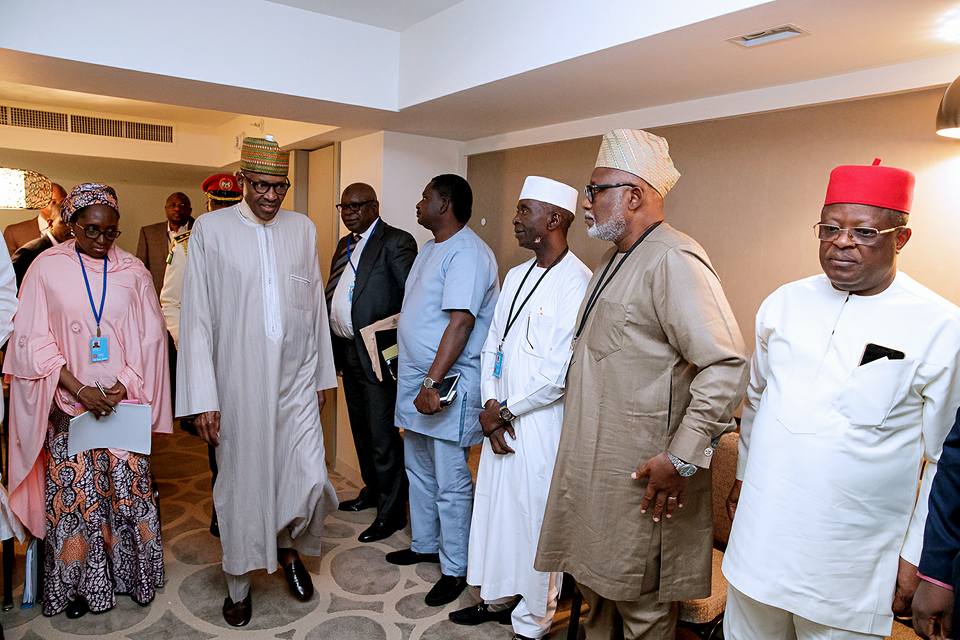
The presidency alerted Nigerians of a speech purportedly delivered by President Muhammadu Buhari at the ongoing United Nations General Assembly (UNGA) in the United States of Amercia (USA).

In a tweet early Tuesday, the presidency said on Twitter that Nigerians should disregard the said post advising the UN on the need to restructure the global body.

“There’s a fake speech circulating online as the text of President @MBuhari’s #UNGA Address, to be delivered Tuesday. Please DISREGARD it,” the post from the verified Twitter account @NGRPresident (Presidency Nigeria‏), said.

President Buhari is among the leaders to speak at the UN General Assembly today.

This year’s debate theme is ‘Focusing on People: Striving for Peace and a Decent Life for All on a Sustainable Planet.’

Below is the fake Mr Buhari’s speech:

The president of the United Nation’s General Assembly,

Your Excellencies,

Heads of States and governments,

Distinguished Delegates,

Ladies and Gentlemen.

On behalf of the government and people of the Federal Republic of Nigeria, I congratulate you, Mr President, on your election to preside over the 72nd session of the United Nations’ General Assembly.

I also wish to express my country’s appreciation to the Secretary General of the United Nations, Mr Antonio Guterres, for his steady leadership and this body’s dedication to the search for a peaceful and equitable world through the charter of the United Nations.

Every year, we gather here to deliberate on the affairs of the world. Sometimes we implement what we talked about and move humanity an inch closer to that ideal relationship as members of the world community.

At other times, we have our talks and end up not implementing anything to the disappointment of millions and millions of people around the world who look up to this body to provide leadership in a world that is constantly oscillating between advancement and doom.

In all of these, we often forget that what we have accomplished in the last 72 years is unprecedented in the annals of human history.

The world may be badly governed, but the fact that there is a form of governance agreed upon by all is an accomplishment in and of itself.

So, I congratulate us all. Mr President, as we say in Nigeria, he who does not look ahead remains behind. Our charge now is to aspire to make this world better for the next generation. We, the generation that knows how the world was before the United Nations was formed, must bequeath to those coming behind us a better United Nations that would be in a position to deal with the challenges of tomorrow.

To accomplish that, we need to fast forward the reformation long proposed in this chamber. To restructure or not to restructure is no longer the question – the United Nations must be restructured for it to remain relevant in years to come. How to restructure the United Nations should be our priority number one.

Several ideas are out there. All that we need is to get them together and agree on what works for majority of the people of this world.

As a leader of one of the leading African nations, I want to see a United Nation’s Security Council that is expanded to have one or two African permanent members with veto powers. It is a fair thing to do – one that will benefit the world by giving it a chance for a more balanced outlook to matters of importance to us all.

As we have learned in Nigeria, sometimes you need to change in order to remain the same. It is the first principle of renewal. In the continent of Africa, the post-colonial era is going into a new phase. In another generation, there would not be any African alive who could remember when European powers once governed Africa.

That emerging generation is creating new challenges for the African order left behind by the colonial powers. My generation is managing that challenge with the hope of leaving behind nation states that are less prone to crisis. We cannot continue to pretend that conflicts that emerged as a result of our colonial heritage have been resolved.

Across our continent, they are still there. In some cases, bad governance is exacerbating these conflict points. Here are some of the things we are doing to make sure that we bequeath to the upcoming generations of Africans a continent that is healthy, wealthy and well-grounded in law and order.

We are close to enshrining in the African Union’s creed the fundamental principle of democracy, which says that a credible people’s mandate should determine who governs any nation across Africa. We are taking it a step further by pushing to make that mandate limited.

We believe that Africa has numerous talents and no man or woman should be in the leadership saddle for an inordinate time. We are also working hard to expand the African market and open it up for our people to benefit from the free flow of goods, services and knowledge across the continent. It is the only path to prosperity for over one billion people in Africa yearning for opportunities to show the world the potentials they have.

As Africans, we will continue to build partnerships across the world. As we stretch our hands out for friendship, we do so with the expectation that our hands would be met not with pity and charity but with respect and dignity. Africans have a lot to offer the world, not just its minerals and human potentials. We are committed to resetting that old perception with a new one that proclaims Africa as a land ready for business.

Those who have taken the steps to invest in Africa can attest to the mutual benefit that comes with it. In areas of infrastructural developments, research and security, we urgently need a respectable and mutually beneficial partnership with the world. Integration of the continent and expansion of prosperity can only come when there are good roads, constant electricity, clean water and descent healthcare for our people.

The United States government, The European Union, private investors and non-governmental organizations are getting involved in these ventures.

Africa will continue to welcome the world in every enterprise that will uplift our people. It is only when we add value and build capital that we will reduce the grim statistics of Africa’s child mortality rate from preventable deaths.

It is only then that we can reduce deaths on the Mediterranean Sea of African youths running away from conflicts and poverty. The challenge is ours. We accept the responsibility. As in the past, we know that we do well when we share skills and expertise. That was how we were able to work together with partners around the world to reduce the AIDS epidemic. That was how, in the last two decades, we were able to defeat diseases like polio, tuberculosis and ringworm in several parts of Africa. Africans have always been appreciative of the assistance we receive.

We have also paid back to the international community with our involvement in Peace Keeping missions across the world. Mr President, on matters of security, there is no gainsaying that when one part of the globe is insecure, all parts of the globe become potential victims of that insecurity. The activities of several extreme groups jeopardize not just the nation where they emanated but everyone far and in-between.

The free movement of fighters and weapons has all but made the issue of security a global problem. As we have learned in Nigeria, you compromise the security of the whole when components of the sum are not fully valued, appreciated and integrated with the whole.

We in Africa have been partners in the quest for a secure world. We will continue to be committed to the mission until all threats to peace across the world are eliminated. In Nigeria, we have degraded the capability of the Boko Haram terrorist group. We are on the path to eliminating the last of their safe heavens.

We have also secured the release of some of our abducted Chibok Girls. We are working hard to secure the release of the rest and to finish the job of closing the Boko Haram chapter and get the North East of Nigeria back to a peaceful region that it used to be.

Along this line, Mr President, we at the United Nations need to do more to bring about a more equitable world where a large group of people does not feel suppressed, undervalued and alienated. Last year, I talked about the need for Palestinians to have their own state. Progress has not been made on that matter in the past one year. It is one of those problems that we must not punt to another generation. Any glaring unfairness, like the Palestinian case, diminishes our moral authority to preach and lecture the world on other cases.

As we have learned in Nigeria, our stubborn self-righteousness blocks our ears from hearing the cry of those that we left on the fringe of society and blocks our eyes from seeing and reading the handwriting on the wall. In the urgent matter of the nuclear stand-off with North Korea, we hope that calm heads prevail. And as our ancestors say, that the disobedient fowl does not wait to be put into a pot of soup before it obeys.

We in Africa hope that North Korea and, indeed, all the nations with nuclear weapons will hasten to eliminate them all. We don’t aspire to have nuclear weapons in the continent of Africa, the cradle of mankind. We will preserve Africa in case the nuclear-armed nations of the world decide to destroy themselves in their so-called mutual assured destruction.

Should that happen, be assured that there will be a place in Africa for those of you who will be lucky enough to survive your self-inflicted annihilation. While we do not wish for that, we have this saying in Nigeria that, “na when soldier slap you, you go sabi say police na your friend.”

Mr President, Nigeria is always willing to work with the United Nations and other international organizations to advance human progress.

May the United Nations continue on its challenging task of being an instrument for peace, and may the goals that this General Assembly “for peace and a decent life for all on a sustainable planet” be accomplished in our time.

Thank you all for listening. Muhammadu Buhari, President, Federal Republic of Nigeria

Dipo Olowookere is a journalist based in Nigeria that has passion for reporting business news stories. At his leisure time, he watches football and supports 3SC of Ibadan. Mr Olowookere can be reached via [email protected]

Advertisement
Click to comment

Leave a Reply

Your email address will not be published. Required fields are marked *

General

Ikeja Electric Fumes Over Impropriety Allegations Against CEO, Chairman

Published

on

folake soetan kola adesina Ikeja Electric

By Adedapo Adesanya

Ikeja Electricity Distribution Company has described as malicious and misleading a widespread publication currently circulating online alleging impropriety about its chief executive, Ms Folake Soetan, and its board chairman, Mr Kola Adesina.

The management of the DisCo noted that a publication attributed to ‘Nigerian Global Business Forum’ defamed its CEO and the chairman of the IKEDC board.

The company said, “The publication, attributed to yet to be verified individuals and organisation, is clearly intended to misinform the public and bring the company and its leadership into disrepute through fabricated claims, the DisCo observed.”

Ikeja Electric noted that its investigation so far revealed that the ‘Nigerian Global Business Forum’ is an unregistered organisation with no recognised legal or corporate existence locally or abroad.

According to the energy firm, the signatories, “Dr Alaba Kalejaiye” and “Musa Ahmed,” have no verifiable professional credentials or established public profiles, and the publication contains false and misleading statements regarding Ikeja Electric’s operations, safety record, and financial practices.

The organisation said it had instructed its legal advisers to conduct a thorough forensic investigation and to initiate defamation proceedings against the authors, publishers, and any persons or entities found responsible for sponsoring or disseminating this malicious publication.

Ikeja Electric said it operates within a strict framework of accountability and remains committed to transparency and service improvement, warning it will not tolerate coordinated disinformation campaigns aimed at undermining public confidence and tarnishing its corporate integrity.

“Ikeja Electric remains steadfast in its mandate to deliver reliable power while upholding the highest standards of corporate governance and customer excellence.

Members of the public are advised to disregard the false publication in its entirety,” it said in a statement.

Continue Reading

General

PMS May Sell N1,000 Per Litre if Marketers Adopt Costly Coastal Loading

Published

on

PMS pump price

By Aduragbemi Omiyale

Nigerians may be forced to purchase premium motor spirit (PMS), commonly known as petrol, for almost N1,000 per litre if marketers choose to go for the costly coastal evacuation and not the cheaper gantry loading, the Dangote Petroleum Refinery has cautioned.

Though the company clarified that marketers were free to choose their preferred mode of evacuation, it emphasised that the implication of adopting the coastal loading was that consumers would pay more for the product because of the extra costs.

According to Dangote Refinery, “Coastal logistics can add approximately N75 per litre to the cost of petrol, which, if passed on to consumers, would push the pump price of PMS close to N1,000 per litre.”

The firm noted that its “world-class gantry facility” has 91 loading bays capable of loading up to 2,900 tankers daily.

Operating on a 24-hour basis, the facility can evacuate over 50 million litres of Premium Motor Spirit PMS, 14 million litres of Automotive Gas Oil (diesel) and other refined products each day, it added, urging marketers and policymakers to prioritise logistics choices that support price stability and consumer welfare.

It stressed that direct gantry evacuation eliminates port charges, maritime levies and vessel-related costs that do not add value to end users, helping to optimise costs, improve distribution efficiency and support price stability.

“Reliance on coastal delivery, particularly within Lagos, may introduce avoidable costs with material implications for fuel pricing, consumer welfare and overall economic wellbeing,” the company stated in a statement.

Based on Nigeria’s average daily consumption of about 50 million litres of PMS and 14 million litres of diesel, the refinery estimated that sustained dependence on coastal logistics could impose an additional annual cost of roughly N1.752 trillion. This cost, it said, would ultimately be borne either by producers or Nigerian consumers.

The refinery also renewed calls for coordinated investment in pipeline infrastructure nationwide, arguing that functional pipelines linking refineries to depots would significantly cut distribution costs, improve supply reliability and strengthen national energy security.

It said domestic refining has already delivered measurable benefits to the Nigerian economy. Since the commencement of operations, the price of diesel has fallen from about N1,700 per litre to N1,100 and currently trades between N980 and N990. Similarly, PMS prices have declined from about N1,250 per litre to between N839 and N900.

It added that increased local supply has sharply reduced fuel importation, eased foreign exchange pressures and improved market stability, contributing to a stronger naira, which recently traded at about N1,385 to the dollar.

Continue Reading

General

FG Targets 25 million Women in New National Programme Scale-up

Published

on

women SMEs

By Adedapo Adesanya

The federal government has launched the Nigeria for Women Programme Scale-Up (NFWP-SU), a strategic investment initiative which is expected to target over 25 million Nigerian women nationwide.

In a Friday statement, it was disclosed that President Bola Tinubu this week inaugurated the NFWP-SU programme, declaring the initiative a strategic national investment and unveiling the government’s ambition to expand its reach to over 25 million Nigerian women across the country.

According to the statement, the President, represented by Vice President Kashim Shettima, said the scale-up marks a decisive shift in Nigeria’s development strategy, with women’s economic empowerment, family stability, and social development placed firmly at the centre of national growth.

He stressed that Nigeria cannot achieve sustainable prosperity while half of its population remains structurally constrained.

“Women are not peripheral to national development. They are central drivers of productivity, custodians of family stability, and indispensable partners in our ambition to build a resilient, competitive and prosperous nation,” the President said, noting that empowering women is essential to job creation, food security, financial inclusion and economic diversification under the Renewed Hope Agenda.

President Tinubu described the programme as more than a social intervention, calling it “a strategic investment in Nigeria’s economic infrastructure.”

He said the success of Phase I of the programme, which reached over one million beneficiaries across six states, provided strong evidence that structured, data-driven empowerment models deliver measurable, lasting impact.

Building on that evidence, the President announced a bold national ambition to scale the programme beyond its current targets to reach 25 million women nationwide, creating a sustainable platform for women’s economic inclusion embedded in federal, state and local systems.

He called on development partners, particularly the World Bank, to support the expansion through financing, technical assistance and innovation.

According to the President, the integration of digital platforms such as the Happy Woman App, identity verification and transparent targeting reflects the administration’s insistence on measurable and verifiable public policy.

“The work of the Ministry has shown what focused execution can achieve. This is how public trust is rebuilt and how government resources reach real people with real impact,” he said.

On his part, World Bank Country Director for Nigeria, Mathew Verghis, said the Bank was honoured to co-finance the NFWP-SU with the Federal and State Governments, describing it as fully aligned with the Bank’s new Country Partnership Framework for Nigeria, which prioritises unlocking economic opportunities, strengthening private sector linkages and creating more and better jobs.

Mr Verghis noted that Nigerian women remain disproportionately affected by poverty, with 64.3 per cent living below the lower-middle-income poverty line, despite their critical contributions to agriculture, trade and enterprise.

He said the Women Affinity Group (WAG) model promoted under the programme has proven to be a powerful tool for lifting women out of poverty by enabling collective savings, access to credit, financial discipline and enterprise growth.

Citing examples from the field, he explained that over 28,000 WAGs currently empower about 600,000 women across Nigeria, allowing them to save together, lend responsibly, invest in businesses and transition into formal financial services.

He added that scaling such models could unlock enormous economic gains, noting estimates that reducing gender inequality could increase Nigeria’s annual GDP growth by more than 1.25 percentage points, while closing productivity gaps across key sectors could add nearly $23 billion to the economy.

“This is smart economics. When women thrive, communities grow stronger, and economies become more resilient,” Mr Verghis said.

Also speaking at the event, Mr Robert S. Chase, World Bank Practice Manager for Social Protection and Jobs, described the Nigeria for Women Programme Scale-Up as one of the most ambitious gender-focused social and economic interventions currently being implemented in Africa.

He said the programme reflects a strong partnership between Nigeria and the World Bank, anchored on evidence, innovation and a shared commitment to lifting millions of women out of poverty.

Mr Chase noted that the programme’s strength lies in its ability to build sustainable systems rather than short-term relief, particularly through the Women Affinity Groups model, which combines social capital, financial inclusion and access to productive opportunities.

According to him, the scale-up phase demonstrates Nigeria’s readiness to institutionalise women’s empowerment as a core development strategy and not merely a welfare initiative.

The NFWP-SU Phase II is a $540 million programme, co-financed by the World Bank and the Federal and State Governments, expanding implementation to all 36 states and the Federal Capital Territory. It aims to directly reach five million women, generate about 4.5 million jobs, and benefit nearly 19.5 million Nigerians indirectly, while laying the groundwork for the broader expansion to 25 million women.

Under the leadership of Minister Imaan Sulaiman Ibrahim, the Ministry of Women Affairs and Social Development has positioned the programme as the centrepiece of wider social and economic reforms.

In Phase I alone, over 26,500 Women Affinity Groups were formed with more than 560,000 members, who collectively saved over N4.9 billion, expanded businesses, paid school fees and met household health needs.

The model has since attracted international interest, with other countries seeking to understudy Nigeria’s experience.

Beyond economic empowerment, the ministry has linked the programme to digital inclusion, civic identity, child protection and family welfare, while rolling out complementary initiatives in agribusiness, energy access, skills development and protection services.

Continue Reading

Trending