Connect with us

Feature/OPED

Imo State: Where there is no Legislature

Published

on

By Walter Duru

In modern democratic societies, the legislature performs three conventional functions of representation, law-making and oversight responsibilities. The 1999 Constitution of the Federal Republic of Nigeria (as amended) has provided the legislature in different sections, the powers to perform these functions at both the central and state levels.

The legislature controls through legislation, all economic, social and political activities of the state or country. It also scrutinizes the policies of the Executive and provides the framework of the judiciary to operate.

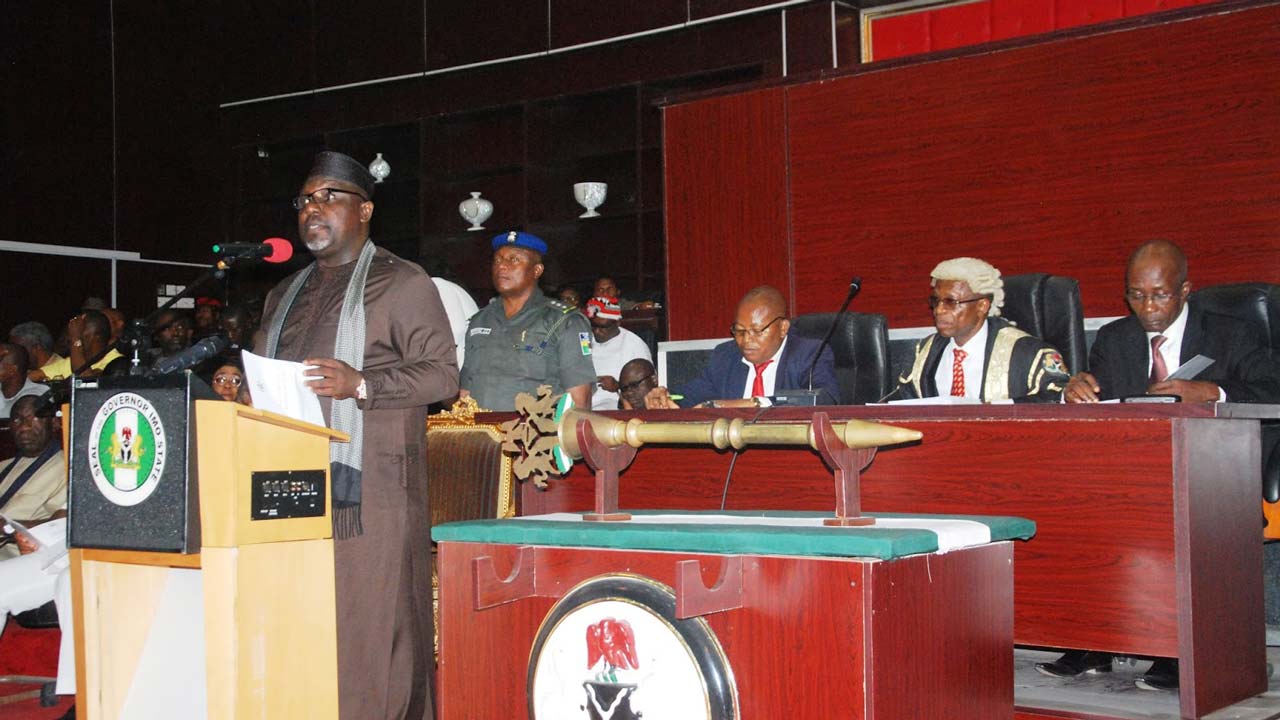
Contrary to the above norm, in Imo State, there are three arms of Government – the Executive, the Executive and the Executive. The executive has one name, Rochas Anayochukwu Ethelbert Okorocha, who rules the State (with his family) as a conquered people. The State Assembly is mere O yes rubber stamp. In Imo, it is the state versus her citizens, instead of the state for the citizens. I challenge whoever that thinks otherwise to prove me wrong, with verifiable facts and superior argument(s).

Anyone dreaming that recent developments at the State House of Assembly suggest they have woken up from slumber should wake up from that sleep and take some malaria pills. It is a huge joke and there is nothing like Imo State House of Assembly; instead, we have Okorocha House of clowns, in practical terms. What we have occupying the exulted positions of state lawmakers is a bunch of timid opportunists and puppets, who believe that their ascension to the state legislature is a special favour from the cad governor of the state, hence, they owe him worship.

How else do you describe a state Assembly that cannot boast of any meaningful people-oriented legislation since its inauguration? How else can one explain the fact that the only time people hear about Imo State House of Assembly is when there is a Budget or Supplementary Budget to ‘adopt;’ not pass, as this Assembly has never scrutinized any budget proposal submitted to it. The budgetary process is done in utmost secrecy and is mere ratification of the governor’s submission. Sometimes, the budget is signed and spending commences before the so-called annual budget proposal is submitted to the Assembly. Majority of the members of the State Assembly do not know what goes on in the legislature. Most legislative decisions are taken in the Executive Chambers. Another time you hear of the Assembly is when there is a request for loan for the personal use of the ‘Emperor’ or when there is an obnoxious anti people bill, usually sponsored by the Executive, through one of the puppets? A typical instance is that of the anti-media bill, smuggled in through the Deputy Speaker, Ugonna Ozurigbo.

They are at the beck and call of the Governor and have never and will never investigate whatever the executive is doing. No questions are ever asked; by the way, who, in the State Assembly has the guts to contemplate questioning the Governor or any of his allies?

It is an indubitable fact that the Speaker of the State Assembly, Acho Ihim takes instructions from the executive and can do anything to please the Governor. Some other members of the State Assembly kneel before him and practically tremble at the mention of his (Okorocha’s) name. I refuse to include that ridiculous title of Honourable, because, they are about the most dis-honourable people I have ever seen in public offices.

I simply smiled when a Civil Society colleague in Owerri attempted preaching Open Budgeting to Imo Government. Without apologies to a few of the lawmakers that relate with me, I can bet with my life that majority of them do not even have copies of the annual budget of the state they claim to be passing. Has the Assembly ever interrogated any budget proposal by the Executive? The Imo State Annual Budget is a secret document that only the governor and his cronies have access to. How then can the citizens be involved in the business of governance? How can they track government spending and budget performance?

How many bills that can promote good governance, enhance accountability, improve the socio-economic well-being of the citizens and secure the livelihood and future of Imo people have the present State Assembly passed? If it is not abortion bill today, it is anti-media bill tomorrow; from one obnoxious move to another. How did we get to this point in Imo?

Not even the public outcry that followed the numerous atrocities of the Okorocha-led government has moved them to act. Not even the blood of Soromtochukwu spilled during the illegal demolition of Ekeukwu Owerri. They are so dumb that they could not even pretend to be investigating any of the allegations against this ultra-corrupt government in the state.

From the complete absence of due process and rule of law, to the waste of scarce resources on trivialities; from non-payment of workers’ salaries, gratuities and pension of retirees, to issuance of dud cheques to pensioners; from failure to account for Bailout funds, Paris refunds and even the over one trillion Naira that has entered the state in the last seventy months to the use of state resources in conducting personal businesses.

What about the flagrant disobedience to Court orders and illegal demolition of private and public buildings? Land grabbing is a major characteristic of the present administration. How can a government seize landed property, using governmental powers and convert them to private use?

Nearly seven years into the present administration in the state, no local government election has been held. Where are the hundreds of billions accruing to the twenty-seven local government areas of the state? Is it the billions said to have been spent on statues? Now, Imo has Ministry of Happiness, with the Governor’s younger sister as Commissioner. Indeed, Imo has been rescued.

What about the Imo State Oil Producing Areas Development Commission- ISOPADEC, which funds should be statutory? At some point, Okorocha claimed to be saving the ISOPADEC billions for the construction of a Maritime University in Osemotor in Oguta Local Government Area of the State. Where is the Maritime University, nearly seven years after and where is the money?

The present administration in Imo is synonymous with corruption and is obviously irredeemable. But, where are the other two arms of government? The State Judiciary has become a toothless bulldog and cannot bite. Judicial pronouncements are disregarded with impunity and till date, nobody is in Prison for contempt.

Members of the Legislature that should have been the hope of the people to check the excesses of this ultra-corrupt government in Imo go cap in hand begging for contracts and favour from the executive. At some point, the governor engaged them with executive functions in Local Government areas.

Of all the atrocities of the present administration, the public outcry, media reports and petitions from citizens, which one has the present state Assembly investigated? Which member of the governor’s cabinet has either been summoned or questioned by the Legislature? Which decision of the Governor, no matter how ridiculous and unpopular, has the present Assembly questioned?

How can you have a docile and complicit State Assembly and still expect to have a responsible executive? The fact is that the State Assembly is responsible and should be held responsible for the misdeeds of the present executive.

Recent developments in the State Assembly may have been fueled by the fact that the governor is sitting on their constituency allowance and may have reneged on earlier promises. Following the initial protest of Budget boycott, funds are said to have been released to the leadership of the house and their cronies, who are mere messengers of the executive to rise against their colleagues; yes, divide and rule. Some of the resignation letters flying around may have been written and assented, prior to their emergence as principal officers. No one should be deceived. These guys cannot be trusted.

Ultimately, the surest way forward is for Imo citizens to take their destiny in their hands. Little wonder the mood of the last meeting of Nigerian Human Rights community in Owerri was for a declaration of a State of emergency in the State.

The only way for the State Assembly to redeem its image is to initiate immediate impeachment proceedings against the governor. For the lawmakers already marked for suspension, the die is cast. Can they, for once, get emboldened and stand on the side of the people?

The sorry state of Imo State today should be a lesson for all. 2019 is around the corner. Ndi Imo should not only be interested in who emerges the governor of the state, but those that are going to the State Assembly.

In addition to the business of lawmaking, one of the functions of the Legislature in every democracy is to serve as a check on the activities of the executive. In today’s Imo, where are the laws made by the present administration and what checks have they provided? What oversight functions have they performed? Whom do they represent, other than their pockets and pay master? They are playing along so they can return to the Assembly in 2019; what a shame. Governor Okorocha runs Imo like an extension of his private business empire and members of the legislature sit as spectators?

There is no gainsaying the fact that indeed, there is no ‘capacity’ in the State Assembly and its leadership deserves no place in history.

Building a vibrant legislature is one sure way of deepening democracy, checking tyranny, promoting good governance, ensuring checks and balances and indeed, safeguarding the future of the people. From 2019, Ndi Imo must ensure that these ‘traders’ do not return to the state Assembly for any reason and through any means. Write down all their names and blacklist them, as they are undeserving of any position of responsibility.

The step being taken by Imo People’s Action for Democracy to ‘Occupy’ the State during the Christmas celebration is commendable and should have the sign in of all well-meaning Imolites. All stakeholders must join hands in sending a strong warning to this Nebuchadnezzar in Imo. The surest way forward is for the citizens of the state to take their destiny in their hands.

As for the present Imo State House of Assembly, the members should bury their faces shame.

The time to reclaim the people’s state is now. Do not be left out!

Dr Walter Duru is a Communication expert and Executive Director, Media Initiative against Injustice, Violence and Corruption-MIIVOC. Reach him on: [email protected]

Dipo Olowookere is a journalist based in Nigeria that has passion for reporting business news stories. At his leisure time, he watches football and supports 3SC of Ibadan. Mr Olowookere can be reached via [email protected]

Advertisement
Click to comment

Leave a Reply

Your email address will not be published. Required fields are marked *

Feature/OPED

CBN’s New Cash Policy: A Welcome Liberalisation or a Risky Retreat?

Published

on

CBN’s $1trn Mirage

By Blaise Udunze

On December 2, 2025, the Central Bank of Nigeria (CBN) announced a policy that significantly departs from the cash-restriction measures Nigerians have faced lately. The apex bank abolished restrictions on cash deposits. Increased the weekly cash withdrawal limits to N500,000 for individuals and N5 million for corporates while substituting the earlier monthly limits of N5 million and N10 million respectively. These modifications, which will be effective from January 1, 2026, represent what the CBN describes as the necessity to “streamline provisions to reflect present-day realities.”

Authorized by the Director of Financial Policy & Regulation, Dr. Rita I. Sike, the policy overhaul aims to lower cash-management expenses, improve security, and lessen money-laundering threats related to Nigeria’s significant dependence on physical cash. Daily ATM withdrawal limits stay fixed at N100,000 and count toward the total cap. Withdrawals exceeding the limits incur charges of three percent for individuals and five percent for companies, with the revenues divided: 40 percent to the CBN and 60 percent to the banks.

This update comes three years following the disputed 2022-2023 cash redesign crisis at a time characterized by extreme cash deficits, extended lines at banks, and devastating impacts on the informal economy. Consequently, the newest order generates responses: praise from individuals who consider it delayed aid, disapproval from those perceiving it as a bewildering backtrack, and concern from those apprehensive about potential enduring hazards.

Experts Applaud a More Realistic Modification

For economists, in a publication by Nairametrics showed that the action taken by the CBN signifies much-needed practicality. Dr. Salisu Ahmed, an economist based in Abuja, refers to the updated limits as “a step,” praising the CBN for gaining a clearer insight into “cash management practices in a predominantly informal economy.”

He stated that the changes will alleviate the difficulties faced by families and small enterprises due to restrictions. Rigid withdrawal caps had limited transactions, made small-scale commerce more difficult, and caused numerous businesses to experience cash-flow problems. “This adjustment signifies a response from the CBN recognizing the challenges Nigerians face daily and easing rules that previously hindered commerce and individual management,” he clarified.

Banking analyst, David Omale, echoes this view, seeing the CBN’s action as a sign of responsiveness. He points out that higher limits could “enhance liquidity for firms facing challenges from inflation, supply-chain issues and unpredictable cash flows.”

In an economy in which over 60 percent of trade is informal and where the adoption of digital payments varies across different socio-economic groups, experts suggest the updated limits correspond more accurately to real-world conditions. These limits offer businesses flexibility to reinstate transactional liberty and may help recover public confidence diminished by previous cash shortages.

Critics Caution About Continuing Disparities and New Threats

However, the praise is not universally shared. Numerous specialists and industry participants contend that the modifications, although appreciated, are inadequate or might even be detrimental.

Financial strategist Nnenna Okafor contends that the updated limits are insufficient for traders and micro-businesses that depend largely on cash to sustain their operations amid challenges. Due to increasing product prices, logistical difficulties, and unreliable digital banking services in regions, she asserts that numerous Nigerians will still need more liquidity than the new thresholds to stay viable.

Within PoS operators’ players, in Nigeria’s payment system, the response is notably divided.

PoS Operators Split

Certain PoS agents appreciate the modifications, anticipating that they will:

–       Reduce friction with banks over “flagged” transactions

–       Facilitate processes for clients requiring withdrawals

–       Rebuild trust after months of cash shortages

Others convey concern. A PoS operator in Lagos cautions that greater cash availability could hinder the adoption of payments. “While easier access to cash can address problems, it may also decrease dependence on PoS terminals and other digital payment solutions that provide long-term security and efficiency,” she remarked.

She argues that if the CBN does not combine the policy with targeted incentives to encourage payment uptake, Nigeria runs the risk of regressing into deep-rooted reliance on cash.

Another operator in Abuja points out a different issue that has to do with unstable cash supply at numerous commercial banks. He insists that simply boosting withdrawal limits does not automatically fix supply shortages. “If banks cannot consistently provide cash, raising limits fails to solve the issue,” he stated.

Other operators also caution that the new setting might push fintech firms out of the market, which possibly allows monopolies to form since only big payment firms can endure the transition back to increased cash usage.

Experts in Security Alert to Increasing Threats, from Crime

Apart from operational issues, security experts have expressed concerns about the dangers linked to greater cash flow.

Abas Ogendengbe, a security expert at Anold Consulting Ltd., warns that increased access to amounts without strict controls “opens up risks for theft, fraud and money laundering.” He contends that without improvements in surveillance transaction tracking and reporting frameworks by banks, criminal groups might take advantage of the restrictions.

Nigeria continues to confront:

–       High rates of petty theft

–       Organised criminal cash-for-goods networks

–       Ransom-based criminality

–       Fraudulent cash-flow manipulation

He contends that a policy boosting the amount of currency in circulation should consequently be accompanied by enhanced institutional protections, rather than diminished ones.

Advantages of the New Policy: Relief, Liquidity, and Business Freedom

Although it has faced criticism, the CBN’s decision carries benefits:

  1. Increased Liquidity for the Informal Sector

Small-scale merchants, farm producers, haulers, craftsmen, and market participants relying significantly on cash will experience ease in transferring money, purchasing stock, and expanding their businesses.

  1. Reduced Transaction Friction

Companies that once faced limiting restrictions now recover agility, enhancing business continuity and lowering administrative challenges.

  1. Restoration of Public Trust

After the trauma of the cash scarcity era, easing restrictions may slowly rebuild confidence in the banking system and encourage more people to save and transact through formal channels.

  1. Policy Simplicity

The updated limits, while still restricted, are more straightforward and less administrative compared to the special-authorization system.

The Disadvantages: Policy Volatility, Inflationary Risks, and Stunted Digitalisation

Nonetheless, the policy change is also accompanied by drawbacks:

  1. Weakening of Monetary Policy Credibility

Regular significant reversals indicate instability and undermine confidence. A central bank needs to be consistent and foreseeable; Nigeria’s policy environment has shifted in the contrary.

  1. Potential for More Money Laundering

Unlimited cash deposits and increased withdrawal limits are inconsistent with standards for preventing illegal financial transactions.

  1. Undermining Digital Payment Growth

The increase in fintech was expedited amidst cash availability. A return to reliance on cash might hinder innovation. Dampen the use of safer trackable digital methods.

  1. Increased Risk of Robbery and Cash-Based Crime

An increased amount of cash in use results in tangible currency to be stolen additional opportunities for criminals and amplified operational difficulties for the police.

  1. Higher Costs of Cash Management

The processes of currency production, circulation, and safeguarding place financial strains on the banking sector and the CBN.

Policy Details and Operational Complexities

The CBN’s circular offers instructions for operations:

–       Excess withdrawal charges:

3 percent for individuals

5 percent for corporates

–       Revenue sharing:

40 percent to CBN, 60 percent to banks

–       Withdrawals from ATMs and PoS terminals contribute to the limit, highlighting the importance for customers to monitor where their withdrawals originate.

–       ATMs can now be loaded with all denominations, although third-party cheque cashing is still limited to N100,000.

–       Exemptions are maintained for government revenue accounts, microfinance banks, and primary mortgage banks.

–       The removal of exemptions for embassies and donor agencies is a move that some parties consider diplomatically risky.

The CBN frames this policy change as a balance, boosting liquidity while still maintaining the nation’s goal of a cashless economy. Nevertheless, its effectiveness depends on the ability of the government and financial institutions to encourage payments while addressing the security challenges posed by greater cash circulation.

A Relief Today, a Question Mark Tomorrow

The CBN’s updated cash-policy structure provides support for families, small enterprises, and the informal sector. It addresses some of the severe effects of previous policies and shows a readiness, though delayed, to adjust to practical realities.

However, the enduring consequences are complex. The policy creates openings, as money laundering hampers progress in payments, increases security threats, and shows a regulatory environment grappling with achieving stability and trustworthiness.

Nigeria is at an intersection. While cash can relieve hardships, it cannot shape the future economic landscape. The current task is to apply this policy without hindering progress, undermining financial integrity, or jeopardizing monetary stability.

The question of whether this constitutes a liberalisation or an expensive withdrawal will in the end hinge on a single element, the CBN’s ability to pair increased liquidity with stronger oversight, steadfast policy direction, and sustained digital-payment incentives.

Only then can Nigeria avoid sliding backward and instead build a financial system that truly reflects the realities of its people, its economy, and its future.

Blaise, a journalist and PR professional, writes from Lagos, can be reached via: [email protected]

Continue Reading

Feature/OPED

When Stability Matters: Gauging Gusau’s Quiet Wins for Nigerian Football

Published

on

NFF President Ibrahim Musa Gusau

By Barr. Adefila Kamal

Football in Nigeria has never been just a sport. It is emotion, argument, nationalism, and sometimes heartbreak wrapped into ninety minutes. That passion is a gift, but it often comes with a tendency to shout down progress before it has the chance to grow. In the middle of this noise sits the Nigeria Football Federation under the leadership of Ibrahim Musa Gusau, a man who has chosen steady hands over loud speeches, structure over drama, and long-term rebuilding over chasing instant applause.

When Gusau took office in 2022, he understood one thing clearly: the only way to fix Nigerian football is to repair its foundations. He said it openly during the 2025 NNL monthly awards ceremony — you cannot build an edifice from the rooftop. And true to that conviction, his tenure has taken shape quietly through structural investments that don’t trend on social media but matter where the future of the game is built. The construction of a players’ hostel and modern training pitches at the Moshood Abiola Stadium is one of the clearest signs of this shift. Nigeria has gone decades without basic infrastructure for its national teams, especially youth and age-grade squads. Gusau’s administration broke that pattern by delivering the first dedicated national-team hostel in our history, a project that signals an understanding that success is not luck — it is preparation.

The same thread runs through grassroots football. The maiden edition of the FCT FA Women’s Inter-Area Councils Football Tournament emerged under this administration, giving young female players a structured platform instead of the token attention they usually receive. These initiatives are not flashy. They do not dominate headlines. But they form the bedrock of any footballing nation that wants to be taken seriously.

Gusau’s leadership has also focused on lifting the domestic leagues out of years of decline. The NFF has revamped professional and semi-professional competitions, working to create consistent scheduling, fair officiating, and marketable competition structures. The growing number of global broadcasting partnerships — something unheard of in the old NPFL era — has brought more eyes, more credibility and more opportunities for clubs and players. Monthly awards for players, coaches and referees have introduced a culture of performance and merit, something our domestic game has needed for years. These are reforms that reshape the culture of football far beyond one season.

Internationally, Nigeria regained a powerful seat at the table when Gusau was elected President of the West African Football Union (WAFU B). This is not a ceremonial achievement. In football politics, influence determines opportunities, hosting rights, development grants, international appointments and the respect with which nations are treated. For too long, Nigeria’s voice in the region was inconsistent. Gusau’s emergence changes that, and it places Nigeria in a position where its administrative competence cannot be dismissed.

His administration has also made it clear that women’s football, youth development and academy systems are no longer side projects. There is a renewed intention to repair the broken pathways that once produced global stars with almost predictable frequency. If Nigeria is going to remain a powerhouse, development must become a machine, not an afterthought.

Still, for many observers, none of this seems to matter because the yardstick is always a single match, a single tournament or a single disappointing moment. Public criticism often grows louder than the facts. Fans want instant results, and when they don’t come, the instinct is to blame whoever is in office at the moment. But this approach has repeatedly sabotaged Nigerian football. Constant leadership changes wipe out institutional memory and scatter reform efforts before they mature. No nation becomes great by resetting its football house every time tempers flare.

Gusau’s leadership is unfolding at a time when FIFA and CAF are tightening their expectations for professionalism, financial transparency and infrastructure. Nigeria cannot afford scandals, disarray or combative politics. We need the kind of administrative consistency that global football bodies can trust — and this is exactly the lane Gusau has chosen. He has not been perfect; no administrator is. But he has been consistent, measured and focused. In an ecosystem that often rewards noise, this is rare.

For progress to hold, Nigeria must shift from the culture of outrage to a culture of constructive contribution. The media, civil society, ex-players, club owners, fan groups — everyone has a role. The truth is that Nigerian football’s biggest enemy has never been the NFF president, whoever he might be at the time. The real enemies are impatience, instability and emotional decision-making. They derail strategy. They kill reforms. They weaken institutions. And they turn football — our greatest cultural asset — into a battlefield of blame.

Gusau’s effort to reposition the NFF is a reminder that real development is rarely glamorous. It is slow, disciplined and often misunderstood. But it is the only route that leads to the future we claim to want: a football system built on structure, modern governance, infrastructure, youth development and global influence. Nigeria will flourish when we start protecting our institutions instead of tearing them down after every misstep.

If we truly want Nigerian football to rise, we must recognise genuine work when we see it. We must support continuity when it is clearly producing a roadmap. And we must resist the temptation to substitute outrage for analysis. Ibrahim Musa Gusau’s tenure is not defined by noise. It is defined by groundwork — the kind that elevates nations long after the shouting stops.

Barr. Adefila Kamal is a legal practitioner and development specialist. He serves as the National President of the Civil Society Network for Good Governance (CSNGG), with a long-standing commitment to transparency, institutional reform and sports governance in Nigeria

Continue Reading

Feature/OPED

Unlocking Capital for Infrastructure: The Case for Project Bonds in Nigeria

Published

on

Taiwo Olatunji Project Bonds in Nigeria

By Taiwo Olatunji, CFA

Nigeria’s infrastructure ambition is not constrained by vision, but by the financing architecture. The public sector balance sheet, which has been the primary source of financing, has become very tight, while financing from the private sector is available and increasing, with a focus on long-term, naira-denominated assets. Hence, the challenge lies in effectively connecting this capital to bankable projects at scale and with discipline. Project bonds, created, structured and distributed by investment banks, are the instruments required to bridge the country’s infrastructure needs.

The scale of the need is clear. Nigeria’s Revised NIIMP (2020–2043) estimates ~US$2.3 trillion, about US$100bn, a year is required annually for the next 30 years to lift infrastructure to 70% of GDP. Africa’s pensions, insurers and sovereign funds already hold over US$1.1 trillion that can be mobilised for this purpose, but they require new and innovative approaches to enhance their participation in addressing this challenge.

What is broken with the status quo?

Nigeria continues to finance inherently long-dated assets through the issuance of local currency public bonds, Sukuk and Eurobonds. This approach creates a heavy burden on the government’s balance sheet while sometimes causing refinancing risk and FX exposures, where naira cash flows service dollar liabilities. It has also led to the slow conversion of the pipeline of identified projects because many infrastructure projects have not been prepared, appraised and structured to attract the private sector.

Why project bonds and where they sit in the stack

Project bonds are debt securities issued by project SPVs and serviced from project cash flows, typically secured by concessions, offtake agreements, or availability payments. Unlike typical bonds (corporate or government), which are backed by the sponsor’s balance sheets, project bonds are backed by the cash flow generated by the financed project. They often have longer duration, are tradeable, aligned with the long operating life of infrastructure projects and best suited for pension and insurance investors.

Globally, this type of instrument has been used to finance major projects such as toll roads, power plants, and social infrastructure. For example, in Latin America, transportation and energy projects have been financed through project bonds from local and international investors, through the 144A market, a U.S. framework that allows companies to access large institutional investors without going through a full public offering. Similarly, in India, rupee-denominated project bonds have benefited from partial credit guarantees provided by institutions like Crédit Agricole Corporate and Investment Bank, which help lower investment risk and attract more investors.

In practice, project bonds can be structured in two ways: (i) as a take-out instrument, refinancing bank or DFI construction loans once an asset has reached operational stability; or (ii) as a bond issued from day one for brownfield or late-stage greenfield projects where revenue visibility is high, often supported by credit enhancements such as guarantees.

In both cases, the instrument achieves the same outcome: aligning long-term, project cash flows with the long-term liabilities of domestic institutional investors.

The enabling ecosystem is already emerging

1. Nigeria is not starting from zero. Regulatory infrastructure is already in place. The Securities and Exchange Commission (SEC) has issued detailed rules governing Project Bonds and Infrastructure Funds, creating standardized issuance structures aligned with global best practice and familiar to institutional investors. The SEC is also mulling the inclusion of the proposed rules on Credit Enhancement Service Providers in the existing rules of the Commission.

2. Market benchmarks are already available. The sovereign yield curve, published by the Debt Management Office (DMO) through its regular monthly auctions, provides a transparent reference point for pricing. This curve serves as the base risk-free rate, against which project bond spreads can be calibrated to reflect construction, operating, and sector-specific risks.

3. The National Pension Commission (PenCom) has revised its Regulation on the investment of Pension Fund Assets, increasing the amount of the country’s N25.9 trillion pension assets to be allocated to infrastructure.

4. InfraCredit has established a robust local-currency guarantee framework, supporting an aggregate guaranteed portfolio of approximately ₦270 billion. The portfolio carries a weighted average tenor of ~8 years, with demonstrated capacity to extend maturities up to 20 years. (InfraCredit 2025)

Why merchant banks should lead

Merchant banks sit at the nexus of origination, structuring, underwriting, and distribution, and they need to work with projects sponsors, financiers and government to develop a pipeline of bankable infrastructure projects. A pipeline of bankable infrastructure projects is important to attract investors as they prefer to invest in an economy with a recognizable pipeline. A pipeline also suggests that a structured and well-thought-out approach was adopted, and the projects would have identified all the major risks and the proposed mitigants to address the identified risks.

This “banks-as-catalysts” model, an economic framework that states banks can play an active and creative role in promoting industrialization and economic development, particularly in emerging markets, can be adopted to structure and mobilise domestic private finance into Infrastructure projects.

Coronation Merchant Bank’s role and vision

At Coronation, we believe the identification, structuring and testing of bankable infrastructure projects are the constraints to mobilization of private capital into the infrastructure space. We bring an integrated platform across Financial Advisory, Capital Mobilization, Commercial Debt, Private Debt and Alternative Financing to identify, structure, underwrite and distribute infrastructure debt into domestic institutions. The Bank works with DFIs, guarantee providers and other banks to scale issuance. Our franchise has supported infrastructure debt issuances via the capital markets, likewise Nigerian corporates and the Government.

From Insight to Execution

If you are considering the issuance of a project bond or you want to discuss pipeline readiness, kindly contact [email protected] or call 020-01279760.

Taiwo Olatunji, CFA is the Group Head of  Investment Banking at Coronation Merchant Bank

Continue Reading

Trending