Economy
FG Kicks Off Pilot Scheme to Boost Sustainable Agric
By Dipo Olowookere
Federal Government has commenced the African Soil Information Service (AFSIS) pilot project in order to address the lack of quality information and data on soil and agricultural landscape which would help boost sustainable agricultural productivity across the Nigerian agro-ecologies.
The project which is being funded by Bill and Melinda Gates Foundation builds technology innovations and services to fill one of the major gaps in spatial Information in African soil that is widely acknowledged to be hampering scientific progress in agri-economic development.
It is for this reason that Bill and Melinda Gate Foundation and Alliance for Green Revolution in Africa initiated AFSIS projects in 5 countries namely Tanzania, Ethiopia, Ghana, Kenya and Nigeria.
Already, many international partners such as Icraf, CiAT are supporting the initiative intended to last four years.
The Project will take off in Ebonyi and Kebbi State; while the new techniques/ technologies will be used to build capacity through training of staff in Abuja, Kaduna and Ibadan over the next one week.
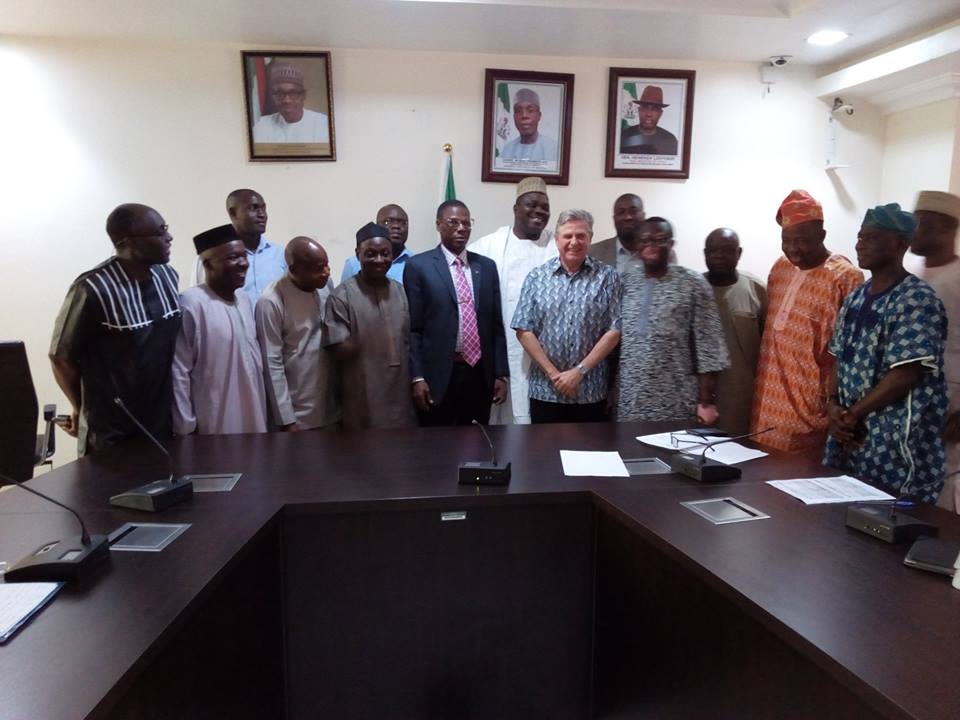
Permanent Secretary of the Ministry, Dr Bukar Hassan, during his meeting with members of the Ministerial Steering Committee on the African Soil Information Service (AFSIS) and formal launching of the AfSIS pilot project in the Ministry said he was impressed with the work AFSIS is doing to build technology innovations and services to drive the future of African Agriculture, particularly Nigeria and expressed hope that the technology would assist governments, farmers and relevant stakeholders in agriculture to pay more attention to soil development in moving the agricultural sector forward.
Represented by the Director, Plantation in the Department Of Agriculture, Mr Quadri Olalekan, he declared that, “Our farmers will no longer continue to shoot in the dark, the project is important and we will be able to maximize the duration of the project and get the best out of it.”
Earlier, the Director, Lands and Climate Change, Engr. Sunday Edibo, has explained that the AfSIS project which is being funded by the Bill and Melinda Gates Foundation is aimed at “rapidly expanding the use of world class information technology and data science to ensure that Africa’s soil and landscape resources are described, understood and used effectively to increase agricultural productivity and lower the ecological footprints of agriculture as a means of raising the prosperity of Africa’s communities and nations.”
He explained further that the African Soil Information Service project (AfSIS) is in collaboration with the Nigeria Soil Information System (NiSIS) and the Ministry to update soil and landscape information for Nigeria using modern measurement and mapping techniques.
Engineer Edibo said the area of work covered so far include; fairly detailed soil and fertilizer response survey of the central maize producing area of Nigeria; training of soil and plant laboratory for NiSIS and IITA staff in spectral methods for soil prediction; compilation and updating of relevant remote sensing data for soil and landscape mapping and spectral and spatial prediction model development to generate new soil maps and landscape information products.
He stated that the team would commence the training of staff of the ministry on soil/crop standard operating procedures (SOP) and the information gathered would be used in soil maps and assist farmers in crop production, particularly in supporting the development of grasses in ranches.
Chairman of the AfSIS-NiSIS Ministerial Steering Committee and a University don in the Department of Soil Science, Institute for Agricultural Research, Ahmadu Bello University, Zaria, Prof Ishaku Amapu, in his presentation, said the AfSIS–NiSIS pilot project on Nutrient assessment of Nigeria crop lands is starting with Kebbi and Ebonyi states with 582 locations and 208 locations respectively with focus on soil development.
Professor Amapu said the pilot project would among other things provide spatially explicit observations, measurements and predictions of nutrients level and the information would be used for ranches to provide grasses needed for healthy growth of animals.
He appealed to the Federal Government to expedite action on the complete survey of the remaining part of the country.
The AfSIS Senior Adviser, World Agro Forestry Centre (ICRAF), Nairobi, Kenya, Dr Bruce Scott, remarked that presently, the Agriculture sector is not innovative and proactive for it is not using the best technology and science available; stating that, “In human sector, there has been tremendous innovation but not so in Agriculture, because we have refused to innovate in terms of leveraging on new science and technology.”
Dr Scott who promised that AfSIS would continue to be a good partner, urged the Federal Government to transform its agriculture sector to make it more productive for farmers and the people of Nigeria.
It would be recalled that the Minister of Agriculture and Rural Development, Mr Audu Ogbeh, who was worried by dearth of relevant soil information in Nigeria inaugurated a Ministerial Steering Committee on the African Soil Information Service (AFSIS) in the Ministry last year.
Economy
Brent Crude Falls Below $80 as Middle East Peace Deal Eases Risk
By Adedapo Adesanya
The price of Brent crude fell below $80 per barrel following a 5 per cent slide for a second day in a row as details emerged of an interim deal to end the war in the Middle East and reopen the Strait of Hormuz, including an agreement to allow Iran to sell oil on Tuesday.
Brent futures lost $4.21 or 5.1 per cent yesterday to settle at $78.96 a barrel, while the US West Texas Intermediate (WTI) crude fell $4.70 or 5.8 per cent to $76.05 per barrel.
Details of the interim deal to end the war began to emerge on Tuesday, with US President Donald Trump saying it will rule out a nuclear weapon for Iran. He said the text of the deal states clearly that Iran will not have a nuclear weapon, and the full agreement would be made public in a formal setting in a few days.
Speaking at the G7 meetings in France, the American President added that he liked the idea of sending the Iran deal to Congress for review, a request by some Republican lawmakers.
According to Reuters, a senior US official said the deal allows Iran to immediately begin selling oil and fuel, and included banking, transportation and insurance services to facilitate the sales. The official added the agreement has conditions.
The deal would extend a tenuous ceasefire announced in April by another 60 days and reopen the Strait of Hormuz, which Iran has effectively blocked since the US and Israel first attacked Iran.
Under the agreement, Iran will be allowed to immediately resume oil and fuel sales, according to the Wall Street Journal, along with the banking, insurance, and shipping services needed to move those cargoes. The deal effectively reconnects one of the world’s largest oil producers to global energy markets overnight.
The market is also betting that traffic through Hormuz will normalise, easing fears over a chokepoint that normally handles roughly a fifth of global oil flows.
The speed of the decline highlights just how much of crude’s rally had become tied to geopolitical risk.
Other factors weighing on oil prices included worries about China’s economy, rising global inflation and interest rates, and US calls for peace between Russia and Ukraine.
The American Petroleum Institute (API) estimated that crude oil inventories in the United States fell by 8.33 million barrels in the week ending June 12. Official data from the US Energy Information Administration (EIA) will be released later on Wednesday.
Economy
Nigeria’s Petrol Import Bill Plunges 96% in First Quarter of 2026
By Adedapo Adesanya
Nigeria’s petrol import bill crashed further as the latest foreign trade statistics by the National Bureau of Statistics (NBS) indicated that about N87.401 billion was spent on the importation of fuel between January and March 2026.
A comparative analysis showed the figure plunged by 96.2 per cent or N2.184 trillion compared with the N2.271 trillion spent on fuel imports between January and March 2025.
The NBS data revealed that fuel did not feature among the top 19 traded products with the rest of the world, Africa, or West Africa during the review period.
The biggest factor is the ramp-up of production at Dangote Petroleum Refinery, which has significantly reduced Nigeria’s dependence on imported Premium Motor Spirit (PMS). As local supplies increasingly meet domestic demand, marketers have had less need to source petrol from overseas.
According to the data, the leading traded products included crude petroleum oils and oils obtained from bituminous minerals, gas oil, durum wheat, machines for reception, conversion and transmission of data, used vehicles, motorcycles, agricultural seeders, medicaments, aircraft parts, butanes, petroleum bitumen, sugar cane, herbicides and fuel additives.
The report read, “The value of total imports stood at N13,619.33bn in the first quarter of 2026, representing an 18.17 per cent decrease from the value recorded in the corresponding quarter of 2025 (N16,644.42bn) and a 21.05 per cent decrease compared to the value recorded in Q4 2025 (N17,250.93bn).
“Analysis of Nigeria’s import trade reveals that China remained the leading source of imports in the first quarter of 2026, followed by the United States of America, India, Germany, and the United Arab Emirates.
The most imported commodities during the quarter were petroleum oils and oils obtained from bituminous minerals (crude), gas oil, durum wheat, machines for the reception, conversion, and transmission of voice, images, or data, and used vehicles with diesel or semi-diesel engines.
“The value of other oil products imported in Q1 2026 stood at N748.10bn, reflecting an 85.05 per cent decrease from N5,005.22bn in Q1 2025 and an 81.38 per cent decrease from N4,018.31bn recorded in Q4 2025.
“Nigeria spent N2.694tn on petrol imports in the first quarter of 2022. The import bill declined by N661bn, or 24.5 per cent, to N2.033tn in the corresponding period of 2023.”
Economy
Ripple Invests in Flutterwave to Accelerate African Stablecoin Payments
By Aduragbemi Omiyale
Leading provider of blockchain-based enterprise solutions, Ripple, has participated in Flutterwave’s Series E fundraising, which values the company at $3.2 billion.
Ripple’s strategic investment marks the definitive next phase of Flutterwave’s long-term stablecoin strategy, seamlessly connecting its existing cross-border settlement capabilities with enterprise-grade digital liquidity.
This will enable African businesses to bypass legacy frictions, ultimately bolstering Nigeria’s role as the primary hub for global digital asset trade and driving sustained economic resilience across the African continent.
This is because it will accelerate the adoption of digital asset infrastructure, bringing unprecedented speed, liquidity, and cost-efficiency to cross-border commerce throughout Africa.
The partnership is built on three core pillars: embedding RLUSD into Flutterwave’s payment rails and Send App remittance corridors as a primary settlement asset for high-volume channels; leveraging the XRP Ledger (XRPL) for faster transaction clearing; and deploying a unified API to seamlessly bridge Flutterwave’s domestic network with Ripple Payments, Ripple’s global payments network.
By merging traditional fiat payment methods, including local cards, mobile wallets, and bank transfers, with Ripple’s enterprise blockchain technology, the partnership eliminates the historical friction points of African cross-border payments, such as multi-day delays and inflated FX margins. Instead, businesses will experience guaranteed liquidity, predictable pricing, and real-time settlement.
By embedding RLUSD into its core ecosystem, the company is finalising a ‘stablecoin-first’ payment architecture that eliminates traditional bottlenecks. This unified approach delivers a consistent, scalable, and compliant liquidity stack that transforms how African enterprises interact with global markets, effectively cementing a new way for digital money acceptance that is both borderless and locally grounded.
Commenting on the development, the Managing Director of MEA at Ripple, Reece Merrick, said, “Flutterwave has built one of the most advanced payments networks in Africa, and as its infrastructure evolves, stablecoins are becoming central to that story.
“Our investment will establish RLUSD within that infrastructure, with Flutterwave driving stablecoin flows over the XRPL and deepening its role as a settlement layer for real-world payments across the continent.
“Together we also plan to bring Ripple Payments’ speed and efficiency to cross-border transactions in the region, opening up faster, lower-cost financial services to businesses and consumers at scale.”
On his part, the chief executive of Flutterwave, Mr Olugbenga ‘GB’ Agboola, said, “This investment marks a pivotal moment in our journey, enabling us to significantly scale our infrastructure and expand our stablecoin-enabled payments roadmap. By unlocking faster settlement and lower-cost cross-border payments, we are building a payment superhighway that connects African commerce directly to the global economy.
“This partnership is a catalyst for Nigerian and African sovereignty in the digital financial age, ensuring our markets are primary participants in the global digital asset revolution.”
With this capital and a deepened product alliance, Flutterwave will accelerate its goal to bridge traditional financial systems with next-generation digital asset infrastructure.
Building on its established scale – having raised over $500 million and processed over a billion transactions worth over $50 billion – Flutterwave is positioned to unlock massive economic potential for small-to-medium enterprises (SMEs) and global enterprises operating across Africa.
-
Feature/OPED6 years agoDavos was Different this year
-
Travel/Tourism10 years ago
Lagos Seals Western Lodge Hotel In Ikorodu
-
Showbiz3 years agoEstranged Lover Releases Videos of Empress Njamah Bathing
-
Banking8 years agoSort Codes of GTBank Branches in Nigeria
-
Economy3 years agoSubsidy Removal: CNG at N130 Per Litre Cheaper Than Petrol—IPMAN
-
Banking3 years agoSort Codes of UBA Branches in Nigeria
-
Banking3 years agoFirst Bank Announces Planned Downtime
-
Sports3 years agoHighest Paid Nigerian Footballer – How Much Do Nigerian Footballers Earn