Connect with us

Economy

European Stocks Under Pressure on US Inflation Data

Published

on

By investors Hub

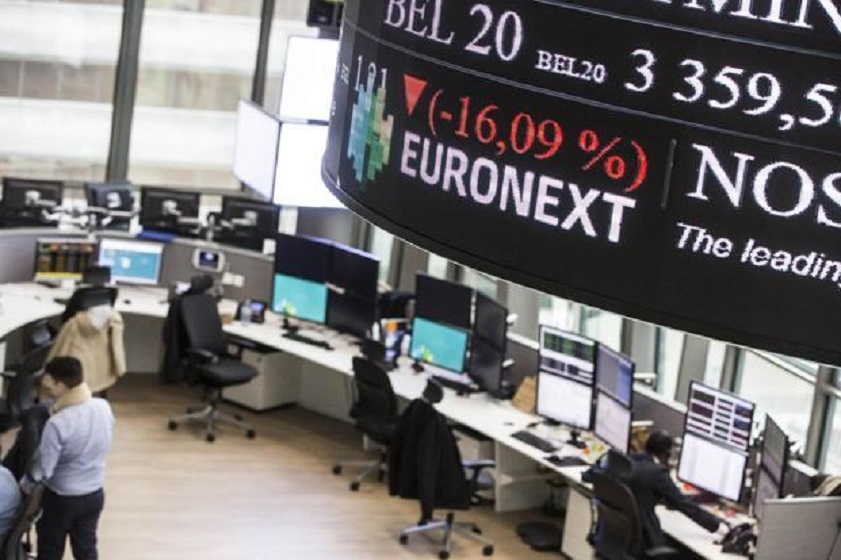
European stocks have come under pressure following the release of the U.S. inflation data after moving to the upside earlier in the session.

While the German DAX Index has fallen by 0.8 percent, the French CAC 40 Index is down by 0.5 percent and the U.K.?s FTSE 100 Index is down by 0.3 percent.

Swiss bank Credit Suisse has jumped after revealing that its fourth quarter net loss narrowed from last year.

Sky Plc and BT Group have also moved higher in London after they agreed to pay 4.464 billion pounds to secure the broadcast rights for the bulk of Premier League football games from the 2019/20 season.

Food group Danone has moved higher on news company intends to sell part of its 21.3 percent stake in Japan-listed Yakult Honsha Co.

Meanwhile, German steelmaker Thyssenkrupp has moved lower after its first quarter profits and revenue came in lower than estimated.

Galliford Try has also come under pressure on equity dilution worries after the construction group and homebuilder announced a 150 million capital raising to help cover the impact of Carillion’s liquidation.

On the data front, the euro area economy grew at a slightly slower pace in the fourth quarter, flash estimate published by Eurostat showed.

GDP climbed 0.6 percent sequentially following the third quarter’s 0.7 percent expansion. The growth came in line with the preliminary flash estimate published on January 30th.

Eurozone industrial production for December rose 0.4 percent month-on-month, beating forecasts for 0.2 percent growth.

Separate reports showed German consumer price index rose 1.6 percent year-on-year in January after a 1.7 percent increase in December, while the German economy grew 0.6 percent sequentially in the fourth quarter, in line with expectations but slightly slower than the 0.7 percent expansion in the third quarter


Modupe Gbadeyanka is a fast-rising journalist with Business Post Nigeria. Her passion for journalism is amazing. She is willing to learn more with a view to becoming one of the best pen-pushers in Nigeria. Her role models are the duo of CNN's Richard Quest and Christiane Amanpour.

Click to comment

Leave a Reply

Your email address will not be published. Required fields are marked *

Economy

Naira Weakens to N1,357/$1 at Official Market, N1,385/$1 at Black Market

Published

on

forex black market

By Adedapo Adesanya

The Naira suffered a 0.55 per cent or 91 Kobo loss against the US Dollar in the Nigerian Autonomous Foreign Exchange Market (NAFEX) on Tuesday, June 16, closing at N1,357.18 /$1 compared with the previous day’s N1,356.27/$1.

It also weakened against the Pound Sterling at the official market during the session by N11.53 to trade at N1,820.39/£1 versus Monday’s rate of N1,808.86/£1, but appreciated against the Euro by N2.06 to quote at N1,573.79/€1 versus the preceding session’s N1,575.85/€1.

In the black market, the Nigerian currency crashed against the Dollar yesterday by N5 to sell for N1,385/$1, in contrast to the N1,380/$1 it was traded a day earlier, and at the GTBank FX desk, it traded flat at N1,373/$1.

Nigeria’s gross external reserves surged to $50.505 billion, the highest international Dollar balance since January 2009, affirming expectations that the local currency will remain along a stable band. The FX reserves position was buoyed by inflows from oil sales.

In its Article IV consultation report on Nigeria, the International Monetary Fund (IMF) said that the Naira remains significantly undervalued despite recent gains from FX reforms. It noted that its Real Effective Exchange Rate (REER) assessment showed the local currency was still trading below levels supported by the country’s economic fundamentals, saying the Naira should have traded around N1,142.04/$1 using the end-of-2025 exchange rate benchmark, or N1,130.88/$1 when calculated using the average exchange rate for the year.

As for the cryptocurrency market, prices showed renewed risk appetite as total 24-hour trading volume jumped 51 per cent to $207 billion, open interest rose 2.4 per cent to $113.41 billion, and liquidations surged 64 per cent to $561 million, with shorts accounting for the bulk of the forced exits, according to Coindesk data.

Cardano (ADA) slid 2.7 per cent to $0.1731, Binance Coin (BNB) slumped 1.6 per cent to $605.80, Ripple (XRP) declined by 1.5 per cent to $1.22, Bitcoin (BTC) fell 0.8 per cent to $65,739.70, Dogecoin (DOGE) also tumbled by 0.6 per cent to $0.0873, and TRON (TRX) depreciated by 0.6 per cent to $0.3166.

However, Ethereum (ETH) grew by 0.5 per cent to $1,795.40, and Solana (SOL) rose by 0.2 per cent to $73.81, while the US Dollar Tether (USDT) and the US Dollar Coin (USDC) remained unchanged at $1.00 apiece.

Continue Reading

Economy

Brent Crude Falls Below $80 as Middle East Peace Deal Eases Risk

Published

on

brent crude oil

By Adedapo Adesanya

The price of Brent crude fell below $80 per barrel following a 5 per cent slide for a second day in a row as details emerged of an interim deal to end the war in the Middle East and reopen the Strait of Hormuz, including an ‌agreement to allow Iran to sell oil on Tuesday.

Brent futures lost $4.21 or 5.1 per cent yesterday to settle at $78.96 a barrel, while the US West Texas Intermediate (WTI) crude fell $4.70 or 5.8 per cent to $76.05 per barrel.

Details of the interim deal to end the war began to emerge on Tuesday, with US President ⁠Donald Trump saying it will rule out a nuclear weapon for Iran. He said the text of the deal states clearly that Iran will not have a nuclear weapon, and the full agreement would be made public in a formal setting in a few days.

Speaking at the G7 meetings in France, the American President added that he liked the idea of sending the Iran deal to Congress for review, a request by some Republican lawmakers.

According to Reuters, a senior US official said the deal allows Iran to immediately begin selling oil ​and fuel, and included banking, transportation and insurance services to facilitate the sales. The official added the agreement has conditions.

The deal would extend a ​tenuous ceasefire announced in April by another 60 days and reopen the Strait of Hormuz, which Iran has effectively blocked since the US and Israel first attacked Iran.

Under the agreement, Iran will be allowed to immediately resume oil and fuel sales, according to the Wall Street Journal, along with the banking, insurance, and shipping services needed to move those cargoes. The deal effectively reconnects one of the world’s largest oil producers to global energy markets overnight.

The market is also betting that traffic through Hormuz will normalise, easing fears over a chokepoint that normally handles roughly a fifth of global oil flows.

The speed of the decline highlights just how much of crude’s rally had become tied to geopolitical risk.

Other factors weighing on oil prices included worries about China’s economy, rising global inflation and interest rates, and ‌US calls for ⁠peace between Russia and Ukraine.

The American Petroleum Institute (API) estimated that crude oil inventories in the United States fell by 8.33 million barrels in the week ending June 12. Official data from the US Energy Information Administration (EIA) will be released later on Wednesday.

Continue Reading

Economy

Nigeria’s Petrol Import Bill Plunges 96% in First Quarter of 2026

Published

on

Petrol Import Bill

By Adedapo Adesanya

Nigeria’s petrol import bill crashed further as the latest foreign trade statistics by the National Bureau of Statistics (NBS) indicated that about N87.401 billion was spent on the importation of fuel between January and March 2026.

A comparative analysis showed the figure plunged by 96.2 per cent or N2.184 trillion compared with the N2.271 trillion spent on fuel imports between January and March 2025.

The NBS data revealed that fuel did not feature among the top 19 traded products with the rest of the world, Africa, or West Africa during the review period.

The biggest factor is the ramp-up of production at Dangote Petroleum Refinery, which has significantly reduced Nigeria’s dependence on imported Premium Motor Spirit (PMS). As local supplies increasingly meet domestic demand, marketers have had less need to source petrol from overseas.

According to the data, the leading traded products included crude petroleum oils and oils obtained from bituminous minerals, gas oil, durum wheat, machines for reception, conversion and transmission of data, used vehicles, motorcycles, agricultural seeders, medicaments, aircraft parts, butanes, petroleum bitumen, sugar cane, herbicides and fuel additives.

The report read, “The value of total imports stood at N13,619.33bn in the first quarter of 2026, representing an 18.17 per cent decrease from the value recorded in the corresponding quarter of 2025 (N16,644.42bn) and a 21.05 per cent decrease compared to the value recorded in Q4 2025 (N17,250.93bn).

“Analysis of Nigeria’s import trade reveals that China remained the leading source of imports in the first quarter of 2026, followed by the United States of America, India, Germany, and the United Arab Emirates.

The most imported commodities during the quarter were petroleum oils and oils obtained from bituminous minerals (crude), gas oil, durum wheat, machines for the reception, conversion, and transmission of voice, images, or data, and used vehicles with diesel or semi-diesel engines.

“The value of other oil products imported in Q1 2026 stood at N748.10bn, reflecting an 85.05 per cent decrease from N5,005.22bn in Q1 2025 and an 81.38 per cent decrease from N4,018.31bn recorded in Q4 2025.

“Nigeria spent N2.694tn on petrol imports in the first quarter of 2022. The import bill declined by N661bn, or 24.5 per cent, to N2.033tn in the corresponding period of 2023.”

Continue Reading

Trending