Connect with us

Banking

Coronation Merchant Bank Grows Gross Earnings 66% in 2017

Published

on

Coronation Merchant Bank Group

By Dipo Olowookere

Nigeria’s leading merchant banking brand, Coronation Merchant Bank Limited, has announced its 2017 full year results, posting a 66 percent increase in its gross earnings.

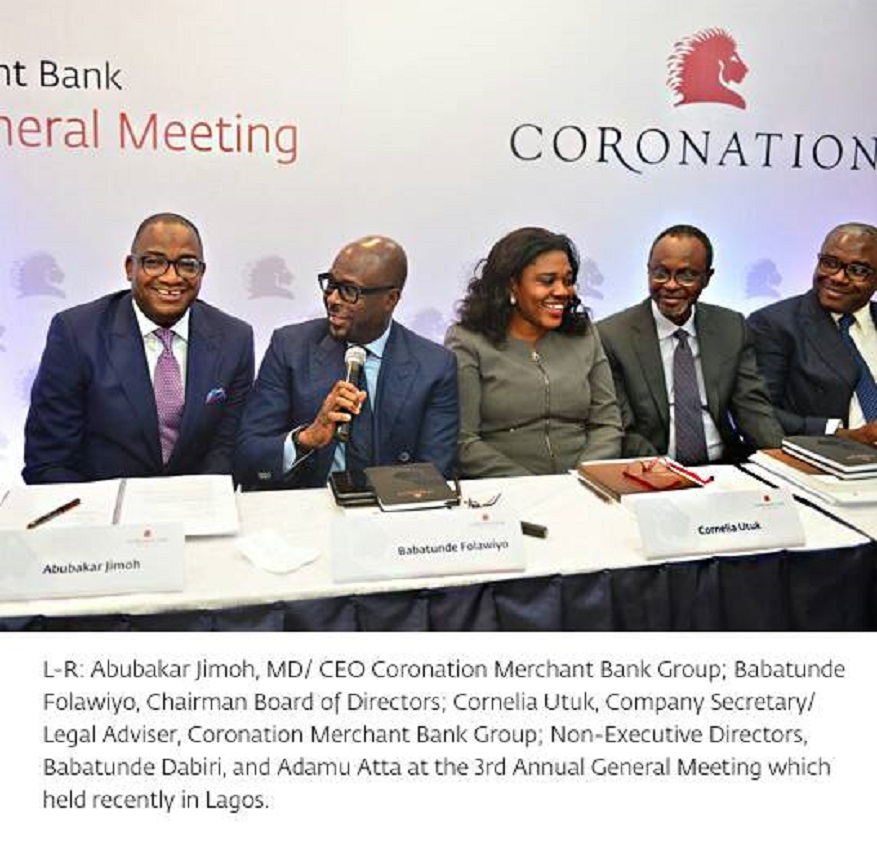
Presenting the financial documents to its stakeholders at the Annual General Meeting (AGM) held in Lagos, chief executive of the lender, Mr Abu Jimoh, said the firm achieved a Profit Before Tax of N5.1 billion.

According to him, “Despite the tough market conditions that characterized significant parts of the year, the underlying business fundamentals of the bank remained strong as reflected in the gross earnings growth of 66 percent to N25.5 billion in 2017.

“As we progress in our journey to become Africa’s premier investment bank, we remain committed to providing our clients with superior financial services whilst generating attractive and sustainable returns for shareholders.”

Mr Jimoh further said, “The impressive results of the bank in the last three years demonstrate the effectiveness of our strategy, the quality of our past decisions and the commitment of our board and management to maximize shareholder value whilst actively expanding our franchise in select, high growth markets where we believe we have a competitive advantage.”

He said Coronation MB Group recorded a notable improvement in key performance metrics in 2017, despite the tough and challenging operating environment.

“Our interest income growth of 67 percent y/y and non-interest income growth of 57 percent in 2017 re-affirm the sustainability of our core business growth.

“We will continue to gain momentum in our efforts to achieve more diversified earnings, as we strengthen our subsidiaries offerings.

“Our deliberate focus on the efficiency of our business operations has continued to yield considerable returns for the bank.

“Despite the high inflation rate, cost-to-income ratio increased marginally by 90bps to 46.1 percent (Dec 2016: 45.2 percent), reaffirming the bank’s commitment to rein in costs while improving operating efficiency,” the bank chief noted.

Mr Jimoh said aside from the strong earnings performance, the group recorded a significant growth in its Balance Sheet in 2017.

Total assets increased by 28 percent to N136.7 billion from N106.6 billion in December 2016, and shareholder’s funds increased to N29.5 billion from N25.9 billion – a valid testament to the resilience of the group’s operations and its adaptability to current market realities and challenges.

But Mr Jimoh assured that, “We will continue to maintain a disciplined and prudent approach in asset creation in line with our overall risk management framework and evidenced in our growth in loan book of 42 percent which increased from N22.7 billion to N32.3 billion with zero NPL.”

He said, “While general economic conditions and the regulatory environment remain tight, we believe that our new business and lending strategies, embedded risk management culture and continuous cost savings will enable us to stand firm throughout this period.”

Mr Jimoh told stakeholders that, “In the coming years, we will focus on the disciplined implementation of our growth strategy to drive efficiency in all segments of our business leveraging fintech and process re-engineering.”

Coronation Merchant Bank group was established to fill the gap in a long-underserved market segment, seeking to address the need for long-term capital across key sectors of the economy, and has two branches located in Abuja and Port Harcourt with its Head Office in Lagos, Nigeria.

The Group offers investment and corporate banking, private banking/wealth management and global markets/treasury services to its diverse clients.

It also offers securities trading/brokerage, asset management and trustees services via its subsidiaries; Coronation Securities Limited, Coronation Asset Management Limited respectively.


Dipo Olowookere is a journalist based in Nigeria that has passion for reporting business news stories. At his leisure time, he watches football and supports 3SC of Ibadan. Mr Olowookere can be reached via [email protected]

Advertisement
1 Comment

Leave a Reply

Your email address will not be published. Required fields are marked *

Banking

Sterling Bank, AltBank Meet Full Recapitalisation After N153bn Injection

Published

on

sterling bank logo

By Modupe Gbadeyanka

The banking subsidiaries of Sterling Financial Holdings Company Plc, Sterling Bank and The Alternative Bank (AltBank), have met the full recapitalisation requirements of the Central Bank of Nigeria (CBN).

The chief executive of Sterling Holdings, Mr Yemi Odubiyi, said the recapitalisation strengthens the group’s ability to support economic activity while maintaining financial resilience.

“This exercise goes beyond regulatory compliance. It positions us to expand credit responsibly, accelerate innovation, and provide sustained support to businesses and households, while maintaining the discipline required in a challenging operating environment,” he said.

Mr Odubiyi noted that fully capitalising both Sterling Bank and The Alternative Bank reinforces the organisation’s dual-bank structure and its ability to serve conventional and non-interest segments.

“Our structure enables efficient deployment of capital across complementary markets and positions us to respond with agility to evolving customer needs,” he said, adding that strong investor participation across the capital programmes reflects confidence in the group’s governance and long-term strategy.

He further pointed out that the strengthened balance sheet provides a platform for the company’s next phase of growth.

“We are entering this phase from a position of significant financial strength, with the capacity to scale non-banking businesses, deepen digital capabilities, and pursue disciplined expansion opportunities while delivering sustainable value for shareholders,” Mr Odubiyi said.

Sterling Holdings achieved this feat after raising fresh capital between December 2024 and October 2025, positioning itself well ahead of the 2026 industry deadline.

In December 2024, it completed a N75 billion private placement, raising N73.86 billion in net proceeds. Of this amount, N68.8 billion was allocated to Sterling Bank and N5 billion to The Alternative Bank, strengthening the capital base of both institutions.

This was followed by a N28.79 billion rights issue, which was oversubscribed by N10.29 billion. Regulatory approvals in May 2025 enabled the allotment of N26.639 billion under the rights issue, with the oversubscription restructured into a private placement, enabling AltBank to meet the capital requirement for non-interest banks with national licences.

Sterling HoldCo further strengthened its capital position through an N88 billion public offer in October 2025, which recorded an oversubscription. The CBN has cleared the full amount of N96.69 billion for recognition as additional capital, while the Securities and Exchange Commission (SEC) approved the allotment of 13,812,239,000 shares.

In total, the group injected N153 billion into Sterling Bank and The Alternative Bank, bringing both institutions into full compliance with the revised capital requirements.

Continue Reading

Banking

SERAP Sues CBN Over Alleged Missing N3trn

Published

on

SERAP

By Adedapo Adesanya

The Socio-Economic Rights and Accountability Project (SERAP) has filed a lawsuit against the Central Bank of Nigeria (CBN) for failing to account for N3 trillion in public funds, alleged to be missing or diverted.

The lawsuit followed the grave allegations contained in the latest annual report by the Auditor-General of the Federation, published on September 9, 2025. It includes over N629 billion paid to ‘unknown beneficiaries’ as part of the Anchor Borrowers’ Programme.

In the suit number FHC/ABJ/CS/250/2026 filed last week at the Federal High Court in Abuja, SERAP is seeking: “an order of mandamus to direct and compel the CBN to account for and explain the whereabouts of the missing or diverted N3 trillion of public funds, including detailed reports of how exactly the funds were spent.”

In the suit, SERAP argued that, “These grim allegations by the Auditor-General suggest grave violations of the public trust, the provisions of the Nigerian Constitution 1999 [as amended], the CBN Act, and anticorruption standards.”

SERAP is arguing that, “These grave violations also reflect a failure of CBN accountability more generally and are directly linked to the institution’s persistent failure to comply with its Act and to uphold the principles of transparency and accountability.”

According to SERAP, “These violations have seriously undermined the ability of the CBN to effectively discharge its statutory functions and the public trust and confidence in the bank. The CBN ought to be committed to transparency and accountability in its operations.”

SERAP is also arguing that, “Nigerians have the right to know the whereabouts of the missing or diverted public funds. Granting the reliefs sought would advance the right of Nigerians to restitution, compensation and guarantee of non-repetition.”

The suit filed on behalf of SERAP by its lawyers: Ms Oluwakemi Agunbiade and Ms Valentina Adegoke, read in part: “According to the Auditor-General, the CBN in 2022 failed to remit over N1 trillion [N1,445,593,400,000.00] of ‘the Federal Government’s portion of operating surplus’ into the Consolidated Revenue Fund (CRF) account.”

“The Auditor-General fears that the money may have been ‘diverted.’ He wants the money recovered and remitted to the treasury.”

“The CBN also failed to recover over N629 billion [N629,040,000,000.00] paid to ‘unknown beneficiaries’ as part of the Anchor Borrowers’ Programme, a programme ‘meant to support farmers to ensure sustainable food production in the country,’” it said.

SERAP noted that the Auditor-General raised serious concerns over financial management at the apex bank, citing unaccounted intervention funds and unrecovered loans running into hundreds of billions of naira.

The report noted that the number of beneficiaries who collected certain disbursed funds remains unknown and that efforts to recover the money have been inadequate. Over N784.4 billion in unpaid and overdue loans issued between 2018 and May 2022 remain outstanding, with fears that diversion of funds may have worsened food security challenges. The Auditor-General has called for full recovery and remittance of the funds to the treasury.

The report also questions over N125.37 billion spent by the CBN in 2022 on intervention activities allegedly linked to national security, federal and state government engagements, and financial sector capacity building. According to the Auditor-General, there was no documentary evidence to support the expenditure, nor proof of approval by the National Assembly. He warned that the spending may not align with Section 2 of the CBN Act and could have been diverted, again urging that the funds be recovered and paid into the treasury.

Further scrutiny revealed that the CBN “unjustifiably” spent N1.79 billion on 43 operational vehicles for the Nigeria Immigration Service, despite no clear connection to the Bank’s statutory mandate and no evidence of delivery or procurement documentation. Additionally, 43 contracts worth over N189.5 billion allegedly suffered deliberate delays, leading to irregular contract variations of over N9.27 billion without proper records. The Katsina branch of the CBN also failed to recover over N90 million in COVID-19 intervention loans to SMEs.

In each case, SERAP noted that the Auditor-General expressed concern that the funds may have been diverted or mismanaged and demanded recovery and remittance to the treasury.

Continue Reading

Banking

We Now Pay Depositors of Failed Bank Within Days—NDIC

Published

on

NDIC

By Adedapo Adesanya

The Nigeria Deposit Insurance Corporation (NDIC) says depositors of failed banks in Nigeria can now access their insured funds within days.

The corporation said the development is a part of ongoing reforms aimed at strengthening confidence in the country’s financial system.

The chief executive of NDIC, Mr Thompson Sunday, disclosed this on Thursday at the NDIC Special Day of the 47th Kaduna International Trade Fair, noting that recent interventions had significantly improved the speed and efficiency of depositor compensation.

Represented by Mrs Regina Dimlong, the Assistant Director of Communications and Public Affairs, Mr Sunday said the corporation had successfully deployed the Bank Verification Number (BVN) system to facilitate prompt payments to customers of recently failed banks, including Heritage Bank Limited, Union Homes Plc and Aso Savings and Loans Plc.

“Depositors were paid within days of closure without the need to fill physical forms or visit NDIC offices.

“This is a part of our reform efforts to make depositor protection faster, simpler and more transparent,” he said.

According to him, the reforms were designed to restore public confidence in the banking system and prevent panic withdrawals, especially during periods of financial stress.

Mr Sunday explained that NDIC’s mandate spans deposit insurance, bank supervision, distress resolution and liquidation of failed banks, adding that the Corporation works closely with the Central Bank of Nigeria (CBN) to ensure early detection of risks in insured institutions.

He disclosed that in 2024, NDIC reviewed its deposit insurance framework, increasing coverage for depositors of Deposit Money Banks, Mobile Money Operators and Non-Interest Banks to N5 million, while customers of Microfinance Banks, Primary Mortgage Banks and Payment Service Banks are now covered up to N2 million.

He noted that the revised thresholds now guarantee full protection for about 99 per cent of depositors nationwide, particularly small savers and low-income earners.

The NDIC boss urged Nigerians to ensure their BVNs are properly linked to their bank accounts, stressing that this had become the primary channel for accessing insured deposits in the event of bank failure.

Continue Reading

Trending