Economy
Asian Shares Fall as Trade War Fears Resurface
By Investors Hub
Asian stocks fell on Thursday as trade war fears resurfaced and the U.S. Federal Reserve sounded slightly more hawkish after raising interest rates for the second time this year.
Investors also adopted a cautious stance ahead of the European Central Bank’s monetary policy announcement later in the day amid expectations the central bank will signal a winding down of its vast bond-buying program by the end of this year.
China’s Shanghai Composite Index dipped 5.33 points or 0.2 percent to 3,044.46 after reports suggested the Trump administration is preparing to proceed with tariffs on Chinese goods.
Hong Kong’s Hang Seng Index fell 284.98 points or 0.9 percent to close at 30,440.17 after a slew of economic data from China disappointed investors.
Industrial production in China was up an annual 6.8 percent in May, the National Bureau of Statistics said. That was shy of expectations for 7.0 percent, which would have been unchanged from April.
Chinese retail sales grew an annual 8.5 percent in May – also missing expectations for 9.6 percent and down from 9.4 percent in the previous month.
Fixed asset investment gained 6.1 percent year-on-year, missing forecasts for 7.0 percent, which would have been unchanged from the April reading.
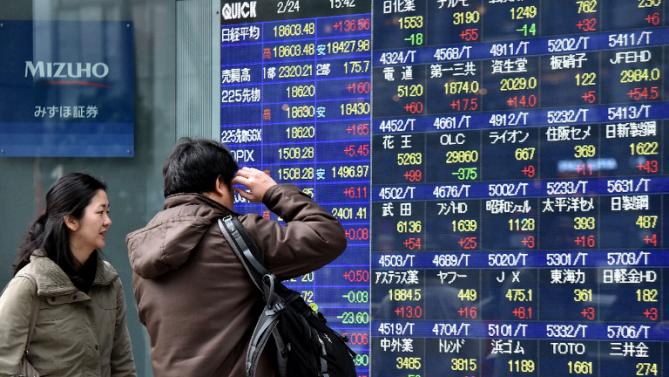
Japanese shares lost ground as a firmer yen on worries about global trade and a faster pace of interest rate hikes sapped investors’ appetite for risk.
The Nikkei 225 Index slumped 227.77 points or 1 percent to 22,738.61, while the broader Topix Index closed 0.9 percent lower at 1,783.89.
Toyota shed 0.9 percent after saying it will invest $1 billion in Asia ride-sharing company Grab. Honda Motor, Nissan, Panasonic and Sony declined 1-2 percent. Toshiba jumped 2.7 percent after announcing a share buyback.
Japanese industrial production climbed 0.5 percent month-over-month in April, faster than the 0.3 percent estimated earlier, final data from the Ministry of Economy, Trade and Industry showed. This marked the third successive monthly increase.
Australian shares fluctuated before closing slightly lower, dragged down by banks. The benchmark S&P/ASX 200 Index edged down 6.90 points or 0.1 percent to 6,016.60, while the broader All Ordinaries Index ended little changed with a negative bias.
The big four banks fell between half a percent and 1.1 percent ahead of ECB and BoJ meetings. Atlas Iron slumped 18.2 percent after the government said it doesn’t have priority rights to develop certain ship berths in Port Hedland.
Material stocks bucked the downward trend, with heavyweights BHP Billiton and Rio Tinto rising 0.4 percent and 0.6 percent, respectively.
Gold miner Newcrest advanced 1 percent to snap a four-session losing streak. Telstra Corp, Australia’s largest telecom company, jumped over 5 percent after an upgrade from J.P. Morgan.
DroneShield’s shares climbed almost 14 percent after the drone security firm won its biggest ever order for DroneGuns from an unspecified Middle Eastern country.
The unemployment rate in Australia came in at a seasonally adjusted 5.4 percent in May, a tad below expectations for 5.5 percent and down from 5.6 percent in April. The economy added 12,000 jobs last month, shy of expectations for 19,000 after an addition of 22,600 a month earlier.
Economy
Nigeria’s Pension Fund Assets Jump 22% to N27.45trn in 2025
By Adedapo Adesanya
Nigeria’s pension fund assets surged by 22 per cent or N4.94 trillion to N27.45 trillion in 2025 from N22.51 trillion in 2024, according to the latest data from the National Pension Commission (PenCom).
The year-on-year growth underscores the resilience of the Contributory Pension Scheme (CPS), supported by steady employer and employee contributions, improved compliance and stronger investment returns across fixed income and equities.
The achievement capped a year of uninterrupted monthly expansion, reinforcing the sector’s role as one of Nigeria’s most stable pools of long-term domestic capital, despite a challenging macroeconomic environment, an industry analyst said.
Pension assets rose progressively from N22.86 trillion in January 2025 to N23.26 trillion in February and N23.38 trillion in March. By mid-year, assets had climbed to N24.62 trillion, before accelerating in the second half to N25.89 trillion in August, N26.66 trillion in October, N27.05 trillion in November and ultimately N27.45 trillion in December.
On a year-on-year basis, the industry expanded significantly. Total pension assets stood at N22.51 trillion in December 2024. The increase of N4.94 trillion over 12 months translates to approximately 22 per cent growth, reflecting both fresh contributions and investment returns.
The 12-month growth and broader annual expansion are driven by three primary factors: sustained pension contributions, investment income across asset classes, and the expansion of RSA funds.
Mandatory employer and employee contributions under the CPS continued to provide steady inflows, supported by improved compliance among corporate employers, and the expansion of coverage contributed to the accumulation of assets throughout the year.
PFAs benefited from improved yields in fixed income markets and positive performance in domestic equities during parts of the year. Both realised and unrealised gains contributed to the increase in assets under management, while the bulk of the growth came from Retirement Savings Account (RSA) Funds, particularly Funds II and III, which account for the largest share of contributors.
RSA Fund II, the default fund for active contributors below 50 years, grew from N9.24 trillion in December 2024 to N11.52 trillion in December 2025, an increase of N2.28 trillion.
RSA Fund III rose by about N1.10 trillion to N7.02 trillion, while RSA Fund IV, designed for retirees, also recorded significant growth, adding roughly N630 billion during the year.
These three funds collectively represent the core of pension savings within the system and were instrumental in driving the overall asset expansion.
A review of portfolio composition shows that federal government securities remained the dominant investment class, accounting for the largest share of pension assets. Holdings in FGN bonds and treasury bills continued to provide stability and predictable returns.
Corporate debt securities and money market instruments also contributed meaningfully, offering attractive yields amid tight monetary conditions. Meanwhile, domestic equities supported asset growth during market rallies, helping diversify returns.
The balanced allocation across fixed income, equities and other instruments helped cushion portfolios against volatility while sustaining steady growth in total assets.
With assets at N27.45 trillion, the sector continues to deepen its role in long-term domestic capital formation.
Economy
NASD OTC Exchange Drops 0.92%
By Adedapo Adesanya
There was a 0.92 per cent correction at the NASD Over-the-Counter (OTC) Securities Exchange on Tuesday, February 17, pushed by declines in the share prices of 11 Plc and Central Securities Clearing System (CSCS) Plc.
11 Plc lost N28.80 during the session to trade at N263.00 per share compared with the previous day’s N291.80 per share, and CSCS Plc weakened by N4.84 to N75.25 per unit from N80.09 per unit.
Consequently, the NASD Unlisted Security Index (NSI) slid by 36.87 points to 3,964.55 points from 4,001.42 points, and the market capitalisation lost N22.06 billion to end N2.372 trillion compared with Monday’s value of N2.394 trillion.
Business Post reports that there were five price gainers yesterday, which could not lift the market.
They were led by FrieslandCampina Wamco Nigeria Plc, which appreciated by N5.89 to N77.24 per share from N71.35 per share, First Trust Mortgage Bank Plc grew by 8 Kobo to 90 Kobo per unit from 82 Kobo per unit, Geo-Fluids Plc increased by 8 Kobo to N3.58 per share from N3.50 per share, Lagos Building Investment Company (LBIC) Plc gained 7 Kobo to close at N3.48 per unit versus N3.41 per unit, and Acorn Petroleum Plc added 2 Kobo to sell at N1.33 per share compared with the previous day’s N1.31 per share.
During the session, the volume of transactions slid 91.0 per cent to 4.2 million units from 46.2 million units, the value of trades declined 88.4 per cent to N61.9 million from N532.8 million, and the number of deals shrank 2.3 per cent to 43 deals from 44 deals.
CSCS Plc remained the most active stock by value (year-to-date) with 31.9 million units exchanged for N1.9 billion, trailed by Resourcery Plc with 1.05 billion units worth N408.6 million, and Geo-Fluids Plc with 71.8 million units valued at N299.1 million.
The most traded stock by volume (year-to-date) remained Resourcery Plc with 1.05 billion units sold for N408.6 million, followed by Geo-Fluids Plc with 71.8 million transacted for N299.1 million, and CSCS Plc with 31.9 million units traded for N1.9 billion.
Economy
Nigerian Stocks Give up 0.47% to Profit-taking
By Dipo Olowookere
The Nigerian Exchange (NGX) Limited suffered a 0.47 per cent decline on Tuesday a day after hitting all-time highs in its key performance barometers.
This was influenced by profit-taking in Nigerian stocks, as investors cashed out from the gains recorded in the past trading sessions.
According to data, the All-Share Index (ASI) was down by 899.50 points during the session to 189,362.94 points from the preceding session’s 190,262.44 points, and the market capitalisation decreased by N577 billion to N121.553 trillion from the N122.130 trillion achieved a day earlier.
Business Post reports that the sell-offs were intense yesterday as four of the sectors tracked ended in the red.
The consumer goods space improved by 2.54 per cent, but this was not enough to save Customs Street from crumbling when market activity ended at 2:30 pm.
The banking index was down by 3.69 per cent, the insurance space tumbled by 0.57 per cent, the industrial goods counter depleted by 0.50 per cent, and the energy sector dipped 0.06 per cent.
Despite the loss, the market breadth index remained positive after the bourse closed with 44 price gainers and 40 price losers, implying strong investor sentiment.
The trio of Mecure, SAHCO, and Zenith Bank gave up 10.00 per cent each to trade at N93.60, N117.00, and N80.55 apiece, while RT Briscoe depreciated by 9.95 per cent to N14.12, and Tripple G crashed by 9.77 per cent to N6.00.
Conversely, ABC Transport zoomed off by 9.94 per cent to N9.07, Zichis jumped 9.93 per cent to N13.06, Red Star Express appreciated by 9.87 per cent to N29.50, Meyer grew by 9.81 per cent to N22.95, and Japaul increased by 9.78 per cent to N3.03.
As for the activity chart, investors traded 1.2 billion stocks worth N60.2 billion in 86,607 deals compared with the 1.1 billion stocks valued at N64.0 billion transacted in 64,821 deals on Monday, representing a fall in the trading value by 5.94 per cent, and a surge in the trading volume and number of deals by 9.09 per cent and 33.61 per cent apiece.
Access Holdings ended the session as the busiest equity after the sale of 103.5 million units for N2.7 billion, Zenith Bank traded 93.1 million units valued at N8.0 billion, Japaul transacted 73.8 million units for N223.6 million, First Holdco exchanged 54.3 million units worth N2.6 billion, and Secure Electronic Technology sold 45.9 million units valued at N83.3 million.
-
Feature/OPED6 years agoDavos was Different this year
-
Travel/Tourism10 years ago
Lagos Seals Western Lodge Hotel In Ikorodu
-
Showbiz3 years agoEstranged Lover Releases Videos of Empress Njamah Bathing
-
Banking8 years agoSort Codes of GTBank Branches in Nigeria
-
Economy3 years agoSubsidy Removal: CNG at N130 Per Litre Cheaper Than Petrol—IPMAN
-
Banking3 years agoSort Codes of UBA Branches in Nigeria
-
Banking3 years agoFirst Bank Announces Planned Downtime
-
Sports3 years agoHighest Paid Nigerian Footballer – How Much Do Nigerian Footballers Earn