Economy
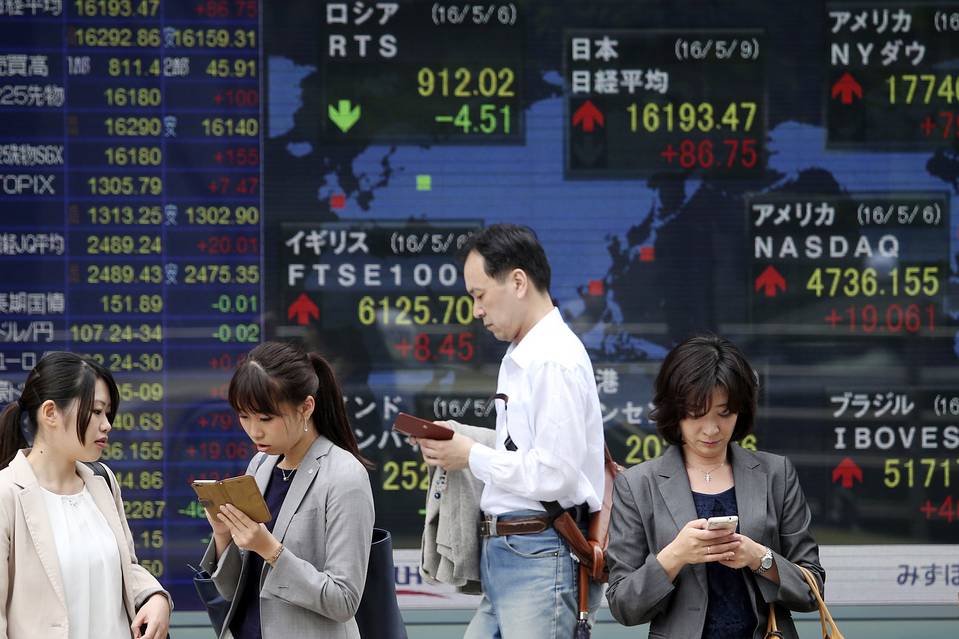
Asian Stocks Fall on Disappointing Data from China, Japan
By Investors Hub
Asian stocks tumbled on Monday as weaker than expected U.S. jobs data for November as well as disappointing data from China and Japan raised fresh concerns over global growth.
Brexit-related uncertainty and rising tensions between the U.S. and China over the detention of tech company Huawei’s CFO Meng Wanzhou also dented investor sentiment.
Chinese shares fell as data on trade pointed to slower global demand. The benchmark Shanghai Composite Index dropped 21.31 points or 0.8 percent to 2,584.58, while Hong Kong’s Hang Seng Index ended down 311.38 points or 1.2 percent at 25,752.38.
China’s exports rose 5.4 percent in November from a year earlier, customs data showed on Saturday, marking the weakest performance since a 3 percent contraction in March. Import growth stood at 3 percent, the slowest since October 2016.
Separately, Chinese consumer inflation and producer price inflation eased in November, giving policymakers more room to loosen fiscal and monetary policies.
Japanese shares hit a six-week low on worries over fresh U.S.-China trade tensions after White House trade adviser Peter Navarro said the Trump administration would raise tariff rates on China if the two countries fail to resolve their issues during the 90-day truce period.
Data showing that the Japanese economy contracted the most in over four years in the third quarter also added to investor worries over slowing global growth. GDP shrank at an annualized rate of 2.5 percent in July-September, worse than an initial estimate of a 1.2 percent contraction, revised data showed.
The Nikkei 225 Index tumbled 459.18 points or 2.1 percent to close at 21,219.50, the lowest level since October 29th. The broader Topix index closed 1.9 percent lower at 1,589.81.
Machinery firms fell on concerns over Chinese demand. Fanuc dropped 1.9 percent, Hitachi Construction Machinery declined 4.1 percent and Komatsu slumped 5.2 percent.
Nissan Motor lost 2.9 percent after Tokyo prosecutors indicted the automaker along with its ousted Chairman Carlos Ghosn. Market heavyweight Fast Retailing shed 2.4 percent.
Japan Display plummeted 10.6 percent on a Nikkei report that it is cutting production of liquid crystal display panels for the iPhone XR.
Pioneer Corp plummeted 27.3 percent on news that private equity firm Baring Private Equity will buy the cash-strapped electronics firm for $900 million.
Australian markets hit two-year lows amid renewed worries about slowing global growth and U.S.-China trade tensions.
The benchmark S&P/ASX 200 Index plunged 129.00 points or 2.3 percent to 5,552.50, while the broader All Ordinaries Index slumped 130.40 points or 2.3 percent to 5,627.50.
The big four banks lost 3-4 percent, while mining heavyweights BHP and Rio Tinto ended mixed. Engineering service provider WorleyParsons plummeted 4.7 percent.
Meanwhile, Oil Search gained 0.6 percent and Santos advanced 1.4 percent as oil extended gains from Friday.
Gold miner Evolution rallied 2.5 percent and Newcrest Mining advanced 1.6 percent after gold prices rose to a nearly five-month high on Friday.
Economy
CSCS, FrieslandCampina Lead OTC Exchange’s 2.08% Leap
By Adedapo Adesanya
Market bellwethers, Central Securities Clearing System (CSCS) Plc and FrieslandCampina Wamco Nigeria Plc, lifted the NASD Over-the-Counter (OTC) Securities Exchange by 2.08 per cent on Monday, August 3.
CSCS Plc, the Nigerian securities depository company, gained N10.00 to close at N112.00 per share compared with the previous session’s N102.00 per share, and FrieslandCampina Wamco Nigeria Plc advanced by N4.71 to quote at N152.64 per unit versus last Friday’s N147.93 per unit.
As a result, the NASD Security Index (NSI) added 92.14 points to finish at 4,523.85 points compared with the preceding session’s 4,431.71 points, and the market capitalisation appreciated by N55.31 billion to N2.715 trillion from N2.659 trillion.
Business Post reports that the price of MRS Oil Plc crashed during the trading day by N12.00 to N120.00 per share from N132.00 per share, and UBN Property Plc dipped by 3 Kobo to N1.90 per unit from N1.93 per unit.
Trading data showed that the volume of securities exchanged rose by 113.1 per cent to 1.5 million units from 690,990 units, and the number of deals climbed by 19.2 per cent to 31 deals from 26 deals, while the value of securities slid by 13.1 per cent to N65.2 million from N75.0 million.
Great Nigeria Insurance (GNI) Plc remained the most traded stock by value on a year-to-date basis, with 3.4 billion units valued at N8.4 billion, followed by Infrastructure Credit Guarantee (Infracredit) Plc with 2.3 billion units sold for N6.5 billion, and CSCS Plc with 76.8 million units traded for N5.5 billion.
GNI Plc also closed the session as the most traded stock by volume on a year-to-date basis, with 3.4 billion units worth N8.4 billion, followed by Infracredit Plc with 2.3 billion units exchanged for N6.5 billion, and Resourcery Plc with 1.1 billion units transacted for N415.7 million.
Economy
Nigeria Introduces 1.5% Stamp Duty on Bitcoin, Crypto Transactions
By Adedapo Adesanya
The Nigeria Revenue Service (NRS) has introduced a 1.5 per cent stamp duty on eligible virtual asset transactions, with the tax deducted directly from the cryptocurrency purchased before it is credited to the buyer’s wallet.
According to the new guidelines issued on Monday, anyone buying Bitcoin (BTC), USDT or other cryptocurrencies in Nigeria will receive fewer digital assets due to the deduction.
This requires registered crypto exchanges and other Virtual Asset Service Providers (VASPs) to withhold the levy in the digital asset being traded and remit it to the government, marking Nigeria’s most comprehensive move yet to bring cryptocurrency transactions into the country’s tax net.
Unlike traditional taxes deducted from a customer’s bank account, the 1.5 per cent charge will be taken from the cryptocurrency itself, meaning buyers will receive less Bitcoin, USDT or other tokens than they paid for.
The tax body stated that “income tax deducted at source and stamp duty shall be remitted to the service in the originating token of the transaction.”
Besides the new stamp duty, the guidelines also clarify how income tax, Value Added Tax (VAT) and other tax obligations will apply to virtual asset activities such as trading, staking, mining and other crypto-related transactions.
To illustrate the new rule, the tax authority said a buyer who pays N1 million for one Bitcoin will receive only 0.985 BTC after 0.015 BTC is deducted as stamp duty and remitted to the government. When that Bitcoin is later sold, the next buyer will also have 1.5 per cent deducted from the cryptocurrency credited to their wallet.
The NRS said the guidelines are intended to provide clarity for taxpayers, crypto exchanges, peer-to-peer (P2P) marketplace operators, financial institutions, tax consultants and all participants in Nigeria’s virtual asset ecosystem.
According to the guidelines, the 1.5 per cent duty applies to eligible virtual asset transactions facilitated through registered exchanges and other recognised intermediaries. Where a cryptocurrency is used to complete a transaction that already attracts stamp duty under the law, the applicable duty on the underlying instrument will also be payable.
For crypto users, the implication is higher transaction costs, as eligible purchases will attract the 1.5 per cent stamp duty, while VAT on exchange service fees and income tax on taxable gains may also apply, depending on the nature of the transaction.
Economy
Naira Appreciates to N1,364/$1 at Official Market
By Adedapo Adesanya
The Naira opened the week on a positive note, as it appreciated against the US Dollar by N3.39 or 0.25 per cent in the Nigerian Autonomous Foreign Exchange Market (NAFEX) on Monday, August 3, to N1,364.83/$1 from N1,368.22/$1 last Friday.
However, it suffered a marginal decline against the Pound Sterling in the official market during the session by 10 Kobo to close at N1,837.89/£1 compared with the preceding session’s N1,837.79/£1, and lost 6 Kobo on the Euro to sell at N1,573.93/€1, in contrast to the previous trading day’s N1,573.87/€1.
At the black market segment, the Nigerian currency traded flat against the Dollar yesterday at N1,405/$1, and at the GTBank forex counter, it was unchanged at N1,374/$1.
Interbank FX transactions increased sharply as market makers’ activities raised total Dollar volume exchanged to $137.048 million, more than 132 per cent above $58.990 million in turnover at the previous close. The surge in turnover was driven by increased deals at the NFEM window. The central bank reported that deal count at the interbank FX window rose to 138 from 67 on Friday.
As for the cryptocurrency market, major tokens advanced despite ongoing uncertainty around unresolved Coldcard wallet sweeps that have drained hundreds of Bitcoin (BTC), while traders are watching whether bitcoin can hold above $63,000 through the US session. BTC rose by 1.70 per cent to $63,765.88.
Bitcoin treasury firm Strategy disclosed Monday it sold 1,638 bitcoin for about $105 million between July 27 and Aug. 2, its third sale of 2026, per an SEC filing.
Also, an attacker has moved about 1,816 bitcoins, or roughly $114 million, from more than 5,200 addresses since July 30 in a fourth wave of sweeps targeting BTC in Coldcard-generated addresses.
Cardano (ADA) appreciated by 6.7 per cent to $0.1959, Binance Coin (BNB) gained 1.5 per cent to sell for $590.82, Solana (SOL) jumped by 1.3 per cent to $73.72, TRON (TRX) soared by 0.9 per cent to $0.3286, Dogecoin (DOGE) also grew by 0.9 per cent to $0.0703, Ripple (XRP) advanced by 0.5 per cent to $1.07, and Ethereum (ETH) rose by 0.4 per cent to $1,863.33, while the US Dollar Tether (USDT) and the US Dollar Coin (USDC) traded flat at $1.00 apiece.